
London pillar
London conservation areas: what you may and may not change
every London borough has multiple conservation areas. What changes inside them, how Heritage Statements work, and which alterations still qualify.
every London borough has multiple conservation areas. What changes inside them, how Heritage Statements work, and which alterations still qualify.
A Heritage Statement on the area’s character and your scheme’s effect on it, plus scaled drawings. Section 72 of the Planning (Listed Buildings and Conservation Areas) Act 1990 requires councils to preserve that character. The householder fee is £548, a lawfulness certificate £274, a new dwelling £610. The London Borough of Richmond upon Thames alone has 85 of them.
| Borough | Conservation areas | Area covered |
|---|---|---|
| Richmond upon Thames | 85 | 3,172 ha |
| Bromley | 69 | 1,302 ha |
| Lambeth | 65 | 863 ha |
| Tower Hamlets | 61 | 673 ha |
| Westminster | 56 | 1,715 ha |
| Hounslow | 43 | 2,064 ha |
| Newham | 8 | 68 ha |
| Barking and Dagenham | 4 | 22 ha |
Source: planning.data.gov.uk conservation-area register joined to the organisation register, retrieved 1 September 2026, with hectares computed from the published boundaries and accurate to about 1%. The permitted development consequences are Article 2(3) and Schedule 2, Part 1 of the General Permitted Development Order 2015; demolition in a conservation area is ‘relevant demolition’ under section 196D of the Town and Country Planning Act 1990.
Designation does not stop work; it removes the shortcuts. On Article 2(3) land the General Permitted Development Order 2015 withdraws Class B outright, so any enlargement of the roof — a rear dormer included — needs a full application. Cladding the outside in render, timber, tile or artificial stone stops being permitted. An outbuilding may no longer stand between a side elevation and the boundary. The deeper six and eight metre rear extension, the one that normally runs on a neighbour consultation, is not available here at all: the larger home extension provisions are switched off on Article 2(3) land, so the ordinary three and four metre limits are the ceiling.
No, and the difference decides which rights you still hold. Article 2(3) bites automatically the moment a council designates an area under section 69 of the Planning (Listed Buildings and Conservation Areas) Act 1990. An Article 4 direction is a separate instrument a council makes deliberately, often street by street, to withdraw rights that designation leaves alone. A single property can sit under both. Waltham Forest carries 807 Article 4 areas on the national register while Redbridge carries none, and both boroughs have conservation areas.
Conservation area consent was abolished in 2013 and folded into planning permission. Pulling down a building, or a substantial length of boundary wall, is now relevant demolition under section 196D of the Town and Country Planning Act 1990 — a criminal offence without consent, not merely a breach to be regularised later. Trees carry a rule that catches most owners out: section 211 of the same Act requires six weeks of written notice to the council before lopping or felling any tree in a conservation area, protected by an order or not. The council can spend that window making one.
Three things, in proportion to the scheme. What gives the area its character — the building line, the roofscape, the materials, the boundary treatments. Which of those your proposal touches. And why the result preserves or enhances them, because that is the statutory test section 72 hands the case officer. A statement that describes the building in detail but never engages with the street around it does not answer the question the council is obliged to ask.
All 33 boroughs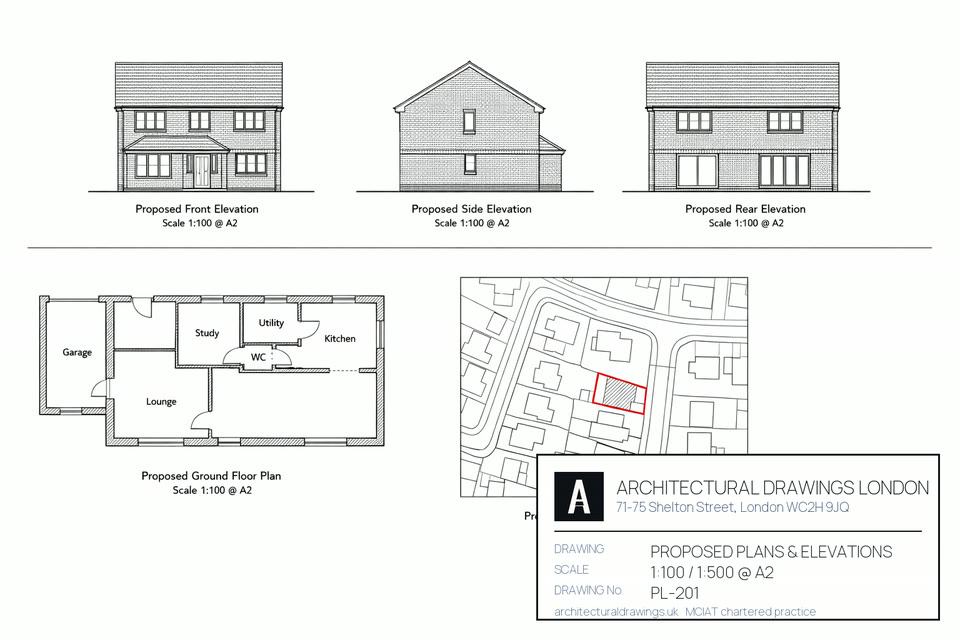

Pick a slot that suits you. No obligation and no sales pressure, just straight answers on your planning route.
Free site survey. MCIAT chartered.
Start free quoteOr contact us about your project first
