The register records 31 conservation areas covering about 670 hectares, none of them dated on the national platform. Ealing has uploaded no Article 4 register either, so the council’s own policies map is the only reliable check for a specific address.
Measure
Ealing
London
Conservation areas in the register
31
1,141
Area covered
670 hectares
—
Designations carrying a date
none
—
Article 4 areas in the register
not recorded
—
Householder approval rate
86.6%
83.0%
Decided inside eight weeks
98.6%
—
Lawful development certificates issued
2,048
—
Sources: registers from the MHCLG Planning Data Platform, retrieved 1 September 2026, with hectares computed from the published boundaries; decision figures from MHCLG PS1 and PS2, twelve quarters to March 2026. ‘Not recorded’ means the borough has not uploaded that register, never that no direction exists — the platform’s own guidance is explicit on the point.
Where do Ealing’s conservation area boundaries actually run?
Ealing has 31 conservation areas in the national register, and the map here shows where each of them begins and ends. Type in a postcode and the lookup happens locally, in the page — nothing is sent to us, and nothing is sent to the council. One caveat before you lean on it: these outlines are generalised for rendering, so use them to find the area you are in, and use the council’s own mapping for any property that looks like it straddles a line.
Between them those 31 areas take in about 669.8 hectares, and the spread is tighter than most London boroughs manage — the Cuckoo Estate is the biggest at 50.1 hectares, and even the smallest, around the Hanwell Clock Tower, still covers 1.5. Most entries carry a linked council document for the area, which is the thing worth reading before you draw anything, because that is where the council writes down what it considers the character of a place to be. Two gaps in the record matter. Ealing has uploaded no designation dates whatever, so the register cannot tell you how old any of these designations are, and only one Article 4 area appears against the borough. That single polygon is what has been published, not necessarily what is in force; treat an almost-empty Article 4 layer here as a question for the planning department rather than an answer from it.
Mapped from the conservation-area and article-4-direction-area datasets published at planning.data.gov.uk, read on 15 August 2026 and verified again on 1 September 2026. Contains public sector information licensed under the Open Government Licence v3.0
In detail
Answers for Ealing
How many conservation areas does Ealing have?
Ealing has 30 designated conservation areas, including Ealing Broadway, Pitshanger, Bedford Park, Acton Green, Hanwell.
What changes need planning in a Ealing conservation area?
Any external alteration visible from a public space typically requires full planning permission inside a conservation area: roof additions, dormers, replacement windows, rendering, hardstanding, and demolition. Internal works generally do not, unless the property is also listed.
Do I need a Heritage Statement in Ealing?
Yes — every application inside a conservation area requires a Heritage Statement. It must address the conservation area character appraisal, identify heritage assets, and explain how the design preserves or enhances character. We prepare this as part of every conservation-area application.
Can I have a roof extension or mansard in a Ealing conservation area?
Rear mansards and dormers are routinely approved in many London conservation areas where the design matches the terrace's existing roofscape — particularly in Hackney, Islington, Tower Hamlets, Lambeth and Southwark. Front-facing dormers are almost universally refused.
How long does conservation area approval take in Ealing?
Ealing Council statutory determination is 8 weeks for householder applications. Conservation officer consultation adds 2–3 weeks in practice. Expect 11–14 weeks from validation to decision.
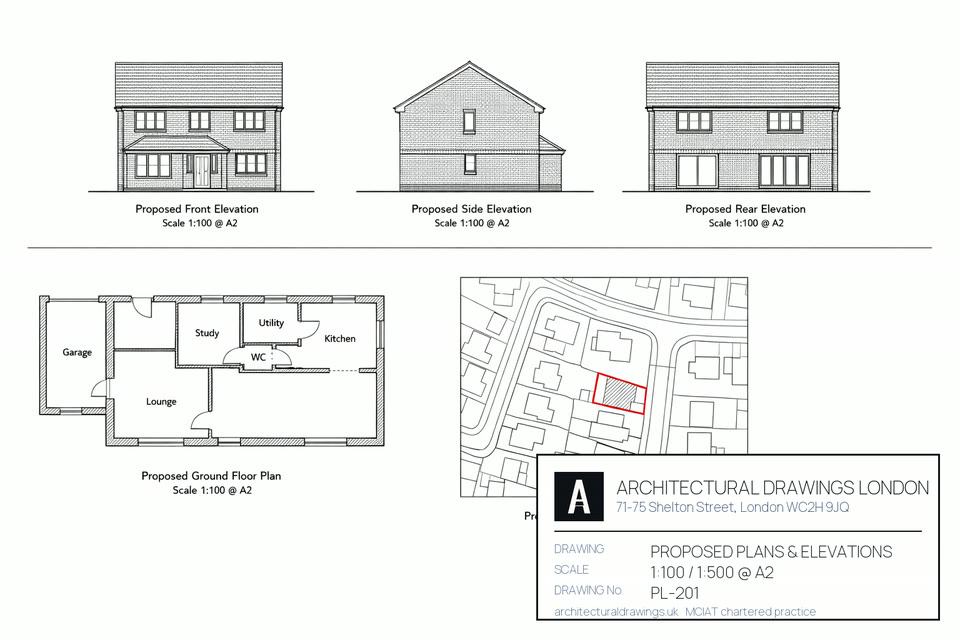
Planning application setExisting, proposed and location plans on one sheet — as the council receives it through the Planning Portal.
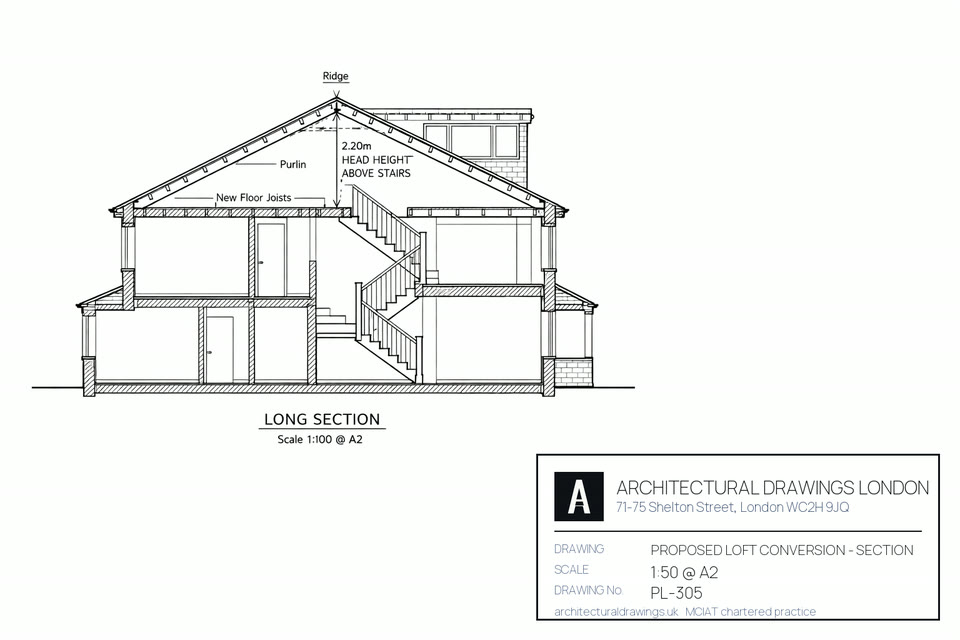
Long sectionHead height over the stair, dormer geometry and ridge height resolved to scale.
The planning set that goes to the council through the Planning Portal: proposed elevations, plans, and the OS location plan with your site outlined.
Book a call
Speak to a chartered technologist — free 15 minutes
Pick a slot that suits you. No obligation and no sales pressure, just straight answers on your planning route.
Which postcode districts around Ealing do we cover for conservation area application work?
Every Ealing postcode district we draw in, the stock that dominates
it and the authority that validates a conservation area application there. Ealing fees below are the
statutory England rates for 2026, not conservation area application estimates.
Postcode
Area
Dominant stock
What it means for a conservation area application
UB5
Northolt
1930s semi-detached, post-war estates
Northolt sits wholly inside UB5, so Ealing Council validates every conservation area application submitted from an UB5 address.
UB6
Greenford / Perivale
1930s semi-detached
Greenford / Perivale sits wholly inside UB6, so Ealing Council validates every conservation area application submitted from an UB6 address.
NW10
Willesden / Harlesden / Kensal Green
Modern apartments, post-war estates
NW10 straddles a boundary: Willesden / Harlesden / Kensal Green addresses fall to Brent Council or Ealing Council, so confirm which authority validates the conservation area application before submitting NW10 drawings.
W4
Chiswick / Bedford Park
Arts & Crafts villas (listed)
W4 straddles a boundary: Chiswick / Bedford Park addresses fall to Hounslow Council or Ealing Council, so confirm which authority validates the conservation area application before submitting W4 drawings.
W3
Acton
Victorian and Edwardian terraces
W3 straddles a boundary: Acton addresses fall to Ealing Council or Hounslow Council, so confirm which authority validates the conservation area application before submitting W3 drawings.
W5
Ealing
Edwardian villas, Victorian terraces
W5 covers Ealing only; Ealing Council handles the conservation area application.
W7
Hanwell
Edwardian villas, 1930s semi-detached
Hanwell sits wholly inside W7, so Ealing Council validates every conservation area application submitted from an W7 address.
W13
West Ealing
Edwardian terraces
West Ealing sits wholly inside W13, so Ealing Council validates every conservation area application submitted from an W13 address.
Which Ealing neighbourhoods suit a conservation area application best?
Roof pitch, wall build-up and plot depth change every few Ealing
streets, and each one changes what a conservation area application can achieve at that address.
Greenford (UB6) — 1930s semi-detached defines Greenford, where 1930s semi-detached set what a conservation area application can do. On these 1930s semis the prior approval route often replaces a full application across UB6. Any Greenford conservation area application is validated by Ealing Council, with Greenford station the usual Greenford reference point on the site plan.
Northolt (UB5) — a conservation area application in Northolt starts from 1930s semi-detached, post-war estates, and Northolt reads as 1930s semi-detached, post-war estates. On these 1930s semis the prior approval route often replaces a full application in UB5. Ealing Council assesses Northolt conservation area applications against its own Northolt character guidance, and the location plan we draw for Northolt references Northolt Tube.
Bedford Park (W4) — Arts & Crafts garden suburb, conservation defines Bedford Park, where arts & crafts villas (listed) set what a conservation area application can do. Most applications on these Victorian streets are householder applications validated on existing and proposed plans across W4. Any Bedford Park conservation area application is validated by Ealing Council, with Bedford Park Estate the usual Bedford Park reference point on the site plan.
Pitshanger (W5) — conservation area application work in Pitshanger means edwardian villas. Pitshanger is Edwardian conservation area. Edwardian houses here typically need the same householder set plus a roof plan where a dormer is proposed throughout W5. Ealing Council decides the Pitshanger application, and Pitshanger Lane anchors the Pitshanger location plan.
Park Royal (NW10) — industrial fringe, new residential defines Park Royal, where modern apartments, post-war estates set what a conservation area application can do. Post-war stock here frequently sits inside an estate layout across NW10. Any Park Royal conservation area application is validated by Ealing Council, with Park Royal station the usual Park Royal reference point on the site plan.
Ealing Broadway (W5) — conservation area application work in Ealing Broadway means edwardian villas, victorian terraces. Ealing Broadway is Edwardian villas, Victorian terraces. Most applications on these Victorian streets are householder applications validated on existing and proposed plans throughout W5. Ealing Council decides the Ealing Broadway application, and Ealing Broadway station anchors the Ealing Broadway location plan.
Acton (W3) — conservation area application work in Acton means victorian and edwardian terraces. Acton is Victorian and Edwardian terraces. Most applications on these Victorian streets are householder applications validated on existing and proposed plans throughout W3. Ealing Council decides the Acton application, and Acton Town anchors the Acton location plan.
What local planning policy applies to a conservation area application in Ealing?
How designation changes a Ealing conservation area application: Ealing Council maintains 30 conservation areas, including Hanwell, Ealing Broadway, Pitshanger. Inside any of them a Ealing conservation area application cannot rely on permitted development, and the route becomes a £548 householder application determined in 8 weeks rather than a £249 prior approval in 6 weeks. Bedford Park sets the tone for Ealing casework.
Ealing and Article 4: Article 4 for HMOs in specific streets in Acton, Ealing and Southall. A conservation area application planned at a W3 address is checked against that direction first; Ealing Council publishes the Ealing extent, and the W3 line rarely follows the Ealing boundary you would expect.
Ealing housing stock: Victorian and Edwardian villas in Ealing central; 1930s semi-detached in Northolt and Hanwell; mansion blocks along main roads; Bedford Park is a listed Arts & Crafts garden suburb. Leafy outer-west London; Bedford Park conservation area has strict heritage controls; rest of borough generally permissive. Read that before choosing a conservation area application route in Ealing — construction, not postcode, sets what is achievable.
Who decides a conservation area application on the edge of Ealing?
Hounslow — the Hounslow boundary runs against Ealing, so a conservation area application a street from Ealing is decided by Hounslow Council instead. Hounslow runs 30 conservation areas across W3 and its neighbours, which is why conservation area applications priced for Ealing are re-checked against Hounslow policy whenever the Ealing address sits on that edge.
Hillingdon — cross the Ealing boundary and Hillingdon Council takes the conservation area application instead, applying 29 conservation areas of its own around HA4. We re-price conservation area applications at the Ealing edge because Hillingdon policy and Ealing policy rarely align on conservation area application depth.
Brent — adjoining Ealing, with 22 conservation areas centred on NW2. A conservation area application on the far side of the Ealing line is determined by Brent Council, so the Ealing quote for conservation area applications is checked against Brent guidance before it is issued.
Hammersmith and Fulham — adjoining Ealing, with 45 conservation areas centred on W6. A conservation area application on the far side of the Ealing line is determined by Hammersmith & Fulham Council, so the Ealing quote for conservation area applications is checked against Hammersmith and Fulham guidance before it is issued.
Sources for this Ealing conservation area application page: borough policies maps and
conservation-area registers (2025–26), Royal Mail postcode district boundaries,
the Town and Country Planning (Fees for Applications) (England) Regulations, the Town
and Country Planning (General Permitted Development) (England) Order 2015 as amended,
and the Party Wall etc. Act 1996.
A london terraced street of the type we survey — conservation area planning in Ealing.