Merton's protected areas, from Wimbledon Village to Mitcham
Merton has 28 conservation areas. What alters inside one, what a Heritage Statement is expected to do, and which changes survive designation. Scale matters more here than most people expect: over the twelve quarters to March 2026 Merton refused 11.1% of householder applications and 25.4% of minor ones. Source: MHCLG live planning statistics.
How are Merton conservation area applications decided?
On the drawings, almost always. Merton delegated 99.3% of decisions to case officers, second only to Redbridge, and only 0.3% of householder cases ran past thirteen weeks. Its 28 conservation areas cover 707 hectares, Wimbledon North the largest at 150.
Measure
Merton
London
Conservation areas
28
1,141
Designated area
707 ha
—
Largest area
Wimbledon North, 150 ha
—
Decisions delegated to officers
99.3%
97.0%
Decided beyond 13 weeks
0.3%
—
Householder approval
88.9%
83.0%
Conservation area counts and boundaries here are taken from the planning.data.gov.uk register as read on 1 September 2026, with areas in hectares computed from the published polygons. Decision figures are MHCLG's PS1 and PS2 district returns covering the twelve quarters ending March 2026. Contains public sector information licensed under the Open Government Licence v3.0.
Is my Wimbledon or Mitcham address inside a designated boundary?
Every shaded shape below is a real designation, taken from the register councils file their conservation areas to, and the search box tests a postcode against those shapes without a round trip to a server. One thing to hold in mind before you rely on it: a drawn boundary is an approximation of a legal one. Where your plot touches an edge, the map can tell you the question exists and no more, and Merton’s own boundary record is what answers it.
Merton’s designated land is lopsided, and the lopsidedness is the useful fact. Wimbledon North accounts for 150.3 of the borough’s 707.2 designated hectares — better than a fifth of it in one area — while Leopold Road, at 0.6 hectares, would fit inside Wimbledon North more than two hundred times. So a Merton reader’s odds of being designated depend heavily on which end of the borough they are in, and the map is worth checking even if your neighbours have extended freely. On dates, this page will not help and will not pretend to: the register holds no designation date for any Merton area, so if you need to know when yours was made, the council’s records are the only source. It does hold a council document for every area, which is the better outcome of the two — wherever the map puts you, there is a council page for that area to read before a line is drawn. Article 4 is the missing layer. Merton has filed no directions to the national register, so none can be shown, and that should not be read as there being none to find.
Every figure on this map traces back to the conservation-area and article-4-direction-area datasets published at planning.data.gov.uk, taken on 15 August 2026 and reviewed once more on 1 September 2026. Contains public sector information licensed under the Open Government Licence v3.0
In detail
Answers for Merton
How many conservation areas does Merton have?
Twenty-eight conservation areas are designated in the borough. Wimbledon Village, John Innes, Mitcham Cricket Green and Wimbledon Common are among them.
What changes need planning in a Merton conservation area?
Any external alteration visible from a public space typically requires full planning permission inside a conservation area: roof additions, dormers, replacement windows, rendering, hardstanding, and demolition. Internal works generally do not, unless the property is also listed.
Do I need a Heritage Statement in Merton?
Effectively yes, and it is among the first things a Merton validation officer looks for. The statement has to answer the character appraisal written for that designation, set out which heritage assets the proposal touches, and argue that the scheme preserves or enhances the area rather than merely failing to harm it. Ours gets written with the drawings — a heritage statement composed after the fact reads exactly like one.
Can I have a roof extension or mansard in a Merton conservation area?
A rear mansard or dormer following the roof line already running along the terrace is consented regularly inside London conservation areas, Merton's included, and the same holds in Islington, Hackney and Southwark. Turn to the front and the calculation changes entirely: an addition visible from the street alters the thing the designation exists to protect, and refusal is much the commoner outcome.
How long does conservation area approval take in Merton?
Merton's statutory determination period on a householder application is 8 weeks, and conservation officer consultation usually adds two or three to that. From validation to decision notice, 11 to 14 weeks is the honest range. Merton settles 99.3% of its decisions under delegated powers, so your timetable is rarely hostage to a committee cycle.
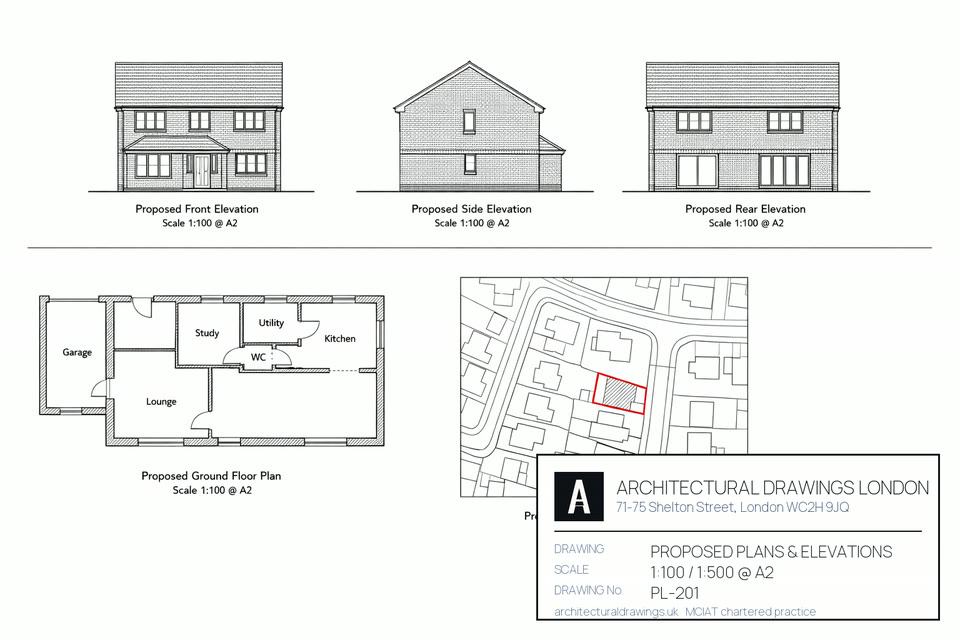
Planning application setExisting, proposed and location plans on one sheet — as the council receives it through the Planning Portal.
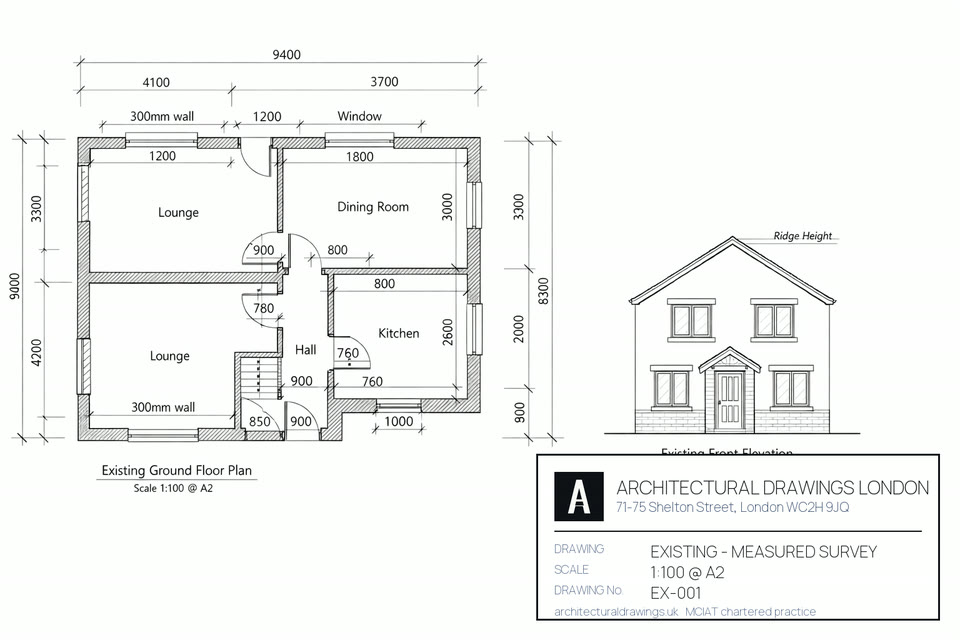
Measured surveyEvery dimension recorded on site in a measured survey before a line of the proposal is drawn.
The planning set that goes to the council through the Planning Portal: proposed elevations, plans, and the OS location plan with your site outlined.
Book a call
Speak to a chartered technologist — free 15 minutes
Pick a slot that suits you. No obligation and no sales pressure, just straight answers on your planning route.
Where in Merton does a conservation area application actually get determined?
Merton district by district: the stock that dominates each one, and which council validates an application coming out of it. Fees quoted lower down are statutory England rates for 2026.
Postcode
Area
Dominant stock
What it means for a conservation area application
SW19
Wimbledon / Colliers Wood
Victorian villas, Edwardian terraces
SW19 takes in Wimbledon and Colliers Wood and sits mostly with Merton, though it reaches into Wandsworth at its northern edge. Check the address rather than assuming from the district.
SW20
Raynes Park
Victorian villas, Edwardian terraces
Raynes Park sits wholly inside SW20, so Merton Council validates every conservation area application submitted from an SW20 address.
SM4
Morden
1930s semi-detached, post-war flats
Morden sits wholly inside SM4, so Merton Council validates every conservation area application submitted from an SM4 address.
CR4
Mitcham
1930s semi-detached, post-war estates
Mitcham fills CR4, and Merton Council validates every application arriving out of that district.
SW16
Streatham / Norbury
Edwardian terraces, post-war flats
SW16 spans Streatham and Norbury across four authorities, Merton among them alongside Lambeth, Croydon and Wandsworth. Only the address itself resolves which of them decides.
SW17
Tooting / Earlsfield
Edwardian terraces
SW17 is Tooting and Earlsfield, shared between Merton and Wandsworth. Both policies maps are consulted for the address before we advise on a route.
How does a conservation area application differ street by street across Merton?
The borough runs from Wimbledon Village to Mitcham, and the building stock changes as sharply as the street names do. Pitch, plot depth and wall construction all bear on what a scheme can achieve at a single address.
Wimbledon (SW19, SW20) — Victorian villas, Edwardian terraces defines Wimbledon, where victorian villas, edwardian terraces set what a conservation area application can do. Most applications on these Victorian streets are householder applications validated on existing and proposed plans across SW19. Any Wimbledon conservation area application is validated by Merton Council, with All England Club the usual Wimbledon reference point on the site plan.
Wimbledon Village (SW19) — Georgian and Victorian village conservation defines Wimbledon Village, where georgian and victorian villas set what a conservation area application can do. Applications on Georgian stock here almost always need a heritage statement alongside the drawings across SW19. Any Wimbledon Village conservation area application is validated by Merton Council, with Wimbledon Village High Street the usual Wimbledon Village reference point on the site plan.
Raynes Park (SW20) — a conservation area application in Raynes Park starts from 1930s semi-detached, edwardian terraces, and Raynes Park reads as 1930s semi-detached, Edwardian terraces. Edwardian houses here typically need the same householder set plus a roof plan where a dormer is proposed in SW20. Merton Council assesses Raynes Park conservation area applications against its own Raynes Park character guidance, and the location plan we draw for Raynes Park references Raynes Park station.
Morden (SM4) — a conservation area application in Morden starts from 1930s semi-detached, post-war flats, and Morden reads as 1930s semi-detached, post-war flats. On these 1930s semis the prior approval route often replaces a full application in SM4. Merton Council assesses Morden conservation area applications against its own Morden character guidance, and the location plan we draw for Morden references Morden Tube.
Mitcham (CR4) — 1930s semi-detached, post-war estates defines Mitcham, where 1930s semi-detached, post-war estates set what a conservation area application can do. On these 1930s semis the prior approval route often replaces a full application across CR4. Any Mitcham conservation area application is validated by Merton Council, with Mitcham Cricket Green the usual Mitcham reference point on the site plan.
Colliers Wood (SW19) — conservation area application work in Colliers Wood means edwardian terraces, post-war flats. Colliers Wood is Edwardian terraces, post-war flats. Edwardian houses here typically need the same householder set plus a roof plan where a dormer is proposed throughout SW19. Merton Council decides the Colliers Wood application, and Colliers Wood Tube anchors the Colliers Wood location plan.
South Wimbledon (SW19) — conservation area application work in South Wimbledon means edwardian terraces. South Wimbledon is Edwardian terraces. Edwardian houses here typically need the same householder set plus a roof plan where a dormer is proposed throughout SW19. Merton Council decides the South Wimbledon application, and South Wimbledon Tube anchors the South Wimbledon location plan.
What local planning policy applies to a conservation area application in Merton?
Merton conservation designations: 28 in total, running from the Village down to Mitcham Cricket Green and taking in the common at Wimbledon on the way. Designation takes away the permitted development route, so the work becomes a householder planning application instead of a prior approval. The householder application fee in England is £548, with an eight-week target. The fee for a larger householder prior approval is £249, and that route runs to six weeks. Which designation you happen to sit in matters rather less than how visible the change is from the pavement, and no published figure ranks one Merton area as harder than another.
Article 4 and your Merton conservation area application: Merton Council has made no borough-wide direction, so permitted development for a conservation area application in Merton generally survives outside Merton conservation areas and listed curtilages. A Lawful Development Certificate at £274 is how a SW19 owner records that a conservation area application was lawful.
What Merton is built from: Victorian villas in Wimbledon; Edwardian terraces in Tooting and Colliers Wood; 1930s semi-detached in Morden and Raynes Park; post-war flats in Mitcham. Wimbledon is heavily conservation-controlled; outer Merton (Morden, Mitcham) is permissive. That mix decides the conservation area application route in Merton more than the postcode does.
Which neighbouring authorities border Merton?
Kingston upon Thames — the Kingston upon Thames boundary runs against Merton, so a conservation area application a street from Merton is decided by Kingston Council instead. Kingston upon Thames runs 22 conservation areas across KT1 and its neighbours, which is why conservation area applications priced for Merton are re-checked against Kingston upon Thames policy whenever the Merton address sits on that edge.
Wandsworth — adjoining Merton, with 45 conservation areas centred on SW8. A conservation area application on the far side of the Merton line is determined by Wandsworth Council, so the Merton quote for conservation area applications is checked against Wandsworth guidance before it is issued.
Lambeth — the Lambeth boundary runs against Merton, so a conservation area application a street from Merton is decided by Lambeth Council instead. Lambeth runs 64 conservation areas across SE1 and its neighbours, which is why conservation area applications priced for Merton are re-checked against Lambeth policy whenever the Merton address sits on that edge.
Croydon — cross the Merton boundary and Croydon Council takes the conservation area application instead, applying 24 conservation areas of its own around CR0. We re-price conservation area applications at the Merton edge because Croydon policy and Merton policy rarely align on conservation area application depth.
Sources for this Merton conservation area application page: borough policies maps and
conservation-area registers (2025–26), Royal Mail postcode district boundaries,
the Town and Country Planning (Fees for Applications) (England) Regulations, the Town
and Country Planning (General Permitted Development) (England) Order 2015 as amended,
and the Party Wall etc. Act 1996.
A measured survey being recorded on site — conservation area planning in Merton.