Every loft type across every London roof line — dormer, mansard, hip-to-gable, L-shape, Velux and rooflight. LDC or full planning route, building regs, structural calcs and party wall, fixed price.
London roof types fall into five common conversion patterns. The right one depends on roof geometry, head height, planning constraints (Article 4, conservation area) and how much usable floor area you want. Below is the plain-English decision matrix, with the typical fixed fee for each.
Cheapest, fastest, always Permitted Development unless your house is listed. No external profile change — windows sit flush with the slate. Adds light but no headroom; floor area only useful where the existing ridge is over 2.4m.
Box projection from the rear roof slope. Permitted Development if under 40m³ (terrace) or 50m³ (semi/detached) and set back 20cm from the eaves with matching materials. The most common London loft — works on Victorian, Edwardian and 1930s housing stock.
Rear dormer plus an extension over the back-addition (Victorian outrigger). Gains two extra rooms instead of one. Usually exceeds PD cube limits so needs Householder Planning (8-week determination, £258 council fee) — but rarely refused on a Victorian terrace.
Rebuilds a hipped end into a vertical gable wall, then adds a rear dormer. Best for semi-detached 1930s houses where the side slope wastes space. Gable-end rebuild is not PD on flats or in Article 4 zones — needs Householder Planning in most central London boroughs.
Rebuilds the entire rear (or both) roof slopes to near-vertical, creating a full-height extra floor. Always needs Full Planning, never PD. Approved widely in Camden, Islington, Westminster and Kensington & Chelsea conservation areas where the historic mansard typology already exists.
We confirm before quoting whether your loft has the head height and structural capacity for a conversion — and which type makes most sense.
Most London lofts qualify for Lawful Development Certificate (permitted development). We check Article 4 and conservation constraints first.
Option studies including massing, internal layout and roof geometry — chosen to maximise usable space within PD or policy limits.
Staircase Part K compliance, Part B fire escape, Part L insulation, Part E acoustic separation from the flat below.
Ridge beam, purlins, steelwork, floor joist upgrade, dormer framing — chartered engineer sign-off.
Almost every London loft triggers Party Wall notices. We draft notices and coordinate with surveyors.
Most London loft conversion submissions complete in 18–25 working days from instruction. The council then takes 8 weeks on a Lawful Development Certificate or Householder Planning, or 13 weeks on a Mansard Full Planning application. Building Regulations sign-off runs in parallel during construction.
Day 1 — head-height check, Article 4 + conservation lookup, fixed quote.
Days 3–5 — loft access, ridge and joist measurements, party wall scope.
Days 6–14 — dormer geometry, staircase Part K, engineer steelwork sized.
Days 15–22 — Part B fire, Part L thermal, Part E acoustic, Part F ventilation.
Days 23–25 — Planning Portal lodgement, party wall notices drafted.
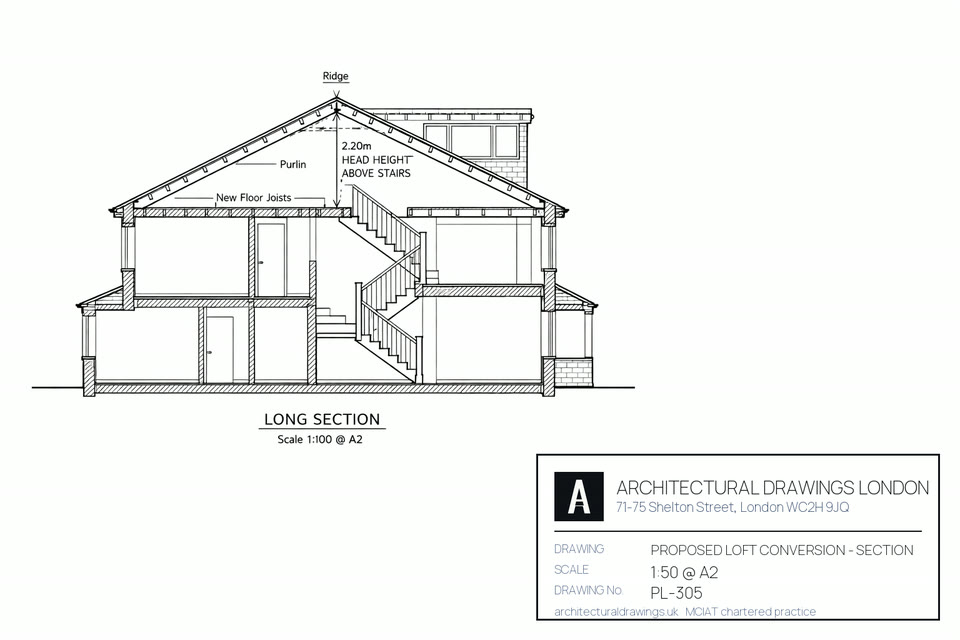
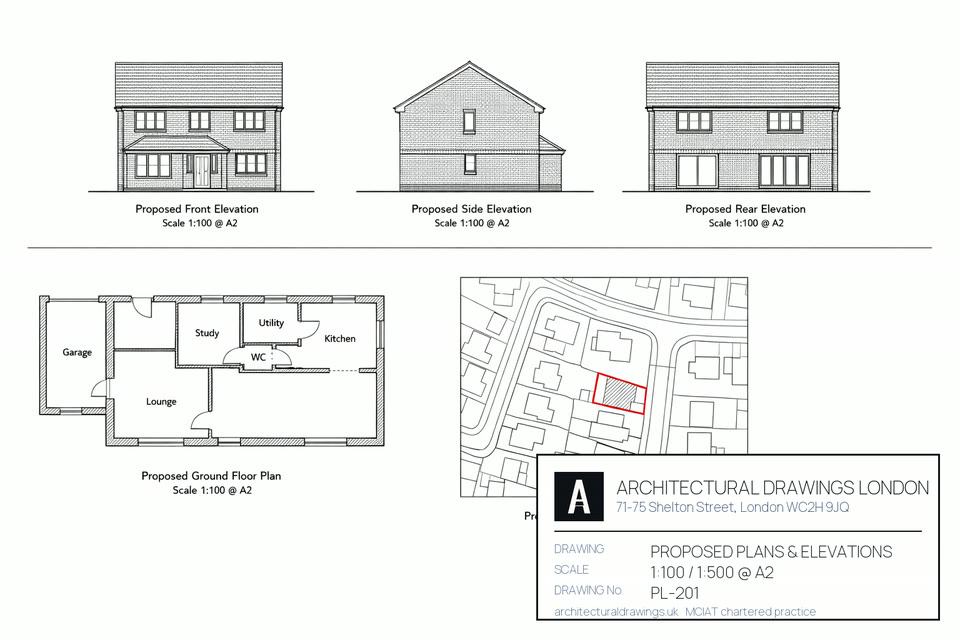
Anonymised drawings from an L-shape dormer loft conversion to an Edwardian terrace in N16. Lawful Development Certificate confirmed in 7 weeks, followed by Full Plans Building Regulations submission with chartered structural engineer sign-off on the new ridge beam and floor joists.
Want the full PDF set? Start a free quote and we’ll email a redacted sample matching your loft type.
PD-route dormer or Velux, drawings + LDC.
L-shape, hip-to-gable, or planning-route dormer.
Full Planning + Heritage Statement.
Every case is different. Call +44 7592 201 353 for a five-minute chat.
Start a free quote →Most London loft conversions fall under Permitted Development if under 40m³ (terrace) or 50m³ (semi/detached), with matching materials and set back 20cm from eaves. Flats, conservation areas, Article 4 zones and listed buildings need full planning. We confirm at the survey.
A dormer is a box projection from an existing sloped roof. A mansard rebuilds the entire rear (or both) roof slopes near-vertical, creating a full-height floor. Mansards offer most space but need planning (not PD).
Usually yes on the rear, but front and side dormers are rarely approved. Conservation area rear dormers in Camden, Westminster, Islington, Hackney etc. need a sensitive design and Heritage Statement — included in our bespoke tier.
2.3m from existing ceiling joist to existing ridge is the practical minimum for a standard conversion. Below 2.2m usually requires lowering the ceiling below or mansard design.
Yes — most London lofts trigger Party Wall notices. Rear dormers can also prompt right-to-light considerations in dense terraced contexts. We handle both.
Three featured loft submissions across Greater London. Planning references verifiable on each council’s public portal — full case studies publishing shortly.
Victorian terrace, E8. 38m³ rear dormer under Permitted Development. Lawful Development Certificate confirmed in 6 weeks. Full Plans Building Regs with ridge beam steelwork and Part B fire-protected staircase.
1930s semi-detached, W13. Hip rebuild into vertical gable wall plus rear box dormer. Householder Planning approved at delegated officer level with no amendments. Structural sign-off on new gable wall lintel and ridge beam.
Grade II conservation street, NW1. Mansard rebuild to match historic typology already present on the terrace. Full Planning with Heritage Statement and conservation officer pre-application. Approved with one round of dormer cheek-profile amendments.
From feasibility check to planning submission — how we design dormer, mansard and hip-to-gable lofts across London.
From feasibility to completion certificate in four months. The dormer design maximised every inch and the Party Wall process was handled seamlessly.
Leave your number and a chartered technologist will call you back within 30 minutes during working hours (Mon-Fri 9-6, Sat 10-4).
No obligation. No sales pressure. Just expert advice.
Fixed fee from £1,225. Free quote in 60 seconds. Covers every London borough.
Get my free quote →