72 protected areas: Richmond upon Thames, Kew and Barnes
Seventy-two conservation areas cover much of Richmond upon Thames. What changes inside one, what a heritage statement has to say, and which alterations survive designation.
How many conservation areas does Richmond upon Thames have?
The national register records 85, covering about 3,172 hectares — more designations and more designated ground than any other London borough. Inside them Class A side extensions, cladding and Class B roof enlargement are removed outright, so most Richmond schemes are applications.
Measure
Richmond upon Thames
London
Conservation areas in the register
85
1,141
Area covered
3,172 hectares
largest in London
Householder approval rate
80.2%
83.0%
Householder appeals involving a listed building
12.1%
—
Larger-extension prior approvals granted
211
73.0% of those determined
Householder appeals allowed after refusal
43.8% of 667
40.8% of 13,067
Sources: conservation areas from the planning.data.gov.uk register, retrieved 1 September 2026, with hectares computed from the published boundaries and accurate to about 1%; decision figures from MHCLG PS1 and PS2, twelve quarters to March 2026; appeals from Planning Inspectorate casework decided 2016–2026. Counts published by the council itself differ slightly from the national register, usually because a boundary revision is held as a separate entry.
How much of Richmond upon Thames is inside a conservation area boundary?
Enough of it that finding your own address on the map is the sensible first move. The outlines below are the designated boundaries as held nationally, and the postcode box matches against them without the query leaving your browser. Then read the edges with a little suspicion — they have been generalised for drawing and cannot arbitrate a property that looks half in and half out, which in a borough this heavily designated is a situation you are more likely than most to meet.
Richmond’s designated land comes to roughly 3,172.1 hectares. To put a number on how unusual that is, it is more than nine times the conservation area coverage of neighbouring Kingston upon Thames, and in much of this borough sitting outside a designation is closer to the exception than the rule. The distribution is lopsided: Richmond Park alone accounts for 945.9 hectares, close to three in every ten designated hectares in the borough, while the Oaklands Estate at the other end of the range covers 0.4. Almost every entry has a council document attached to it, so here the guidance you need before designing starts with a link rather than a phone call — an advantage worth using, because a scheme argued against the council’s own published character assessment is a much shorter conversation at committee. The Article 4 dataset is the gap. Nothing is recorded against Richmond in it, and that reflects what has been uploaded rather than what has been made, so confirm any direction with the council before assuming permitted development is available.
Drawn from planning.data.gov.uk: the conservation-area dataset and the article-4-direction-area dataset, both pulled on 15 August 2026 and re-checked on 1 September 2026. Contains public sector information licensed under the Open Government Licence v3.0
In detail
Answers for Richmond upon Thames
How many conservation areas does Richmond upon Thames have?
Seventy-two conservation areas are designated across the borough, Ham Common, Barnes Village, Twickenham Riverside, Hampton Wick, Kew Green and Richmond Green among them. Each carries its own character appraisal that an application has to answer. Only 50.0% of Richmond's 5,874.8 hectares is built up, with parks, commons and the river taking the rest, which is part of why so much of the built fabric ended up designated.
What changes need planning in a Richmond upon Thames conservation area?
Any external alteration visible from a public space typically requires full planning permission inside a conservation area: roof additions, dormers, replacement windows, rendering, hardstanding, and demolition. Internal works generally do not, unless the property is also listed.
Do I need a Heritage Statement in Richmond upon Thames?
Yes. Anything inside one of Richmond's 72 conservation areas needs a heritage statement, and a useful one does three jobs: it argues against the appraisal Richmond has published for that one designation and no other, it names the assets affected, and it says, without hedging, why the proposal preserves or enhances the thing that was designated. Of 85,800 homes counted in the VOA's council tax stock at 31 March 2025, 37.8% pre-date 1919, so the document is doing real work here rather than ticking a box. We write it as part of the application.
Can I have a roof extension or mansard in a Richmond upon Thames conservation area?
Rear mansards and rear dormers get through designation where the roof form already exists further along the terrace, and that case is made with a streetscene drawing rather than an assertion. A dormer on the principal elevation is a different proposition and is rarely accepted anywhere in the borough. No rate is published for either outcome, so treat any percentage you are quoted as unsourced.
How long does conservation area approval take in Richmond upon Thames?
Eight weeks is the statutory period on a householder application, and Richmond's own return shows 2,750 of 2,957 householder decisions landing inside it. Source: MHCLG live planning statistics. Consulting the conservation officer usually adds two to three weeks on top, so plan for 11 to 14 weeks between validation and statutory determination.
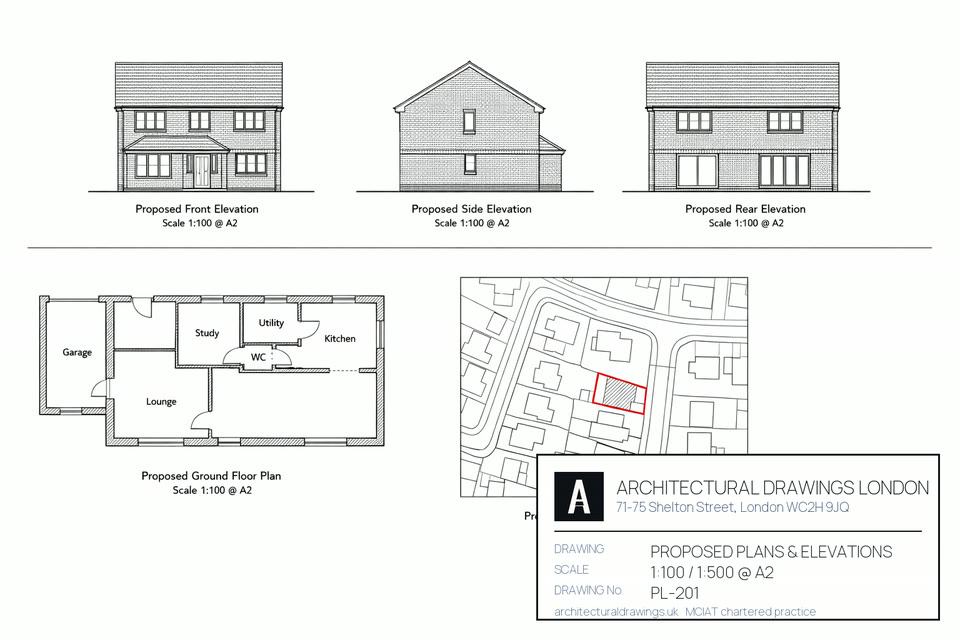
Planning application setExisting, proposed and location plans on one sheet — as the council receives it through the Planning Portal.
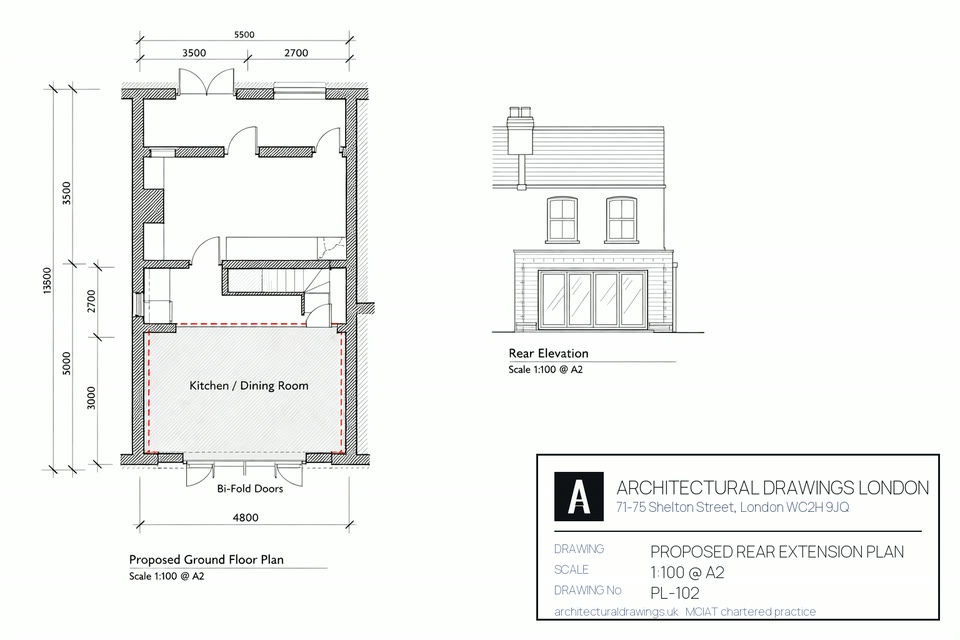
Proposed planExisting footprint in solid hatch, the new rear extension dimensioned against it.
A london terraced street of the type we survey — conservation area planning in Richmond upon Thames.
Book a call
Speak to a chartered technologist — free 15 minutes
Pick a slot that suits you. No obligation and no sales pressure, just straight answers on your planning route.
Which Richmond upon Thames postcodes does this conservation area application service cover?
Every Richmond upon Thames district we draw in, with the housing stock that fills it and the council that validates work there. Fees shown are England's statutory 2026 rates for determining an application. They are what the council takes, not what the drawings cost.
Postcode
Area
Dominant stock
What it means for a conservation area application
SW13
Barnes
Georgian villas, Edwardian terraces
SW13 covers Barnes only; Richmond Council handles the conservation area application.
SW14
Mortlake / East Sheen
Edwardian villas, 1930s semi-detached
Mortlake and East Sheen share SW14, which lies entirely inside the borough, so Richmond validates every application from an SW14 address.
TW1
Twickenham
Georgian fragments, Victorian terraces, Edwardian villas
TW1 covers Twickenham. Richmond determines applications from it under its own Local Plan, with the relevant character appraisal read alongside.
TW2
Twickenham / Whitton
Georgian fragments, Victorian terraces, Edwardian villas
TW2 runs from Twickenham out to Whitton, all of it Richmond. The case officer works from the TW2 conservation-area map wherever a designation touches the plot.
TW9
Richmond / Kew
Georgian terraces, Victorian villas
TW9 covers Richmond town and Kew, entirely inside the borough. Kew Green is one of the designations that shapes what can be done to a roof there.
TW10
Richmond / Ham
Georgian terraces, Victorian villas
TW10 takes in Richmond Hill and Ham. Both are Richmond, and Ham Common is one of the designations in play there.
TW11
Teddington
Edwardian villas, Victorian terraces
Teddington is TW11 and wholly Richmond. Flood Zone 3 covers 16.93% of the borough's land, so on a riverside plot the opening question is whether a Flood Risk Assessment belongs in the submission.
TW12
Hampton / Hampton Hill
Georgian villas, Edwardian terraces, 1930s semi-detached
Hampton and Hampton Hill both sit in TW12, wholly within Richmond. One council validates, one Local Plan applies.
How does a conservation area application differ street by street across Richmond upon Thames?
A Richmond street can change age band twice inside 200 metres, and with it the pitch of the roof, the build-up of the wall and the depth of the plot behind. All three feed into what a conservation-area application can realistically ask for.
Hampton (TW12) — conservation area application work in Hampton means georgian villas, edwardian terraces, 1930s semi-detached. Hampton is Georgian and Edwardian villages. Applications on Georgian stock here almost always need a heritage statement alongside the drawings throughout TW12. Richmond Council decides the Hampton application, and Hampton Court Palace anchors the Hampton location plan.
Whitton (TW2) — a conservation area application in Whitton starts from 1930s semi-detached, and Whitton reads as 1930s semi-detached. On these 1930s semis the prior approval route often replaces a full application in TW2. Richmond Council assesses Whitton conservation area applications against its own Whitton character guidance, and the location plan we draw for Whitton references Whitton station.
Ham (TW10) — conservation area application work in Ham means georgian villas, post-war estates. Ham is Georgian common, post-war estate. Applications on Georgian stock here almost always need a heritage statement alongside the drawings throughout TW10. Richmond Council decides the Ham application, and Ham Common anchors the Ham location plan.
Mortlake (SW14) — a conservation area application in Mortlake starts from victorian and edwardian terraces, and Mortlake reads as Victorian and Edwardian terraces. Most applications on these Victorian streets are householder applications validated on existing and proposed plans in SW14. Richmond Council assesses Mortlake conservation area applications against its own Mortlake character guidance, and the location plan we draw for Mortlake references Mortlake station.
Richmond (TW9, TW10) — conservation area application work in Richmond means georgian terraces, victorian villas. Richmond is Georgian centre, riverside conservation. Applications on Georgian stock here almost always need a heritage statement alongside the drawings throughout TW9. Richmond Council decides the Richmond application, and Richmond Green anchors the Richmond location plan.
Twickenham (TW1, TW2) — conservation area application work in Twickenham means georgian fragments, victorian terraces, edwardian villas. Twickenham is Georgian and Victorian riverside town. Applications on Georgian stock here almost always need a heritage statement alongside the drawings throughout TW1. Richmond Council decides the Twickenham application, and Twickenham Stadium anchors the Twickenham location plan.
Kew (TW9) — a conservation area application in Kew starts from georgian and edwardian villas, and Kew reads as Georgian and Edwardian villas around the green. Applications on Georgian stock here almost always need a heritage statement alongside the drawings in TW9. Richmond Council assesses Kew conservation area applications against its own Kew character guidance, and the location plan we draw for Kew references Kew Gardens.
How do conservation areas and Article 4 affect a conservation area application in Richmond upon Thames?
How designation changes a Richmond upon Thames conservation area application: Richmond Council maintains 72 conservation areas, including Hampton Wick, Twickenham Riverside, Barnes Village. Inside any of them a Richmond upon Thames conservation area application cannot rely on permitted development, and the route becomes a £548 householder application determined in 8 weeks rather than a £249 prior approval in 6 weeks. Twickenham Riverside sets the tone for Richmond upon Thames casework.
Richmond upon Thames permitted development status: there is no borough-wide direction from Richmond Council, so a conservation area application at a SW13 address is normally still permitted development. We certify that with a £274 Lawful Development Certificate rather than leaving a Richmond upon Thames sale to argue it later.
What Richmond upon Thames is built from: Georgian in Richmond Green and Twickenham; Edwardian villas in Barnes and East Sheen; 1930s semi-detached in Whitton; riverside cottages along the Thames. Highest conservation area coverage in London; Royal Parks and Thames corridor add heritage layers; design quality heavily scrutinised. That mix decides the conservation area application route in Richmond upon Thames more than the postcode does.
Who decides a conservation area application on the edge of Richmond upon Thames?
Hounslow — the Hounslow boundary runs against Richmond upon Thames, so a conservation area application a street from Richmond upon Thames is decided by Hounslow Council instead. Hounslow runs 30 conservation areas across W3 and its neighbours, which is why conservation area applications priced for Richmond upon Thames are re-checked against Hounslow policy whenever the Richmond upon Thames address sits on that edge.
Kingston upon Thames — adjoining Richmond upon Thames, with 22 conservation areas centred on KT1. A conservation area application on the far side of the Richmond upon Thames line is determined by Kingston Council, so the Richmond upon Thames quote for conservation area applications is checked against Kingston upon Thames guidance before it is issued.
Wandsworth — adjoining Richmond upon Thames, with 45 conservation areas centred on SW8. A conservation area application on the far side of the Richmond upon Thames line is determined by Wandsworth Council, so the Richmond upon Thames quote for conservation area applications is checked against Wandsworth guidance before it is issued.
Hammersmith and Fulham — adjoining Richmond upon Thames, with 45 conservation areas centred on W6. A conservation area application on the far side of the Richmond upon Thames line is determined by Hammersmith & Fulham Council, so the Richmond upon Thames quote for conservation area applications is checked against Hammersmith and Fulham guidance before it is issued.
Sources for this Richmond upon Thames conservation area application page: borough policies maps and
conservation-area registers (2025–26), Royal Mail postcode district boundaries,
the Town and Country Planning (Fees for Applications) (England) Regulations, the Town
and Country Planning (General Permitted Development) (England) Order 2015 as amended,
and the Party Wall etc. Act 1996.
The planning set that goes to the council through the Planning Portal: proposed elevations, plans, and the OS location plan with your site outlined.