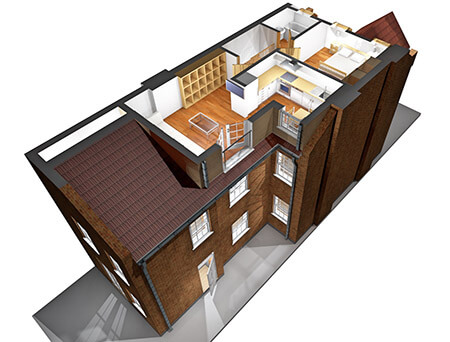
London's most space-efficient loft solution when PD-route dormers are blocked. Our chartered team designs mansards that get approved in conservation areas — with heritage statements and officer negotiation built in.
We check against your borough's mansard design guide (Islington, Camden, Hackney, Tower Hamlets all publish them) and design to match.
Required for conservation areas — demonstrates the mansard respects the character and townscape of the terrace.
Accurate photomontage showing how the mansard sits alongside your neighbours — often decisive at committee.
Mansards invariably trigger Party Wall notices. Structural package includes new ridge, tie beams, floor joists.
Full liaison with planning officer, committee representation if called in.
Part L thermal, Part B fire (mansards require careful fire-escape consideration), Part E acoustic.
Every case is different. Call 020 7946 0000 for a five-minute chat.
Start a free quote →It depends on the borough policy and the terrace context. Islington, Hackney and Tower Hamlets all allow mansards in many conservation areas following their design guides. Westminster is stricter. We advise case-by-case at the feasibility stage.
70° at the front slope is typical — steep enough to maximise floor area while reading as a roof rather than a full storey. Front dormers are usually small and symmetrical.
Often yes, but councils favour applications supported by the wider street. Where precedents exist nearby — common in Islington, Hackney — approval is far more likely.
Full-height — typically 2.3–2.5m ceiling from the new floor. Unlike a dormer, which gives partial head height, a mansard is a full additional storey.
Conservation area mansards use small, proportioned, timber-framed sash-style windows on the mansard face, set back behind a parapet. Flat rooflights for the flat roof portion. We design to match the terrace.
Fixed fee from £1,575. Free quote in 60 seconds. Covers every London borough.
Get my free quote →