Altering a period home in Hounslow's conservation areas
Hounslow has 30 conservation areas. This page sets out what designation changes, what an officer looks for in a heritage statement, and which alterations still go through.
How much of Hounslow sits inside a conservation area?
More land than any borough but Richmond upon Thames. Hounslow’s 43 conservation areas cover 2,064 hectares, and Osterley Park alone accounts for 285 of them. The borough approved 69.9% of householder applications, and the Inspectorate allowed 49.3% of its 659 householder appeals.
Measure
Hounslow
London
Conservation areas (national register)
43
1,141
Designated area
2,064 ha
—
Largest area
Osterley Park, 285 ha
—
Householder approval
69.9%
83.0%
Householder appeals allowed after refusal
49.3% of 659
40.8% of 13,067
Conservation area counts and boundaries are drawn from planning.data.gov.uk, the national register, as it stood on 1 September 2026; the hectare figures are computed from those published boundaries. Decision figures come from the MHCLG District Planning Application Statistics, PS1 and PS2, for the three years ending March 2026. Appeal outcomes come from Planning Inspectorate casework, decisions issued across 2016 to 2026. Contains public sector information licensed under the Open Government Licence v3.0
How do I find out if a Hounslow property is inside a conservation area?
Start with the postcode box on the map. It compares the point you give it against the designated boundaries as the national register holds them, entirely on your own machine, and shows which area you have landed in, if any. Treat a near miss as an open question rather than as a no. The shapes are smoothed for display, so a plot that straddles a boundary is something for Hounslow’s own mapping to answer, not a simplified outline.
The scale of designation here is different from most of London, and it changes what the map is telling you. Hounslow’s conservation areas cover 2,063.9 hectares. The largest, Osterley Park, runs to 284.5 hectares on its own — parkland and its setting, not a few streets of villas — and even the smallest, Woodlands Grove, is 4.2 hectares, so there are no token frontages in this borough. Two things follow. Being inside a boundary is ordinary here rather than unlucky, so the useful question is which character the area is held to have, not whether you are caught. And the supporting documents are patchy: fourteen areas have no designation date in the register, and fourteen have no council document, so for a sizeable minority of the map nothing is filed nationally setting out what should be preserved. Designation has also been a continuing act rather than a historic one — the earliest date recorded is 7 November 1968 and the most recent 3 September 2024. Two Article 4 direction areas are published for the borough and appear on the map alongside the designations.
Source data: the planning.data.gov.uk conservation-area and article-4-direction-area datasets, first pulled on 15 August 2026 and re-checked on 1 September 2026. Contains public sector information licensed under the Open Government Licence v3.0
In detail
Answers for Hounslow
How many conservation areas does Hounslow have?
Thirty conservation areas are designated across Hounslow. Chiswick, Bedford Park, Old Isleworth and Brentford are among them, and the designations cluster heavily towards the eastern end of the borough.
What changes need planning in a Hounslow conservation area?
Any external alteration visible from a public space typically requires full planning permission inside a conservation area: roof additions, dormers, replacement windows, rendering, hardstanding, and demolition. Internal works generally do not, unless the property is also listed.
Do I need a Heritage Statement in Hounslow?
Yes — a heritage statement accompanies every application inside a conservation area. It has to engage with the area's own character appraisal, identify the heritage assets in play, and set out how the design preserves or enhances what is already there. It is drafted alongside the drawings rather than added at the end, which is the difference between an argument and an afterthought.
Can I have a roof extension or mansard in a Hounslow conservation area?
Rear mansards and rear dormers do get through in Hounslow's designated areas, where the form follows what the terrace already does above eaves level. Front-facing dormers are refused almost without exception. Keep in mind the odds you are playing against: the council grants 69.9% of its householder applications where London as a whole grants 83.0%, so there is not much room for a roof design that has to be argued for twice.
How long does conservation area approval take in Hounslow?
Hounslow Council has 8 weeks of statutory determination time on a householder case, and the conservation officer's consultation usually swallows another fortnight to three weeks on top. From validation to a decision landing on your doormat, plan for something nearer three months. Treat the eight weeks as a formality rather than a forecast: an extension of time was agreed on 1,575 of the 3,929 applications this council decided, which is 40.1% against a London figure of 34.5%. Two applicants in five here are asked to sign the statutory deadline away. Source: MHCLG live planning statistics
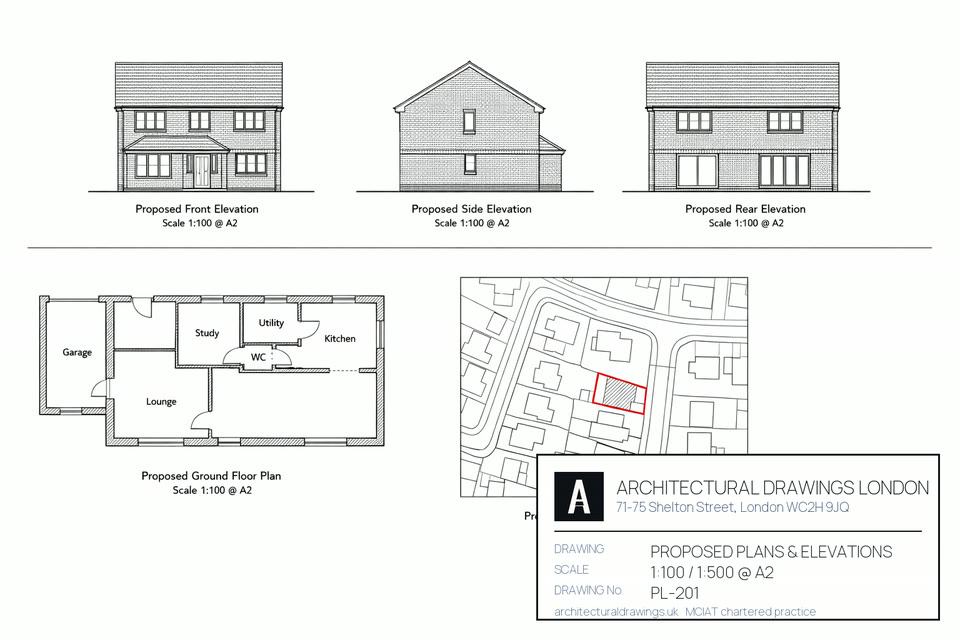
Planning application setExisting, proposed and location plans on one sheet — as the council receives it through the Planning Portal.
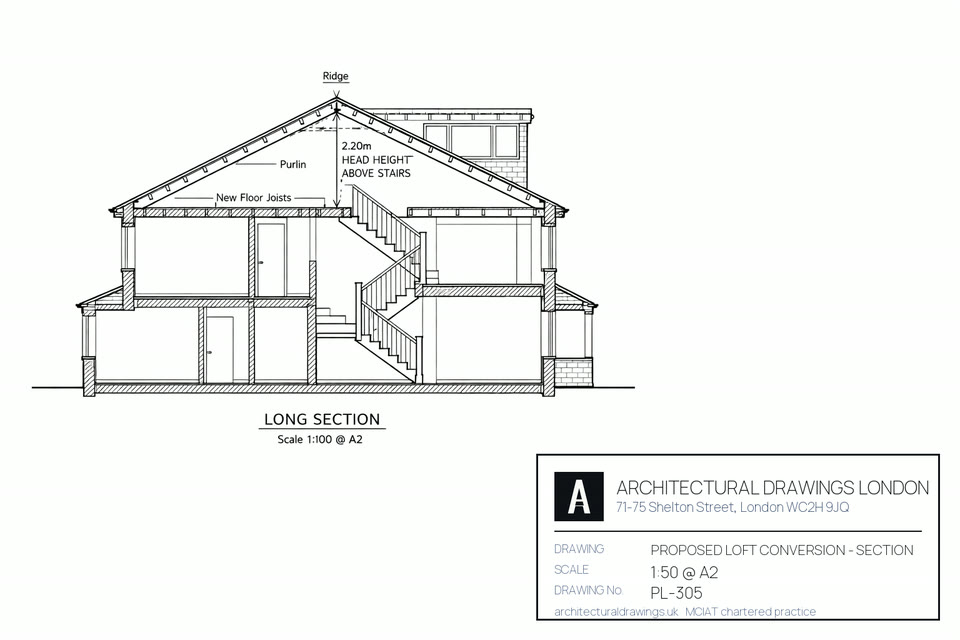
Long sectionHead height over the stair, dormer geometry and ridge height resolved to scale.
A measured survey being recorded on site — conservation area planning in Hounslow.
Book a call
Speak to a chartered technologist — free 15 minutes
Pick a slot that suits you. No obligation and no sales pressure, just straight answers on your planning route.
Where in Hounslow does a conservation area application actually get determined?
Below: the Hounslow postcode districts on our books, the housing typical of each, and which council validates a conservation area application at that address. Fees quoted are England's statutory rates for 2026, not our charges.
Postcode
Area
Dominant stock
What it means for a conservation area application
TW7
Isleworth
Georgian and Victorian terraces
TW7 is Isleworth, entirely within the borough; Hounslow Council determines the application, applying the conservation-area map that covers Isleworth
TW8
Brentford
Georgian fragments, Victorian terraces, new-build
A TW8 address in Brentford is determined by Hounslow Council, against the Local Plan policies covering Brentford
TW13
Feltham
1930s semi-detached, post-war estates
A TW13 address in Feltham is determined by Hounslow Council, against the Local Plan policies covering Feltham
TW14
Feltham / East Bedfont
Edwardian villas in Chiswick and Turnham Green; Georgian in Isleworth; 1930s semi-detached in Hounslow and Feltham; riverside new-build in Brentford
A conservation area application at an TW14 address in Feltham / East Bedfont is determined by Hounslow Council under its own Local Plan policies for Feltham / East Bedfont.
W3
Acton
Victorian and Edwardian terraces
W3 straddles a line as well: Acton addresses go to Ealing Council or to Hounslow Council. Confirm the validating authority before any W3 drawings go in
W4
Chiswick / Bedford Park
Arts & Crafts villas (listed)
W4 runs across a boundary. Chiswick and Bedford Park addresses fall either to Hounslow Council or to Ealing Council, so establish which authority validates before W4 drawings are submitted
TW3
Hounslow
1930s semi-detached, post-war flats
Hounslow town centre sits wholly inside TW3, so every conservation area application from a TW3 address is validated by Hounslow Council
TW4
Hounslow West
Edwardian villas in Chiswick and Turnham Green; Georgian in Isleworth; 1930s semi-detached in Hounslow and Feltham; riverside new-build in Brentford
TW4 is Hounslow West, wholly inside the borough; Hounslow Council handles the application, and its officers work from the conservation-area map for that district
Which Hounslow neighbourhoods suit a conservation area application best?
Wall build-up, roof pitch and plot depth alter from one Hounslow street to the next, and each alteration changes what a conservation area application can achieve at that address.
Chiswick (W4) — Edwardian villas, conservation defines Chiswick, where edwardian villas, victorian terraces set what a conservation area application can do. Most applications on these Victorian streets are householder applications validated on existing and proposed plans across W4. Any Chiswick conservation area application is validated by Hounslow Council, with Chiswick House the usual Chiswick reference point on the site plan.
Brentford (TW8) — conservation area application work in Brentford means georgian fragments, victorian terraces, new-build. Brentford is Georgian fragments, riverside new-build. Applications on Georgian stock here almost always need a heritage statement alongside the drawings throughout TW8. Hounslow Council decides the Brentford application, and Kew Bridge anchors the Brentford location plan.
Isleworth (TW7) — a conservation area application in Isleworth starts from georgian and victorian terraces, and Isleworth reads as Georgian and Victorian terraces. Applications on Georgian stock here almost always need a heritage statement alongside the drawings in TW7. Hounslow Council assesses Isleworth conservation area applications against its own Isleworth character guidance, and the location plan we draw for Isleworth references Old Isleworth.
Hounslow (TW3) — 1930s semi-detached, post-war flats defines Hounslow, where 1930s semi-detached, post-war flats set what a conservation area application can do. On these 1930s semis the prior approval route often replaces a full application across TW3. Any Hounslow conservation area application is validated by Hounslow Council, with Hounslow Central the usual Hounslow reference point on the site plan.
Feltham (TW13) — a conservation area application in Feltham starts from 1930s semi-detached, post-war estates, and Feltham reads as 1930s semi-detached, post-war estates. On these 1930s semis the prior approval route often replaces a full application in TW13. Hounslow Council assesses Feltham conservation area applications against its own Feltham character guidance, and the location plan we draw for Feltham references Feltham station.
Hanworth (TW13) — conservation area application work in Hanworth means 1930s semi-detached. Hanworth is 1930s semi-detached. On these 1930s semis the prior approval route often replaces a full application throughout TW13. Hounslow Council decides the Hanworth application, and Hanworth Park anchors the Hanworth location plan.
Turnham Green (W4) — Edwardian villas, conservation defines Turnham Green, where edwardian villas set what a conservation area application can do. Edwardian houses here typically need the same householder set plus a roof plan where a dormer is proposed across W4. Any Turnham Green conservation area application is validated by Hounslow Council, with Turnham Green the usual Turnham Green reference point on the site plan.
What local planning policy applies to a conservation area application in Hounslow?
Hounslow conservation designations: the council's own list runs to 30, Chiswick, Bedford Park and Old Isleworth among them. Designation takes the permitted-development route off the table. The work then needs a householder application at £548, decided over 8 weeks, where an undesignated address could have gone the prior approval route at £249 in 6. Which designation applies to you is an address question, so check yours on the map before committing to a design. The borough's conservation areas are concentrated in the east, and a good deal of western Hounslow carries none at all.
No blanket Article 4 over Hounslow: Hounslow Council has not withdrawn permitted development across Hounslow, so a conservation area application outside a Hounslow conservation area usually keeps it. The £274 Lawful Development Certificate is still the document a W4 owner wants on file.
Hounslow housing stock: Edwardian villas in Chiswick and Turnham Green; Georgian in Isleworth; 1930s semi-detached in Hounslow and Feltham; riverside new-build in Brentford. Chiswick is one of west London's most conservation-controlled areas; outer Hounslow is permissive suburban. Read that before choosing a conservation area application route in Hounslow — construction, not postcode, sets what is achievable.
Who decides a conservation area application on the edge of Hounslow?
Hillingdon — cross the Hounslow boundary and Hillingdon Council takes the conservation area application instead, applying 29 conservation areas of its own around HA4. We re-price conservation area applications at the Hounslow edge because Hillingdon policy and Hounslow policy rarely align on conservation area application depth.
Ealing — cross the Hounslow boundary and Ealing Council takes the conservation area application instead, applying 30 conservation areas of its own around W3. We re-price conservation area applications at the Hounslow edge because Ealing policy and Hounslow policy rarely align on conservation area application depth.
Hammersmith and Fulham — the Hammersmith and Fulham boundary runs against Hounslow, so a conservation area application a street from Hounslow is decided by Hammersmith & Fulham Council instead. Hammersmith and Fulham runs 45 conservation areas across W6 and its neighbours, which is why conservation area applications priced for Hounslow are re-checked against Hammersmith and Fulham policy whenever the Hounslow address sits on that edge.
Richmond upon Thames — cross the Hounslow boundary and Richmond Council takes the conservation area application instead, applying 72 conservation areas of its own around SW13. We re-price conservation area applications at the Hounslow edge because Richmond upon Thames policy and Hounslow policy rarely align on conservation area application depth.
Sources for this Hounslow conservation area application page: borough policies maps and
conservation-area registers (2025–26), Royal Mail postcode district boundaries,
the Town and Country Planning (Fees for Applications) (England) Regulations, the Town
and Country Planning (General Permitted Development) (England) Order 2015 as amended,
and the Party Wall etc. Act 1996.
The planning set that goes to the council through the Planning Portal: proposed elevations, plans, and the OS location plan with your site outlined.