What is protected in Kingston upon Thames besides buildings?
Trees, on a scale no other borough matches. Kingston carries 7,145 tree preservation zones in the national register, alongside 114 Article 4 areas and 28 conservation areas covering 349 hectares. Southborough is the largest at 50 hectares. It holds 867 listed buildings.
Measure
Kingston upon Thames
London
Conservation areas
28
1,141
Designated area
349 ha
—
Tree preservation zones
7,145
—
Article 4 areas
114
—
Listed buildings
867
—
Extension of time agreed
15.6%
34.5%
Sources: conservation area counts and boundaries from the planning.data.gov.uk register, retrieved 1 September 2026, with hectares computed from the published boundaries. Article 4, tree preservation and listed building counts from the planning.data.gov.uk designation registers; a count of zero there means the register has no entry for that borough, never that none exist. Decision figures from MHCLG PS1 and PS2, twelve quarters to March 2026. Open Government Licence v3.0.
Why does the Kingston upon Thames map show more Article 4 than conservation area?
Two different sets of lines appear on the map here, and the difference between them is the point. One set is the borough’s 28 conservation areas. The other is its Article 4 areas, of which the register holds 113 — four times as many, cut far more finely. Both come from national data and the postcode search runs on your device. Being simplified shapes, they will place you on one side of a boundary or the other but will not survey where that boundary actually falls.
That imbalance is the practical story in Kingston. Conservation area designation covers about 349.1 hectares, with Southborough the largest single area at 49.8 hectares and Oakhill recorded in more than one piece, the smaller running to 0.8. Article 4 coverage, by contrast, is granular enough that a Kingston address can sit under a direction while falling outside every conservation area shown — which is the usual reason a householder here is told a rear extension or a new rooflight needs consent when someone two streets away did the same work without one. The register carries no designation dates for the borough and no linked appraisal documents against any of the 28 areas, so use the map as a locator and go to the council for the written character assessment. If your postcode lights up an Article 4 polygon and nothing else, permitted development is still the wrong assumption to start from.
Layer sources: conservation areas and article-4 direction areas, both taken from planning.data.gov.uk, retrieval date 15 August 2026, checked again on 1 September 2026. Contains public sector information licensed under the Open Government Licence v3.0
In detail
Answers for Kingston upon Thames
How many conservation areas does Kingston upon Thames have?
Kingston upon Thames has 22 designated conservation areas, including Kingston Old Town, Surbiton, Hampton Wick, Coombe Hill.
What changes need planning in a Kingston upon Thames conservation area?
Any external alteration visible from a public space typically requires full planning permission inside a conservation area: roof additions, dormers, replacement windows, rendering, hardstanding, and demolition. Internal works generally do not, unless the property is also listed.
Do I need a Heritage Statement in Kingston upon Thames?
Yes — every application inside a conservation area requires a Heritage Statement. It must address the conservation area character appraisal, identify heritage assets, and explain how the design preserves or enhances character. We prepare this as part of every conservation-area application.
Can I have a roof extension or mansard in a Kingston upon Thames conservation area?
Rear mansards and dormers are routinely approved in many London conservation areas where the design matches the terrace's existing roofscape — particularly in Hackney, Islington, Tower Hamlets, Lambeth and Southwark. Front-facing dormers are almost universally refused.
How long does conservation area approval take in Kingston upon Thames?
Kingston Council statutory determination is 8 weeks for householder applications. Conservation officer consultation adds 2–3 weeks in practice. Expect 11–14 weeks from validation to decision.
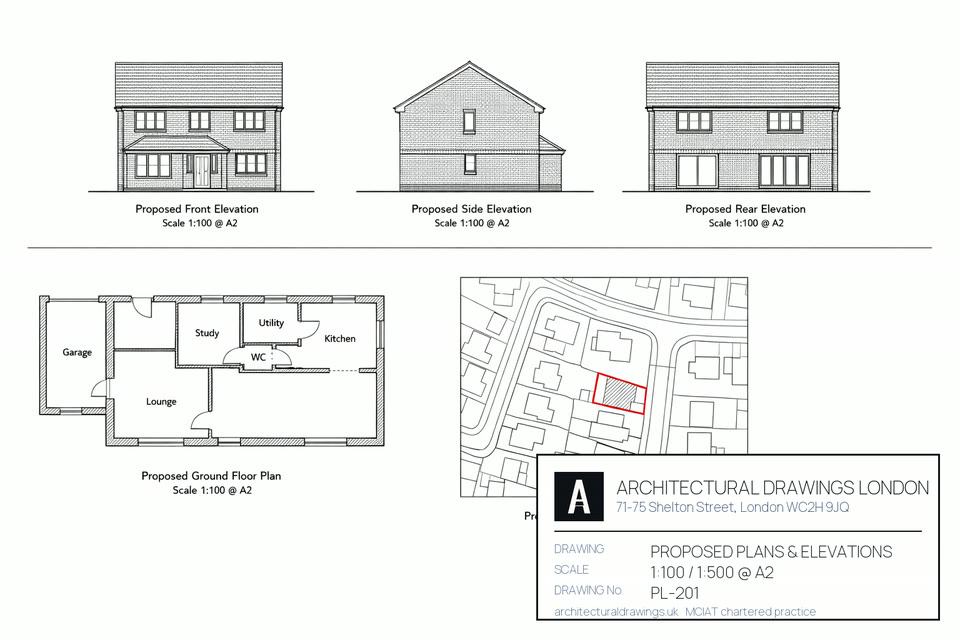
Planning application setExisting, proposed and location plans on one sheet — as the council receives it through the Planning Portal.
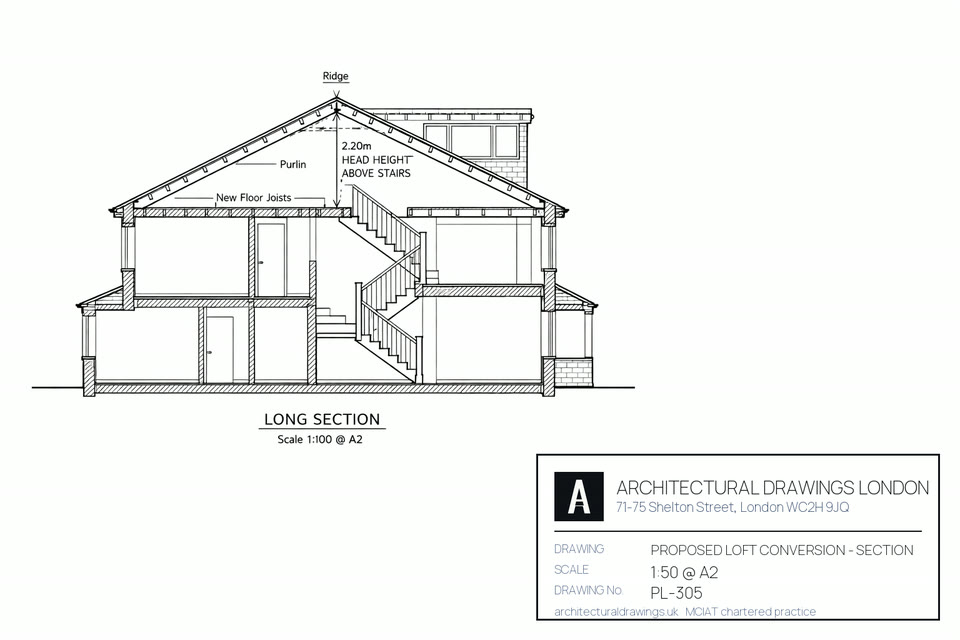
Long sectionHead height over the stair, dormer geometry and ridge height resolved to scale.
A london terraced street of the type we survey — conservation area planning in Kingston upon Thames.
Book a call
Speak to a chartered technologist — free 15 minutes
Pick a slot that suits you. No obligation and no sales pressure, just straight answers on your planning route.
Where in Kingston upon Thames does a conservation area application actually get determined?
Every Kingston upon Thames postcode district we draw in, the stock that dominates
it and the authority that validates a conservation area application there. Kingston upon Thames fees below are the
statutory England rates for 2026, not conservation area application estimates.
Postcode
Area
Dominant stock
What it means for a conservation area application
KT1
Kingston upon Thames
Georgian fragments, Victorian terraces, 1930s semi-detached
KT1 covers Kingston upon Thames only; Kingston Council handles the conservation area application.
KT2
Kingston / Norbiton
Georgian fragments, Victorian terraces, 1930s semi-detached
Kingston / Norbiton sits wholly inside KT2, so Kingston Council validates every conservation area application submitted from an KT2 address.
KT3
New Malden
Edwardian villas, 1930s semi-detached
New Malden sits wholly inside KT3, so Kingston Council validates every conservation area application submitted from an KT3 address.
KT5
Surbiton / Tolworth
Edwardian villas, mansion blocks
A conservation area application at an KT5 address in Surbiton / Tolworth is determined by Kingston Council under its own Local Plan policies for Surbiton / Tolworth.
KT6
Surbiton
Edwardian villas, mansion blocks
KT6 covers Surbiton only; Kingston Council handles the conservation area application.
KT9
Chessington
1930s semi-detached
A conservation area application at an KT9 address in Chessington is determined by Kingston Council under its own Local Plan policies for Chessington.
How does a conservation area application differ street by street across Kingston upon Thames?
Roof pitch, wall build-up and plot depth change every few Kingston upon Thames
streets, and each one changes what a conservation area application can achieve at that address.
Kingston (KT1, KT2) — conservation area application work in Kingston means georgian fragments, victorian terraces, 1930s semi-detached. Kingston is Georgian and Victorian centre, riverside. Applications on Georgian stock here almost always need a heritage statement alongside the drawings throughout KT1. Kingston Council decides the Kingston application, and Kingston Market anchors the Kingston location plan.
Surbiton (KT5, KT6) — a conservation area application in Surbiton starts from edwardian villas, mansion blocks, and Surbiton reads as Edwardian villas, mansion blocks. Edwardian houses here typically need the same householder set plus a roof plan where a dormer is proposed in KT5. Kingston Council assesses Surbiton conservation area applications against its own Surbiton character guidance, and the location plan we draw for Surbiton references Surbiton station.
New Malden (KT3) — a conservation area application in New Malden starts from edwardian villas, 1930s semi-detached, and New Malden reads as Edwardian villas, 1930s semi-detached. Edwardian houses here typically need the same householder set plus a roof plan where a dormer is proposed in KT3. Kingston Council assesses New Malden conservation area applications against its own New Malden character guidance, and the location plan we draw for New Malden references New Malden High Street.
Chessington (KT9) — a conservation area application in Chessington starts from 1930s semi-detached, and Chessington reads as 1930s semi-detached, post-war estates. On these 1930s semis the prior approval route often replaces a full application in KT9. Kingston Council assesses Chessington conservation area applications against its own Chessington character guidance, and the location plan we draw for Chessington references Chessington World of Adventures.
Tolworth (KT5, KT6) — a conservation area application in Tolworth starts from 1930s semi-detached, post-war flats, and Tolworth reads as 1930s semi-detached, post-war flats. On these 1930s semis the prior approval route often replaces a full application in KT5. Kingston Council assesses Tolworth conservation area applications against its own Tolworth character guidance, and the location plan we draw for Tolworth references Tolworth Tower.
Norbiton (KT2) — a conservation area application in Norbiton starts from victorian terraces, edwardian villas, and Norbiton reads as Victorian terraces, Edwardian villas. Most applications on these Victorian streets are householder applications validated on existing and proposed plans in KT2. Kingston Council assesses Norbiton conservation area applications against its own Norbiton character guidance, and the location plan we draw for Norbiton references Norbiton station.
Coombe (KT2, KT3) — conservation area application work in Coombe means 1930s detached, edwardian villas. Coombe is 1930s detached and large semi-detached. Edwardian houses here typically need the same householder set plus a roof plan where a dormer is proposed throughout KT2. Kingston Council decides the Coombe application, and Coombe Hill anchors the Coombe location plan.
Does Kingston upon Thames planning policy restrict a conservation area application?
Conservation areas covering Kingston upon Thames: Kingston Council runs 22, and Surbiton, Hampton Wick, Coombe Hill are the ones Kingston upon Thames owners meet most. A conservation area application inside a Kingston upon Thames conservation area loses permitted development, so the Kingston upon Thames submission is a householder application at £548 decided in 8 weeks — not a £249 prior approval decided in 6 weeks. In Surbiton a conservation area application is judged on the street elevation first.
Article 4 and your Kingston upon Thames conservation area application: Kingston Council has made no borough-wide direction, so permitted development for a conservation area application in Kingston upon Thames generally survives outside Kingston upon Thames conservation areas and listed curtilages. A Lawful Development Certificate at £274 is how a KT1 owner records that a conservation area application was lawful.
Kingston upon Thames housing stock: Edwardian villas in Surbiton and New Malden; Victorian terraces in Kingston central; 1930s semi-detached in Chessington and Tolworth; post-war in New Malden. Outer south-west London suburban; generally permissive; riverside conservation areas add character in Kingston town. Read that before choosing a conservation area application route in Kingston upon Thames — construction, not postcode, sets what is achievable.
Who decides a conservation area application on the edge of Kingston upon Thames?
Richmond upon Thames — the Richmond upon Thames boundary runs against Kingston upon Thames, so a conservation area application a street from Kingston upon Thames is decided by Richmond Council instead. Richmond upon Thames runs 72 conservation areas across SW13 and its neighbours, which is why conservation area applications priced for Kingston upon Thames are re-checked against Richmond upon Thames policy whenever the Kingston upon Thames address sits on that edge.
Merton — the Merton boundary runs against Kingston upon Thames, so a conservation area application a street from Kingston upon Thames is decided by Merton Council instead. Merton runs 28 conservation areas across SW16 and its neighbours, which is why conservation area applications priced for Kingston upon Thames are re-checked against Merton policy whenever the Kingston upon Thames address sits on that edge.
Sutton — adjoining Kingston upon Thames, with 17 conservation areas centred on SM1. A conservation area application on the far side of the Kingston upon Thames line is determined by Sutton Council, so the Kingston upon Thames quote for conservation area applications is checked against Sutton guidance before it is issued.
Sources for this Kingston upon Thames conservation area application page: borough policies maps and
conservation-area registers (2025–26), Royal Mail postcode district boundaries,
the Town and Country Planning (Fees for Applications) (England) Regulations, the Town
and Country Planning (General Permitted Development) (England) Order 2015 as amended,
and the Party Wall etc. Act 1996.
The planning set that goes to the council through the Planning Portal: proposed elevations, plans, and the OS location plan with your site outlined.