TL;DR — Key Facts
- Dormer loft conversion: £50,000 – £70,000 (inner London premium borough)
- Mansard conversion: £80,000 – £120,000
- Velux conversion: £28,000 – £40,000
- Planning permission: Restricted by Article 4 in some areas
- Conservation areas: 38 in Kensington and Chelsea
Loft conversion costs in Kensington and Chelsea
This is the cost picture. The service page for loft conversions in Kensington and Chelsea covers the submission itself.
Loft conversion build costs in Kensington and Chelsea depend primarily on the type of conversion. As an inner London premium borough, Kensington and Chelsea sits at the higher end of London loft conversion pricing.
Loft conversion build costs in Kensington and Chelsea
These figures are build costs only and do not include professional fees (architect, structural engineer, Party Wall surveyor) or council fees. The actual cost will depend on the size of your loft, the specification of the fit-out, the structural complexity, and access constraints.
A standard dormer loft conversion typically adds 20-30 square metres of living space, while a mansard can add 30-50 square metres with full standing head height throughout. The additional floor area and value uplift typically exceeds the cost of the conversion, making loft conversions one of the most cost-effective home improvements in Kensington and Chelsea.
Which loft type suits Kensington and Chelsea properties?
Where an attic storey exists, the workable project is usually internal reconfiguration and rooflights on the rear slope, which on a listed building still needs listed building consent. Adding a mansard where the terrace does not already have one is difficult, because the argument depends on the roofline of the whole terrace rather than your section of it. Edwardian mansion blocks have no individually owned roof.
Dormer loft conversions
Kensington and Chelsea has extensive streets of terraced housing, making rear dormer loft conversions the most popular option. A flat-roof rear dormer on a Victorian or Edwardian mid-terrace can add 20-30 square metres of living space. Rear dormers on terraced houses generally fall under Permitted Development, provided they do not exceed the highest part of the existing roof and are set back from the eaves. Properties in conservation areas may need full planning permission for dormers visible from the highway.
Mansard loft conversions
Mansard conversions replace the existing roof slope with a near-vertical front and a shallow-sloped top, creating a full additional storey. Mansard conversions always require planning permission as they alter the roofline. In Kensington and Chelsea, mansard conversions are assessed on a case-by-case basis, with design quality, streetscene impact, and conservation area status being key considerations. Mansard conversions are more expensive than dormers but create significantly more usable floor area with full standing head height throughout.
Velux (rooflight) conversions
A Velux or rooflight conversion is the simplest and most affordable option, suitable where there is already sufficient head height in the existing loft space. Rooflights are installed into the existing roof slope without changing its shape. This type of conversion almost always falls under Permitted Development and is particularly suitable for properties in Kensington and Chelsea's 38 conservation areas where changes to the roofline may not be acceptable. The trade-off is less usable floor area compared to a dormer or mansard.
Planning permission for lofts in Kensington and Chelsea
On most Royal Borough terraces the mansard is already there. Stucco Regency and Victorian terraces were frequently built or later altered with an attic storey behind the parapet, so the question is more often whether the existing roof space can be improved than whether a new storey can be added. With 38 conservation areas, an Article 4 Direction and heavy listed building coverage, either version needs consent.
Permitted Development for lofts
Most rear dormer and Velux loft conversions fall under Permitted Development and do not require a planning application. The key PD conditions are:
- The dormer must not exceed the highest part of the existing roof
- The dormer must be set back at least 200mm from the eaves
- Materials must be similar in appearance to the existing house
- No verandas, balconies, or raised platforms
- Side-facing windows must be obscure-glazed and non-opening below 1.7m
- Volume limit: 40 cubic metres for terraced houses, 50 cubic metres for others
Article 4 Directions
Kensington and Chelsea has Article 4 Directions in place. Article 4 Directions covering HMOs, office-to-residential, and basement developments — RBKC has some of the strictest basement policies in London. While most Article 4 Directions in London target HMO conversions or commercial changes of use rather than loft conversions directly, it is important to check whether any specific restrictions apply to your property. We verify this as part of our initial assessment.
Conservation areas
Kensington and Chelsea has 38 conservation areas, including Kensington, Chelsea, Notting Hill, Holland Park, Earls Court. In conservation areas, Permitted Development rights for loft conversions are more restricted. Front-facing dormers and side-facing dormers visible from the highway generally require planning permission. Rear dormers may still qualify as PD, but the conservation officer may have views on materials and design. Mansard conversions in conservation areas are assessed against the area's character appraisal and management plan.
Mansard planning permission
Permission is needed for any mansard. On most Royal Borough terraces the attic storey already exists, so the realistic project is improving what is there rather than adding to it - and on a listed building that internal work needs listed building consent in its own right. Adding a new mansard where the terrace lacks one is an argument about the whole composition.
The Royal Borough publishes its own pre-application charges. Buy the enquiry. This borough withdrew 1,378 applications in three years, 20.3% of all decisions and the highest rate in London (MHCLG planning statistics, retrieved 1 September 2026) - a withdrawal is a scheme that was going to fail, and an early officer view is the cheapest way to discover that before the drawings exist.
Our drawing fees for loft conversions in Kensington and Chelsea
At Architectural Drawings London. Our MCIAT chartered architectural technologists prepare everything needed for planning submission (where required) and building regulations approval.
Drawing fees for loft conversions
Every package includes a measured survey, existing and proposed floor plans and elevations, roof plan, sections, and a site plan. For mansard conversions, we also prepare a design and access statement and streetscene elevation. Our fees are 30% below typical London architect rates for the same scope of work.
We cover all Kensington and Chelsea postcodes: SW1, SW3, SW5, SW7, SW10, W8, W10, W11, W14.
Frequently asked questions
How much does a loft conversion cost in Kensington and Chelsea?
Loft conversion costs in Kensington and Chelsea vary by type. A rear dormer loft conversion typically costs £50,000 to £70,000. A mansard conversion costs £80,000 to £120,000. A Velux (rooflight only) conversion costs £28,000 to £40,000. These are build costs only.
Do I need planning permission for a loft conversion in Kensington and Chelsea?
No, as a working assumption. The borough combines an Article 4 Direction, 38 conservation areas and listed status across much of the stock, and it issued just 118 lawful development certificates in three years (MHCLG planning statistics, retrieved 1 September 2026) — the second-lowest count in London. On a listed building, internal alterations need consent as well, which is the requirement most often missed on a loft project here.
What is the minimum head height for a loft conversion in Kensington and Chelsea?
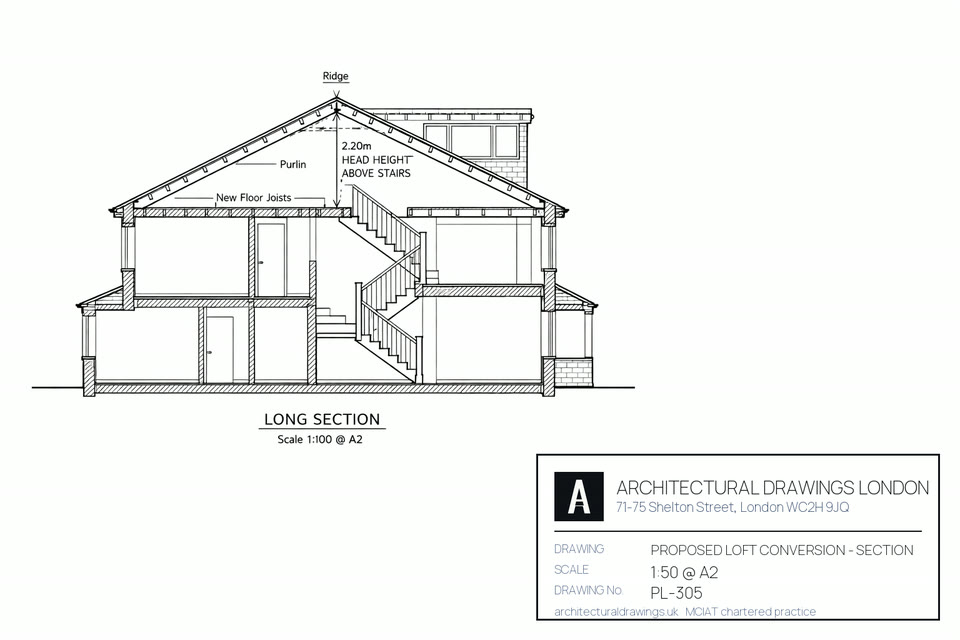
Two point two metres from the top of the ceiling joists to the underside of the ridge is the conventional test, and on most Royal Borough terraces it is the wrong question. These houses generally already have an attic storey behind the parapet, so the height exists and the project is improving what is there. On a listed building that internal work needs listed building consent in its own right.
Do I need a Party Wall Agreement for a loft conversion in Kensington and Chelsea?
Royal Borough houses are terraced throughout, so work at roof level engages the Party Wall etc. Act 1996 on both flanks of a mid-terrace property. Where the building is listed, the party wall notice and the listed building consent run entirely separately: neither one authorises the other, and the Act's two-month period is not shortened by having consent in hand.
Can I get a mansard loft conversion approved in Kensington and Chelsea?
Kensington and Chelsea assesses mansard applications on a case-by-case basis. RBKC Planning will consider the impact on the streetscene, conservation area status, design quality, and any existing precedents on your street.