Key differences at a glance
- Cost: Loft £45k–65k · Mansard £65k–110k (London averages)
- Space gained: Loft adds 1–2 rooms with sloped ceilings · Mansard adds a full new storey
- Planning: Loft usually Permitted Development · Mansard always needs full planning
- Build time: Loft 8–12 weeks · Mansard 12–16 weeks (plus planning lead time)
- Value added: Both add 15–25% property value; mansard typically more in absolute terms
If you own a Victorian terrace, an Edwardian semi, or a period townhouse in London, you have almost certainly considered converting your loft. The question is not whether to go up -- it is how far to go up. A standard loft conversion with a rear dormer is the most common route. A mansard conversion is the more ambitious alternative: it replaces your entire roof structure to create a full additional storey with vertical walls and near-flat ceiling throughout.
Both options add bedrooms, bathrooms, and significant value to your property. But they differ in cost, planning requirements, build complexity, timescale, and the amount of usable space they deliver. In this guide, we compare loft conversions and mansard conversions in detail -- drawing on our experience as MCIAT chartered architectural technologists preparing drawings for both types across all 33 London boroughs.
By the end, you will know which conversion type suits your property, your budget, and your borough's planning policies -- and exactly what drawings and approvals you need to get started.
Where does a mansard actually get approved?
In the boroughs whose terraces were built for one. Wandsworth’s Datahub set records 2,310 mansard applications at 87% approved and Kensington and Chelsea 229 at 97%; Waltham Forest managed 42% on 172. A mansard alters the front roof plane, so it is never permitted development.
| Borough | Mansard applications in the Datahub | Approved |
|---|---|---|
| Islington | 3,192 | 52% |
| Wandsworth | 2,310 | 87% |
| Westminster | 2,242 | 81% |
| Lambeth | 1,404 | 70% |
| Hackney | 892 | 72% |
| Kensington and Chelsea | 229 | 97% |
| Waltham Forest | 172 | 42% |
Source: Planning London Datahub (Greater London Authority), retrieved 15 August 2026. Counts phrase-match published application descriptions and ingestion depth differs by borough, so compare the approval percentages across rows rather than the volumes. The permitted development position is Schedule 2, Part 1, Class B of the General Permitted Development Order 2015, which excludes any enlargement beyond the plane of the front roof slope.
What is a standard loft conversion?
A standard loft conversion transforms your existing roof space into habitable rooms without fundamentally changing the roof structure. The existing roof remains largely intact, with modifications made to insert dormers, strengthen the floor, add a staircase, and install windows. The key characteristic is that the original roof slope is preserved on at least some elevations, and the conversion works within the existing roof envelope rather than replacing it entirely.
Dormer types
The most common loft conversions in London use one or more of the following dormer configurations:
- Rear dormer (flat-roof box dormer): The workhorse of London loft conversions. A flat-roofed box is built out from the rear roof slope, typically spanning the full width of the property. This maximises headroom and usable floor area at the back of the house while leaving the front roof slope untouched. The vast majority of dormer loft conversions in London are rear dormers.
- L-shaped dormer: An extension of the rear dormer that wraps around the side of the property over the rear addition (the "outrigger" or back addition common on Victorian terraces). This L-shape creates significantly more floor area than a straight rear dormer and is particularly popular on two-storey Victorian terraces with single-storey or two-storey rear returns.
- Hip-to-gable conversion: On semi-detached and detached houses with hipped roofs (where the roof slopes inward on the side elevation), the hip is extended outward to create a vertical gable wall. This is often combined with a rear dormer. Hip-to-gable conversions are common in outer London boroughs where semi-detached houses predominate -- Bromley, Croydon, Sutton, Kingston, Harrow, and similar areas.
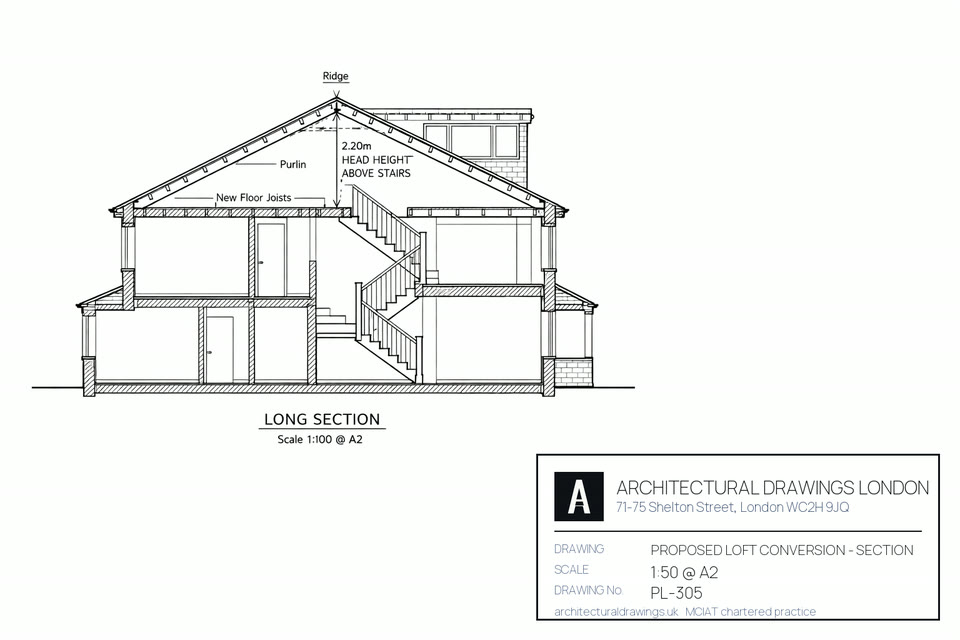
- Velux (rooflight) conversion: The simplest and cheapest option, involving no structural changes to the roof profile. Velux windows are installed into the existing roof slope. This works only where the existing roof space has sufficient headroom (at least 2.2 metres from the floor joist to the ridge at the tallest point). Velux conversions are relatively rare in London because most terraced houses lack the headroom.
Permitted Development eligibility
Standard loft conversions with rear dormers usually qualify as Permitted Development (PD), meaning they do not need planning permission. However, PD rights come with strict conditions:
- The volume added must not exceed 40 cubic metres for terraced and semi-detached houses, or 50 cubic metres for detached houses
- The dormer must not extend beyond the plane of the existing roof slope facing a highway (i.e. no front dormers under PD)
- The dormer must not exceed the height of the existing ridge
- Materials must be similar in appearance to the existing house
- No balconies or raised platforms (Juliet balconies with obscured glass are usually acceptable)
- Side-facing windows must be obscure-glazed and non-opening below 1.7 metres from finished floor level
- The property must not be in a conservation area with an Article 4 Direction removing PD Class B/C rights, and must not be a listed building
Even when your loft conversion qualifies as Permitted Development, we strongly recommend applying for a Lawful Development Certificate (LDC) at £274. This gives you a legal document from the council confirming the work is lawful -- essential when you come to sell the property. Read more about our loft conversion service.
What is a mansard conversion?
A mansard conversion is fundamentally different from a standard loft conversion. Rather than working within the existing roof structure, a mansard replaces the entire roof with a new structure that creates a full additional storey. The defining features are:
- A near-vertical front wall at approximately 72 degrees from horizontal, clad in slate or tile to match the streetscape. This wall looks like a very steeply pitched roof from the street but functions as a vertical wall inside, giving full standing headroom right to the edges of the room.
- A flat or near-flat roof behind the mansard wall, set behind a parapet. From the street, the roof is invisible -- all you see is the angled mansard wall with its dormer windows.
- Dormer windows set into the mansard wall. These are typically vertically proportioned sash-style windows that echo the fenestration pattern of the floors below.
- Full standing headroom throughout. Unlike a standard loft conversion where rooms have sloped ceilings and limited headroom at the eaves, a mansard room has a flat (or gently angled) ceiling with at least 2.3 metres of headroom throughout. The usable floor area is close to 100% of the footprint, compared to 60-75% in a typical dormer loft.
The name comes from the French architect François Mansart (1598-1666), who popularised the steep-angled roof form in Paris. In London, mansard roofs are an established part of the architectural vocabulary -- you will see historic mansard roofs on Georgian and early Victorian buildings throughout central London. Modern mansard conversions draw on this precedent.
Why mansards always need planning permission
A mansard conversion always requires full planning permission. It cannot be done under Permitted Development. The reasons are straightforward:
- It changes the roof profile -- the original pitched roof is demolished and replaced with a mansard form
- It raises the overall building height (the mansard wall is taller than the original ridge in most cases)
- It alters the front elevation, which is visible from the public highway
- It creates a new storey, which exceeds the scope of PD loft conversion rights
This means that every mansard project requires professional architectural drawings, a Design and Access Statement, and a formal application to the borough council. The planning process typically takes 8 weeks for determination after validation, with 2-3 weeks of drawing preparation beforehand. In conservation areas, a Heritage Statement is also required, and the determination may take longer.
Side-by-side comparison
The following table summarises the key differences between a standard dormer loft conversion and a mansard conversion in London.
| Feature | Standard Loft (Dormer) | Mansard Conversion |
|---|---|---|
| Build cost (London) | £45,000 – £65,000 | £65,000 – £110,000 |
| Usable space gained | 1–2 rooms (typically 15–25 m²) | Full storey (typically 25–45 m²) |
| Headroom | Full height at centre, sloped at eaves (60–75% usable) | Full standing height throughout (95–100% usable) |
| Planning permission | Usually Permitted Development (no application needed) | Always requires full planning permission |
| Build time | 8 – 12 weeks | 12 – 16 weeks |
| Total project time | 5 – 7 months (PD route) | 7 – 10 months (including planning) |
| Value added | 15 – 20% of property value | 20 – 25% of property value |
| Best property types | Any house with adequate ridge height; terraces, semis, detached | Victorian/Edwardian terraces and semis; townhouses |
| Roof impact | Existing roof retained; dormer added to rear slope | Entire roof removed and rebuilt |
| Drawing fees (our pricing) |
Planning permission: loft vs mansard
The planning route is one of the biggest practical differences between the two conversion types. It affects your timeline, your risk, and your costs before construction even begins.
Loft conversions: usually Permitted Development
The majority of standard dormer loft conversions in London qualify as Permitted Development under Class B (additions to the roof of a dwellinghouse) of the Town and Country Planning (General Permitted Development) Order. This means no planning application is required -- you can proceed with building regulations approval and start construction without waiting for a council decision.
However, PD rights are not universal. They are removed or restricted in the following situations:
- Conservation areas: Many London boroughs have extensive conservation area coverage. In conservation areas, rear dormers may still be permitted under PD, but front dormers and side dormers are typically restricted. Check your specific conservation area appraisal.
- Article 4 Directions: Some boroughs have Article 4 Directions that specifically remove PD rights for loft conversions. This is common in parts of Camden, Islington, Hackney, Tower Hamlets, and Westminster.
- Flats and maisonettes: PD rights for loft conversions apply only to houses, not flats. If your property is a flat (even a top-floor flat), you need planning permission for any roof alteration.
- Volume limits exceeded: If your proposed dormer exceeds 40 m³ (terraced/semi) or 50 m³ (detached), you need planning permission.
Even where PD applies, you still need building regulations approval for the structural work, fire safety, insulation, stairs, and electrics. And we always recommend a Lawful Development Certificate for legal certainty.
Mansard conversions: always full planning
There is no Permitted Development route for a mansard conversion. Every mansard project in London requires a full householder planning application (£548 council fee in 2026). The application includes:
- Existing and proposed floor plans, elevations, and sections -- all to scale
- A site plan and block plan showing the property in context
- A Design and Access Statement explaining the design rationale and how the proposal respects the local character
- In conservation areas: a Heritage Statement assessing the impact on the significance of the conservation area
- Potentially: a daylight/sunlight assessment if the mansard significantly increases the bulk of the building near neighbouring windows
The planning risk with mansards is higher than with loft conversions. The council will assess the visual impact on the streetscape, the effect on neighbouring properties, and whether the mansard design is appropriate for the local architectural character. In some boroughs, mansards are actively encouraged; in others, they face significant resistance.
Our MCIAT chartered technologists have a council-ready drawing review for mansard planning applications across London. We know which boroughs welcome mansards and which require careful design justification. Learn more about our mansard conversion service.
Heritage sensitivity and conservation areas
Conservation area designation does not automatically prevent a mansard conversion, but it does raise the bar significantly. The council will assess whether the mansard:
- Preserves or enhances the character and appearance of the conservation area
- Respects the prevailing roofscape and building heights in the street
- Uses appropriate materials (natural slate is usually required, not concrete tiles)
- Has window proportions and detailing that complement the existing building
- Does not set an undesirable precedent for further roof extensions in the area
In many conservation areas, the key argument in favour of a mansard is precedent. If other properties on the same terrace already have mansard roofs -- whether historic originals or approved modern additions -- the council is far more likely to approve yours. This is where local knowledge and careful precedent research by your architectural technologist can make the difference between approval and refusal.
Build costs in London
Construction costs in London are higher than the national average due to higher labour rates, access constraints (scaffolding on narrow terraced streets, parking restrictions, skip permits), and the complexity of working on period buildings with older structural elements.
Standard loft conversion: £45,000 – £65,000
A typical rear dormer loft conversion in London costs between £45,000 and £65,000 including all construction, structural steelwork, plastering, plumbing, electrics, and decoration. The main cost variables are:
- Dormer size: A full-width rear dormer costs more than a narrow dormer or Velux-only conversion
- L-shaped vs straight dormer: An L-shaped dormer extending over the rear return adds £8,000–£15,000
- Bathroom: Adding an en-suite or shower room in the loft adds £5,000–£10,000 depending on specification
- Staircase location: Routing the staircase may require modifications to the floor below, adding cost
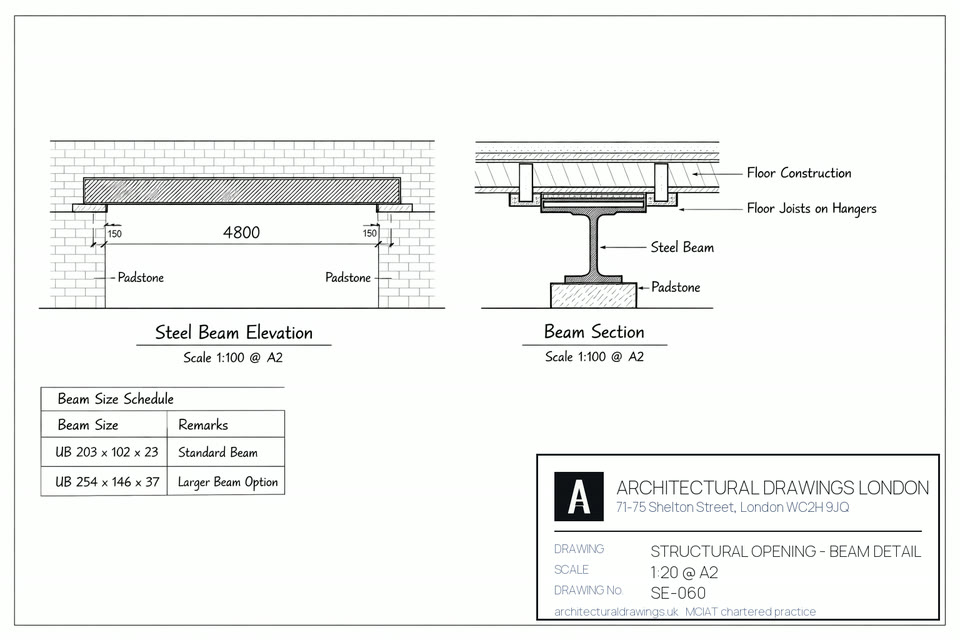
- Structural complexity: Older properties may need more extensive steelwork if existing timbers are undersized or damaged
- Specification and finish: Budget fittings vs high-end tiling, underfloor heating, bespoke joinery
Mansard conversion: £65,000 – £110,000
A mansard conversion in London typically costs between £65,000 and £110,000. The higher cost reflects:
- Complete roof removal and rebuild: The entire existing roof structure is demolished and replaced with a new structural frame, new load-bearing walls, and a flat or low-pitch roof
- Greater structural work: The new mansard walls impose different loads on the existing building structure, often requiring additional steelwork and foundation work
- Scaffolding and temporary weather protection: The house is open to the elements during the roof replacement. Full scaffold wrap and temporary weatherproofing are essential and add £3,000–£6,000
- Larger floor area: Because a mansard creates more usable space, there are more square metres to finish -- more flooring, more plastering, more skirting, more painting
- Higher specification cladding: The mansard wall typically needs natural slate hanging or high-quality tile work, which costs more than the lead or zinc cladding on a simple rear dormer
- Planning costs: Drawing fees, application fees, and potentially pre-application fees add to the project cost. These are not incurred with a PD loft conversion
On a per-square-metre basis, a mansard is often comparable to or cheaper than a standard dormer loft conversion. A dormer might deliver 20 m² of usable space at £55,000 (£2,750/m²), while a mansard might deliver 35 m² at £85,000 (£2,430/m²). The total is higher, but the value per square metre is better.
Drawing fees: our pricing for each
At Architectural Drawings London, we prepare the full set of drawings and documents needed for both loft conversions and mansard conversions. Our fees are fixed, transparent, and 30% below typical London architect rates -- because we are MCIAT chartered architectural technologists who specialise in technical drawings and planning submissions, not full-service architecture practices.
Loft conversion drawings
Mansard conversion drawings
Both packages include unlimited revisions during the design stage and council liaison through to determination. The difference in price between the loft and mansard packages reflects the additional design work, documentation, and planning management required for a mansard application.
Get a free loft quote → Get a free mansard quote →
Which London boroughs favour mansards?
Planning policy on mansard conversions varies significantly across London's 33 boroughs. Some boroughs have explicit policies supporting mansard extensions on appropriate properties; others are more cautious or restrictive. Local knowledge is critical -- a design that sails through planning in Hackney might be refused in Westminster.
Boroughs with a strong mansard tradition
The following boroughs have a well-established tradition of mansard roof extensions, with numerous approved precedents and generally supportive planning policies:
- Hackney: One of the most mansard-friendly boroughs in London. Hackney's housing stock is predominantly Victorian terraces, many of which already have mansard conversions. The council's design guidance acknowledges mansards as an appropriate form of roof extension where they complement the existing streetscape. Success rates are high.
- Islington: Islington has extensive experience with mansard applications on its Georgian and Victorian terraces. The borough has supplementary planning guidance on roof extensions that specifically addresses mansard design. Natural slate and vertically proportioned windows that echo the floors below are expected.
- Tower Hamlets: The borough's stock of Victorian terraces in areas like Bow, Mile End, and Bethnal Green makes it a strong mansard territory. Planning officers are familiar with mansard proposals and there are numerous approved precedents to reference.
- Lambeth: South London boroughs like Lambeth have a strong tradition of mansard conversions, particularly on the Victorian terraces of Brixton, Clapham, and Streatham. Lambeth's design policies are generally supportive where the mansard respects the existing building proportions.
- Southwark: Similar to Lambeth, Southwark's Victorian terraced streets in Peckham, Camberwell, and Dulwich see regular mansard applications with good approval rates. The borough values good design and appropriate materials.
Boroughs with greater scrutiny
- Westminster: Westminster has some of the most extensive conservation area coverage in London. Mansard proposals face detailed scrutiny from conservation officers. Approval is achievable but requires exceptional design quality, full precedent analysis, and usually a pre-application consultation. Materials specification is critical -- only natural Welsh slate is typically accepted.
- Kensington & Chelsea: One of the more restrictive boroughs for mansards. RBKC has detailed policies on roof extensions and resists proposals that alter the established roofline in conservation areas. However, on non-conservation streets and where strong precedent exists, approval is possible.
- Camden: Camden is mixed. Some areas (particularly Victorian terraces in Kentish Town and Tufnell Park) have a well-established mansard tradition and high approval rates. Conservation areas in Hampstead and Belsize Park face much greater scrutiny.
ROI and value added
Both loft conversions and mansard conversions are among the most financially rewarding home improvements you can make in London. The return on investment is driven by London's high property prices per square metre, which mean that adding even modest additional floor area can generate substantial value.
Loft conversion ROI
A standard dormer loft conversion typically adds 15–20% to a property's value in London. On a £600,000 terraced house, that represents £90,000–£120,000 of additional value against a build cost of £45,000–£65,000. The ROI is particularly strong because:
- The build cost is relatively modest
- No planning application fees or risk (under PD)
- Shorter build time means less disruption and fewer financing costs
- A third bedroom with en-suite moves a property into a higher price bracket in many London markets
Mansard conversion ROI
A mansard conversion typically adds 20–25% to a property's value, reflecting the greater amount of space created. On the same £600,000 property, that represents £120,000–£150,000 of additional value against a build cost of £65,000–£110,000. In prime London locations where values per square metre are highest, the returns can be even more compelling:
- In Islington, Hackney, and Camden, property values of £800–£1,200 per square foot mean that a mansard adding 35 m² (375 sq ft) could add £300,000–£450,000 against a total project cost (build + drawings + planning) of £80,000–£120,000
- A mansard creates a full additional storey, which is qualitatively different from a loft room with sloped ceilings. Estate agents can market it as a proper bedroom floor, not an "attic room"
- The added space typically accommodates two bedrooms and a bathroom, compared to one bedroom and one bathroom in a standard loft -- potentially moving a property from "3 bed" to "5 bed" territory
The higher upfront cost of a mansard is almost always justified by the greater value created -- provided the planning application is approved. This is why the quality of your architectural drawings and Design & Access Statement is so important. A refusal means wasted time, wasted fees, and a planning history that can make resubmission harder.
How to decide: loft or mansard?
The right choice depends on your specific property, your goals, your budget, and your appetite for planning risk. Here is a framework for deciding.
Choose a standard loft conversion if:
- You need one additional bedroom (with or without en-suite) and do not need to maximise every square metre
- Your property qualifies for Permitted Development and you want to avoid the uncertainty and timeline of a planning application
- Your budget is under £65,000 for construction
- You need to move quickly -- a PD loft can be completed 2-3 months faster than a mansard when you factor in the planning process
- Your property is in a conservation area where mansards face resistance but rear dormers are generally accepted
- You have a detached or semi-detached house with a hipped roof that lends itself to a hip-to-gable + rear dormer combination
Choose a mansard conversion if:
- You want to maximise the space and create a full additional storey with two or more rooms
- You want full standing headroom throughout -- no sloped ceilings, no cramped eaves
- Your property is a Victorian or Edwardian terrace in a borough with a strong mansard tradition (Hackney, Islington, Tower Hamlets, Lambeth, Southwark)
- You are comfortable with the planning process and the 8-week determination period
- You are investing for the long term and want the maximum value uplift from a single project
- Your terrace already has mansard precedents on neighbouring properties -- these significantly strengthen a planning application
Still unsure?
The best starting point is a site visit and feasibility assessment. Our MCIAT chartered technologists can visit your property, assess the existing roof structure and local planning context, and advise on whether a loft conversion, a mansard, or a combination approach is the right option. This initial consultation is included in your quote at no extra charge.
Frequently asked questions
Is a mansard more expensive than a loft conversion?
Yes. A mansard conversion in London typically costs between £65,000 and £110,000, compared to £45,000 to £65,000 for a standard dormer loft conversion. The higher cost reflects the greater structural complexity -- a mansard requires demolishing and rebuilding the entire roof structure, adding new load-bearing walls, and creating a larger finished floor area. However, on a per-square-metre basis, a mansard is often comparable in cost to a dormer loft, because it delivers significantly more usable space.
Do I need planning permission for a loft conversion in London?
Most standard loft conversions in London fall under Permitted Development (PD) rights and do not need planning permission. The volume added must not exceed 40 cubic metres for terraced and semi-detached houses, or 50 cubic metres for detached houses. The dormer must not face the highway, must not exceed the existing ridge height, and materials must be similar in appearance to the existing building. However, PD rights are removed in many London conservation areas with Article 4 Directions, and do not apply to flats or listed buildings. We recommend obtaining a Lawful Development Certificate (£274) even when PD applies, to provide legal proof for future property sales.
Which adds more value: loft or mansard?
Both add significant value to London properties. A standard loft conversion typically adds 15–20% to a property's value, while a mansard conversion adds 20–25%. In absolute terms, a mansard usually adds more because it creates a full additional storey with full standing headroom throughout, rather than rooms with sloped ceilings. Estate agents can market a mansard floor as a proper bedroom storey, not an "attic room." In prime London boroughs where values per square metre are highest, the additional value from a mansard can be £150,000–£300,000 against a build cost of £65,000–£110,000.
Can any house have a mansard conversion?
Not every house is suitable for a mansard conversion. Mansards work best on Victorian and Edwardian terraced and semi-detached houses where the existing roof pitch, party wall arrangement, and structural capacity support the conversion. Detached houses can also have mansards, but the design is more complex as all four roof slopes must be addressed. Properties in conservation areas face additional scrutiny, and some boroughs have specific policies that resist mansard extensions on certain street types or building styles. A structural assessment and planning appraisal by an experienced architectural technologist are essential before committing to a mansard project. Request a free feasibility assessment.
How long does a mansard conversion take?
A mansard conversion in London typically takes 12 to 16 weeks of construction time on site, compared to 8 to 12 weeks for a standard dormer loft conversion. However, the total project timeline is longer because mansards always require planning permission. The drawing preparation stage takes 2-3 weeks, the planning application process takes 8 weeks for determination (plus 1-2 weeks for validation), and building regulations approval runs in parallel. From initial instruction to moving into the finished space, expect 7 to 10 months for a mansard, compared to 5 to 7 months for a loft conversion under Permitted Development.