Which Southwark postcodes does this loft conversion service cover?
Postcode by postcode: where we draw, what sort of housing sits there, and which authority receives a roof scheme from that address. The fee column carries 2026 statutory England charges — what it costs a council to consider paperwork, not an estimate of building anything.
| Postcode | Area | Dominant stock | What it means for a loft conversion |
|---|
| SE1 | Bermondsey / Borough / Waterloo | Georgian terraces, post-war flats, new-build | SE1 is the boundary-crossing district: Bermondsey, Borough and Waterloo addresses can fall to Southwark or to Lambeth. Only the policies map answers that, and it answers address by address, not by neighbourhood name. |
| SE5 | Camberwell | Georgian villas, Victorian terraces | Camberwell is split: SE5 runs across the Southwark–Lambeth line, and roughly four in five recorded sales in the district fall on the Southwark side. Confirm the authority from the policies map rather than from the postcode. |
| SE15 | Peckham / Nunhead | Victorian terraces, post-war estates | SE15 takes in Peckham and Nunhead, both inside the borough. Southwark officers handle the case and apply the district's conservation area designations street by street. |
| SE16 | Bermondsey / Rotherhithe | Warehouse conversions, Georgian terraces, new-build | SE16 covers Bermondsey and Rotherhithe and lies entirely inside the borough, so Southwark's own Local Plan policies apply throughout and there is no boundary question to resolve. |
| SE17 | Walworth | Post-war estates, new-build towers | SE17 is Walworth, entirely within the borough. Southwark determines the application, with the local conservation area boundaries doing most of the work on what a roof alteration is allowed to look like. |
| SE21 | Dulwich Village | Georgian villas, Edwardian villas (Dulwich Estate) | SE21 crosses the Southwark–Lambeth line at Dulwich Village, so one street can belong to either authority. Look the address up on the policies map first — the postcode alone will not tell you who validates the loft drawings. |
| SE22 | East Dulwich | Victorian and Edwardian terraces | SE22 is East Dulwich and sits wholly inside the borough. Southwark case officers determine it, reading the conservation area map for that part of the district as they go. |
| SE24 | Herne Hill | Victorian villas, Edwardian terraces | Herne Hill is the awkward one. SE24 is divided between Lambeth and Southwark, and validation goes to whichever authority the address falls in — worth settling before the drawings are packaged. |
How does a loft conversion differ street by street across Southwark?
A Southwark loft is decided by three things that change street by street: the pitch of the existing roof, what the walls are genuinely built of, and how deep the plot runs behind the rear wall. An Albany Road terrace and a Dulwich semi four miles away give different answers to the same brief.
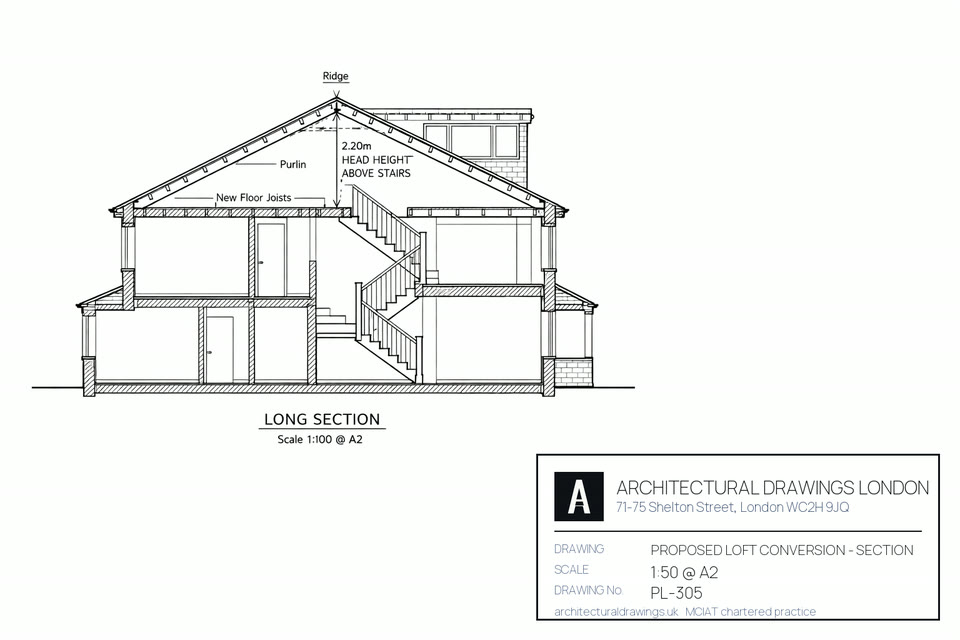
- East Dulwich (SE22) — loft conversion work in East Dulwich means victorian and edwardian terraces. East Dulwich is Victorian and Edwardian terraces. The Victorian butterfly and double-pitched roofs on these streets normally clear the 2.2 m head height a dormer conversion needs once the ceiling joists are raised throughout SE22. Southwark Council decides the East Dulwich application, and Lordship Lane anchors the East Dulwich location plan.
- Rotherhithe (SE16) — a loft conversion in Rotherhithe starts from warehouse conversions, post-war estates, new-build, and Rotherhithe reads as warehouse conversions, riverside. Post-war roofs on these estates are often trussed in SE16. Southwark Council assesses Rotherhithe loft conversions against its own Rotherhithe character guidance, and the location plan we draw for Rotherhithe references Surrey Quays.
- Elephant and Castle (SE1, SE17) — loft conversion work in Elephant and Castle means post-war estates, new-build towers. Elephant and Castle is regenerated quarter, modernist origins. Post-war roofs on these estates are often trussed throughout SE1. Southwark Council decides the Elephant and Castle application, and Elephant and Castle station anchors the Elephant and Castle location plan.
- Nunhead (SE15) — loft conversion work in Nunhead means victorian terraces. Nunhead is Victorian terraces around the cemetery. The Victorian butterfly and double-pitched roofs on these streets normally clear the 2.2 m head height a dormer conversion needs once the ceiling joists are raised throughout SE15. Southwark Council decides the Nunhead application, and Nunhead Cemetery anchors the Nunhead location plan.
- Bermondsey (SE1, SE16) — loft conversion work in Bermondsey means warehouse conversions, georgian terraces, new-build. Bermondsey is warehouse conversions, Georgian fragments. Georgian roofs here are shallow and often behind a parapet throughout SE1. Southwark Council decides the Bermondsey application, and Bermondsey Street anchors the Bermondsey location plan.
- Borough (SE1) — loft conversion work in Borough means georgian and victorian terraces, warehouse conversions. Borough is Georgian and Victorian terraces, market quarter. Georgian roofs here are shallow and often behind a parapet throughout SE1. Southwark Council decides the Borough application, and Borough Market anchors the Borough location plan.
- Camberwell (SE5) — Georgian villas, Victorian terraces defines Camberwell, where georgian villas, victorian terraces set what a loft conversion can do. Georgian roofs here are shallow and often behind a parapet across SE5. Any Camberwell loft conversion is validated by Southwark Council, with Camberwell Green the usual Camberwell reference point on the site plan.
Does Southwark planning policy restrict a loft conversion?
Conservation areas covering Southwark: Southwark Council runs 43, and Peckham Rye, Borough, Camberwell Grove are the ones Southwark owners meet most. A loft conversion inside a Southwark conservation area loses permitted development, so the Southwark submission is a householder application at £548 decided in 8 weeks — not a £249 prior approval decided in 6 weeks. In Borough a loft conversion is judged on the street elevation first.
What Article 4 takes away: the borough-wide direction covering houses in multiple occupation, plus a further direction over office-to-residential conversion around Bermondsey and Elephant & Castle. Neither bites on a straightforward loft, but the mapped boundaries are drawn address by address, so we check an SE1 site against them before pricing rather than assuming. Where rights do survive, prior approval is the other route worth knowing: of 54 larger householder prior approvals determined across the borough in the three years to March 2026, 38 were decided as not requiring approval and only four were refused.
Flood zones, and what they actually decide: 43.2% of the borough's 28.9 square kilometres sits in Flood Zone 3, and 46.2% in Zone 2 — among the most extensive coverage of any London authority. That does not mean those homes are expected to flood. The zones map the undefended extent, with the Barrier and the river walls taken out of the picture entirely. What a zone determines is paperwork: whether the validation checklist asks for a Flood Risk Assessment. A loft adds no ground-floor footprint, so it rarely triggers one; a lower-ground conversion in the same house often does, because new habitable rooms below flood level are treated quite differently. The fabric matters too — Georgian and Regency stock around Bermondsey and Borough, Victorian terraces through Camberwell and Peckham, Dulwich Estate housing under its own private scheme across much of SE21 and SE22, and riverside new build. That mix decides whether the job runs as permitted development, a £274 certificate, or a £548 application. Contains public sector information licensed under the Open Government Licence v3.0
Which neighbouring authorities border Southwark?
- Tower Hamlets — adjoining Southwark, with 58 conservation areas centred on E1. A loft conversion on the far side of the Southwark line is determined by Tower Hamlets Council, so the Southwark quote for loft conversions is checked against Tower Hamlets guidance before it is issued.
- City of London — cross the Southwark boundary and City of London Corporation takes the loft conversion instead, applying 27 conservation areas of its own around EC1. We re-price loft conversions at the Southwark edge because City of London policy and Southwark policy rarely align on loft conversion depth.
- Lambeth — the Lambeth boundary runs against Southwark, so a loft conversion a street from Southwark is decided by Lambeth Council instead. Lambeth runs 64 conservation areas across SE1 and its neighbours, which is why loft conversions priced for Southwark are re-checked against Lambeth policy whenever the Southwark address sits on that edge.
- Lewisham — cross the Southwark boundary and Lewisham Council takes the loft conversion instead, applying 30 conservation areas of its own around SE3. We re-price loft conversions at the Southwark edge because Lewisham policy and Southwark policy rarely align on loft conversion depth.
Sources for this Southwark loft conversion page: borough policies maps and
conservation-area registers (2025–26), Royal Mail postcode district boundaries,
the Town and Country Planning (Fees for Applications) (England) Regulations, the Town
and Country Planning (General Permitted Development) (England) Order 2015 as amended,
and the Party Wall etc. Act 1996.