TL;DR — Key Facts
- Dormer loft conversion: £50,000 – £70,000 (inner London premium borough)
- Mansard conversion: £80,000 – £120,000
- Velux conversion: £28,000 – £40,000
- Planning permission: Restricted by Article 4 in some areas
- Conservation areas: 56 in Westminster
What does a Westminster loft conversion involve?
A mansard, usually, and a long timetable. Westminster’s Datahub set records 2,242 mansard applications at 81% approved against 440 rear dormers. The council settled only 74.5% of householder decisions inside eight weeks, with 16.2% running past thirteen. It also holds 3,455 listed buildings, more than any other London borough.
| Measure | Westminster | Outcome |
|---|---|---|
| Mansard applications in the Datahub | 2,242 | 81% approved |
| Rear dormer applications in the Datahub | 440 | 76% approved |
| Listed buildings in the register | 3,455 | most in London |
| Conservation areas | 56 | 1,715 hectares |
| Decided inside eight weeks | 74.5% | 16.2% beyond thirteen |
| Mansard drawing package | from £1,575 | our fixed fee |
Sources: Datahub rows from the Planning London Datahub, retrieved 15 August 2026 — phrase-matched descriptions, comparable within Westminster only; registers from the MHCLG Planning Data Platform, retrieved 1 September 2026; decision figures from MHCLG PS1 and PS2, twelve quarters to March 2026; the package fee is our own published fixed fee. Build costs on this page are our own 2026 London range.
What does a Westminster loft cost by roof type?
That is the cost side of it. For the submission itself — what the drawing set contains and how the council handles it — see loft conversions in Westminster.
Build cost is driven first by conversion type and second by the plain fact of central London. The median Westminster sale ran to £887,250 across 2,114 transactions in 2025, 8.5% down on the year before. Source: HM Land Registry Price Paid, 2025 transactions, retrieved 1 September 2026. Labour, access and specification all price off that reality.
Loft conversion build costs in Westminster
Those are construction figures alone. They carry no design fee, no structural engineer, no Party Wall surveyor and no council charge. What shifts them is how big the loft is, what the fit-out is specified to, how complicated the structure turns out to be, and access — which in central Westminster tends to mean scaffold licences and restricted delivery windows rather than a driveway to park on.
Westminster rarely permits either form as normally described, whether the dormer at 20-30 square metres or the mansard at 30-50. On the Belgravia and Pimlico terraces an attic storey generally exists already, so the gain is from reconfiguring it rather than adding one, and on a listed building that internal work requires consent in its own right. The mansion blocks offer no individually owned roof at all.
Which loft type suits Westminster properties?
Where an attic storey is already present, improving it internally with rooflights on a concealed slope is the realistic project — and on a listed building the internal work needs consent in its own right. Adding a new mansard where the terrace lacks one is assessed against the roofscape of the whole composition. Mansion blocks throughout the borough have no individually owned roof space.
Dormer loft conversions
Terraced streets are common enough that a rear dormer is the default request, and a flat-roof dormer on a Victorian or Edwardian mid-terrace typically adds 20 to 30 square metres. Nationally that form often falls inside permitted development so long as it stays below the existing ridge and sets back from the eaves. In Westminster it frequently does not, because a conservation area designation or a listing removes the right in the first place — and 44.1% of the borough's 132,190 dwellings predate 1900 (VOA CTSOP4.1, at 31 March 2025).
Mansard loft conversions
A mansard trades the sloping roof for a near-vertical front face with a shallow deck on top, buying a full extra storey with standing height right across it. It always requires planning permission, since the roofline itself changes. That application is read here against design quality, streetscene and conservation area status, and on a listed building it needs listed building consent besides — the borough took 4,689 of those decisions in three years and granted 92.2% of them. Mansards cost more than dormers and hand back considerably more usable floor.
Velux (rooflight) conversions
Rooflights drop into the existing slope and leave the roof profile alone, which is exactly why a Velux conversion is often the only version that gets through inside Westminster's 56 conservation areas. It costs the least, it needs head height you already have, and it returns less floor than any alternative. On a mansion block or a stucco terrace that is frequently the entire choice available.
Does a Westminster loft need planning permission?
Westminster issued 85 certificates for proposed works to listed buildings in three years, against eight for the next borough (MHCLG planning statistics, retrieved 1 September 2026). On a Belgravia or Pimlico terrace the loft question is therefore usually a listed building question, and the mansard those houses call for frequently already exists as an original attic storey. Add 56 conservation areas and an Article 4 Direction and permission is the default assumption.
Permitted Development for lofts
Only 533 lawful-development certificates were logged here across the twelve quarters ending last March — four for every thousand of the borough's 132,190 dwellings, where London as a whole logged 36,657 (MHCLG planning statistics, retrieved 1 September 2026). Count them that way and the point lands before you read another line: the permitted-development route that carries most London loft conversions barely operates in Westminster. Where it does reach, these are the conditions attached to it:
- The dormer must not exceed the highest part of the existing roof
- The dormer must be set back at least 200mm from the eaves
- Materials must be similar in appearance to the existing house
- No verandas, balconies, or raised platforms
- Side-facing windows must be obscure-glazed and non-opening below 1.7m
- Volume limit: 40 cubic metres for terraced houses, 50 cubic metres for others
Article 4 Directions
Westminster has Article 4 Directions in place. Multiple Article 4 Directions — office-to-residential restrictions, HMO conversions, retail to residential in shopping zones. While most Article 4 Directions in London target HMO conversions or commercial changes of use rather than loft conversions directly, it is important to check whether any specific restrictions apply to your property. We verify this as part of our initial assessment.
Conservation areas
Westminster has 56 conservation areas, including Mayfair, Belgravia, Marylebone, Pimlico, Soho, Covent Garden, St John's Wood. In conservation areas, Permitted Development rights for loft conversions are more restricted. Front-facing dormers and side-facing dormers visible from the highway generally require planning permission. Rear dormers may still qualify as PD, but the conservation officer may have views on materials and design. Mansard conversions in conservation areas are assessed against the area's character appraisal and management plan.
Mansard planning permission
A mansard needs permission everywhere, and in Westminster it will also frequently need listed building consent - the council issued 85 certificates for proposed works to listed buildings in three years, against eight for the next borough (MHCLG planning statistics, retrieved 1 September 2026). On the Belgravia and Pimlico terraces an attic storey usually exists already, making the project an alteration to a listed roof rather than an addition to an ordinary one.
Westminster publishes its own pre-application charges. Buy them. This is one of the two slowest authorities in London for householder work - 74.5% decided inside eight weeks and 16.2% beyond thirteen (MHCLG planning statistics, retrieved 1 September 2026) - and it issued 419 enforcement notices, more than any other borough. Discovering a problem at determination here is expensive in time as well as money.
Our drawing fees for loft conversions in Westminster
Everything is produced by our own MCIAT chartered architectural technologists: whatever the planning route turns out to be, plus the building regulations set, which every loft needs whether or not consent is involved.
Drawing fees for loft conversions
A measured survey opens every package, then existing and proposed floor plans, elevations, the roof plan, sections and a site plan. A mansard also pulls in a design and access statement, plus an elevation of the whole terrace running either side of you. Same scope a London architect would issue, priced 30% under.
The borough covers seven districts and we work across all of them: SW1, W1, W2, W9, NW1, NW8, WC2 — Pimlico up to St John's Wood.
Frequently asked questions
How much does a loft conversion cost in Westminster?
Type drives the number. A rear dormer in Westminster generally sits at £50,000 to £70,000. A mansard runs £80,000 to £120,000. A Velux or rooflight-only job lands at £28,000 to £40,000. Those are construction figures out of our own quoting, with no professional fees inside them.
Do I need planning permission for a loft conversion in Westminster?
No, as a working assumption anywhere in Westminster. The Article 4 Direction, 56 conservation areas and the listed building density remove permitted development across the residential borough, and the council recorded no larger rear extensions at all under the neighbour-consultation scheme (MHCLG planning statistics, retrieved 1 September 2026). It also issued 419 enforcement notices, the most in London, so unauthorised roof work is found here.
What is the minimum head height for a loft conversion in Westminster?
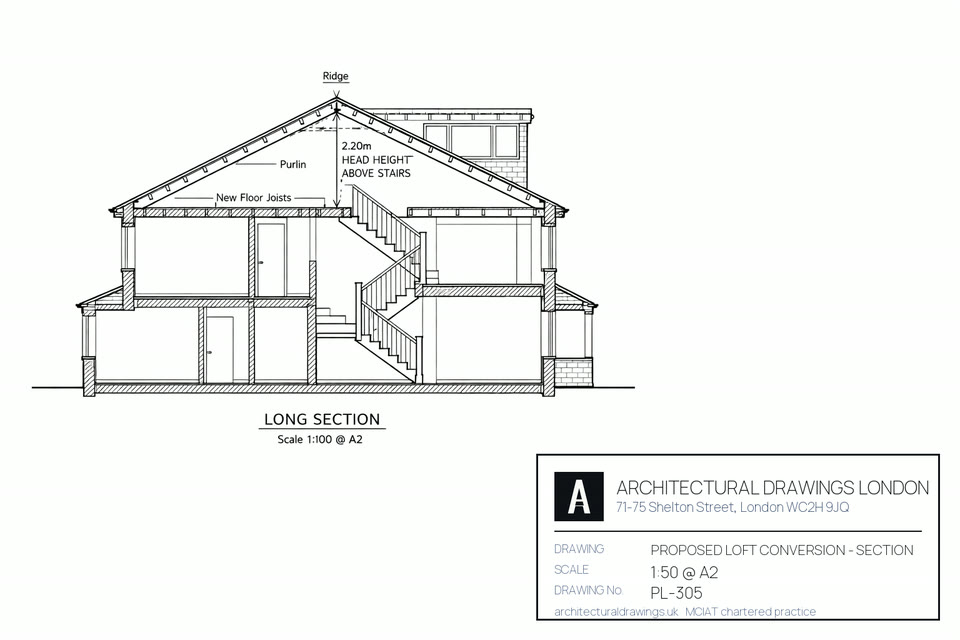
The 2.2 metre rule of thumb, taken from the top of the ceiling joists to the underside of the ridge, rarely applies in Westminster. The Belgravia and Pimlico terraces usually have an attic storey already, and the mansion blocks have no individually owned roof. Where a roof can be altered at all, listed building consent is the governing question — and it reaches the inside of the building as well as the outside.
Do I need a Party Wall Agreement for a loft conversion in Westminster?
Westminster's residential stock is terraced throughout, and roof work on a mid-terrace house is notifiable to owners on both sides. Where the building is listed, the award between neighbours and the heritage consent answer to different regimes, and you need both; securing either one leaves the other's timetable exactly as it was. The Act's two months runs from service, not from consent.
Can I get a mansard loft conversion approved in Westminster?
Each mansard is judged on its own, and on ordinary householder work Westminster grants at almost exactly the London average: 1,077 of 1,294 decisions, 83.2%, against a pooled 83.0% (MHCLG planning statistics, retrieved 1 September 2026). Where the borough parts company is the heritage load. It took 4,689 listed building consent decisions to alter or extend in the period — 37.3% of every such decision made anywhere in London. Streetscene, precedent on your own street and the honesty of the detailing are what an officer weighs on a roof here.