
Planning Drawings · City of London
Planning Permission Drawings in City of London
No hourly billing
3–4 weeks to submission
Covering all City of London postcodes
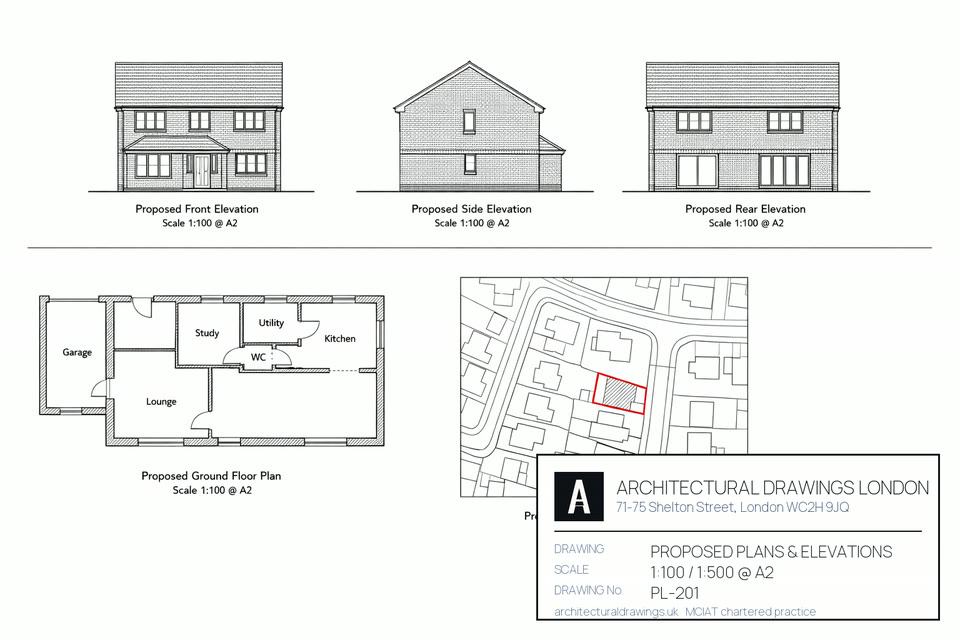
The same scaled set as anywhere — existing and proposed plans, elevations and sections, with a 1:1250 location plan. What differs is the context: the City decided 1,352 applications in twelve quarters and only five were householder, so most schemes are commercial and carry heritage constraints from the outset.
| Measure | City of London | London |
|---|---|---|
| All applications decided | 1,352 | 163,144 |
| Approval rate, all applications | 97.3% | — |
| Householder applications decided | 5 | 77,680 |
| Applications with an agreed extension of time | 76.0% | 34.5% |
| Conservation areas | 28 covering 136 ha | 1,141 |
| Listed buildings in the register | 616 | — |
| Planning drawing package | from £840 | our fixed fee |
Sources: decision figures from MHCLG District Planning Application Statistics (PS1 and PS2), twelve quarters to March 2026; registers from the MHCLG Planning Data Platform, retrieved 1 September 2026; the package fee is our own published fixed fee. No householder approval rate is published for the City and none is quoted here — the statutory return suppresses a rate below thirty decisions.
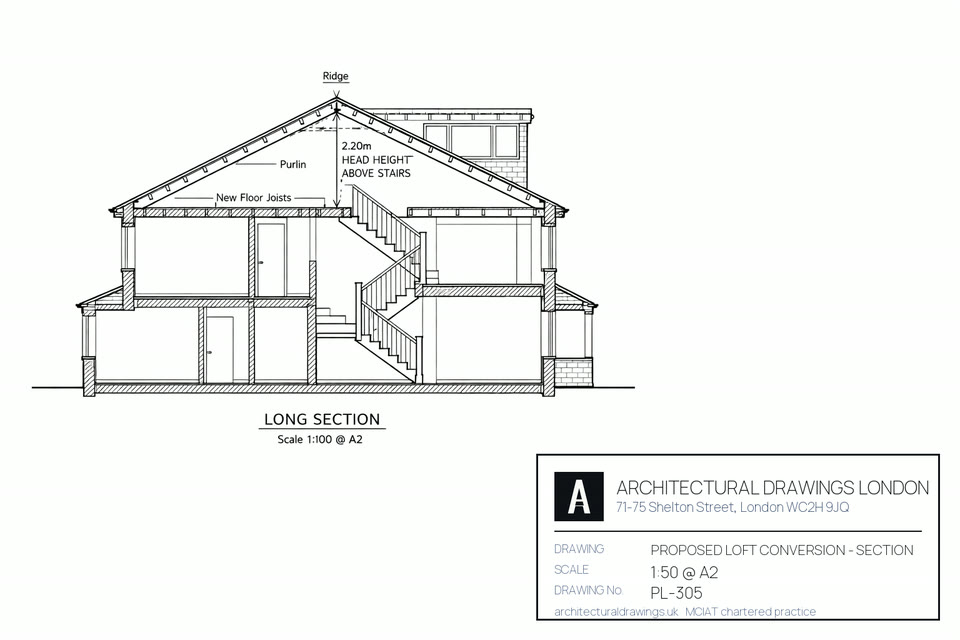
A planning permission drawings package in City of London, where the stock is largely Very limited residential — Barbican Estate (listed post-war), is the full measured-survey-to-submission drawing set City of London Corporation needs in order to determine an application: existing and proposed plans, elevations and sections at 1:100 and 1:50, a location and site plan, and the supporting statements the case officer asks for.
Prepared and reviewed by the architectural technologist team at Architectural Drawings London — CIAT Affiliate, professional indemnity insured.Last reviewed 2026-08-03.
Housing stock in City of London: Very limited residential — Barbican Estate (listed post-war), Golden Lane Estate, modern luxury flats; overwhelmingly commercial.
Character: Overwhelmingly commercial; residential planning extremely constrained; listed building density the highest of any London borough.
Article 4: Several directions run here — office-to-residential conversion, demolition, shopfront alteration — so the Article 4 Directions that bite in the City are commercial ones, not householder ones.
An architectural technologist laser-measures every room on site. Sixty to ninety minutes covers a typical City flat; a maisonette spread over two Barbican levels takes rather longer.
Revit or AutoCAD, plotted at 1:100 where the whole floorplate is needed and 1:50 where the detail is, annotated to the standard the Corporation validates against.
Unlimited revisions until you approve. Shadow studies for committee-sensitive applications.
Site location plan, block plan, Design & Access Statement where required.
We lodge the application with the City of London Corporation and settle the statutory fees on your behalf.
Every officer query, consultation response and amendment handled through to determination.

Single planning or regs submission.
Planning + building regs + structural.
Listed, conservation, complex sites.
Move the controls for an indicative figure. It anchors your budget — it is not a quote. Every project is priced after a site survey.
Build costs are separate and quoted by your contractor. See our published fees.
The EC districts we draw in, what was built in each, and which authority signs off a planning drawing set at that address. Fees shown below are the England statutory rates for 2026, not our drawing fees.
| Postcode | Area | Dominant stock | What it means for a planning drawing set |
|---|---|---|---|
| EC1A | Smithfield | Mostly commercial, residential lofts | Smithfield sits wholly inside EC1A, so City of London Corporation validates every planning drawing set submitted from an EC1A address. |
| EC2Y | Barbican | Listed Brutalist apartments (Barbican Estate) | EC2Y covers Barbican only; City of London Corporation handles the planning drawing set. |
| EC3N | Tower Hill / Aldgate | Very limited residential — Barbican Estate (listed post-war) | Tower Hill / Aldgate sits wholly inside EC3N, so City of London Corporation validates every planning drawing set submitted from an EC3N address. |
| EC4M | St Paul's | Mostly commercial, listed residential | A planning drawing set at an EC4M address in St Paul's is determined by City of London Corporation under its own Local Plan policies for St Paul's. |
| EC4V | Blackfriars | Very limited residential — Barbican Estate (listed post-war) | A planning drawing set at an EC4V address in Blackfriars is determined by City of London Corporation under its own Local Plan policies for Blackfriars. |
| EC4Y | Temple | Very limited residential — Barbican Estate (listed post-war) | Temple sits wholly inside EC4Y, so City of London Corporation validates every planning drawing set submitted from an EC4Y address. |
| EC2A | Shoreditch | Warehouse conversions, modern infill | EC2A straddles the boundary at Shoreditch. Some addresses are validated by Hackney Council and others by the City of London Corporation, so settle which one applies before any EC2A drawing set is submitted. |
Floor-to-floor height, structural grid and party-wall build-up differ block by block across the City, and all three limit what a drawing set is able to propose at a given address.
How designation changes a City of London planning drawing set: City of London Corporation maintains 27 conservation areas, including Smithfield, Fleet Street, Whitefriars. Inside any of them a City of London planning drawing set cannot rely on permitted development, and the route becomes a £548 householder application determined in 8 weeks rather than a £249 prior approval in 6 weeks. Smithfield sets the tone for City of London casework.
Article 4 and your City of London planning drawing set: Multiple Article 4 Directions around office-to-residential, demolition, and shopfront changes. At a EC1A address that matters twice over, because City of London Corporation applies the direction unevenly across City of London — we read the City of London policies map for the exact EC1A address before quoting planning drawings.
City of London housing stock: Very limited residential — Barbican Estate (listed post-war), Golden Lane Estate, modern luxury flats; overwhelmingly commercial. Overwhelmingly commercial; residential planning extremely constrained; one of the two highest listed-building densities in London. Read that before choosing a planning drawing set route in City of London — construction, not postcode, sets what is achievable. City of London Corporation charges £548 for a householder application and has 8 weeks to determine it.
Sources for this City of London planning drawing set page: borough policies maps and conservation-area registers (2025–26), Royal Mail postcode district boundaries, the Town and Country Planning (Fees for Applications) (England) Regulations, the Town and Country Planning (General Permitted Development) (England) Order 2015 as amended, and the Party Wall etc. Act 1996.
Direct answers to what City residents, lessees and freeholders ask us most often about planning drawings.
Start a free quote →Our planning fee is agreed up front and set by the route your address forces. A householder application takes the shortest drawing set; listed building consent, a change of use and a flat conversion each demand a longer set and a thicker file of supporting material. The Corporation charges its own statutory fee on top, set nationally at £548 for a householder application. One number puts the local pattern in perspective: just 55 certificates of lawful development were recorded here over the same three years, which is how rarely City work runs on the permitted-development route at all.
Once validated, the Corporation aims to determine householder cases in 8 weeks and majors in 13, in line with the statutory targets. Treat its published speed figures carefully. The City returned every non-prior-approval householder decision as inside eight weeks in all twelve quarters, with nothing in any slower band at all, which is the signature of a reporting convention, not of a measured spread of decision times. The figure that does carry information is the extension of time: agreed on 1,027 of 1,352 decisions here, 76%, against 34.5% across the 33 boroughs pooled. The City negotiates a longer clock far more often than it beats the short one. Our own instruction-to-submission span is 3-4 weeks.
Yes — City of London has Article 4 Directions in force. Multiple Article 4 Directions around office-to-residential, demolition, and shopfront changes. Article 4 removes specific permitted development rights that would otherwise apply, meaning full planning permission is required where PD would normally be sufficient. We check Article 4 status for your specific property before quoting.
The Corporation has designated 27 conservation areas, Barbican, Smithfield and Fleet Street among them, across a territory of only 314.7 hectares that is 89.7% built up (Ordnance Survey built-up extent). At that density very little escapes a designation, a listing, or the setting of one. An application inside a conservation area needs heritage assessment and, in most cases, a Heritage Statement.
For residential work inside the City, a architectural technologist reaches the same planning outcome as a dedicated consultant, usually for less money. Our CIAT-affiliated team carries the drawings, the submission and the officer liaison as a single package. The casework mix says what the job here actually is. Over three years of MHCLG returns ending in March 2026, the Corporation decided 452 listed building consents to alter or extend, and 5 householder planning applications. Heritage consent, not householder permission, is the route almost every City home has to take.
We cover all City of London postcodes — EC1, EC2, EC3, EC4 — as well as the immediately adjacent boroughs. Survey appointments are available within 3 working days across City of London.
City of London's very limited residential — Barbican Estate (listed post-war) housing stock and 27 conservation areas mean that design quality matters. City of London Corporation officers are experienced reviewers; well-drawn, consistent applications are processed faster than revisions-heavy ones.
Yes. Refusal by the Corporation opens a twelve-week window in which an appeal to the Planning Inspectorate can be lodged as of right. Written representations take 16-20 weeks, a hearing 24-32. Worth weighing before you commit: in the Inspectorate's record of City appeals decided from 2016 onwards, 150 reached a decision, 33 of them allowed and 117 dismissed. About one in five succeeds. Read that as an appeal outcome, not an approval rate — the appellants are that self-selected minority who were refused and decided to press on. Where a refusal turned on design or policy, we draft the appeal statement and redraw the scheme.

If your property sits on a boundary, here are the neighbouring options.
One CIAT-affiliated team, every architectural technology service, inside the Square Mile. The residential brief here is unlike anywhere else in London. There are 8,060 dwellings in the City, and a third of them — 32.9% — went up between 1965 and 1972 (VOA CTSOP4.1, dwelling counts at 31 March 2025). That is the Barbican and Golden Lane generation. Nearly all of it is flats, and a flat carries no householder Permitted Development rights whatsoever.
A construction-ready drawing package compliant with every Approved Document — Part A structure, Part B fire, Part L thermal, Part M accessib...
Every loft type across every City of London roof line — dormer, mansard, hip-to-gable, L-shape, Velux. LDC or full planning route, building ...
The whole spectrum — rear extensions, side returns, wraparounds, double-storey, basement digs. Planning-led design with detailed technical p...
City of London's most space-efficient loft solution when PD-route dormers are blocked. Our team designs mansards that get approved...
Turn your unused City of London garage into a bedroom, home office or open-plan kitchen-diner. Planning route assessment, full building regu...
Full architectural technology service for basement digs and cellar conversions in City of London — structural underpinning design, waterproo...
Chartered structural engineer calculations for every residential intervention in City of London — steel beams, lintels, pad foundations, wal...
Measured surveys across City of London — floor plans, elevations and sections to ±3mm accuracy. Leica Disto laser + BLK360 point-cloud scann...
End-to-end Party Wall Act 1996 service for City of London — Section 1, 3 and 6 notices, schedule of condition surveys, party wall award coor...
London's most popular loft type — the full-width rear dormer. Planning or Permitted Development route assessed for your City of London prope...
Leave your number and an Architectural technologist will call you back within 30 minutes during working hours.
No obligation. No sales pressure. Just expert advice about planning permission drawings in City of London.
Free quote in 60 seconds. No hourly billing. CIAT Affiliate.
Get my free quote →
