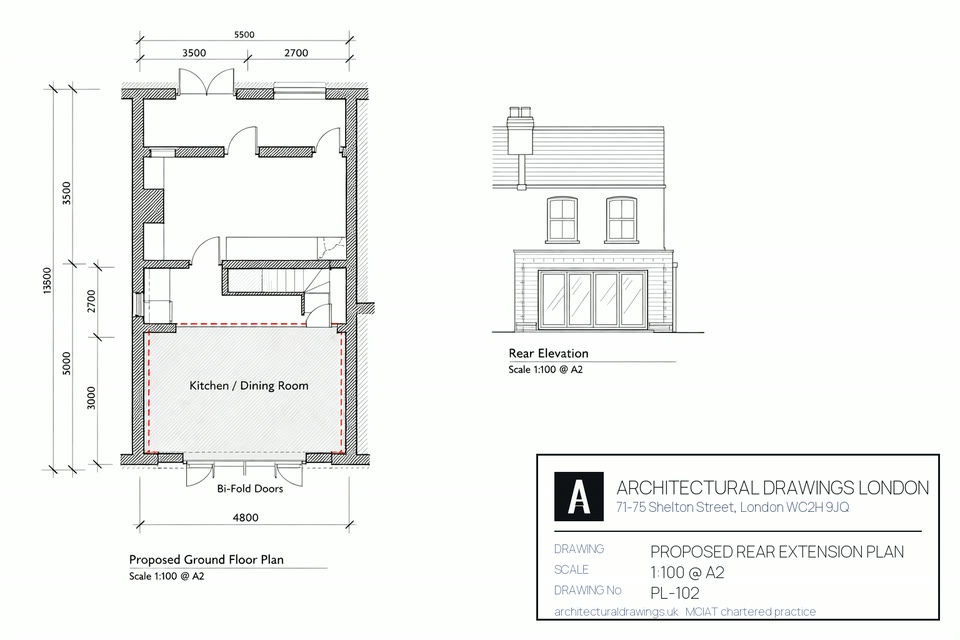
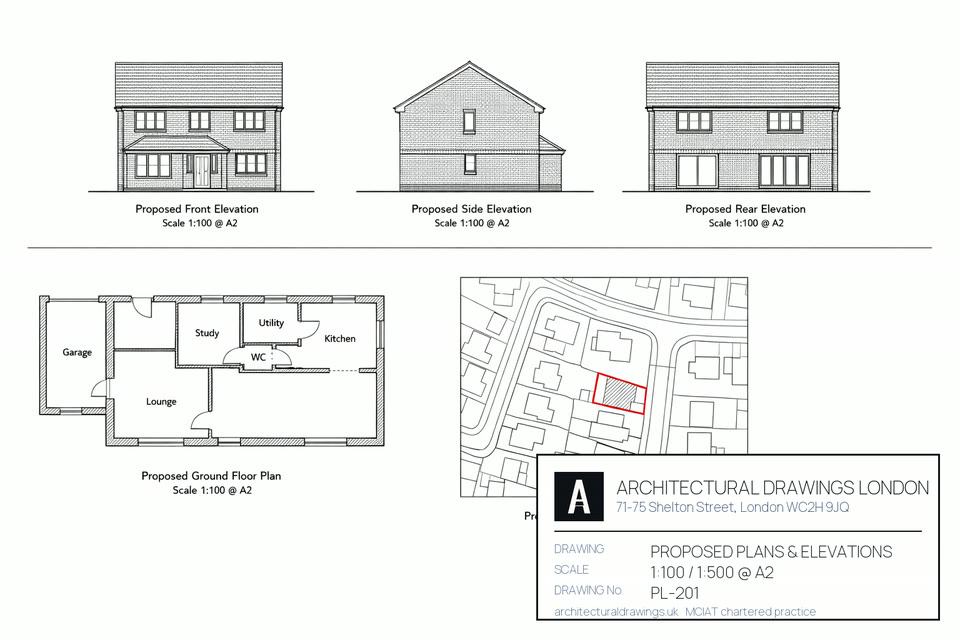
The whole spectrum — rear extensions, side returns, wraparounds, double-storey, basement digs. Planning-led design with detailed technical phase, ideal for large 1930s detached and semi-detached in Chislehurst and Bickley typical of Bromley.
More than any other London borough, if the extension qualifies as permitted development in the first place. Of the 377 larger rear extensions notified to Bromley under the prior approval procedure in the twelve quarters to March 2026, 320 were returned as prior approval not required. At 84.9% that is the highest of the 27 boroughs whose caseload is large enough to measure, against 61.9% for London pooled, and only 37 were refused. Push past the permitted-development limits and the picture inverts: Bromley granted 79.8% of its 4,706 householder applications, below London's 83.0%, and only 72.7% of its minor applications were decided inside the statutory period.
| Measure | Bromley | London |
|---|---|---|
| Larger rear extensions notified under prior approval | 377 | 14,643 |
| … returned as prior approval not required | 84.9% — highest of the 27 measurable boroughs | 61.9% |
| … refused | 9.8% | 24.9% |
| Householder decisions made | 4,706 | 77,680 |
| Householder approval rate | 79.8% | 83.0% |
| Householder decisions taking more than thirteen weeks | 185 of 3,628, or 5.1% | — |
| Minor applications decided in the statutory period | 72.7% | 84.4% |
| Householder appeals allowed by an inspector | 41.2% of 1,113 | 35.6% across England |
| Lawful development certificates recorded | 1,675 | 36,657 |
| Conservation areas | 69 covering 1,302 ha | 1,141 across London |
Sources: rows one, two, three and five from MHCLG District Planning Application Statistics (PS1 and PS2), twelve quarters to March 2026. Row four from the Planning London Datahub, retrieved 15 August 2026 — phrase-matched descriptions, comparable within Bromley only. Row six from planning.data.gov.uk, retrieved 1 September 2026. Most Bromley larger-extension notifications are simply waved through as ‘not required’, which is the cheapest route to a 6m rear extension anywhere in the borough outside a conservation area.
In Bromley — Large 1930s detached and semi-detached in Chislehurst and Bickley; Edwardian in Beckenham; Victorian in Bromley town; Metropolitan Green Belt covers significant rural-fringe land for the most part — a house extension drawings package is the full measured-survey-to-submission drawing set London Borough of Bromley needs in order to determine an application: existing and proposed plans, elevations and sections at 1:100 and 1:50, a location and site plan, and the supporting statements the case officer asks for.
Prepared and reviewed by the architectural technologist team at Architectural Drawings London — CIAT Affiliate, professional indemnity insured.Last reviewed 2026-08-03.


The whole spectrum — rear extensions, side returns, wraparounds, double-storey, basement digs. Planning-led design with detailed technical phase, ideal for large 1930s detached and semi-detached in Chislehurst and Bickley typical of Bromley.
Housing stock in Bromley: Large 1930s detached and semi-detached in Chislehurst and Bickley; Edwardian in Beckenham; Victorian in Bromley town; Metropolitan Green Belt covers significant rural-fringe land.
Character: Largest London borough by area; substantial Green Belt; conservation areas in most town centres; generally permissive elsewhere.
Every quote begins with a measured survey and a photographic record, plus an Article 4 and conservation check read off the borough policies map. The difference between a certified extension and a refused one is usually settled before any design work starts.
You see 2 or 3 worked concept options before anything is fixed: different internal layouts, different glazing strategies, and roof forms priced against what a local builder will actually quote.
A submission set built to validate first time — site location plan, existing and proposed floor plans, elevations, sections through the new build-up, and a design and access statement wherever Bromley Council asks for one.
Steel beam, foundation, lintel design. Chartered engineer sign-off.
Party wall notices served wherever the extension works against a shared boundary, and a Thames Water build over agreement prepared wherever foundations fall within 3m of a public sewer. On the borough's terraced and semi-detached stock both come up regularly.

Single planning or regs submission.
Planning + building regs + structural.
Listed, conservation, complex sites.
Move the controls for an indicative figure. It anchors your budget — it is not a quote. Every project is priced after a site survey.
Build costs are separate and quoted by your contractor. See our published fees.
The borough runs from Beckenham out to Biggin Hill, and its postcodes do not behave alike: BR1, BR3 and BR5 sit wholly inside it, while SE20 and SE26 do not. Each row shows the dominant stock and who validates an extension there. Fee columns show the England-wide 2026 statutory charge, not a build estimate.
| Postcode | Area | Dominant stock | What it means for a house extension |
|---|---|---|---|
| SE26 | Sydenham | Victorian villas, Edwardian terraces | SE26 runs across the Lewisham boundary at Sydenham, so an extension here may be validated by either council. The dividing line follows individual streets, and the SE26 policies map is what settles it. |
| SE20 | Anerley / Penge | Victorian and Edwardian terraces | SE20 covers Anerley and Penge across a borough line, some addresses answering to Bromley and others to Croydon. Confirm the authority before the drawings are packaged, because the two validation lists differ. |
| BR1 | Bromley / Bickley | Victorian terraces, Edwardian villas, post-war flats | BR1 covers Bromley town centre and Bickley in full, so this council validates and determines every extension at a BR1 address, applying the Local Plan policies drafted for that part of the borough. |
| BR2 | Hayes / Keston | Victorian terraces, Edwardian villas, post-war flats | BR2 covers Hayes / Keston only; Bromley Council handles the house extension. |
| BR3 | Beckenham | Edwardian villas, 1930s semi-detached | Beckenham sits inside BR3 with no boundary complication at all: one authority, one validation list, one set of Local Plan policies to design against. |
| BR4 | West Wickham | 1930s semi-detached | A house extension at an BR4 address in West Wickham is determined by Bromley Council under its own Local Plan policies for West Wickham. |
| BR5 | Orpington / Petts Wood | 1930s semi-detached | Orpington and Petts Wood share BR5, entirely within the borough, so Bromley Council is the deciding authority for any extension at a BR5 address. |
| BR6 | Orpington | 1930s semi-detached | BR6 covers Orpington only; Bromley Council handles the house extension. |
Bromley is the largest London borough by area and only 49.3% of it is built up, against 66.0% for London as a whole. Plot depth is rarely the binding constraint here. Designation and Green Belt usually are.
It stops very little that is genuinely permitted development, and a fair amount that is not. The council refuses under one larger-extension notification in ten. But once a scheme needs a householder application — because it exceeds the depth or height limits, or because the house sits inside one of the 69 conservation areas, or because it is a flat — Bromley is a below-average grantor at 79.8% and a slow one. Its own return shows 185 householder decisions taking longer than thirteen weeks, and 67 of those longer than six months.
Inspectors overturn Bromley more often than they overturn most councils. Of the 1,113 householder appeals decided from Bromley refusals between July 2016 and June 2026, 459 were allowed — 41.2%, against 35.6% for England and a 39.8% median across the London boroughs. That is not an approval rate, and it should not be read as one: only refused applicants appeal, and the great majority never do. What it does say is that a Bromley refusal is worth a second opinion before it is treated as final.
The fabric works in your favour. A quarter of Bromley's 143,430 dwellings — 25.7% — were built between 1930 and 1939, against 16.0% across London, and a further 26.7% between 1945 and 1972. Interwar and post-war semis on wide plots are the easiest stock in London to extend without touching the planning system at all, which is the practical explanation for that 84.9% figure. Only 12.1% of the borough predates 1900, and it is that minority, concentrated in the town centres and Chislehurst, where the designations sit.
Sharply different, and in Bromley's favour on the prior approval route. The four neighbouring authorities include two of the three toughest larger-extension councils in London.
Sources for this Bromley house extension page: borough policies maps and conservation-area registers (2025–26), Royal Mail postcode district boundaries, the Town and Country Planning (Fees for Applications) (England) Regulations, the Town and Country Planning (General Permitted Development) (England) Order 2015 as amended, and the Party Wall etc. Act 1996.
Refusal here is recoverable, but it is a long detour. The Planning Inspectorate has decided 1,184 householder appeals from Bromley: 478 allowed, 689 dismissed, 17 split — a 40.4% success rate against 39.0% for London, near enough identical. Read it correctly, though. Those 1,184 cases were brought by owners already holding a refusal, not a sample of extensions in general, and 40.4% allowed on appeal is nothing like an approval rate. The number that should shape your design is this council's own householder refusal rate of 20.2% — and the 34.2% it refuses on minor schemes, roughly one in three, is why anything beyond a straightforward householder extension needs more care rather than less.
Half of those appeals took longer than 69 days to decide from the day they were lodged, time added to the 8 weeks already spent with the council. Every single one — 100.0% — was determined on paper: no hearing, no inquiry, nobody in a room. In other words the drawings and the written case were all the evidence there was; nobody stood up to explain them. 12.8% involved the setting of a listed building. The practical lesson is that the drawings must carry the argument unaided, first time.
Every appeal figure on this page comes from the 1,184 householder cases this borough has generated in the Planning Inspectorate's published casework, published as Open Government Licence v3.0 material.
What Bromley owners ask before they instruct anyone — refusal risk, permitted development limits, party walls, and what this council will and will not accept — answered without hedging.
Start a free quote →Most straightforward extensions here need no permission at all: a single-storey rear extension held to 3m or 4m, a side extension at no more than half the width of the house, all under the national order. Flats, listed buildings and conservation areas are the exceptions, and there full planning permission is the only way through. We confirm which category applies at the site survey, and certify the position if you want it on record.
Under the national order a single-storey rear extension on an attached house here may project 3m, and 4m on a detached one, with 6m and 8m reachable through the larger householder prior approval route. The council determined 377 of those prior approvals between April 2023 and March 2026, refusing just 37, so the route is worth using. Flats, listed buildings and Article 4 land fall outside the right entirely.
Two separate costs sit behind an extension here. Ours is a fixed design fee covering planning, building regulations and structural calculations in one package. The other is the build, priced by contractors per square metre and driven by access, ground conditions and specification — a side return infill lands well below a two-storey rear on that measure. The Land Registry's price paid file puts the 2025 Bromley median at £525,000 over 4,410 sales, so most owners are extending into a market that carries the work. Contains HM Land Registry data (c) Crown copyright and database right 2026
There is no Bromley-specific basements policy, so a basement conversion is assessed under the national framework on structure, drainage and flood risk rather than against a local SPD. Flood zoning rarely decides it here: Environment Agency mapping places 1.71% of borough land in Flood Zone 3, which means a Flood Risk Assessment is only occasionally the document that settles an application. Foundations coming within 3m of a public sewer need a build over agreement from Thames Water on top of all that.
Both, usually. On a Victorian terrace around Bromley Town a side return infill claims the dead side passage to widen the kitchen; a rear extension trades garden for floor area. A wraparound does both, and per square metre it is usually the better buy. Which one we recommend comes out of the free site visit, not off a list.
Bromley's large 1930s detached and semi-detached in Chislehurst and Bickley terraced and semi-detached stock typically suits rear single-storey extensions (kitchen-diners), side-return infill extensions, or double-storey rear. Wraparound extensions combine both directions for maximum gain. We recommend the most viable option at the free site visit.
We cover all Bromley postcodes — BR1, BR2, BR3, BR4, BR5, BR6, BR7, BR8, SE6, SE9, SE12, SE20, SE26 — with local surveyors. Survey appointments within 3 working days.
Decisions are taken against the London Plan and the council's own Local Plan, and the recurring tests are material match, neighbour amenity and Part L. Between April 2023 and March 2026 Bromley granted 5,111 of 6,712 applications — 76.1%, against 81.0% pooled across the 33 boroughs — so a scheme that ignores those tests fails here more often than the London average would lead you to expect. Where the planning history is tangled we include a pre-application advice summary. Source: MHCLG live planning statistics.

If your property sits on a boundary, here are the neighbouring options.
Survey, planning drawings, building regulations and structural calculations for a Bromley address all come out of one CIAT-affiliated practice, so nothing is handed between consultants halfway through the job.
A construction-ready drawing package compliant with every Approved Document — Part A structure, Part B fire, Part L thermal, Part M accessib...
Every loft type across every Bromley roof line — dormer, mansard, hip-to-gable, L-shape, Velux. LDC or full planning route, building regulat...
Bromley's most space-efficient loft solution when PD-route dormers are blocked. Our team designs mansards that get approved in Bro...
Turn your unused Bromley garage into a bedroom, home office or open-plan kitchen-diner. Planning route assessment, full building regulations...
Full architectural technology service for basement digs and cellar conversions in Bromley — structural underpinning design, waterproofing st...
Chartered structural engineer calculations for every residential intervention in Bromley — steel beams, lintels, pad foundations, wall remov...
Measured surveys across Bromley — floor plans, elevations and sections to ±3mm accuracy. Leica Disto laser + BLK360 point-cloud scanning, Au...
End-to-end Party Wall Act 1996 service for Bromley — Section 1, 3 and 6 notices, schedule of condition surveys, party wall award coordinatio...
London's most popular loft type — the full-width rear dormer. Planning or Permitted Development route assessed for your Bromley property, bu...
Leave your number and an Architectural technologist will call you back within 30 minutes during working hours.
No obligation. No sales pressure. Just expert advice about house extension drawings in Bromley.
Free quote in 60 seconds. No hourly billing. CIAT Affiliate.
Get my free quote →