Key facts at a glance
- Most house loft conversions in London qualify under Permitted Development
- Volume limit: 40m³ (terraced/semi) or 50m³ (detached)
- Lawful Development Certificate (LDC) costs £274 and is strongly recommended
- Building regulations approval is always required, even without planning permission
- Flats, conservation areas, and Article 4 properties may need full planning
Can you convert a loft without planning permission?
Usually yes, under Class B: 40 cubic metres of added roof volume on a terrace, 50 on a semi or detached house, nothing beyond the front roof plane and nothing above the ridge. Not inside a conservation area, and not on a flat.
| Class B condition | Terrace | Semi or detached |
|---|---|---|
| Added roof volume | 40 m³ | 50 m³ |
| Beyond the front roof plane | not permitted | not permitted |
| Above the highest part of the roof | not permitted | not permitted |
| Set back from the eaves | at least 200mm | at least 200mm |
| Side-facing windows | obscure-glazed, fixed below 1.7m | obscure-glazed, fixed below 1.7m |
| Inside a conservation area | not permitted development | not permitted development |
| On a flat or maisonette | no Part 1 rights at all | no Part 1 rights at all |
Source: Town and Country Planning (General Permitted Development) (England) Order 2015, Schedule 2, Part 1, Class B, as amended, read at 1 September 2026. The allowance is cumulative and measured against the roof as originally built or as it stood on 1 July 1948. A lawful development certificate at £274 is the document that proves the conversion was permitted development, and it is what a buyer’s solicitor will ask for.
So can you, or not?
If you own a house in London and want to convert your loft, the odds are in your favour. The majority of loft conversions on houses -- whether terraced, semi-detached, or detached -- fall under Permitted Development (PD) rights and do not require planning permission. This is because the government has specifically carved out loft conversions as a class of development that homeowners can carry out without needing to apply to their local planning authority, provided certain conditions and limits are met.
However, London is not like the rest of England. The capital has more conservation areas, more Article 4 Directions, and more planning restrictions per square mile than any other part of the country. What qualifies as Permitted Development in a suburb of Manchester might require a full planning application in a street in Camden or Kensington. This guide explains exactly when you can convert your loft without planning permission in London, when you cannot, and what you need to do either way.
It is critical to understand one thing from the outset: even when planning permission is not required, building regulations approval is always required for a loft conversion. Planning and building regulations are two entirely separate systems. Planning deals with whether you can alter the appearance and volume of your property. Building regulations deal with how the work is constructed -- the structural calculations, fire safety, insulation, staircase design, and everything else that makes the loft safe to inhabit.
Which permitted development rules apply to a loft?
Loft conversions fall under Class B of Part 1 of the General Permitted Development Order (GPDO) 2015, as amended. This class grants automatic planning permission for the enlargement of a dwellinghouse consisting of an addition or alteration to its roof, subject to a detailed set of conditions and limitations.
Here are the key rules that your loft conversion must satisfy to qualify as Permitted Development:
Volume limits
This is the single most important rule. The total volume of the roof extension (measured externally) must not exceed:
- 40 cubic metres for terraced houses (including end-of-terrace) and semi-detached houses
- 50 cubic metres for detached houses
The volume is calculated as the addition to the existing roof space above the plane of the existing roof slope. It includes the dormer itself -- walls, roof, and all. Critically, this is a cumulative allowance. If a previous owner added a 15 cubic metre rear dormer, and you are on a terraced house with a 40 cubic metre limit, you only have 25 cubic metres remaining. Any previous roof extensions, including those carried out by former owners, count towards the total.
If the total volume exceeds these limits by even a fraction, the entire development loses its Permitted Development status and you need full planning permission.
Materials must match
The materials used on the exterior of the loft conversion must be similar in appearance to the existing house. This means matching the roof tiles or slates, matching the cladding (if any), and using window frames that are consistent with the rest of the property. In practice, this is rarely a problem -- most loft conversions use matching materials as a matter of course -- but the council can take enforcement action if the materials are conspicuously different.
The 20-centimetre eaves setback
The side elevation of any dormer window must be set back at least 20 centimetres from the eaves of the original roof. This rule exists to prevent dormers from appearing to extend the full width of the roof, which would be visually dominant and out of character with most streetscapes. The 20cm setback creates a visual step that softens the appearance of the dormer.
This measurement is taken from the outer face of the original external wall at eaves level. It applies to both side and rear dormers.
No extension beyond the existing roof plane facing the highway
This is one of the most commonly misunderstood PD rules. No part of the loft conversion can extend beyond the plane of the existing roof slope that faces the highway. In plain English: you cannot have a front-facing dormer under Permitted Development.
The "highway" includes any road, path, or public right of way. For a mid-terrace house on a typical London street, the front of the house faces the highway. This means your dormer must be at the rear. For a corner plot, both the front and the side facing the street are considered to face the highway, which can severely limit your options.
No higher than the highest point of the existing roof
The loft conversion cannot raise the ridge height of the roof. The highest point of the extension must not exceed the highest point of the existing roof. This rules out most mansard-style conversions under PD, as mansards typically raise the roof line or replace the entire roof structure with a new, taller profile.
No balconies, verandas, or raised platforms
You cannot include a balcony, veranda, or raised platform as part of a Permitted Development loft conversion. Juliet balconies (floor-to-ceiling windows with a safety railing but no usable external floor) are permitted, as they are classified as windows, not balconies.
Side-facing windows must be obscure-glazed and non-opening (or high-level)
Any window in a side elevation of the loft conversion that overlooks neighbouring properties must be obscure-glazed and either non-opening or opening only at a point more than 1.7 metres above the floor of the room. This protects neighbours' privacy. Rear-facing windows are not subject to this restriction.
Flat roof rear dormer: the London standard
The most common type of loft conversion in London is the flat roof rear dormer. This is a box-shaped extension that projects from the rear roof slope, with a flat (or very slightly pitched) roof covered in GRP fibreglass, lead, or zinc. It maximises internal headroom and floor area within the Permitted Development volume limits.
A well-designed flat roof rear dormer typically provides:
- A new double bedroom (or two bedrooms on a wider property)
- An en-suite bathroom or shower room
- A staircase from the floor below (usually positioned above the existing staircase)
- Generous headroom of 2.3 to 2.4 metres across most of the new floor
Flat roof dormers are not architecturally glamorous, but they are extremely practical and cost-effective. They are the default solution for London's Victorian and Edwardian terraces, where the rear roof slope provides the only viable expansion space and the volume limits constrain the height and depth of the extension.
For design options beyond a standard rear dormer -- including L-shaped dormers, wrap-around dormers, and hip-to-gable conversions -- see our dedicated loft conversion drawings page.
The Lawful Development Certificate (LDC) process
Even when your loft conversion qualifies as Permitted Development, we strongly recommend applying for a Lawful Development Certificate (LDC). An LDC is a formal legal document from your borough council confirming that your proposed development is lawful and does not require planning permission.
Why get an LDC?
- Proof for resale. When you sell the property, the buyer's solicitor will ask for evidence that any loft conversion was carried out lawfully. Without an LDC, you may need to obtain indemnity insurance or face delays in the sale. An LDC provides clean, unambiguous proof.
- Mortgage lender requirements. Many mortgage lenders require evidence that alterations were either approved by the council or confirmed as lawful. An LDC satisfies this requirement.
- Protection against enforcement. If a neighbour complains to the council about your loft conversion, and the council investigates, an LDC provides a defence. Without one, you would need to demonstrate that the work met all PD conditions -- which can be difficult after the fact, especially if the original roof no longer exists for measurement.
- Peace of mind. An LDC confirms that a qualified council officer has reviewed your drawings and assessed them against the PD rules. If you have misjudged any of the conditions (volume, setback, materials), the council will tell you before you start building, not after.
How the LDC application works
- We prepare your drawings. The LDC application requires scaled drawings showing the existing property and the proposed loft conversion, with dimensions, materials annotations, and volume calculations. These are the same quality of drawings you would need for a full planning application.
- We submit to your borough council. The application is submitted online through the Planning Portal with the £274 fee (2026 rate for a proposed LDC).
- The council assesses the application. The statutory determination period is 8 weeks. The council checks whether the proposal meets all PD conditions. There is no neighbour notification -- the LDC process is a legal assessment, not a planning judgement.
- Decision. The council either issues the LDC (confirming the development is lawful) or refuses it (meaning the development does not qualify as PD and you need full planning permission). If refused, the decision letter will explain which PD condition is not met.
LDC costs at a glance
At Architectural Drawings London, we include the LDC application as part of our loft conversion drawing service. We prepare the drawings, calculate the volume, check Article 4 and conservation area status, and submit the application on your behalf.
When does permitted development not apply?
There are several situations where Permitted Development rights for loft conversions are restricted or entirely removed. If any of the following applies to your property, you will need full planning permission.
Flats and maisonettes
Permitted Development rights under Class B apply only to dwellinghouses. If your property is a flat or maisonette, you have no PD rights for roof extensions. This applies even if you own the top-floor flat and have access to the roof space. Converting a flat's loft space into habitable accommodation always requires a planning application.
Conservation areas
If your property is in a conservation area, your PD rights for loft conversions are restricted. Specifically, you cannot add a dormer window or roof extension that faces a highway. For a property where the rear roof slope does not face any highway, a rear dormer may still be Permitted Development -- but the rules are tighter and the interpretation can vary between boroughs.
London has over 1,000 conservation areas. Some boroughs -- Richmond upon Thames, Westminster, Camden, Kensington & Chelsea -- have conservation area coverage exceeding 70% of their land area. If you are unsure whether your property is in a conservation area, your borough council's planning department can confirm, or you can check the interactive mapping on your borough's website.
Article 4 Directions
An Article 4 Direction is a legal order that removes specific Permitted Development rights from an area. Many London boroughs have Article 4 Directions in conservation areas that specifically remove PD rights for roof alterations. If your property is subject to an Article 4 Direction covering Class B (roof extensions), you need full planning permission for any loft conversion, regardless of its size or position.
Boroughs with extensive Article 4 coverage affecting loft conversions include Camden, Westminster, Islington, Richmond upon Thames, Kensington & Chelsea, and Hackney. We check Article 4 status as one of the first steps on every loft conversion project.
Listed buildings
If your property is a listed building (Grade I, II*, or II), any work that affects its character as a building of special architectural or historic interest requires Listed Building Consent (LBC) in addition to any planning permission. This applies to both internal and external alterations. A loft conversion on a listed building virtually always needs both LBC and full planning permission.
Mansard roof conversions
A mansard roof conversion replaces the existing roof structure with a new, steeper-sided profile that creates a full additional storey. Because a mansard alters the shape and height of the roof fundamentally, it does not fall within the PD rules. Mansard loft conversions in London always require full planning permission.
Mansards are extremely popular in London -- they provide significantly more internal space than a rear dormer -- but the planning requirement adds time and cost to the project. Our mansard roof service covers the full planning application process.
Previous roof extensions
If your property has already had a roof extension (whether by you or a previous owner), this counts towards the cumulative volume limit. If the previous extension used up the entire allowance, you have no remaining PD entitlement and any further roof work needs planning permission. This is a common issue on properties that were already converted once -- the original dormer may have consumed the full 40 or 50 cubic metre allowance.
Properties created by subdivision
If your property was originally part of a larger building (for example, a house that has been converted into flats), PD rights may have been removed by a condition on the original planning permission. Many conversion permissions include a condition removing PD rights to prevent further alterations that could affect the character or amenity of the building. Check the planning history for your property.
Do building regulations still apply?
Even when planning permission is not needed, building regulations approval is mandatory for every loft conversion. Building regulations ensure that the construction is safe, structurally sound, energy efficient, and provides adequate fire escape routes. You cannot legally occupy a loft conversion without building regulations sign-off.
Key building regulations requirements for loft conversions
- Part A -- Structure. The existing floor joists almost certainly need strengthening or replacing to support the load of a habitable room. Steel beams (RSJs) are typically required to form the structural opening for the staircase and to support the new floor and any dormer structure. Structural calculations must be prepared by a structural engineer.
- Part B -- Fire safety. This is often the most complex aspect. All loft conversions in houses of two or more storeys (before the conversion) must provide a protected escape route from the new loft room to the final exit (front door). This typically means enclosing the staircase at all levels with fire-resistant construction and fitting FD30 fire doors to all habitable rooms opening onto the staircase. Interlinked smoke and heat alarms are required on every level.
- Part E -- Sound insulation. If the loft conversion creates a room that is separated from another dwelling (e.g. in a semi-detached or terraced house), the party wall and floor must meet minimum sound insulation standards.
- Part K -- Stairs. The new staircase must comply with regulations on pitch (maximum 42 degrees), minimum headroom (2 metres), width (minimum 600mm for a loft staircase, though 800mm+ is preferred), and the provision of handrails and guarding. The staircase design is one of the most challenging aspects of a loft conversion, particularly in narrow terraced houses where space is limited.
- Part L -- Energy efficiency. The roof, walls, and floor of the loft conversion must meet current Part L insulation standards. This typically means 270mm+ of mineral wool or equivalent between and over the rafters. Windows must achieve a minimum U-value of 1.4 W/m²K. A SAP calculation may be required.
- Part P -- Electrical safety. Any new electrical installations in the loft must be carried out or certified by a Part P registered electrician.
Building control sign-off
Building regulations approval can be obtained through either your local authority building control (LABC) service or a private Approved Inspector. The building control officer will inspect the work at key stages (foundation/steel installation, pre-plaster, and completion) and issue a completion certificate when the work is finished and compliant. This certificate is essential for resale and insurance purposes.
At Architectural Drawings London, our loft conversion packages include full building regulations drawings -- plans, sections, and construction details that your builder and building control officer need.
What drawings do you need for a loft conversion?
Whether you are going through the PD/LDC route or applying for full planning permission, you will need professional architectural drawings. The scope depends on which permissions are required.
For a Permitted Development loft conversion (with LDC)
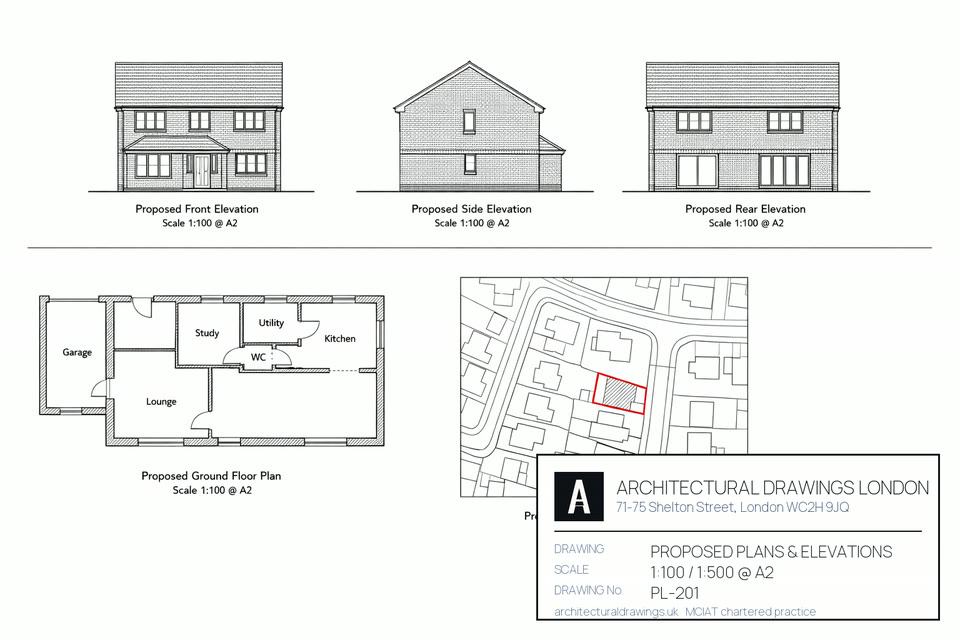
- Site location plan (1:1250) -- showing the property in context
- Block plan (1:200 or 1:500) -- showing the property boundaries
- Existing floor plans (1:50) -- all floors of the existing house
- Proposed floor plans (1:50) -- including the new loft floor layout
- Existing and proposed elevations (1:50) -- all elevations showing the dormer
- Existing and proposed roof plans (1:50)
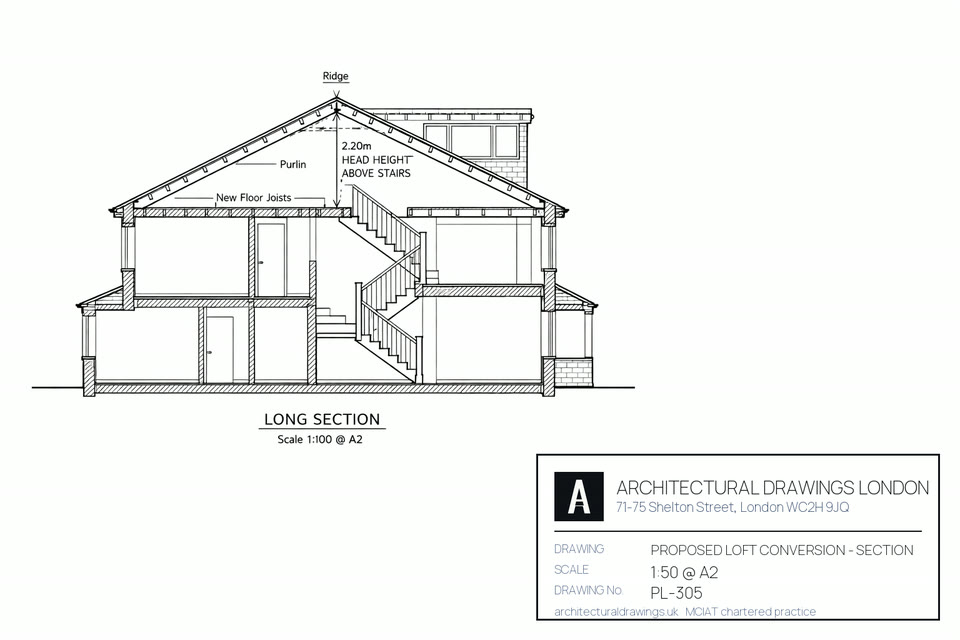
- Existing and proposed sections (1:50) -- showing the internal arrangement, staircase, headroom, and dormer structure
- Volume calculation -- demonstrating compliance with the 40/50m³ limit
For building regulations
- Structural layout plan -- showing steel beam positions, padstones, and load paths
- Construction section details (1:5 or 1:10) -- dormer wall build-up, insulation specification, roof construction
- Staircase design -- plan, section, headroom dimensions, tread/riser calculations
- Fire strategy plan -- escape routes, fire door positions, alarm locations
- Structural engineer's calculations (prepared by our partner structural engineers)
Loft conversion drawing packages
Get a free loft conversion quote →
What does it cost, and how long does it take?
The total cost of a loft conversion in London depends on the type of conversion, the size of the property, and the level of specification. Here is a realistic breakdown for 2026.
| Cost element | Typical range |
|---|---|
| Architectural drawings + building regs | |
| Structural engineer's calculations | £500 – £1,000 |
| Council LDC fee | £274 |
| Building control fees (LABC or Approved Inspector) | £500 – £900 |
| Construction (rear dormer, terraced house) | £45,000 – £65,000 |
| Construction (mansard, terraced house) | £65,000 – £90,000 |
| Total (PD rear dormer) | £47,000 – £70,000 |
Timeline
Typical PD loft conversion timeline
If full planning permission is required (for a mansard or because PD is unavailable), add approximately 10 weeks to the pre-construction phase for the planning application and determination. See our complete planning permission guide for the full process.
Step-by-step: how to convert your loft under PD
- Check your PD eligibility. Confirm your property is a house (not a flat), is not listed, and check conservation area and Article 4 status with your borough council. Check for any previous roof extensions that count towards the volume limit.
- Instruct an architectural technologist. Get a quote from us. We carry out a site survey, assess PD eligibility, and prepare the full drawing package.
- Design the loft conversion. We prepare existing and proposed plans, elevations, sections, and roof plans showing the dormer design, room layout, staircase position, and materials.
- Apply for a Lawful Development Certificate. We submit the LDC application with the £274 fee and full drawing set. The council has 8 weeks to determine.
- Prepare building regulations drawings. In parallel with the LDC, we prepare the building regulations package -- structural layout, construction details, fire strategy, staircase design.
- Appoint a builder and structural engineer. Get competitive quotes from experienced loft conversion builders. We can recommend builders we have worked with across London.
- Start on site. Once the LDC is issued and building control has approved the drawings, construction can begin. A typical rear dormer takes 8-12 weeks on site.
- Building control sign-off. The building control officer inspects at key stages and issues a completion certificate when the work is finished.
Frequently asked questions
Can I convert my loft without planning permission in London?
Yes, most loft conversions on houses in London fall under Permitted Development rights and do not require planning permission. The property must not be a flat, must not be a listed building, and must not be in a conservation area with an Article 4 Direction removing PD rights for roof extensions. The volume of the roof extension must not exceed 40 cubic metres (terraced/semi-detached) or 50 cubic metres (detached). Even when PD applies, we recommend obtaining a Lawful Development Certificate for £274. See our loft conversion service.
What is the volume limit for a permitted development loft conversion?
Terraced and semi-detached houses have a 40 cubic metre volume allowance. Detached houses have a 50 cubic metre allowance. This volume is measured as the total addition above the existing roof plane, including the dormer structure. Any previous roof extensions by you or former owners count towards this limit. If the volume exceeds these limits, full planning permission is required.
Do I need building regulations for a loft conversion even without planning permission?
Yes, absolutely. Building regulations approval is always required for a loft conversion, regardless of whether planning permission is needed. Building regulations cover structural safety, fire safety (protected escape routes, fire doors, smoke alarms), insulation and energy efficiency, staircase design, sound insulation, and electrical safety. You cannot legally occupy a loft conversion without a building regulations completion certificate. See our building regulations service.
What is a Lawful Development Certificate and do I need one for my loft?
A Lawful Development Certificate (LDC) is a formal document from your council confirming that your proposed loft conversion is lawful under Permitted Development. It costs £274 for a proposed development and takes approximately 8 weeks. While not legally required before starting work, an LDC is strongly recommended because buyers' solicitors and mortgage lenders will want proof that the conversion was done lawfully when you sell the property.
Can I do a loft conversion in a conservation area without planning permission?
It depends. In a conservation area, you cannot add a dormer or roof extension that faces a highway (a street or public path). A rear dormer that is not visible from any highway may still qualify as Permitted Development, but the rules are strict and interpretation varies by borough. Many conservation areas also have Article 4 Directions that remove additional PD rights. We always check conservation area and Article 4 status as part of our initial assessment. Read our conservation area guide.