Key takeaways
- You do not legally need a RIBA architect — an MCIAT chartered technologist can handle most residential projects
- Always verify ARB or CIAT registration and Professional Indemnity Insurance
- Ask for references and examples of projects in your London borough
- Get a written scope of work before paying anything
- Borough-specific planning experience is more important than awards
What should you actually check before hiring?
Chartered status, indemnity cover and whether the fee is fixed. None of the three titles is required by law — the Architects Act 1997 protects the word, not the work — and 97.0% of London planning decisions are made by a case officer reading drawings.
| Check | Architect | Chartered technologist |
|---|---|---|
| Protected title | Yes, Architects Act 1997 | Yes, MCIAT |
| Register to verify against | ARB | CIAT |
| Professional indemnity cover | ask for the certificate | ask for the certificate |
| Typical fee basis | % of build cost | fixed fee |
| Required by law for a house extension | No | No |
| London decisions made by a case officer | 97.0% | 97.0% |
| London householder approval rate | 83.0% | 83.0% |
Sources: the Architects Act 1997; the CIAT Royal Charter; MHCLG District Planning Application Statistics (PS1 and PS2), twelve quarters to March 2026. Read at 1 September 2026. Mandatory fee scales for architects were abolished in 1982, so any percentage quoted is a market convention rather than a published rate.
Why does this decision matter?
Choosing the right design professional for your London building project is one of the most consequential decisions you will make. Get it right, and you will have smooth planning approval, accurate drawings that builders can price competitively, and a design that adds real value to your property. Get it wrong, and you face planning refusals, budget overruns, months of delay, and the deeply unpleasant experience of paying twice to have someone else fix the mistakes.
London makes this choice harder than it needs to be. The capital has thousands of architects, technologists, designers, and draughtspeople of wildly varying quality. Unlike hiring a solicitor or an accountant, there is no single dominant professional body that most consumers check. The title "architect" is legally protected (you must be ARB registered to use it), but the title "architectural designer" is not -- anyone can use it, regardless of qualifications or experience.
This guide explains the landscape clearly: who the different professionals are, what credentials matter, how fee structures work, what questions to ask, and what warning signs to watch for.
Architect vs architectural technologist vs designer
The first thing to understand is that there are three distinct categories of design professional working on residential projects in London, and they offer different things at different price points.
Architect (RIBA chartered, ARB registered)
An architect has completed a minimum seven-year university education (Parts 1, 2, and 3) covering architectural design, history, theory, technology, and professional practice. They must be registered with the Architects Registration Board (ARB) -- it is a criminal offence to call yourself an architect without ARB registration. Most practising architects are also chartered members of the Royal Institute of British Architects (RIBA).
Architects offer a holistic design service. At their best, they bring creative vision, spatial thinking, and an understanding of how buildings relate to their context. They can manage the full project lifecycle from concept to completion, including contractor selection, site supervision, and contract administration.
The trade-off is cost. Architect fees in London for residential projects typically range from 7% to 15% of construction cost. On a £60,000 loft conversion, that is £4,200 to £9,000 in professional fees. On a £150,000 two-storey extension, it can exceed £20,000.
Architectural technologist (MCIAT chartered)
An architectural technologist has completed a degree in architectural technology and is a chartered member of the Chartered Institute of Architectural Technologists (CIAT). The professional designation is MCIAT (Member of CIAT) or ACIAT (Associate member, for those working towards chartered status).
Architectural technologists specialise in the technical, regulatory, and construction-focused side of building design. They are experts in translating a design into drawings that satisfy planning authorities and building control, in understanding building regulations, in detailing construction methods, and in coordinating with structural engineers and other consultants.
For standard residential projects in London -- loft conversions, house extensions, mansard roofs, and planning applications -- an MCIAT chartered technologist provides the same quality of technical drawings and regulatory expertise as an architect, typically at 30% lower fees. The cost saving comes from focus: technologists do not offer interior design, furniture specification, or full project management, which keeps overheads lean.
At Architectural Drawings London, our team is MCIAT chartered. We focus specifically on drawings and regulatory submissions for residential projects across all 33 London boroughs.
Architectural designer (unregulated)
Anyone can call themselves an "architectural designer," "building designer," or "design consultant." There is no legal restriction, no required qualification, and no professional body that they must belong to. Some architectural designers are highly experienced professionals who simply choose not to use a protected title. Others have no formal training at all.
This is not to say that all unregulated designers are bad -- many produce excellent work. But the absence of regulation means there is no guaranteed standard of competence, no complaints procedure through a professional body, and no mandatory Professional Indemnity Insurance. If something goes wrong, your recourse is limited.
Our advice: for any project that requires planning permission or building regulations approval in London, use a professional who is registered with either ARB (architect) or CIAT (technologist). The regulatory knowledge, professional accountability, and insurance cover are worth the investment.
RIBA vs CIAT: which body matters?
| Feature | RIBA / ARB (Architect) | CIAT (Architectural Technologist) |
|---|---|---|
| Title protection | "Architect" is legally protected by ARB | "Architectural Technologist" is protected by CIAT charter |
| Minimum education | 7 years (Part 1 + Part 2 + Part 3) | BSc/BEng in Architectural Technology + professional assessment |
| Core strength | Design vision, spatial planning, creative problem-solving | Technical drawing, building regulations, construction detailing |
| PII required? | Yes (ARB and RIBA requirement) | Yes (CIAT Code of Conduct requirement) |
| CPD required? | Yes (35 hours/year for RIBA) | Yes (35 hours/year for CIAT) |
| Complaints procedure? | Yes (ARB conduct process + RIBA grievance) | Yes (CIAT conduct process) |
| Typical fee structure | 7–15% of construction cost | Fixed fee or day rate |
| Best for | Complex design briefs, large new builds, listed buildings, high-end residential | Extensions, loft conversions, planning + building regs submissions, standard residential |
For the majority of London residential projects -- a rear extension, a loft conversion, a mansard roof, a change of use -- the technical drawing and regulatory expertise of a CIAT chartered technologist is the most cost-effective route. You are paying for exactly the skills the project demands, without subsidising services you do not need.
Which fee structure should you accept?
Understanding how design professionals charge is essential for controlling costs and avoiding surprises.
Percentage of construction cost
The fee is calculated as a percentage of the total construction cost, typically 7% to 15% for residential projects. The percentage varies based on project complexity, the scope of services, and the architect's reputation.
The problem: you do not know the construction cost until the project is designed and competitively tendered. This creates a perverse incentive -- the more expensive the project becomes, the higher the architect's fee. It also makes budgeting difficult: if the builder quotes £80,000 instead of the expected £60,000, your architect's fee jumps by £1,400 to £3,000.
A single agreed fee for a defined scope of work. You know exactly what you will pay before work begins. Changes to the scope (extra drawings, additional submissions, significant design changes) are charged separately, but the core fee is fixed.
At Architectural Drawings London. You know the cost before you instruct us.
The advantage: total cost certainty. No surprises, no escalation, no perverse incentives.
Hourly or day rate
Some professionals charge by the hour (£60 to £200+ per hour in London) or by the day (£400 to £1,500+ per day). This can work well for small, well-defined tasks (a two-hour consultation, a half-day pre-app assessment) but becomes unpredictable for larger projects. You are essentially writing a blank cheque, and the total depends on how efficiently the professional works.
What to watch for
- Excluded items. Some architects quote a low fee but exclude the site survey, planning submission, building regulations drawings, or revisions. Ask exactly what is included and get it in writing.
- Revision limits. Check how many rounds of revisions are included. Unlimited revisions sound generous but often mask a higher base fee. Two or three rounds is standard and sufficient for most projects.
- Disbursements. Printing, courier fees, planning application fees, and Ordnance Survey mapping may or may not be included. Clarify upfront.
- Abortive work fees. What happens if you decide not to proceed after the initial design stage? Some contracts include a kill fee. Others charge for work done to date. Understand this before signing.
10 questions to ask before you hire
- Are you registered with ARB, CIAT, or another professional body? Verify the answer independently -- check ARB's register at arb.org.uk or CIAT's register at ciat.org.uk.
- Do you hold Professional Indemnity Insurance? Ask to see the certificate. Minimum cover for residential work should be £250,000, though £500,000+ is preferable.
- Have you worked on projects like mine in my borough? Borough-specific experience is invaluable in London. A professional who has submitted 50 applications to Hackney knows the conservation officer, understands the local policies, and can anticipate objections.
- Can you show me three recent projects of similar scope? Look for completed projects, not just concept renders. Ask whether the projects received planning approval first time.
- What is your fee, and what does it include? Get a written breakdown. Does it include the site survey? Planning submission? Building regulations drawings? How many revisions?
- What is your typical timeline for a project like mine? From instruction to planning submission, how many weeks? Be wary of promises that sound too fast -- rushing drawings leads to validation issues and refusals.
- Who will actually work on my project? In larger practices, the principal shows you the portfolio but a junior does the work. There is nothing wrong with this if the junior is competent, but you should know.
- How do you handle planning refusals? A good professional will tell you how they respond to refusals, whether they charge extra for resubmissions, and what their approval rate is.
- What is your contract? All professional engagements should be governed by a written contract or terms of engagement. RIBA, CIAT, and the JCT all publish standard form contracts for domestic projects.
- Can you provide two or three client references? Contact the references. Ask specifically about communication, timekeeping, fee transparency, and the quality of the drawings.
How do you check credentials and insurance?
This section is not optional. Verifying credentials takes five minutes and can save you thousands of pounds and months of delay.
ARB registration (architects)
Every person calling themselves an architect in the UK must be registered with the Architects Registration Board. You can check the register for free at arb.org.uk. Search by name or registration number. If someone calls themselves an architect and is not on the register, they are committing a criminal offence -- and you should not hire them.
CIAT membership (architectural technologists)
Chartered architectural technologists hold MCIAT status (or ACIAT for associates working towards chartered membership). You can verify membership at ciat.org.uk. CIAT members are bound by a Code of Conduct that requires competence, Professional Indemnity Insurance, and continuing professional development.
Professional Indemnity Insurance (PII)
PII protects you if the professional makes a mistake in their drawings or advice that causes you financial loss. For example, if an error in the structural drawings leads to costly remedial work, PII covers the claim. Both ARB and CIAT require their members to hold PII, but the level of cover varies.
Ask to see the insurance certificate and check:
- Level of cover. Minimum £250,000 for small residential projects. £500,000 to £1,000,000 for larger works.
- Run-off cover. The policy should cover claims made after the project is completed (typically 6 years for simple contracts, 12 years for deeds).
- Exclusions. Some policies exclude specific types of work (e.g. asbestos-related, contaminated land). Make sure your project is not excluded.
How do you read a portfolio?
A portfolio is only useful if you know what to look for. Here is how to read one critically.
- Look for completed projects, not renders. CGI renders show what a project might look like. Photographs of completed buildings show what was actually built. Both are valuable, but photographs prove delivery.
- Check relevance. If you need a rear extension in a Victorian terrace in Lewisham, a portfolio of luxury new-build villas in the Cotswolds is irrelevant. Look for projects of similar type, scale, and context.
- Ask about planning outcomes. Was the project approved first time? Were there any negotiations or conditions? A professional who gets approval consistently in your borough is far more valuable than one who produces beautiful drawings that get refused.
- Look at the drawings, not just the buildings. Ask to see a sample set of planning drawings. Are they clean, accurately dimensioned, with clear annotations? Do they include all required views (plans, elevations, sections, site plan)? Drawing quality directly affects planning success and builder pricing accuracy.
- Note the scale and style range. A professional who shows a range of project types (extensions, lofts, mansards, change of use) demonstrates breadth of regulatory knowledge. This matters because your project may encounter unexpected issues that require flexibility.
What to expect from the process
Understanding the typical workflow helps you evaluate whether a professional is working competently. Here is the standard process for a residential project in London.
- Initial consultation. A conversation about your project, your goals, your budget, and your property. Many professionals offer this free of charge. Some charge a nominal fee (£50 to £200) for an in-depth site visit and consultation.
- Fee proposal and contract. A written proposal outlining the scope of work, fee, timeline, and terms. Read it carefully. Do not proceed without a written agreement.
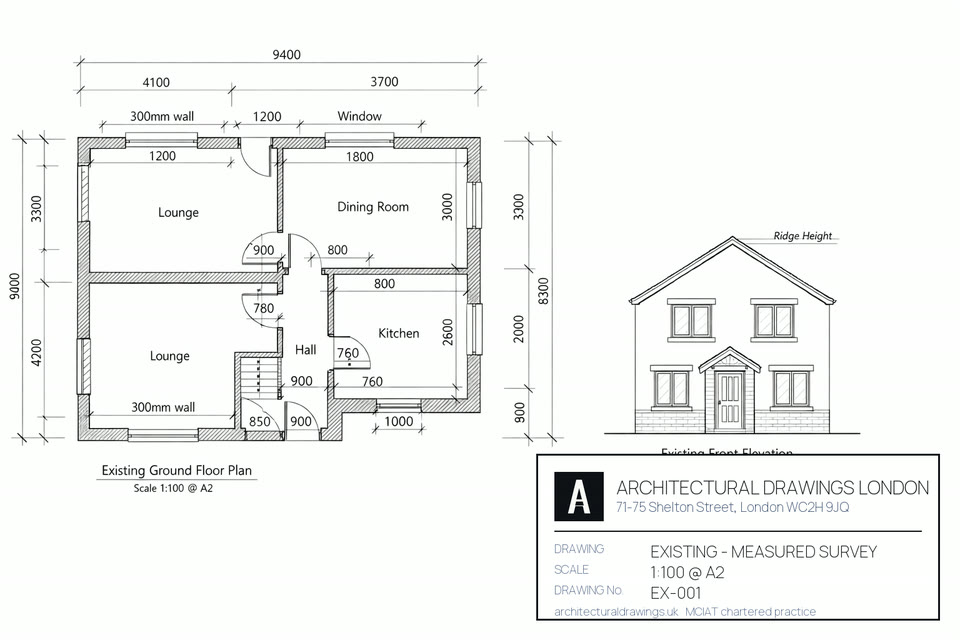
- Site survey. A measured survey of the existing property -- floor plans, elevations, sections, roof profile. This is the foundation for all subsequent drawings. It should be thorough and accurate.
- Design development. The professional prepares initial design options based on your brief, site constraints, planning policy, and building regulations. You review and provide feedback. Expect 2-3 rounds of revisions to reach a final design.
- Planning drawings and submission. Final drawings are prepared to planning application standard. The professional submits the application (or provides you with the drawings to submit yourself). Submission includes the council fee.
- Planning determination. The council processes the application (8 weeks for householder applications). The professional may liaise with the planning officer on your behalf during this period.
- Building regulations drawings. Detailed technical drawings for building control -- structural details, insulation specification, fire strategy. These are typically prepared after planning approval is granted (or in parallel for PD projects). See our building regulations service.
- Builder tender support. The professional may help you obtain and compare builder quotes, answer technical questions from builders, and assist with contractor selection.
What are the red flags?
Based on our experience seeing projects go wrong, here are the warning signs that should make you pause.
- No written contract or terms of engagement. A professional who will not put the agreement in writing is a professional you should not hire. Full stop.
- No PII or refusal to show the certificate. If they cannot prove they have Professional Indemnity Insurance, walk away.
- Not registered with any professional body. This means no accountability, no complaints procedure, and no guaranteed competence standard.
- Pressure to sign immediately. A good professional gives you time to consider their proposal and compare options. Urgency tactics are a red flag.
- Very large upfront payment. A reasonable payment schedule is: a deposit (20-30%) on instruction, a stage payment on completion of design, and the balance on planning submission. Asking for 50% or more upfront, before any work is done, is a concern.
- Vague scope of work. "We'll do the drawings" is not a scope. You need to know exactly which drawings are included, how many revisions, whether the planning submission is included, and whether building regulations drawings are covered.
- No experience with your borough. London has 33 boroughs, each with different policies. A professional who has never submitted to your borough may not understand the local requirements, conservation area policies, or Article 4 Directions that affect your project.
- Unrealistically low fees. If a quote is dramatically lower than others, ask why. It may indicate a less experienced practitioner, a limited scope (essential drawings excluded), or a business model that relies on add-on charges later in the process.
- Poor communication during the enquiry stage. If they are slow to respond, unclear in their communication, or dismissive of your questions before you have even hired them, it will only get worse once you are a client.
- No planning approval track record. Ask for their approval rate. If they cannot or will not answer, that tells you something.
Why London homeowners choose us
At Architectural Drawings London, we are MCIAT chartered architectural technologists who focus exclusively on residential drawings and regulatory submissions across all 33 London boroughs. Here is what we offer:
- No percentage-based escalation, no hidden charges.
- council-ready drawing review. We review every project against the relevant Local Plan policies, conservation area guidance, and Article 4 Directions before submission.
- Experience across all 33 London boroughs. We know the quirks, preferences, and red lines of every London planning department.
- MCIAT chartered, fully insured. Professional Indemnity Insurance, public liability insurance, and full accountability through CIAT's Code of Conduct.
- 30% below typical London architect rates. Because we focus on drawings and regulations -- no interior design, no project management, no overheads you do not need.
Frequently asked questions
What is the difference between an architect and an architectural technologist?
An architect (RIBA/ARB) completes a 7-year education covering design, theory, and practice. An architectural technologist (MCIAT/CIAT) specialises in technical drawing, building regulations, and construction detailing. Both can prepare planning and building regulations drawings. For standard residential projects like extensions and loft conversions, a technologist typically offers the same technical quality at lower fees. Learn about our team.
How much does an architect charge in London?
Architect fees in London typically range from 7% to 15% of construction cost. For a £60,000 loft conversion, that is £4,200 to £9,000. Always clarify what is included. View our pricing.
Do I need an architect for a loft conversion or extension in London?
No, you do not legally need an architect. You need professionally prepared architectural drawings. These can be produced by an architect, an MCIAT chartered technologist, or a qualified building designer. For standard residential projects, an architectural technologist offers specialist technical expertise at a lower cost. Consider a full-service architect for complex design briefs, large new builds, or projects requiring extensive interior design. See our planning drawings service.
What credentials should I check before hiring?
Check ARB registration (arb.org.uk) for architects or CIAT registration (ciat.org.uk) for technologists. Verify Professional Indemnity Insurance -- ask to see the certificate. Check for experience with your project type and your London borough. Ask for client references. Review their portfolio for completed projects, not just renders. All of these checks take minutes and can prevent significant problems.
What are the red flags when choosing an architect?
Key red flags include: no Professional Indemnity Insurance; not registered with ARB or CIAT; no written contract or fee agreement; vague scope of work; large upfront payments before any work begins; no experience with your borough; inability to show completed projects; pressure to sign immediately; and poor communication during the enquiry stage. Trust your instincts -- if something feels wrong at the enquiry stage, it will not improve once you are a paying client.