Key facts at a glance
- Velux (rooflight) loft conversion: £25,000–£40,000 build cost in London
- Dormer loft conversion: £45,000–£65,000 build cost in London
- Velux usually Permitted Development; dormer usually PD for rear
- Dormer provides 70–80% more usable floor area at standing height
- Both need building regulations approval and structural calculations
Velux or dormer — which needs permission?
Neither, usually, outside a conservation area. Rooflights sit under Class C provided they project no more than 150mm beyond the roof plane and rise no higher than the ridge. A dormer sits under Class B and eats into the 40 or 50 cubic metre volume allowance.
| Rooflight (Velux) | Rear dormer | |
|---|---|---|
| Permitted development class | Class C | Class B |
| Projection limit | 150mm beyond the roof plane | set back 200mm from the eaves |
| Volume allowance used | none | 40 m³ terrace, 50 m³ semi or detached |
| Allowed on the front roof slope | yes, subject to the limits | no |
| Higher than the existing ridge | no | no |
| Inside a conservation area | front-facing rooflights need permission | not permitted development at all |
Source: Town and Country Planning (General Permitted Development) (England) Order 2015, Schedule 2, Part 1, Classes B and C, as amended, read at 1 September 2026. Class C rooflights are permitted development on Article 2(3) land except where they face a highway, whereas Class B is removed entirely — which is the single reason so many conservation-area lofts are built as rooflight conversions.
What is a Velux loft conversion?
A Velux loft conversion -- sometimes called a rooflight or skylight conversion -- is the simplest type of loft conversion. It works within the existing roof structure, adding Velux-style roof windows to bring in natural light, insulating the roof space, strengthening the floor joists, and building a staircase to create a usable room. The external profile of the roof remains completely unchanged.
The name "Velux" comes from the Danish manufacturer of roof windows, but it has become a generic term for this type of conversion. The windows sit flush with the roof plane, opening outward from a top or centre pivot. Modern Velux windows can be large -- up to 1.34m wide and 1.6m tall -- and can be combined in pairs or banks to flood the loft with light.
Velux conversions are best suited to properties with generous existing roof space. Victorian and Edwardian terraced houses with steep-pitched roofs of 40 degrees or more often have enough natural headroom at the ridge to accommodate a Velux conversion without needing to alter the roof structure. Properties with shallow roof pitches -- typically anything under 30 degrees -- rarely have sufficient headroom for a comfortable Velux conversion and will likely need a dormer instead.
What is a dormer loft conversion?
A dormer loft conversion extends outward from the existing roof slope, creating a box-like structure with a flat roof (or sometimes a pitched roof) that dramatically increases the usable floor area and headroom. The most common type in London is the flat-roof rear dormer, which runs across the full width of the rear elevation and creates a room with near-vertical walls on three sides.
A dormer involves substantial structural work: the existing rear roof slope is removed, steel beams are installed to support the new structure, new walls are built with brickwork or cladding, and a new flat roof is constructed with appropriate drainage. The front roof slope is typically left intact, with Velux windows added for additional light and ventilation.
Full-width rear dormers are the standard loft conversion type across most of London. They are especially popular on Victorian and Edwardian terraced houses, where the rear of the property is not visible from the street and the dormer can be built under Permitted Development rights. The result is a full-height room that can comfortably accommodate a bedroom, en-suite bathroom, home office, or any other use.
How much usable floor area does each give?
This is the single biggest difference between the two types and the factor that drives most homeowners' decisions.
Velux headroom
In a Velux conversion, the only area with full standing headroom (2.2m+) is directly under the roof ridge. As you move toward the eaves on either side, the headroom drops rapidly. On a typical London terraced house with a 42-degree roof pitch and a 5.5m span, you get roughly 2.5–3 metres of width at standing height down the centre of the room. The sides are usable only for low furniture -- beds pushed against the eaves wall, bookshelves, or storage.
Dormer headroom
A dormer extends the full-height area to the rear wall of the room. On the same terraced house, a full-width rear dormer gives you 4.5–5 metres of width at standing height, with only the front roof slope creating a reduced-height area. This translates to approximately 70–80% more usable floor area at comfortable standing height compared to a Velux conversion of the same footprint.
The practical difference is significant. A Velux loft with an en-suite feels cramped. A dormer loft with an en-suite feels like a proper room. If you need a bathroom in your loft, a dormer is almost always the right choice.
Building regulations and headroom
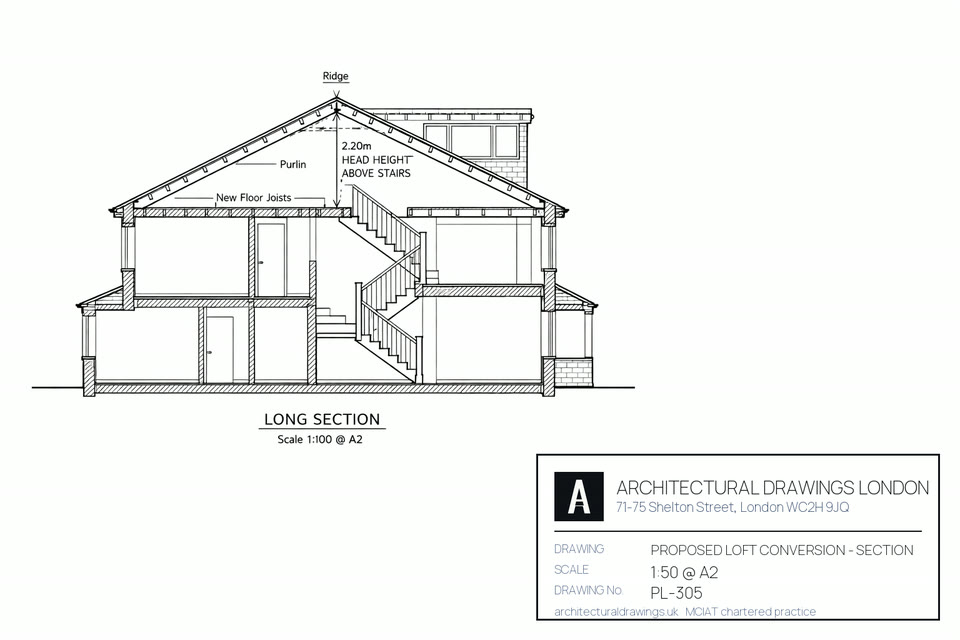
Building regulations require a minimum headroom of 2.0m at the centre of the staircase and 1.9m at the sides. The habitable room itself should have a minimum of 2.2m headroom over at least part of its area. Both conversion types can meet these requirements, but the dormer does so more comfortably and leaves more of the room at full standing height.
What does each cost in London?
Build costs in London are higher than the national average due to labour costs, access logistics, and skip/waste disposal charges. Here are realistic 2026 cost ranges for London properties:
| Cost element | Velux conversion | Dormer conversion |
|---|---|---|
| Build cost (turnkey) | £25,000–£40,000 | £45,000–£65,000 |
| Architectural drawings | ||
| Structural engineer | £400–£800 | £600–£1,200 |
| Building control fees | £400–£700 | £500–£900 |
| Planning/LDC fee | £274 (LDC) | £274 (LDC) or £548 (planning) |
| Party wall surveyor | £800–£1,500 per neighbour | £800–£1,500 per neighbour |
| Typical total | £28,000–£45,000 | £49,000–£72,000 |
The dormer costs roughly 60–80% more than the Velux option. The additional cost is driven by structural steelwork, the dormer frame construction, new roofing and drainage, and the more complex scaffolding required. However, the cost per usable square metre is often comparable because the dormer delivers so much more functional space.
At Architectural Drawings London, the drawing fees are the same for both types because the documentation requirements are identical -- existing and proposed plans, sections, elevations, structural layout, and building regulations details.
Which one needs planning permission?
Velux conversions and planning
A Velux conversion almost always falls under Permitted Development because it does not alter the roof profile. The rooflights sit within the existing roof plane and do not project more than 150mm above it (the PD limit). There is no increase in volume, no change to the ridge height, and no alteration to the external appearance from the street.
The exceptions are:
- Properties in conservation areas where front-facing rooflights may require planning permission
- Properties subject to an Article 4 Direction that specifically removes rooflight PD rights
- Flats and maisonettes, which have no PD rights
- Listed buildings, which always need Listed Building Consent
Dormer conversions and planning
Rear dormers on houses usually fall under Permitted Development, provided they comply with the dimensional limits in Class B of the GPDO:
- The dormer must not exceed 40 cubic metres additional volume (terraced/semi) or 50 cubic metres (detached)
- It must not extend beyond the plane of the existing roof slope facing the highway
- It must be set back at least 200mm from the original eaves
- Materials must be similar in appearance to the existing house
- No veranda, balcony, or raised platform
- Side-facing windows must be obscure-glazed and non-opening below 1.7m
Dormers that face the highway (front dormers) always need planning permission. Dormers in conservation areas need planning permission if they involve alterations to the roof slope facing the highway. In both cases, the application is assessed against the borough's Local Plan policies on roof extensions.
We recommend obtaining a Lawful Development Certificate (£274) for any loft conversion under Permitted Development. It provides legal proof that the work is lawful -- essential when you come to sell.
How do the building regulations differ?
Both Velux and dormer loft conversions require building regulations approval. There is no exemption. The key building regulations requirements are:
- Structure (Part A): Floor joists must be upgraded or new joists installed. Steel beams support the new floor and, in a dormer, the dormer structure itself. A structural engineer's calculations are required.
- Fire safety (Part B): Creating a new storey triggers upgraded fire protection throughout the house. This typically means a protected staircase enclosure with fire doors, interlinked smoke alarms on every level, and fire-rated construction to the loft floor and walls.
- Sound insulation (Part E): Applies to party walls in terraced and semi-detached houses. The loft party wall must achieve appropriate sound insulation levels.
- Thermal insulation (Part L): The new loft space must meet current energy efficiency standards. In a Velux conversion, insulation goes between and over the rafters. In a dormer, the dormer walls, roof, and cheeks all need insulation.
- Staircase (Part K): The new staircase must comply with minimum dimensions -- 220mm tread going, maximum 42-degree pitch, minimum 2m headroom.
The main difference is that a dormer requires additional building regulations documentation for the dormer structure itself -- the steelwork, the flat roof construction, drainage, and the cladding/brickwork to the dormer cheeks and face. A Velux conversion has simpler structural requirements but still needs the same fire safety, sound, and thermal insulation compliance.
When is a rooflight conversion the right choice?
A Velux loft conversion makes sense in several specific scenarios:
- Budget is the primary constraint. If you have £25,000–£40,000 to spend, a Velux conversion delivers a usable new room at a significantly lower cost than a dormer.
- You have a steep roof pitch. Properties with roof pitches of 40 degrees or more often have enough natural headroom for a comfortable Velux room without needing to extend the roof.
- The room will be a bedroom or study. Spaces where you spend most of your time sitting or lying down work well with the sloped ceilings of a Velux conversion. A double bed fits under the eaves, and a desk can sit in the full-height central area.
- You do not need an en-suite bathroom. Fitting a shower, toilet, and basin into the reduced-height areas of a Velux loft is difficult and often results in an uncomfortable bathroom. If a bathroom is not required, the Velux layout works well.
- You want minimal disruption. A Velux conversion is typically completed in 4–6 weeks, compared to 8–12 weeks for a dormer. Less scaffolding, less waste, and less noise.
- You are in a conservation area with strict dormer policies. Some boroughs are reluctant to approve dormers in conservation areas. A Velux conversion avoids this issue entirely.
When is a dormer the better choice?
A dormer conversion is the better option when:
- You need an en-suite bathroom. A dormer provides the full-height space needed for a comfortable shower room or bathroom with proper headroom over the shower, toilet, and basin.
- You want a full-sized room. Master bedrooms, family rooms, and home offices that need bookcases, wardrobes, and standing-height circulation all benefit from the extended headroom of a dormer.
- Your roof pitch is shallow. Properties with roof pitches under 35 degrees do not have enough natural headroom for a comfortable Velux conversion. A dormer solves this by extending the wall height.
- You want to maximise property value. A dormer adds more value because it creates a more marketable room. Estate agents consistently value dormer loft rooms higher than Velux loft rooms.
- You want storage and wardrobes. The flat-ceiling dormer allows full-height fitted wardrobes against the rear wall, something impossible in a Velux conversion.
The overwhelming majority of loft conversions in London are dormers. The additional cost is justified by the dramatically better usable space, and the Permitted Development route for rear dormers means the planning process is straightforward for most properties.
Property value impact
Both types of loft conversion add significant value to London properties, but the returns differ:
| Factor | Velux conversion | Dormer conversion |
|---|---|---|
| Typical value added | 10–15% of property value | 15–20% of property value |
| On a £600k London house | £60,000–£90,000 | £90,000–£120,000 |
| ROI (return on investment) | 150–225% | 125–170% |
| Adds a bedroom to listing? | Yes (with caveats) | Yes |
| En-suite potential? | Limited | Comfortable |
Both conversion types deliver a strong return on investment in London's housing market. The Velux has a higher percentage ROI because the build cost is lower, but the dormer adds more absolute value. A 3-bed Victorian terrace in south London valued at £600,000 could reach £720,000 with a well-executed dormer loft conversion featuring an en-suite -- a net gain of £50,000–£70,000 after build costs.
Crucially, both types require proper documentation -- building control completion certificates, electrical certificates, and (ideally) a Lawful Development Certificate or planning permission decision notice. Without these, the value uplift is compromised because buyers' solicitors and mortgage lenders will flag the missing paperwork.
Our loft conversion drawing fees
Whether you choose a Velux or dormer conversion, the architectural drawings and building regulations documentation you need are essentially the same. At Architectural Drawings London, our loft conversion packages are designed to cover both types.
Loft conversion drawing packages
All drawings are prepared by MCIAT chartered architectural technologists with experience across all 33 London boroughs. Our fees are 30% below typical London architect rates because we specialise in technical drawings and regulatory compliance, not interior design or full project management.
Get a free loft conversion quote →
Frequently asked questions
Is a Velux loft conversion cheaper than a dormer?
Yes. A Velux (rooflight) loft conversion typically costs between £25,000 and £40,000 in London, while a dormer loft conversion ranges from £45,000 to £65,000. The Velux option is cheaper because it retains the existing roof structure and does not require the extensive structural steelwork, brickwork, and roofing that a dormer demands.
Do I need planning permission for a Velux loft conversion in London?
In most cases, no. A Velux loft conversion usually falls under Permitted Development rights because it does not alter the roof profile or add volume beyond the existing roof plane. However, if your property is in a conservation area, subject to an Article 4 Direction, or is a flat or maisonette, you will need planning permission. We recommend obtaining a Lawful Development Certificate (£274) for legal certainty when you come to sell.
How much headroom do you need for a loft conversion?
Building regulations require a minimum of 2.2 metres headroom measured from the finished floor to the ceiling at the highest point. In a Velux conversion, usable headroom is limited to the area directly under the ridge. In a dormer conversion, the flat-roofed dormer box extends the full-height area across the width of the room, typically giving 70–80% more usable floor area at standing height. The staircase also needs a minimum 2.0m headroom at the centre line.
Which loft conversion adds more value to a London property?
A dormer loft conversion typically adds 15–20% to a London property's value because it creates a fully functional room with en-suite potential. A Velux conversion adds around 10–15%. Both deliver a strong return on investment, but the dormer's larger usable space commands higher valuations from estate agents and surveyors. On a £600,000 London property, the difference could be £30,000–£50,000 in additional value.
Can I convert a Velux loft to a dormer later?
Yes, it is possible to upgrade a Velux loft conversion to a dormer later, but it involves significant additional work -- removing the existing rooflights, constructing the dormer structure, and potentially upgrading the floor joists and steelwork. It is more cost-effective to build the dormer from the outset if you know you will need the additional space. If budget is tight now, starting with a Velux and upgrading later remains a viable phased strategy. Get a quote and we can advise on the best approach for your property.