TL;DR — Key Facts
- Build cost per sqm: £3,000 – £4,500 (inner London premium borough)
- Council planning fee: £548 (householder application, 2026)
- Typical projects: rear extension, side-return, two-storey, wraparound
- Conservation areas: 40 designated areas in Islington
- Permitted Development: Restricted by Article 4 in some areas
Why does an Islington extension cost more?
Because it is usually a basement or a mansard rather than a rear box. Islington’s Datahub set records 10,989 basement applications at 61% approved and 3,192 mansards at 52%. Both are phrase-matches on published descriptions, so read them against each other and against Islington’s other work, not against another borough’s count.
| Measure | Islington | Outcome |
|---|---|---|
| Basement applications in the Datahub | 10,989 | 61% approved |
| Mansard applications in the Datahub | 3,192 | 52% approved |
| Extension applications in the Datahub | 13,207 | 62% approved |
| Householder decisions | 1,279 | 90.9% approved |
| Conservation areas | 41 | 583 hectares |
| Householder appeals allowed after refusal | 29.6% of 159 | 40.8% of 13,067 |
Sources: rows one to three from the Planning London Datahub, retrieved 15 August 2026 — phrase-matched descriptions, comparable within Islington only. Row four from MHCLG PS1 and PS2, twelve quarters to March 2026. Row five from planning.data.gov.uk, retrieved 1 September 2026. Row six from Planning Inspectorate casework decided 2016–2026. Build costs on this page are our own 2026 London range.
What does an Islington extension cost in 2026?
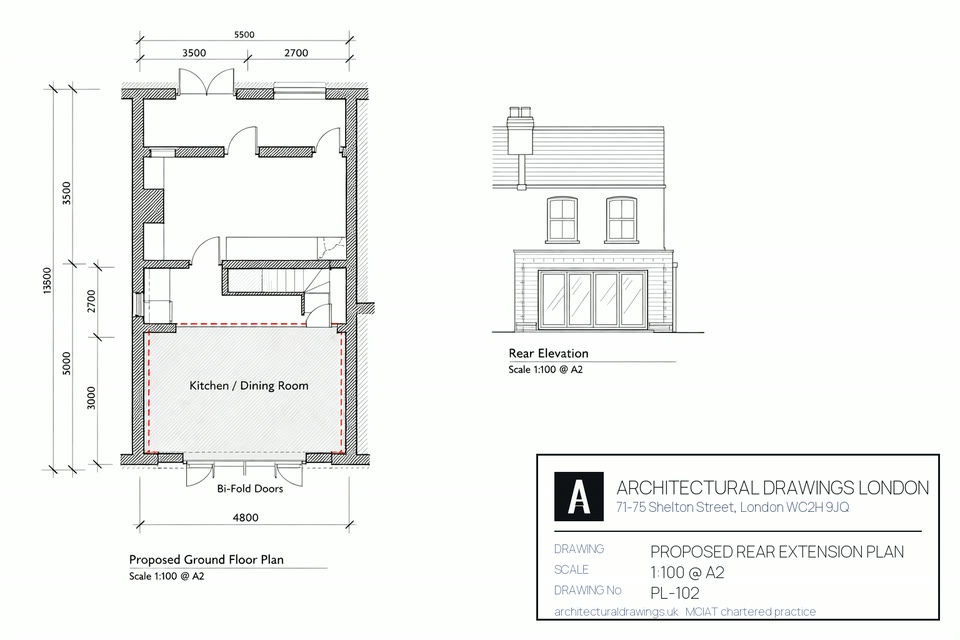
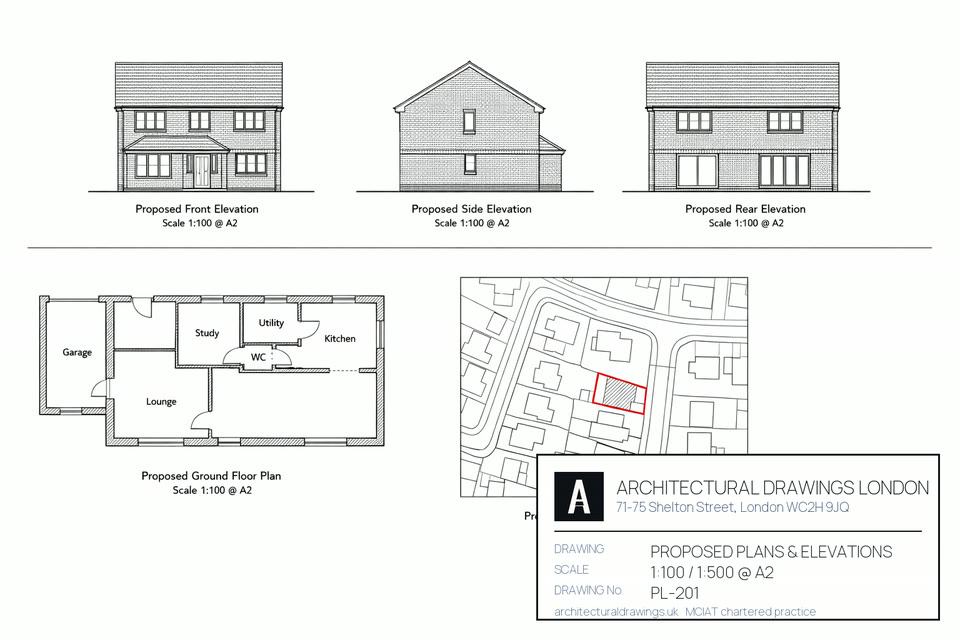
Once the budget works, the next step is the drawing set: house extensions in Islington.
House extension build costs in Islington typically range from £3,000 to £4,500 per square metre, reflecting Islington's position as an inner London premium borough. These figures cover the construction cost only and do not include professional fees, planning fees, or VAT.
There is very little rear depth to build into on an Islington terrace, so extensions here are frequently as much excavation as construction - lowering a floor, forming a lightwell, underpinning against a neighbour. That is engineering work with its own temporary support and party wall implications, and it sets the range far more than any choice of glazing or joinery does.
Typical extension costs in Islington (build only)
On top of the build cost, you will need architectural drawings. These fees are 30% below typical London architect rates.
What drives an Islington extension price up?
Islington determined thirteen larger rear extensions under the neighbour-consultation scheme in three years (MHCLG planning statistics, retrieved 1 September 2026). Thirteen, borough-wide. The reason is not policy but plot depth: Georgian and early Victorian terraces here have rear yards, not gardens, and there is very little ground to build on. Where an extension is possible, an Article 4 Direction and 40 conservation areas govern how it looks.
Conservation areas
Islington has 40 designated conservation areas, including Barnsbury, Canonbury, Highbury, Clerkenwell, Angel. If your property is in a conservation area, Permitted Development rights are restricted, meaning you may need a full planning application (£548 council fee). Conservation area applications also tend to require higher-quality materials and more sympathetic design, which can increase build costs by 10-20%.
Article 4 Directions
Islington has Article 4 Directions in place. Article 4 Direction covering the whole borough removes permitted development rights for HMO conversions (C3 to C4). Separate Article 4 for office-to-residential in key areas. Where Article 4 applies, works that would normally be Permitted Development require a full planning application. This adds £548 to the council fee and typically 2-3 months to the project timeline, which can affect overall costs if you are renting alternative accommodation during the build.
Property type
The housing stock in Islington is predominantly georgian and early victorian terraces, victorian bye-law housing, 1930s mansion blocks, converted industrial buildings in clerkenwell and farringdon. Victorian and Edwardian terraces typically suit side-return and rear extensions, while 1930s semi-detached properties are well suited to two-storey rear extensions. Detached houses offer the most flexibility but often have larger footprints, meaning higher absolute costs even if the per-sqm rate is similar.
Access and logistics
There is no side access anywhere on the historic terraced stock, and often no vehicular access to the rear of the block at all. Spoil comes out through the hallway and materials go in the same way, on streets where parking is at a premium and a skip needs a permit and a suspension. On this housing the logistics are a substantial share of the groundworks cost rather than an overhead.
Our drawing fees for Islington extensions
At Architectural Drawings London. No hourly billing, no surprises. Our fees cover everything needed for a valid planning submission to Islington Council and for building regulations approval.
Drawing fees for extensions in Islington
Every package includes a measured survey of your existing property, existing floor plans and elevations, proposed floor plans and elevations, a site plan, and a design and access statement where required. Our MCIAT chartered architectural technologists handle the full process from survey to submission, and we liaise with Islington Council on your behalf.
We cover all Islington postcodes: N1, N4, N5, N7, N19, EC1.
Is permitted development available in Islington?
Many house extensions in Islington can be built under Permitted Development (PD) rights without needing a planning application. Under PD, single-storey rear extensions can extend up to 6 metres from the original rear wall for terraced and semi-detached houses, or 8 metres for detached houses (under the Prior Approval process). However, Islington has Article 4 Directions that may remove some PD rights. Article 4 Direction covering the whole borough removes permitted development rights for HMO conversions (C3 to C4). Separate Article 4 for office-to-residential in key areas.
Islington's 40 conservation areas cover most of the borough, and the side-extension prohibition is a dead letter on a Georgian terrace - there is no side. What binds is rear depth, already minimal on these plots, and the materials rule over brickwork that is the substance of the designation. An Article 4 Direction reaches further still.
Two-storey extensions need permission, but on most Islington addresses the more basic obstacle is space. These are Georgian and early Victorian terraces with rear yards rather than gardens, and there is often no depth to build a ground floor into, let alone a first. Where a two-storey addition is possible it is usually above an existing closet wing, and the Article 4 Direction governs how it is detailed.
The council issued 398 certificates of lawful development in three years (MHCLG planning statistics, retrieved 1 September 2026). The low count follows from the same fact as everything else on this page: with the Article 4 Direction, the conservation coverage and almost no rear depth to build into, there is not much left for a certificate to confirm. Where one is available, it is worth taking precisely because it is unusual.
Frequently asked questions
How much does a house extension cost in Islington?
Build costs for a house extension in Islington typically range from £3,000 to £4,500 per square metre, as Islington is an inner London premium borough. A typical single-storey rear extension of 15-20 sqm would cost between £45,000 and £90,000 for the build alone. On top of build costs.
Can I extend under Permitted Development in Islington?
Islington's 40 conservation areas cover most of the borough, and the restriction on side extensions is irrelevant on a Georgian terrace with no side. What binds is the rear: extension depth, the treatment of the closet wing, and window proportion. The Article 4 Direction reaches further still. On this stock, assume every external change needs permission until a search of the address says otherwise.
How long does a house extension take in Islington?
A typical house extension project in Islington takes 5-8 months from initial instruction to completion. This breaks down as: 2-3 weeks for measured survey and drawing preparation, 8 weeks for planning determination by Islington Council (if required), 2-4 weeks for building regulations approval, and 8-16 weeks for construction depending on the size and complexity of the extension.
Do I need a Party Wall Agreement for an extension in Islington?
A mid-terrace Islington property has adjoining owners on both sides, and the shallow rear yard means new foundations sit close to theirs almost by definition. Digging and wall work both bring the 1996 statute into play here, which normally means a pair of notices and, frequently, two appointed surveyors. On this stock that is a normal cost, not a dispute.
What experience do you have with extensions in Islington?
We prepare extension drawings for properties across all Islington postcodes (N1, N4, N5, N7, N19, EC1). Our MCIAT chartered architectural technologists understand Islington Council's policies, design guides, and local precedents. We have a council-ready drawing review across all 33 London boroughs.