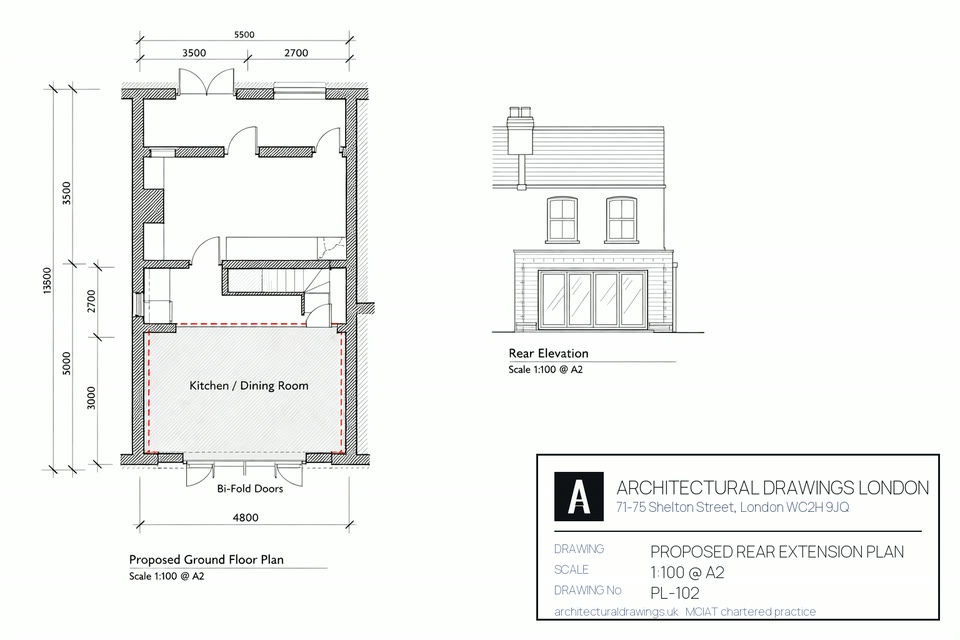
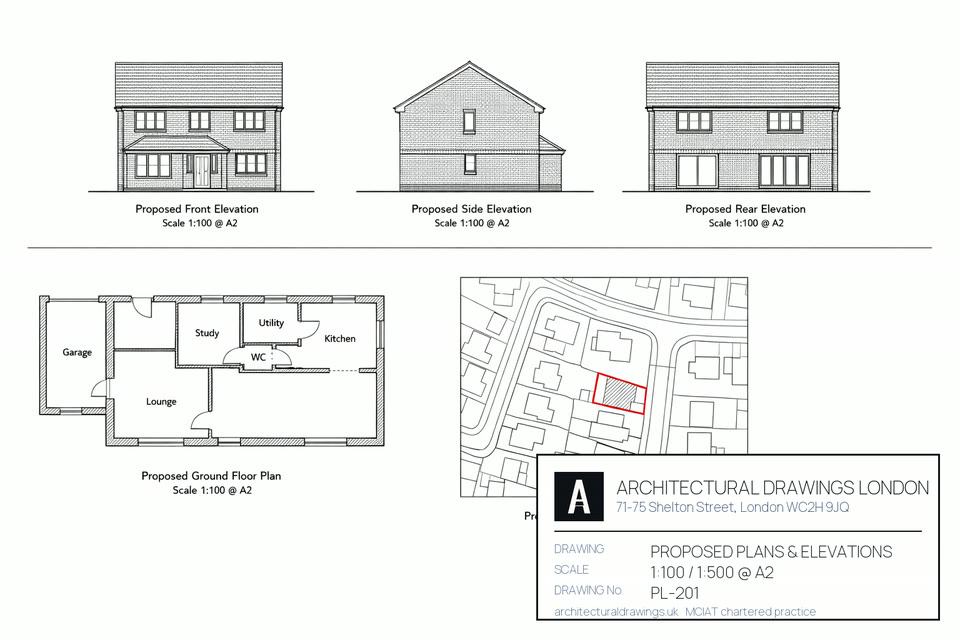
TL;DR — Key Facts
- Build cost per sqm: £2,500 – £3,800 (inner London borough)
- Council planning fee: £548 (householder application, 2026)
- Typical projects: rear extension, side-return, two-storey, wraparound
- Conservation areas: 27 designated areas in City of London
- Permitted Development: Restricted by Article 4 in some areas
Extension costs in City of London
Costs here are build costs. For the drawing package itself — scope, fee and timeline — see house extensions in City of London.
House extension build costs in City of London typically range from £2,500 to £3,800 per square metre, reflecting City of London's position as an inner London borough. These figures cover the construction cost only and do not include professional fees, planning fees, or VAT.
There is no meaningful extension range to quote in the City, because there is almost nothing to extend. The residential stock is flats in listed estates and commercial buildings. Where work happens it is internal reconfiguration, and its cost is driven by the licence to alter, the listed building consent, and the building's own structural constraints, none of which are construction costs in the ordinary sense.
Typical extension costs in City of London (build only)
On top of the build cost, you will need architectural drawings. These fees are 30% below typical London architect rates.
What affects extension costs in City of London
Extensions in the ordinary sense are not really available in the City. The residential stock is the listed Barbican and Golden Lane estates and modern flats in predominantly commercial buildings, and a flat cannot be extended by its leaseholder without the freeholder's involvement in any event. The Corporation took five householder planning decisions in three years (MHCLG planning statistics, retrieved 1 September 2026), which is the whole picture in one figure.
Conservation areas
City of London has 27 designated conservation areas, including Barbican, Smithfield, Fleet Street, Whitefriars, St Paul's. If your property is in a conservation area, Permitted Development rights are restricted, meaning you may need a full planning application (£548 council fee). Conservation area applications also tend to require higher-quality materials and more sympathetic design, which can increase build costs by 10-20%.
Article 4 Directions
City of London has Article 4 Directions in place. Multiple Article 4 Directions around office-to-residential, demolition, and shopfront changes. Where Article 4 applies, works that would normally be Permitted Development require a full planning application. This adds £548 to the council fee and typically 2-3 months to the project timeline, which can affect overall costs if you are renting alternative accommodation during the build.
Property type
The housing stock in City of London is predominantly very limited residential — barbican estate (listed post-war), golden lane estate, modern luxury flats; overwhelmingly commercial. Victorian and Edwardian terraces typically suit side-return and rear extensions, while 1930s semi-detached properties are well suited to two-storey rear extensions. Detached houses offer the most flexibility but often have larger footprints, meaning higher absolute costs even if the per-sqm rate is similar.
Access and logistics
There is no rear garden to reach on a City residential address, and no side return to build into. The practical equivalent of an extension here is internal reconfiguration - which on a Barbican or Golden Lane flat requires listed building consent, because both estates are listed, and consent covers internal alterations as well as external ones.
Our drawing fees for City of London extensions
At Architectural Drawings London. No hourly billing, no surprises. Our fees cover everything needed for a valid planning submission to City of London Corporation and for building regulations approval.
Drawing fees for extensions in City of London
Every package includes a measured survey of your existing property, existing floor plans and elevations, proposed floor plans and elevations, a site plan, and a design and access statement where required. Our MCIAT chartered architectural technologists handle the full process from survey to submission, and we liaise with City of London Corporation on your behalf.
We cover all City of London postcodes: EC1, EC2, EC3, EC4.
Planning vs Permitted Development in City of London
Many house extensions in City of London can be built under Permitted Development (PD) rights without needing a planning application. Under PD, single-storey rear extensions can extend up to 6 metres from the original rear wall for terraced and semi-detached houses, or 8 metres for detached houses (under the Prior Approval process). However, City of London has Article 4 Directions that may remove some PD rights. Multiple Article 4 Directions around office-to-residential, demolition, and shopfront changes.
The City's 27 conservation areas sit over a square mile of almost entirely commercial building. For the small resident population none of the three restrictions changes anything, because flats hold no permitted development rights to begin with. What governs alterations here is listed building consent - the Barbican and Golden Lane estates are both listed - and it reaches the interior.
Two-storey extensions are effectively not available in the City. The residential stock is flats in listed estates and in commercial buildings, where the structure and the demise both belong to someone other than the occupier. Where alteration is contemplated at all, listed building consent rather than an extension application is the relevant route, and it covers internal work as well as external.
The Corporation issued 55 certificates of lawful development in three years (MHCLG planning statistics, retrieved 1 September 2026), the fewest of any London authority. That is not an administrative quirk - it follows from the fact that flats have no permitted development rights under Schedule 2, Part 1 of the Town and Country Planning (General Permitted Development) (England) Order 2015, so in most cases there is nothing for a certificate to confirm.
Frequently asked questions
How much does a house extension cost in City of London?
Build costs for a house extension in City of London typically range from £2,500 to £3,800 per square metre, as City of London is an inner London borough. A typical single-storey rear extension of 15-20 sqm would cost between £37,500 and £76,000 for the build alone. On top of build costs.
Can I extend under Permitted Development in City of London?
The City's 27 conservation areas sit over a square mile that is almost entirely commercial, with the highest listed building density of any London borough. For the small residential population the conservation restrictions are largely beside the point: flats have no permitted development rights to remove, and listed building consent governs alterations to the Barbican and Golden Lane estates regardless.
How long does a house extension take in City of London?
A typical house extension project in City of London takes 5-8 months from initial instruction to completion. This breaks down as: 2-3 weeks for measured survey and drawing preparation, 8 weeks for planning determination by City of London Corporation (if required), 2-4 weeks for building regulations approval, and 8-16 weeks for construction depending on the size and complexity of the extension.
Do I need a Party Wall Agreement for an extension in City of London?
The Party Wall etc. Act 1996 applies between flats as it does between houses, so structural work to a wall or floor separating your home from the next is notifiable. In a City block that question usually arrives after two others have been settled: what the lease actually permits, and whether the building's structure will take the change at all.
What experience do you have with extensions in City of London?
We prepare extension drawings for properties across all City of London postcodes (EC1, EC2, EC3, EC4). Our MCIAT chartered architectural technologists understand City of London Corporation's policies, design guides, and local precedents. We have a council-ready drawing review across all 33 London boroughs.