Key facts at a glance
- London kitchen extension build cost: £2,500–£4,000 per sqm
- Side return infill: £40,000–£75,000 (build only)
- Rear extension (15–25 sqm): £50,000–£100,000 (build only)
- Many single-storey extensions fall under Permitted Development
- Total project timeline: 6–9 months instruction to completion
Which parts of a London kitchen extension have a fixed price?
A kitchen extension divides into three costs: the build, the professional fees and the statutory ones. Only the last is fixed — £548 for a householder application, £274 for a lawful development certificate. London councils approved 83.0% of the 77,680 householder applications they decided in the three years to March 2026.
| Cost | Amount | Basis |
|---|---|---|
| Householder planning application | £548 | Statutory, England, 2026 rate |
| Lawful development certificate | £274 | Statutory |
| Larger home extension prior approval | £249 | Statutory |
| Planning drawing set | from £1,225 | Our fixed fee |
| Building regulations set | from £840 | Our fixed fee |
| Structural calculations | engineer’s fee, by span | Not a statutory scale |
Sources: statutory fees from the Town and Country Planning (Fees for Applications) (England) Regulations 2012 as amended, 2026 rates, retrieved 1 September 2026; London approval rate from MHCLG District Planning Application Statistics (PS1 and PS2), twelve quarters to March 2026, Open Government Licence v3.0. Build costs quoted elsewhere on this page are our own London range for 2026 and are an estimate, not a published statistic.
Kitchen extensions in London: why they cost more
A kitchen extension is the single most popular home improvement project in London. Whether you are opening up a Victorian terraced house with a side return infill, building a full-width rear extension to create an open-plan kitchen-diner, or wrapping around the back of a semi-detached with a combined side and rear extension, the goal is almost always the same: more space, more light, and a room that actually works for modern family life.
London kitchen extensions cost significantly more than the national average. Labour is 20–40% more expensive than outside the M25. Skip hire, scaffolding, and parking permits add borough-specific premiums. Tight terraced sites with limited access push up construction times. And the specification that London homeowners expect -- large-format porcelain tiles, handleless cabinetry, engineered quartz worktops, bi-fold or sliding doors -- adds further cost above a basic build.
This guide breaks down every cost component so you can budget accurately. We cover the build itself, the kitchen fitting, professional fees (including our architectural drawing packages), council fees, and the extras that often catch people out. All figures are based on 2026 London market rates.
Build cost per square metre in London
The most useful benchmark for budgeting a kitchen extension is the cost per square metre of new floor area. In London, this varies depending on the specification level and the complexity of the build.
| Specification | Cost per sqm | What this includes |
|---|---|---|
| Basic | £2,200–£2,800 | Standard blockwork walls, concrete floor, plaster, basic kitchen units, vinyl or laminate flooring, standard radiators |
| Mid-range | £2,800–£3,500 | Insulated cavity walls, underfloor heating, engineered wood or porcelain flooring, mid-range kitchen with stone worktops, bi-fold or sliding doors |
| High-spec | £3,500–£4,500 | High-performance glazing, polished concrete or large-format porcelain floor, bespoke kitchen cabinetry, integrated appliances, structural glass roof, smart home wiring |
These figures cover the shell construction, internal finishes, and M&E (mechanical and electrical) first fix and second fix. They do not include the kitchen itself, professional fees, or council charges -- we cover those separately below.
A useful rule of thumb for London in 2026: budget £3,000 per square metre for a mid-range kitchen extension, then add the kitchen, fees, and contingency on top. This gives you a realistic starting figure that avoids the nasty surprises.
Side return extension vs rear extension: costs compared
In London, the two most common kitchen extension types are the side return infill and the rear extension. They serve different purposes, suit different house types, and come at different price points.
Side return extension
The side return is the narrow alley that runs alongside many London terraced and semi-detached houses, typically between the side wall of the rear addition and the garden boundary wall. It is usually 0.9–1.8 metres wide and 4–6 metres deep.
Infilling the side return is one of the most cost-effective ways to transform a London kitchen. You gain 4–12 square metres of additional floor space, which is enough to turn a cramped galley kitchen into a bright, open-plan kitchen-diner. The structural work is relatively straightforward: a steel beam (RSJ) carries the load where the old side wall is removed, a new glazed roof or flat roof covers the infill, and the kitchen wraps into the new space.
Side return extension cost breakdown
For a detailed guide specifically on side return extensions, see our complete side return extension guide.
Rear extension
A rear extension projects out from the back of the house into the garden. It is the go-to option for creating a large open-plan kitchen-diner-living space. Single-storey rear extensions in London typically range from 12 to 30 square metres, though some wrap-around designs combine a rear extension with a side return infill for maximum floor area.
Rear extension cost breakdown (15–25 sqm)
Open-plan kitchen-diner: additional costs to budget for
Most London homeowners extending their kitchen want to create an open-plan kitchen-diner -- removing the wall between the old kitchen and the dining or living room to create one flowing space. This is where many of the "hidden" costs live.
Structural work
Removing an internal load-bearing wall requires a steel beam (RSJ or universal beam) to transfer the load to new padstones or columns. The beam itself costs £500–£1,500 for the steel, but the installation -- including temporary support (Acrow props), cutting out the wall, lifting the beam into position, and making good -- typically runs £2,000–£5,000 depending on the span and complexity. You will need structural calculations as part of your building regulations submission.
Bi-fold and sliding doors
The rear wall of a kitchen extension is almost always largely or entirely glazed. Bi-fold doors (which fold and stack to one side) and sliding doors (which slide behind each other) are the two most popular options in London. Costs vary enormously depending on material, size, and thermal performance:
- Aluminium bi-fold doors (3m opening): £4,000–£6,000
- Aluminium bi-fold doors (5m opening): £7,000–£12,000
- Slim-frame aluminium sliding doors (3m): £5,000–£8,000
- Slim-frame aluminium sliding doors (5m): £9,000–£15,000
- Crittal-style steel-framed doors: £8,000–£18,000 depending on size
All glazing in a new extension must meet Part L of the Building Regulations for thermal performance. Triple glazing is increasingly specified in London for both energy efficiency and acoustic insulation -- expect a 15–25% premium over double glazing.
Underfloor heating
Underfloor heating is the preferred choice for kitchen extensions because there are no radiators taking up wall space, the heat distribution is even, and it works efficiently with the insulated concrete floor slab that new extensions require. Two options:
- Wet (hydronic) underfloor heating: £60–£90 per sqm installed. Connected to your boiler or heat pump. The better long-term choice.
- Electric underfloor heating: £40–£60 per sqm installed. Cheaper to install but more expensive to run. Best for small areas.
For a 20 sqm kitchen extension, budget £1,200–£1,800 for a wet system.
Rooflights and skylights
Rooflights flood the centre of an extension with natural light -- especially important on deep extensions where the back of the room can feel dark. Options include:
- Fixed flat rooflight (1m x 1m): £800–£1,500 supply and fit
- Opening flat rooflight (1m x 1m): £1,200–£2,000
- Lantern rooflight (1.5m x 1.5m): £2,500–£5,000
- Full-length glazed roof slot: £3,000–£8,000 depending on length
Kitchen fitting
The kitchen itself is a major cost line. London homeowners typically spend:
| Kitchen tier | Supply cost | Fitting cost | Total |
|---|---|---|---|
| Budget (flat-pack, laminate worktops) | £3,000–£6,000 | £2,000–£3,000 | £5,000–£9,000 |
| Mid-range (rigid cabinets, quartz worktops, integrated appliances) | £8,000–£15,000 | £3,000–£5,000 | £11,000–£20,000 |
| High-end (bespoke cabinetry, natural stone, premium appliances) | £18,000–£40,000 | £5,000–£8,000 | £23,000–£48,000 |
We do not design kitchens ourselves -- we are architectural technologists, not kitchen designers. But our drawings include the kitchen layout with appliance positions, service runs, and extraction routes, which your kitchen supplier needs to provide an accurate quote.
Planning permission vs Permitted Development for kitchen extensions
Whether your kitchen extension needs planning permission depends on its size, position, and your property's planning status.
When Permitted Development applies
Single-storey rear extensions are covered by Class A of Part 1 of the General Permitted Development Order (GPDO), provided they meet these conditions:
- The extension does not project more than 6 metres from the original rear wall (semi-detached or terraced) or 8 metres (detached, via Prior Approval notification)
- The maximum height is 4 metres (or the height of the existing house, whichever is lower)
- The eaves height does not exceed 3 metres
- The extension does not cover more than 50% of the garden area
- Materials are similar in appearance to the existing house
- The property is not a flat or maisonette (no PD rights)
- There is no Article 4 Direction removing Class A rights
Side return extensions are also typically Permitted Development if they are single-storey, within the width and height limits, and do not project beyond the rear wall of the original house by more than the PD limit. However, the side wall of a side return extension must be set back at least 1 metre from the boundary and be no more than 4 metres high.
When you need planning permission
- The extension exceeds PD size limits
- The property is in a conservation area and the extension alters the side elevation
- An Article 4 Direction removes the relevant PD class
- The property is a flat
- You are building a two-storey rear extension
- The extension is a wraparound (side + rear combined) that exceeds PD limits on either frontage
For detailed guidance on Permitted Development rules in 2026, see our dedicated guide.
Planning and regulatory fees
Architectural drawing fees for kitchen extensions
At Architectural Drawings London. All drawings are prepared by MCIAT chartered architectural technologists with experience across all 33 London boroughs.
What we provide
- Site location plan at 1:1250
- Block plan at 1:200 showing the extension footprint
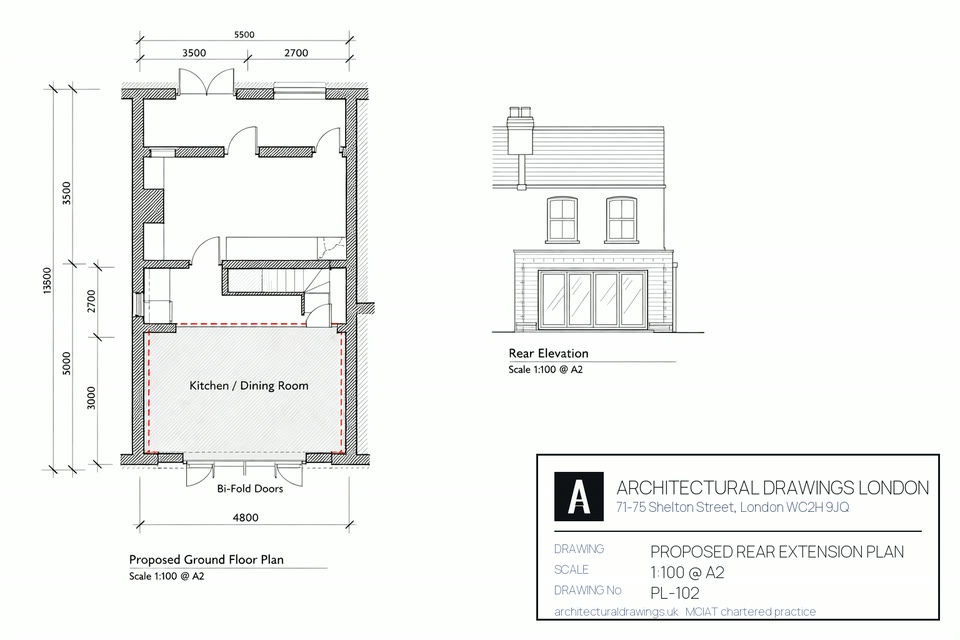
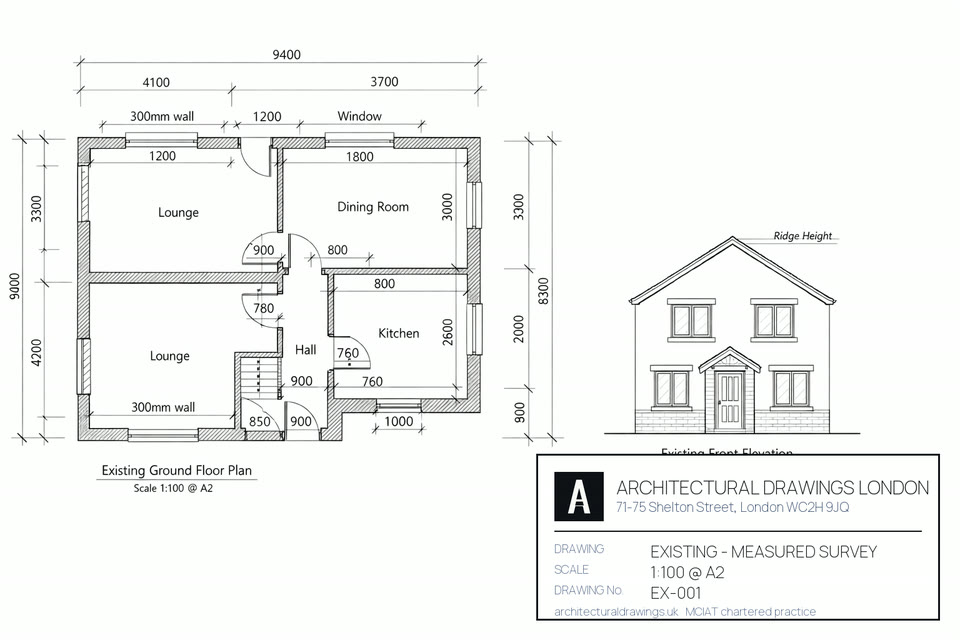
- Existing and proposed floor plans at 1:50
- Existing and proposed elevations at 1:50
- Existing and proposed section drawings
- Kitchen layout with appliance positions
- Design and Access Statement (essential for conservation areas)
- 3D visualisations showing the proposed extension from multiple angles
- Pre-application liaison with the council
- Heritage Statement preparation (if in a conservation area)
These fees are 30% below typical London architect rates because we specialise in technical drawings and regulatory compliance, not interior design or full project management.
Get a free quote for your kitchen extension →
Total kitchen extension cost: putting it all together
Here is a realistic total cost breakdown for three common kitchen extension scenarios in London in 2026:
| Cost item | Side return infill (8 sqm) | Rear extension (20 sqm) | Wrap-around (28 sqm) |
|---|---|---|---|
| Build cost | £28,000–£36,000 | £60,000–£80,000 | £84,000–£112,000 |
| Structural steel | £2,500–£4,000 | £3,000–£5,000 | £5,000–£8,000 |
| Bi-folds / sliding doors | £3,000–£6,000 | £6,000–£12,000 | £8,000–£15,000 |
| Underfloor heating | £600–£900 | £1,400–£2,000 | £2,000–£2,800 |
| Rooflights | £1,500–£3,000 | £2,500–£5,000 | £3,500–£7,000 |
| Kitchen (mid-range, supply + fit) | £12,000–£18,000 | £15,000–£25,000 | £18,000–£30,000 |
| Architectural drawings | |||
| Building regs drawings | |||
| Council fees (planning + building regs) | £400–£850 | £400–£850 | £400–£850 |
| Party Wall costs (if applicable) | £1,000–£2,500 | £1,000–£2,500 | £1,500–£3,500 |
| Contingency (10%) | £5,000–£7,000 | £9,000–£13,000 | £12,000–£18,000 |
| Total | £55,000–£80,000 | £100,000–£150,000 | £135,000–£200,000 |
Always include a 10% contingency in your budget. London kitchen extension projects routinely encounter unforeseen issues: asbestos in old roofing, underpinning requirements near party walls, drainage diversions, or simply the realities of opening up a 100-year-old terraced house. The contingency protects your project from stalling when the unexpected happens.
Kitchen extension timeline in London
From the moment you instruct us to the moment you are cooking in your new kitchen, here is a realistic timeline:
Typical project timeline
Many of these stages overlap. For example, you can tender for builders while the planning application is being determined, and order your kitchen during the early weeks of construction. A well-planned project with professional drawings submitted on day one can shave weeks off the timeline.
How to reduce your kitchen extension cost
London kitchen extensions are not cheap, but there are legitimate ways to keep costs under control without compromising the end result:
- Stay within Permitted Development limits. Avoiding a full planning application saves £548 in council fees and eliminates the 8-week planning wait. If you can achieve the space you need within the PD limits, do it. We will advise you on the maximum size achievable under PD for your specific property.
- Choose a flat roof over a pitched or glazed roof. A flat roof with rooflights is significantly cheaper than a fully glazed roof or a pitched roof with dormers. It also simplifies the build, reducing labour time.
- Use standard door sizes. Bespoke glazing is expensive. Standard bi-fold and sliding door sizes are mass-produced and cost 30–50% less than custom dimensions.
- Separate the build from the kitchen fitting. Get your builder to complete the shell -- plastered walls, screed floor, electrics and plumbing to kitchen positions -- and then bring in a specialist kitchen fitter. This avoids the builder's markup on the kitchen supply.
- Get three competitive quotes. Use our detailed building regulations drawings to get like-for-like quotes from at least three builders. The difference between the highest and lowest quote in London is routinely 25–40%.
- Time your project wisely. Builders are busiest from April to September. Starting your build in the quieter months (October to February) can yield lower quotes and faster start dates.
Frequently asked questions
How much does a kitchen extension cost in London per square metre?
In London, kitchen extension build costs typically range from £2,500 to £4,000 per square metre depending on the specification. A basic rear extension in an outer borough averages £2,500–£3,000/sqm. A high-spec open-plan kitchen-diner in a central borough with bi-fold doors, underfloor heating, and bespoke cabinetry can reach £3,500–£4,000/sqm or more. These figures cover construction only -- kitchen fitting, professional fees, and council charges are additional. View our drawing fees.
Do I need planning permission for a kitchen extension in London?
Many single-storey kitchen extensions in London fall under Permitted Development (PD) and do not require planning permission, provided the extension does not project more than 6 metres from the original rear wall (semi-detached or terraced) or 8 metres (detached, via Prior Approval). However, if your property is in a conservation area, subject to an Article 4 Direction, or you are extending a flat, you will need planning permission. We recommend applying for a Lawful Development Certificate (£274) even when PD applies. Read our PD guide.
How much does a side return extension cost in London?
A side return infill extension in London typically costs £40,000–£75,000 for the build alone, depending on size, specification, and borough. Side returns are usually 1–2 metres wide and 4–6 metres deep, giving 4–12 square metres of additional floor space. Including the kitchen, drawings, and fees, total project costs range from £55,000 to £115,000. See our complete side return guide.
How long does a kitchen extension take to build in London?
A typical kitchen extension in London takes 10–16 weeks to build once on site. Before construction, allow 2–3 weeks for architectural drawings, 8 weeks for planning permission (if required), and 4–6 weeks for building regulations and tender. The total timeline from initial instruction to moving into your new kitchen is typically 6–9 months. Side return extensions tend to be faster (10–12 weeks on site) than larger rear extensions (12–16 weeks).
What are the architectural drawing fees for a kitchen extension in London?
At Architectural Drawings London, elevations, 3D visuals, and pre-app liaison). Get a free quote.