Key costs at a glance
- London build costs: £2,000–£3,500 per m² (2026 rates)
- Single-storey rear extension: £50,000–£80,000 total build
- Double-storey extension: £120,000–£200,000 total build
- Typical project timeline: 7–12 months start to finish
- Council householder planning fee: £548 · council-ready drawing review
A house extension is one of the most significant investments a London homeowner can make. Whether you are adding a single-storey rear extension to create an open-plan kitchen-diner, infilling a side return, or building a full double-storey addition, understanding the true cost -- including the fees you don't always see upfront -- is essential for budgeting accurately and avoiding nasty surprises mid-project.
This guide covers every cost you will encounter when extending your London home in 2026: build costs per square metre, architectural drawing fees, structural engineer fees, council charges, party wall costs, and the hidden extras that catch homeowners off guard. We have prepared extension drawings for hundreds of London homes across all 33 London boroughs, so the figures here reflect real-world project costs, not national averages that undercount London's premium.
Which London extension costs are fixed, and which are estimates?
Only the statutory fees are fixed: £548 for a householder application, £249 for larger-extension prior approval, £274 for a lawful development certificate. Everything else is a range. London councils decided 77,680 householder applications in the three years to March 2026 and approved 83.0% of them.
| Cost | Amount | Fixed or estimated |
|---|---|---|
| Householder planning application | £548 | Fixed by regulation |
| Larger home extension prior approval | £249 | Fixed by regulation |
| Lawful development certificate | £274 | Fixed by regulation |
| Planning drawing set | from £1,225 | Our fixed fee |
| Building regulations set | from £840 | Our fixed fee |
| Build cost per square metre | market range | Estimated |
| Party wall award | surveyors’ fees | Estimated, no statutory scale |
Sources: statutory fees from the Town and Country Planning (Fees for Applications) (England) Regulations 2012 as amended, 2026 rates; approval figures from MHCLG District Planning Application Statistics (PS1 and PS2), decisions made in the twelve quarters to March 2026, Open Government Licence v3.0. Both retrieved 1 September 2026.
What does each type of extension cost to build?
The total cost of a house extension depends on three main factors: the type of extension, the floor area being added, and the specification level of the finishes. Here is what each extension type costs in London in 2026.
Single-storey rear extension: £50,000–£80,000
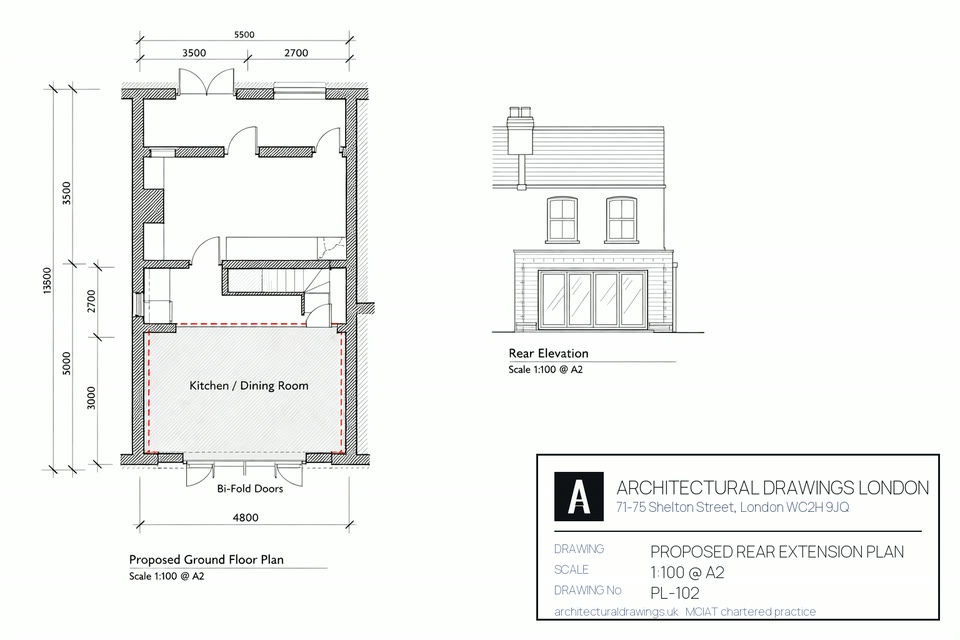
The most popular extension type in London. A typical single-storey rear extension adds 15–25 m² of floor space, usually to create an open-plan kitchen-diner or an enlarged living area with bifold or sliding doors opening onto the garden. Build costs for a single-storey rear extension run at £2,000–£3,500 per m², depending on the specification level.
At mid-range specification, a 20 m² rear extension costs around £56,000–£65,000 for the build alone, plus £3,000–£6,000 in professional fees (architectural drawings, structural engineer, Building Control charges, and council planning fee). Extensions up to 3 metres (attached houses) or 4 metres (detached houses) from the original rear wall typically fall under Permitted Development and do not require planning permission.
Side return extension: £60,000–£90,000
Side return extensions -- also called side infill -- are hugely popular on Victorian and Edwardian terraces in London, where a narrow alley runs along one side of the house. The side return typically adds 8–15 m², transforming a cramped galley kitchen into an open-plan space that connects to the dining room or living area. Build costs per m² are slightly higher (£2,500–£4,000/m²) because the roof junction and the structural opening between the existing house and the new extension require careful detailing, and access for materials through the narrow alley adds logistical complexity.
Most side return extensions need planning permission because Permitted Development rules require that side extensions do not exceed half the width of the original house and are single storey with a maximum eaves height of 3 metres.
Double-storey extension: £120,000–£200,000
A two-storey extension typically adds 30–50 m² across two floors -- usually a kitchen-diner at ground level and a bedroom or bathroom above. The cost per m² is actually lower than a single-storey extension (£1,800–£3,000/m²) because the foundations and roof only need to be constructed once, and scaffolding costs are shared across both floors.
Double-storey extensions always require planning permission. The council will assess the impact on neighbours using the 45-degree rule for daylight protection, and the upper-storey windows will be scrutinised for overlooking. Rear-facing upper windows are usually acceptable; side-facing windows often need to be obscure-glazed and fixed shut below 1.7 metres from finished floor level.
Wraparound extension: £90,000–£130,000
A wraparound combines a rear extension with a side return, creating an L-shaped or U-shaped addition. This is the most transformative single-storey option, typically adding 25–40 m². It almost always needs planning permission because the side element exceeds Permitted Development limits. Wraparound extensions are popular in south and west London boroughs like Wandsworth, Lambeth, and Lewisham, where Victorian terraces have both rear gardens and side alleys.
Basement conversion: £200,000–£400,000+
Basement conversions sit at the high end of the cost spectrum. They involve structural underpinning (or full excavation), tanking and waterproofing, mechanical ventilation, light wells, and significant temporary works. Build costs run at £3,000–£5,000+ per m². Basements are most common in Kensington & Chelsea, Westminster, and Camden, where land values justify the investment. Several boroughs now have specific basement development policies (known as "iceberg home" policies) that limit the extent and depth of basement excavation.
Summary cost table
| Extension type | Typical size | Build cost per m² | Total build cost |
|---|---|---|---|
| Single-storey rear | 15–25 m² | £2,000–£3,500 | £50,000–£80,000 |
| Side return | 8–15 m² | £2,500–£4,000 | £60,000–£90,000 |
| Double storey | 30–50 m² | £1,800–£3,000 | £120,000–£200,000 |
| Wraparound | 25–40 m² | £2,200–£3,500 | £90,000–£130,000 |
| Basement | 30–60 m² | £3,000–£5,000+ | £200,000–£400,000+ |
These are London-specific rates applicable across the 33 boroughs. Inner London (zones 1–3) tends to sit at the higher end due to access constraints, parking restrictions for construction vehicles, and the complexity of working with older housing stock. Outer London boroughs like Bromley, Havering, and Hillingdon may come in 10–15% lower.
Drawing and design fees
Your architectural drawing fees are a small fraction of the total project cost -- typically 2–4% -- but they have an outsized impact on the outcome. The drawings determine the design quality, the planning approval likelihood, and the buildability of the scheme. Cutting corners on drawings to save £500 can result in a £60,000+ build project going wrong, either through planning refusal (losing months) or through construction issues caused by inadequate technical detailing.
Our fees vs the London average
At Architectural Drawings LondonWe are CIAT-affiliated architectural technologists, not RIBA architects -- we do not offer interior design, furniture layouts, or full project management, which keeps our costs lean while delivering the drawings and approvals you actually need.
| Provider | Extension drawings | What is included |
|---|---|---|
| Architectural Drawings London (Essentials) | Measured survey, existing & proposed plans, elevations, site plan, building regs drawings | |
| Architectural Drawings London (Complete) | Essentials + Design & Access Statement, planning agent service, unlimited revisions, 3D visuals | |
| Architectural Drawings London (Bespoke) | from £3,150 | Complex multi-element schemes, heritage statements, conservation area applications |
| Typical London architect (RIBA) | £3,000–£15,000 | Varies widely -- often includes interior design and project management |
| Online plan drawing services | £500–£1,000 | Remote-only, no site visit, limited local knowledge, no planning agent service |
What drawings do you need for an extension?
A house extension project typically requires three sets of drawings, produced in sequence:
- Planning drawings -- existing and proposed floor plans, elevations, site plan, and block plan. These are submitted to the council with your planning application (or used to demonstrate Permitted Development compliance for an LDC application).
- Building regulations drawings -- detailed technical drawings showing construction details, insulation specifications, drainage, foundations, structural elements, and compliance with Part L (energy), Part B (fire safety), Part M (access), and other relevant Building Regulations. Your builder works from these drawings.
- Structural calculations -- prepared by a structural engineer, these specify the steel beams, lintels, foundations, and other structural elements. At Architectural Drawings London, structural calculations are available through our in-house chartered structural engineer at £500–£1,050 depending on project complexity.
Structural calculations are priced separately because they depend on the specific structural requirements of each project.
Get a free quote for your extension →
Do you need planning permission, or is it permitted development?
Whether your extension needs a formal planning application or falls under Permitted Development (PD) has a significant impact on your costs and timeline. Understanding the rules saves you £548 in council fees and 8 weeks of waiting time -- or prevents you from starting work illegally.
Permitted Development limits for house extensions
The following limits apply to houses (not flats or maisonettes, which have no PD rights for extensions). These limits assume no Article 4 Direction applies and the property is not in a conservation area or other designated land:
- Single-storey rear extension (attached house, terraced or semi-detached): maximum 3 metres from the original rear wall without any notification. Up to 6 metres via the Prior Approval (Larger Home Extension) scheme, which requires a £249 fee and neighbour notification.
- Single-storey rear extension (detached house): maximum 4 metres from the original rear wall without notification. Up to 8 metres via Prior Approval.
- Side extensions: must not exceed half the width of the original house. Single storey only, with a maximum eaves height of 3 metres. Must be set back at least 1 metre from the boundary.
- Maximum eaves and ridge height: eaves must not exceed 3 metres (single storey) or the height of the existing eaves (two storey). The ridge of any extension must not exceed the ridge of the existing house.
- Two-storey extensions: always require planning permission. They cannot be done under PD.
- Front extensions: not permitted under PD. Always require planning permission.
- Total coverage: the extension (together with any previous additions and outbuildings) must not result in more than 50% of the garden being covered by buildings.
Even when your extension falls within PD limits, we strongly recommend applying for a Lawful Development Certificate (LDC). This costs £274 and provides formal legal confirmation that the work is lawful -- essential for resale, as buyers' solicitors and mortgage lenders will ask for proof.
When you definitely need planning permission
- Any two-storey or double-storey extension
- Any extension that exceeds the PD size limits listed above
- Wraparound extensions (the side element triggers planning)
- Extensions on flats or maisonettes (no PD rights)
- Extensions in a conservation area where PD rights are restricted
- Extensions on properties subject to an Article 4 Direction
- Any extension on a listed building (also requires Listed Building Consent)
- Basement conversions involving excavation below the existing footprint
Planning costs
Council planning fees (2026 rates)
The statutory determination period for a householder planning application is 8 weeks from validation. In practice, many London boroughs exceed this target -- Tower Hamlets, Hackney, Lambeth, and Southwark regularly take 10–12 weeks. Our council-ready drawing review means your project is unlikely to face refusal, but factoring in a realistic timeline is important for project planning.
Building regulations costs
Every house extension -- whether it has planning permission or falls under Permitted Development -- must comply with the Building Regulations. This is separate from planning permission and deals with the structural safety, fire protection, energy efficiency, and accessibility of the construction.
Building Control fees
You need to notify Building Control before starting work, and an inspector will visit the site at key stages (foundations, damp-proof course, drainage, structural steelwork, and completion). You can use either the council's Building Control service or a private Approved Inspector.
Building regulations costs
The structural engineer is a critical appointment. They calculate the sizes of steel beams needed to support the opening between the existing house and the new extension, specify the foundation depth (which varies depending on soil type and proximity to trees), and ensure the existing structure can carry any additional loads. At Architectural Drawings London, structural calculations are available through our in-house chartered structural engineer, ensuring seamless coordination with your architectural drawings.
Which costs catch London homeowners out?
The build cost and professional fees are the figures everyone asks about, but there are several additional costs that are easy to overlook at the budgeting stage. These hidden costs can add £3,000–£10,000+ to your project total.
Party Wall Act: £700–£1,000 per neighbour
If your extension is built on or near a shared boundary, or if you are excavating within 3 metres of a neighbouring building's foundations (or 6 metres if excavating deeper than the neighbour's foundations), you must serve a Party Wall Notice under the Party Wall etc. Act 1996. If your neighbour dissents -- and they often do -- both parties must appoint a party wall surveyor. Each surveyor's fee is typically £700–£1,000, and the building owner (you) pays both surveyors' fees. For a terraced house with two neighbours, this can cost £2,800–£4,000.
If your neighbour consents in writing, no surveyor is needed and the cost is zero. We recommend sending the notice early -- at least two months before your planned construction start date -- to allow time for the process to complete.
Thames Water build-over agreement
If your extension is built over or within 3 metres of a public sewer, you need a build-over agreement from Thames Water. This involves submitting your foundation details and a CCTV survey of the sewer. The cost is typically £300–£500 for the CCTV survey, and Thames Water may require you to use deeper or reinforced foundations to protect the sewer. In some cases, a sewer diversion is needed, which can cost £5,000–£15,000+. Your architectural drawings should identify the sewer location early so this cost can be assessed before construction begins.
Tree reports and root protection
If there are mature trees on or near your site -- particularly common in leafy boroughs like Richmond, Bromley, and Ealing -- the council may require an Arboricultural Impact Assessment and a Tree Protection Plan. Trees with Tree Preservation Orders (TPOs) or in conservation areas have additional protections, and your foundation design may need to be modified (deeper piles or a raft foundation) to avoid damage to root systems. The structural implications of tree proximity can add £2,000–£5,000 to foundation costs.
Bin and bike storage
Many London boroughs now require that any extension that reduces the available space for waste and recycling bins must include a replacement bin storage area. This is assessed at planning stage. If your extension covers the area where you currently store bins, you will need to incorporate a bin store into the design -- typically a timber or metal enclosure costing £500–£1,500 to build.
Other potential costs
- Contaminated land assessment: £500–£2,000 (required if the site has a history of industrial use)
- Flood risk assessment: £400–£1,200 (required if the site is in Flood Zone 2 or 3)
- Daylight/sunlight assessment: £800–£2,500 (sometimes requested by the council if neighbours object)
- Temporary accommodation: £0–£5,000+ (if the kitchen is out of commission for weeks, some families rent short-term or eat out -- budget for this)
- Skip hire and waste disposal: £300–£500 per skip (most extensions require 2–4 skips)
- Utilities disconnection and reconnection: £200–£1,000 (if gas or water pipes run through the extension area)
- VAT: 20% on all professional fees and construction costs (extensions to existing dwellings are standard-rated, not zero-rated like new builds)
How much does your borough change the number?
Extension costs in London are not uniform. Where you live has a meaningful impact on both the build cost and the professional fees, for several reasons.
Why Kensington costs more than Croydon
- Access and logistics: Inner London sites are harder to reach. Narrow streets, residents' parking zones, and the absence of front driveways for material storage all increase build costs. A builder working in Kensington faces daily parking charges, limited delivery windows (often before 8am only), and manual carrying of materials from the street to the site. These logistical overheads add 10–20% to build costs compared to outer London.
- Labour market: Builders working in prime central London charge more.
- Specification expectations: Homeowners in high-value areas tend to choose higher specification finishes. An extension in Chelsea typically features engineered oak floors, bespoke joinery, and premium kitchen units; the same floor area in Croydon might use laminate flooring and standard units, at a fraction of the cost per m².
- Planning complexity: Boroughs with extensive conservation areas and Article 4 Directions require more detailed applications, Heritage Statements, and potentially Design Review Panel presentations. This increases architectural fees by £500–£2,000 compared to boroughs with straightforward planning environments.
Conservation area premiums
If your property is in a conservation area, expect the following additional costs:
- Heritage Statement: £500–£1,500 (required for all planning applications in conservation areas)
- Material matching: the council will require materials that match the existing building -- London stock brick, natural slate, timber sash windows. These cost 20–40% more than standard alternatives.
- Design restrictions: extensions in conservation areas typically need to be subservient to the original building, which can limit size and roof form. Flat roofs are often preferred over pitched roofs to maintain the original roofline.
- Pre-application advice: strongly recommended in conservation areas. Budget £200–£600 for the council fee.
Borough cost tiers
| Cost tier | Typical boroughs | Build cost per m² | Key factors |
|---|---|---|---|
| Premium | Kensington & Chelsea, Westminster, Camden, City of London | £3,000–£3,500+ | Access constraints, conservation areas, high-spec expectations |
| Upper mid | Islington, Hammersmith, Wandsworth, Richmond, Hackney | £2,600–£3,200 | Mix of conservation and non-conservation, moderate access |
| Mid-range | Lewisham, Greenwich, Lambeth, Southwark, Ealing, Merton | Decent access, varied housing stock, reasonable planning | |
| Outer London | Bromley, Croydon, Havering, Hillingdon, Bexley, Barking | £2,000–£2,600 | Better access, driveways, less conservation, suburban lots |
Our drawing fees are the same regardless of borough -- the complexity of the planning environment is factored into our package pricing, not charged as extras. Whether you are extending in Barnet or Kensington, the drawing fee is the same.
How to budget for your extension
A well-planned budget is the difference between a project that delivers value and one that spirals out of control. Here is how to approach budgeting for a London house extension.
Contingency: always add 10–15%
No extension project goes exactly to plan. You will encounter unexpected costs -- unforeseen ground conditions, hidden asbestos, rotting timbers, or a requirement from Building Control that was not apparent from the initial survey. The industry standard contingency for a house extension is 10–15% of the total build cost. On a £60,000 rear extension, that means setting aside £6,000–£9,000 as contingency. Do not treat this as optional -- it is essential.
Phasing your project
If your budget cannot accommodate the entire project at once, consider phasing. A common approach is to complete the shell and weathertight works (foundations, walls, roof, windows) in phase one, then fit out the interior (kitchen, bathroom, flooring, decoration) in phase two once funds are available. Your architectural drawings should be designed for the full scheme even if construction is phased, to ensure the end result is coherent.
Finance options
- Remortgage: The most common way to fund an extension in London. Lenders typically offer up to 80–85% LTV, and remortgage rates are generally lower than personal loan rates. The added value of the extension often exceeds the cost -- a well-designed rear extension can add 10–15% to your property value.
- Further advance: An additional borrowing facility from your existing mortgage lender. Often simpler than a full remortgage and avoids early repayment charges on your current deal.
- Personal loan: Suitable for smaller projects (under £25,000). Higher interest rates than mortgage borrowing but no need to put your home up as security.
- Savings: If you can fund the project from savings, you avoid interest costs entirely. Many homeowners combine savings for the professional fees and council charges with a remortgage for the build cost.
Total project cost worksheet
Here is a realistic total cost breakdown for a typical 20 m² single-storey rear extension in London at mid-range specification:
Example: 20 m² rear extension total cost
Add 20% VAT on the build cost and professional fees, and the VAT-inclusive total for this example project is approximately £85,000–£87,000. This is a realistic, honest figure for a mid-range rear extension in a mid-tier London borough.
Our extension drawing packages
At Architectural Drawings London, we offer three tiers of service for house extension projects. All drawings are prepared by CIAT-affiliated architectural technologists with experience across all 33 London boroughs.
Everything you need to get your extension approved and built:
- Measured survey of your existing property
- Existing and proposed floor plans at 1:50 or 1:100 scale
- Existing and proposed elevations
- Site location plan and block plan
- Building regulations drawings (detailed construction drawings for your builder)
- Planning Portal submission assistance
Our most popular package, chosen by 70% of extension clients:
- Everything in Essentials, plus:
- Design and Access Statement (required in many London boroughs, especially conservation areas)
- Full planning agent service -- all correspondence with the council on your behalf
- Unlimited design revisions during the planning process
- 3D visualisations to help you (and the planning officer) understand the proposal
- Coordination with structural engineer
Bespoke -- from £3,150
For complex, large-scale, or heritage-sensitive projects:
- Everything in Complete, plus:
- Heritage Statement for conservation area and listed building applications
- Pre-application consultation management
- Design Review Panel preparation (if required by the borough)
- Multi-element schemes (e.g. extension + loft conversion + internal reconfiguration)
- Detailed material specification and schedule
View full pricing → Get a free quote
Build cost by specification level
The build cost per m² varies significantly depending on the finishes you choose. Here is what each specification level looks like in a London house extension:
| Specification level | Cost per m² | What this includes |
|---|---|---|
| Basic | £2,000–£2,600 | Standard kitchen units, vinyl or laminate flooring, painted plasterboard walls, basic sanitaryware, standard aluminium windows, no underfloor heating |
| Mid-range | £2,600–£3,200 | Engineered timber floors, stone worktops, good-quality aluminium or timber windows, quality sanitaryware, tiled splashbacks, LED downlights |
| High | £3,200–£3,500+ | Underfloor heating, bespoke joinery, premium bifold/sliding doors, polished concrete or natural stone floors, smart home wiring, high-end kitchen, integrated appliances |
The biggest cost driver within the extension itself is usually the kitchen. A standard kitchen installation (units, worktops, splashback, appliances) costs £5,000–£10,000. A mid-range kitchen runs £12,000–£25,000. A high-end bespoke kitchen can exceed £40,000. If your extension is primarily a kitchen-diner, the kitchen specification alone can double the fit-out cost.
How long does a house extension take?
From first phone call to moving back into your newly extended home, a typical London house extension takes 7–12 months. Here is the breakdown:
Typical extension project timeline
The planning and party wall stages can run in parallel to some extent -- we recommend starting the party wall process as soon as the planning drawings are finalised, so the party wall award is in place by the time planning permission is granted. This can shave 4–6 weeks off the overall programme.
If your extension falls under Permitted Development, you can skip the planning determination stage entirely, reducing the design-to-site timeline to 4–6 weeks.
How do you bring the cost down without losing the scheme?
- Design within PD limits if possible. Avoiding the planning application process saves £548 in council fees and 8 weeks of waiting time. It also eliminates the risk of refusal and the cost of resubmission.
- Get three builder quotes minimum. London builder prices vary enormously -- we have seen quotes for the same project differ by £20,000. We can recommend builders we have worked with, but always get competitive quotes.
- Consider a side return before a full rear extension. Side returns often add valuable kitchen space at a lower cost than a full rear extension because the existing rear wall can remain largely intact.
- Combine your extension with a loft conversion. If you need both, doing them together saves on scaffold hire, professional fees, and planning application fees. A combined project also means only one period of disruption.
- Choose mid-range specification. The jump from mid-range to high specification adds £400–£700 per m². On a 25 m² extension, that is £10,000–£17,500 extra. Consider whether premium finishes are worth it for every surface.
- Build in quieter months. Builders in London are busiest from March to September. Starting your build in October or November can secure better pricing and a more attentive contractor.
- Manage your own kitchen supply. Builders typically add a 15–20% markup on kitchen units. Ordering directly from a kitchen supplier and having the builder install them can save £2,000–£5,000.
- Invest in good drawings. This sounds counterintuitive as a cost-saving tip, but comprehensive, detailed drawings reduce the number of queries and variations during construction. Variations (changes made on site because the drawings were unclear) are one of the biggest sources of cost overrun on extension projects.
Frequently asked questions
How much does a single storey extension cost in London?
A single storey rear extension in London costs between £50,000 and £80,000 for the build in 2026, depending on size and specification. Build costs run at £2,000–£3,500 per m². A typical 20 m² rear extension at mid-range specification costs around £60,000–£65,000 for construction, plus £3,000–£6,000 in professional fees (architectural drawings, structural engineer, Building Control, and council planning fee). Side return extensions cost £60,000–£90,000 and wraparound extensions £90,000–£130,000. Get a free quote for the drawing fees on your project.
Do I need planning permission for a house extension?
Not always. Single storey rear extensions up to 3 metres (attached houses) or 4 metres (detached houses) from the original rear wall fall under Permitted Development and do not need planning permission. Larger extensions of up to 6 metres (attached) or 8 metres (detached) may qualify under the Prior Approval scheme. Side extensions must not exceed half the width of the original house. However, two-storey extensions, wraparound extensions, and any extension in a conservation area or Article 4 zone typically require full planning permission. The householder planning application fee is £548. Learn more about our extension service.
How much do extension drawings cost?
At Architectural Drawings London. Our Bespoke package for complex schemes starts from £3,150.RIBA architects typically charge £3,000–£15,000 for equivalent work. View our full pricing.
How long does a house extension take from start to finish?
A typical house extension in London takes 7–12 months from initial instruction to completion. The design and planning phase takes 3–4 months (2–3 weeks for drawings, 1–2 weeks for client revisions, 8 weeks for planning determination). The construction phase takes 3–6 months depending on the extension type: 10–14 weeks for a single storey rear, 12–16 weeks for a side return, 16–20 weeks for a wraparound, and 20–26 weeks for a double storey extension. The party wall process (if required) takes 6–8 weeks but can run in parallel with the planning application.
What's the cheapest type of extension to build?
The cheapest type of extension to build in London is a single storey rear extension, with build costs starting from around £50,000 for a 15–20 m² addition at basic specification. Side return infill extensions can also be cost-effective at £60,000–£90,000. Per square metre, double storey extensions actually offer the best value because foundations and roof costs are shared across two floors, bringing the effective rate down to £1,800–£3,000 per m² compared to £2,000–£3,500 for single storey. Staying within Permitted Development limits saves the £548 planning fee and avoids the 8-week wait. Get a free quote to compare options for your property.