Key costs at a glance
- Council householder application fee: £548 (2026 statutory rate)
- Includes: measured survey, existing & proposed plans, elevations, site plan, block plan
- Turnaround: 2–3 weeks for drawings, then 8 weeks council determination
- Anyone altering, extending, or building in London beyond Permitted Development limits
- council-ready drawing review with our CIAT-affiliated technologists
What is fixed in the cost of planning drawings?
Only the council’s fee. A householder application is £548 everywhere in England, a lawful development certificate £274 and larger-extension prior approval £249. Our own drawing packages are fixed before work starts; percentage-based fees are not. Pre-application advice sits outside the fee regulations entirely, and each borough prices it separately, so no London-wide figure for it exists.
| Item | Amount | Fixed by |
|---|---|---|
| Householder planning application | £548 | regulation |
| Lawful development certificate | £274 | regulation |
| Larger home extension prior approval | £249 | regulation |
| Full application, one new dwelling | £610 | regulation |
| Planning drawing set | from £1,225 | our fixed fee |
| Essentials package | from £840 | our fixed fee |
| Pre-application advice | set by each borough | not statutory |
Sources: the Town and Country Planning (Fees for Applications, Deemed Applications, Requests and Site Visits) (England) Regulations 2012, as amended, 2026 rates, retrieved 1 September 2026; our own published fixed fees. Pre-application advice sits outside the regulations and each council prices it separately, which is why no London-wide figure for it appears anywhere on this page.
What are planning drawings?
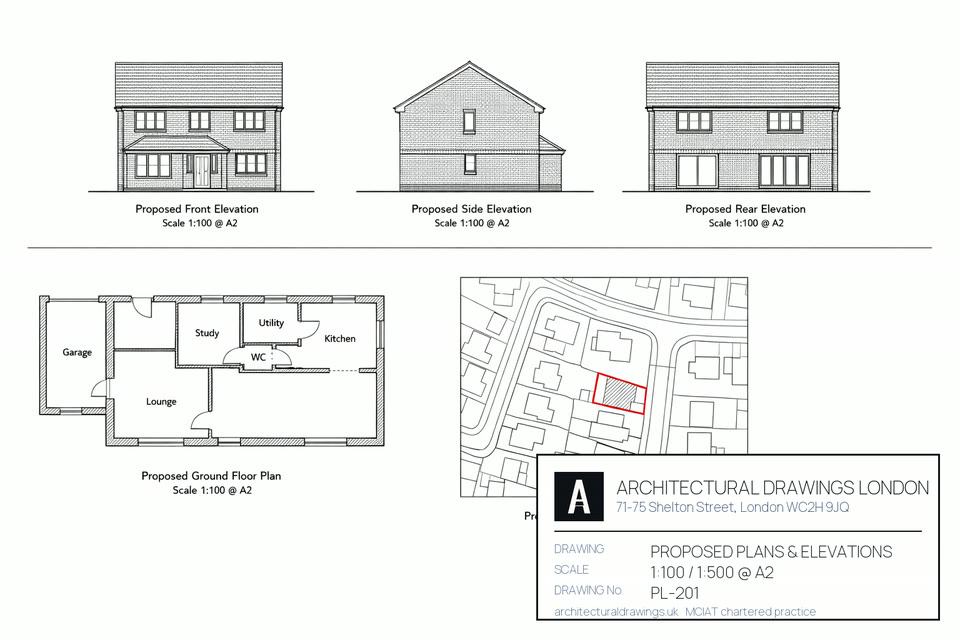
Planning drawings are the scaled, technical architectural drawings you submit to your local planning authority (your London borough council) as part of a planning application. They communicate exactly what you intend to build, alter, or extend, and the council uses them to assess whether your proposal complies with local and national planning policy.
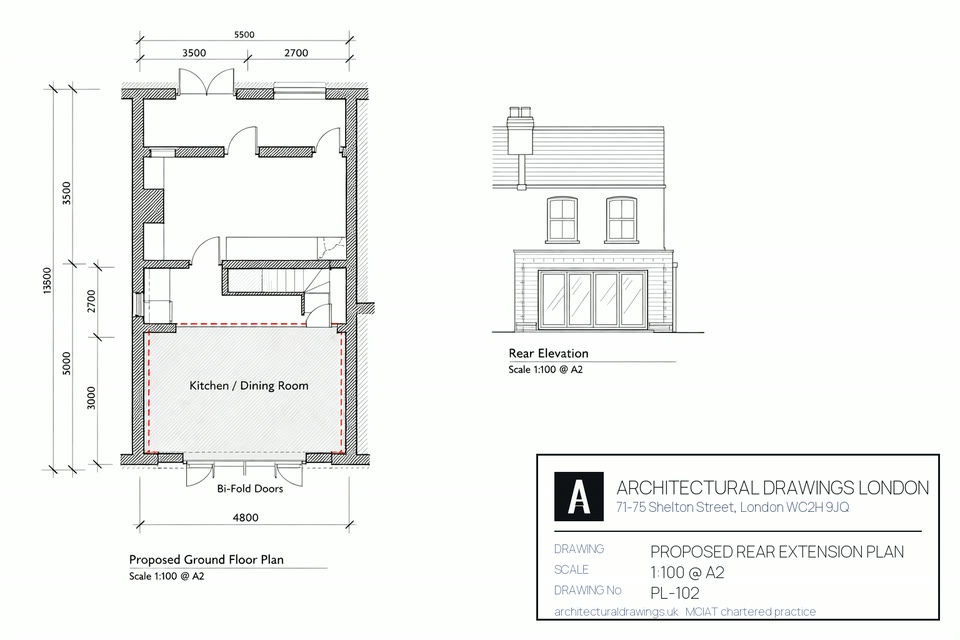
A standard set of planning drawings for a London householder application includes existing and proposed floor plans (at 1:50 or 1:100 scale), existing and proposed elevations, a site location plan (at 1:1250), and a block plan (at 1:200 or 1:500). More complex projects may also require section drawings, roof plans, streetscene elevations, and 3D visualisations to help the planning officer understand the impact of your proposal on the surrounding area.
Planning drawings are distinct from building regulations drawings. Planning drawings deal with the appearance, massing, and siting of a development -- essentially, what it looks like from the outside and how it relates to its neighbours. Building regulations drawings deal with the technical construction -- structural adequacy, fire safety, insulation, drainage, and accessibility. Most projects need both, but they are separate applications with separate fees and separate approval processes.
When do you need planning drawings?
You need planning drawings whenever your project requires a formal planning application. In London, this includes:
- Extensions that exceed Permitted Development limits -- two-storey extensions, side extensions beyond half the width of the house, single-storey rear extensions over 6m (terraced/semi) or 8m (detached)
- Mansard roof extensions -- these always require planning permission as they alter the roofline and add a new storey
- Loft conversions in conservation areas or where Article 4 Directions remove PD rights
- Any work on flats or maisonettes -- no Permitted Development rights exist for flats
- Change of use -- converting a house to flats, or commercial to residential
- New build dwellings -- garden infill, subdivisions, or new-build houses
- Listed building alterations -- Listed Building Consent requires detailed drawings showing all proposed changes
Even when planning permission is not required, you may still need professional drawings for a Lawful Development Certificate (£274 council fee) -- a legal document confirming your project is lawful under Permitted Development. We strongly recommend this for any PD project, as it provides certainty when you come to sell the property.
Not sure whether you need planning permission? Read our complete guide to planning permission in London or request a free quote and we will advise you.
Planning drawing costs by project type
The cost of planning drawings in London varies significantly by project type, complexity, and which package you choose. Here is a detailed breakdown for the most common residential projects in 2026, showing both our Essentials and Complete tier pricing alongside the council's statutory fees.
| Project type | Essentials | Complete | Council fee | Total (Complete) |
|---|---|---|---|---|
| Single-storey rear extension | £548 | £2,008 | ||
| Side return extension | £548 | £2,008 | ||
| Double-storey rear extension | £960 | £548 | £2,008 | |
| Loft conversion (dormer) | £548 | £2,008 | ||
| Mansard roof extension | £548 | £2,008 | ||
| Wraparound extension + loft | £3,150 | £548 | £3,408 | |
| Basement conversion | N/A | £3,150+ | £548 | £3,408+ |
| New build dwelling | N/A | £3,150+ | £610 | £3,728+ |
All prices shown are starting prices. The actual fee depends on the size of the property, the complexity of the design, and whether additional documentation (heritage statements, daylight assessments, tree surveys) is required. Our free online quote tool gives you an accurate price in 60 seconds based on your specific project details.
These fees are fixed and agreed before any work starts. We achieve this by specialising in what we do best -- technical drawings and planning applications -- rather than offering the full suite of architectural design, interior specification, and project management that drives architect fees higher.
What affects the cost of planning drawings?
Not every rear extension costs the same to draw, and not every loft conversion carries the same level of planning risk. Several factors influence the final price of your planning drawings in London.
Property size and number of floors
A larger property takes longer to survey and produces more drawing sheets. A two-bedroom Victorian terrace is faster to document than a five-bedroom detached house with multiple roof levels, existing extensions, and outbuildings. Each additional floor adds an existing and proposed floor plan to the drawing set. Our fees reflect this -- a simple two-storey terrace sits at the lower end of each tier, while a large multi-level property will be quoted towards the upper end.
Project complexity
A straightforward single-storey rear extension is one of the simplest projects to draw and submit. A combined scheme involving a rear extension, side return, loft conversion, internal reconfiguration, and external landscaping is considerably more complex -- it requires more drawing sheets, more detailed design work, and a more comprehensive Design and Access Statement. Multi-element schemes typically fall into our Bespoke tier.
Conservation area status
London has over 1,000 conservation areas. If your property sits within one, the planning officer will scrutinise your proposal more carefully for its impact on the character and appearance of the area. This means higher-quality design work, more detailed drawings showing materials and architectural detailing, a Design and Access Statement that addresses heritage significance, and potentially a Heritage Statement. Projects in conservation areas almost always require our Complete or Bespoke tier.
Article 4 Directions
An Article 4 Direction is a legal order that withdraws specific Permitted Development rights from an area. If your property is subject to one, work that would normally be permitted automatically instead requires a full planning application. Boroughs with extensive Article 4 coverage include Camden, Westminster, Islington, Richmond upon Thames, and Kensington & Chelsea. The additional planning work required to navigate an Article 4 area increases the scope of our service.
Listed building status
Listed buildings require Listed Building Consent for any work that affects their character -- including internal alterations. The drawing and documentation requirements for LBC applications are significantly more onerous than for a standard householder application. While the council fee for Listed Building Consent is £0, the professional fees for preparing the application are higher because of the detailed recording, impact assessment, and design justification required.
Multi-storey and basement projects
Projects that involve structural complexity -- two-storey extensions, mansard conversions, basement excavations -- require more detailed section drawings, structural coordination, and design consideration. These projects typically need our Complete or Bespoke tier, and may also require early coordination with a structural engineer for the subsequent building regulations stage.
What is included in planning drawing fees?
One of the biggest sources of confusion when comparing planning drawing quotes is understanding what is actually included. Some providers quote a low headline figure but then add on measured survey fees, D&A Statements, planning agent fees, and revision charges as extras. Here is exactly what our two standard packages include.
- Measured survey of the existing property -- we visit, take accurate measurements using laser and tape, and produce scaled as-existing drawings. This is always included; we never charge it as a hidden extra.
- Existing floor plans at 1:50 or 1:100 scale -- every floor of the existing building as it currently stands, with room labels, door and window positions, and dimensions.
- Proposed floor plans at 1:50 or 1:100 scale -- showing the layout after the proposed development, clearly indicating new construction, demolition, and retained structure.
- Existing and proposed elevations -- all external faces of the building, showing materials, window proportions, and roof profiles.
- Site location plan at 1:1250 -- showing the property in its wider context with the application site outlined in red.
- Block plan at 1:200 or 1:500 -- showing the property boundaries, footprints, access, and relationship to neighbouring buildings.
- Planning Portal submission -- we complete the application forms and upload all documents on your behalf.
Everything in Essentials, plus:
- Design and Access Statement (D&A) -- a written document explaining the design rationale, contextual analysis, and how the proposal relates to the Local Plan policies. Increasingly required by London boroughs, especially in conservation areas.
- Full planning agent service -- we handle all communication with the council throughout the application process, respond to planning officer queries, negotiate amendments if requested, and manage the application through to decision.
- Unlimited design revisions during the application process -- if the council requests changes or you want to explore different design options, there are no additional revision fees.
- Pre-application policy analysis -- we review the relevant Local Plan policies, check Article 4 status, assess conservation area implications, and identify potential issues before we start designing.
- Liaison with council planning officers -- for sensitive projects, we can arrange informal discussions with the case officer to ensure the design is heading in the right direction before formal submission.
- Post-decision support -- if planning permission is granted with conditions (materials approval, landscaping details, construction management plan), we advise on what needs to be discharged and help prepare the submissions.
Our Complete package is the most popular choice for London homeowners because it includes everything needed for a successful application. There are no hidden extras, no revision fees, and no surprises. The only additional cost is the council's statutory fee (£548 for householder applications).
DIY planning applications vs professional drawings
There is no legal requirement to use a professional for a planning application. Anyone can submit drawings and an application form to the Planning Portal. However, the practical reality is that DIY applications have significantly higher refusal rates, and the consequences of a refusal are more costly than most homeowners realise.
Why DIY planning applications fail
- Inaccurate drawings. Planning drawings must be accurately scaled and dimensioned. Freehand sketches, unscaled PDFs, or drawings produced from memory rather than a measured survey will be rejected at the validation stage before the council even considers the proposal. You have lost your £548 council fee and several weeks of time.
- Missing drawing types. A valid planning application requires a specific set of drawings -- site plan, block plan, existing and proposed floor plans, existing and proposed elevations, and sometimes sections. Each drawing has specific scale and annotation requirements. Missing or incorrect drawings trigger an "invalid" notice from the council.
- Failure to address Local Plan policies. Every London borough has a Local Plan with detailed policies on extension size, design quality, materials, boundary distances, roof profiles, and amenity space. A professional reviews every relevant policy before starting the design. DIY applicants usually discover these policies only when they receive a refusal notice citing them.
- No Design and Access Statement. Many London boroughs now require a D&A Statement for householder applications, particularly in conservation areas. This is a detailed written document that explains the design rationale and contextual analysis. It cannot be improvised -- it requires knowledge of planning policy language and what planning officers are looking for.
- No ability to negotiate. When a planning officer has concerns about a proposal, they often contact the applicant's agent to discuss amendments. DIY applicants receive a refusal letter instead of a phone call, because there is no professional agent to negotiate with.
The true cost of a refused application
A planning refusal costs more than just the £548 council fee you have lost. Consider the full impact:
- £548 -- non-refundable council fee for the refused application
- 8–12 weeks -- the determination period you have waited, plus the time to prepare a fresh application
- £0 -- the resubmission council fee (free within 12 months), but only if you resubmit, not appeal
- Project delay -- 3–5 months added to your project timeline, with knock-on effects on builder availability and construction costs
The total cost of a failed DIY application followed by a professional rescue typically exceeds £2,000 -- more than double what it would have cost to instruct us from day one. This is before accounting for the stress, the builder who has moved on to another job, and the extension that is still not built.
When is a DIY application appropriate?
In fairness, there are narrow circumstances where a DIY approach can work: a simple Lawful Development Certificate for a small rear extension that is clearly within Permitted Development limits, in an area with no Article 4 Directions and no conservation area restrictions. Even then, we would recommend professional drawings to ensure the dimensional calculations are correct -- PD limits are surprisingly easy to miscalculate, and an incorrect LDC application is worse than no application at all.
How to save money on planning drawings
Professional planning drawings are an investment in getting your project approved first time, but there are legitimate ways to keep costs down without compromising on quality.
1. Check whether you need planning permission at all
Many home improvements in London fall under Permitted Development rights and do not require a planning application. A single-storey rear extension within the size limits, a loft conversion within the volume limits (in areas without Article 4 restrictions), and internal alterations all fall under PD. If your project qualifies, you need only a Lawful Development Certificate (£274 council fee) rather than a full planning application (£548). Our Essentials tier can prepare the LDC drawings, saving you the difference in both council fees and drawing fees.
Many architects charge on an hourly basis or as a percentage of the construction cost (typically 7–15% of build cost). For a £100,000 rear extension, a 10% architect fee is £10,000 -- and that is just the design fee, not including structural or building regulations.
3. Prepare before the survey
A few simple preparations can make the measured survey faster and more efficient:
- Clear access to all rooms, the loft space, and the exterior of the property
- Move furniture away from walls in key rooms so we can take accurate measurements
- Have any existing drawings from previous work available (even if old, they provide a useful reference)
- Know your property boundaries -- if there are disputes with neighbours about boundary positions, resolve them before the survey rather than after
- Have a clear idea of what you want to achieve -- the more specific your brief, the fewer design iterations we need
4. Combine projects into a single application
If you are planning both a rear extension and a loft conversion, submit them as a single planning application rather than two separate ones. You pay one council fee (£548) instead of two (£516), and the combined drawing fee is lower than two separate commissions because much of the survey and base drawing work overlaps.
5. Use an architectural technologist, not an architect
For most residential projects in London, you do not need an architect. You need accurate, policy-compliant planning drawings prepared by someone who understands the planning system. CIAT-affiliated architectural technologists specialise in exactly this.
6. Use the free resubmission rule
If your application is refused, you can resubmit a revised application free of charge within 12 months of the decision, provided it is for the same site and same type of development. This saves the full £548 council fee on the second attempt. At our council-ready drawing review, most clients never need this -- but it is a useful safety net.
Our planning drawing pricing
At Architectural Drawings London, every project is handled by a CIAT-affiliated architectural technologist with experience across all 33 London boroughs. Here are our three tiers.
Best for: straightforward householder applications where the design is already clear -- simple rear extensions, Lawful Development Certificates, and projects in boroughs with relaxed planning policies.
Best for: any project where approval is not guaranteed -- conservation areas, Article 4 zones, two-storey extensions, mansard conversions, front-facing alterations, and anything in Camden, Westminster, Kensington & Chelsea, Islington, or Richmond upon Thames.
Bespoke -- from £3,150
Best for: complex or major projects -- listed buildings, new dwellings, change of use, basement developments, and multi-unit schemes. Priced per project following a free initial consultation.
View all pricing → Get a free quote
Council statutory fees (2026 rates)
In addition to the professional drawing fees, every planning application attracts a statutory fee paid directly to the council. These fees are set nationally by the government and are the same across all 33 London boroughs. They are non-refundable, even if your application is refused.
Council planning application fees 2026
The 8-week statutory determination period for householder applications starts when the council validates your application -- not when you submit it. Validation typically takes 1–2 weeks, so the real timeline from submission to decision is closer to 9–10 weeks in practice. Many London boroughs with high application volumes (Tower Hamlets, Hackney, Lambeth, Southwark) regularly exceed the 8-week target.
Pre-application advice fees are the one area where costs vary between boroughs. Camden charges £210 for householder pre-app advice, while Kensington and Chelsea charges £500+. Some boroughs like Hackney offer free informal telephone advice before you submit. We know the pre-app landscape across all 33 boroughs and can advise whether a pre-app is worth the investment for your specific project and location.
How costs vary across London boroughs
While our drawing fees and the council's statutory fees are consistent, the total cost of your planning project can vary depending on which of London's 33 boroughs your property falls in. This is because different boroughs impose different documentation requirements, have varying levels of planning sensitivity, and charge different pre-application fees.
Higher-cost boroughs
- Westminster -- 56 conservation areas covering over 75% of the borough. Almost all projects need a Heritage Statement. Detailed D&A Statements are mandatory. Pre-app fees are at the higher end. Most projects require our Complete or Bespoke tier.
- Kensington & Chelsea -- 38 conservation areas, extensive Article 4 coverage, strict basement development policies. Pre-app fees start at £500. Projects here rarely fall below our Complete tier.
- Camden -- 40 conservation areas, borough-wide Article 4 coverage in many areas. Roof extension policies are among the most restrictive in London. Pre-application consultation is virtually essential.
- Islington -- Daylight/sunlight assessments frequently required (adding £300–£800 to project costs). Conservation area coverage is extensive, particularly around Upper Street, Canonbury, and Barnsbury.
- Richmond upon Thames -- 72 conservation areas, the highest number of any London borough. Extremely strict on alterations visible from the street.
Lower-cost boroughs
- Outer boroughs (Bromley, Havering, Bexley, Sutton, Hillingdon, Barking & Dagenham) -- fewer conservation areas, fewer Article 4 restrictions, more scope for Permitted Development. Many projects can use our Essentials tier. Pre-app fees are at the lower end, and some boroughs offer free informal advice.
- Boroughs with faster determination times reduce the overall project timeline and the associated holding costs -- getting your builder started sooner means less time paying rent on temporary accommodation or living in a building site.
Browse our borough-specific planning pages for detailed guidance on each of London's 33 boroughs, including local policies, Article 4 status, conservation area coverage, and typical project considerations.
Hidden costs to watch for
When comparing quotes from different providers, the headline fee rarely tells the whole story. Here are the most common hidden costs that catch London homeowners by surprise.
- Measured survey charged separately: Some providers quote a low drawing fee but then charge £300–£500 for the measured survey as an add-on. Our fees always include the survey -- it is a fundamental part of producing accurate drawings.
- Revision fees: Many providers charge £100–£200 per round of revisions. If the council requests amendments or you want to explore alternative design options, these charges add up quickly. Our Complete package includes unlimited revisions during the planning process.
- Design and Access Statement: Increasingly required by London boroughs, especially in conservation areas. Some providers charge £200–£500 for this as a separate line item. Included in our Complete package.
- Planning agent fees: Handling council correspondence, responding to case officer queries, and managing the application through to decision. Charged at £300–£800 as an add-on by some providers. Included in our Complete package.
- Party wall surveyor: Required under the Party Wall etc. Act 1996 if your project involves work within 3 metres of a neighbouring building or 6 metres of a neighbouring foundation. Expect £800–£1,500 per adjoining owner. This is a separate legal process -- it cannot be bundled into drawing fees, but we can recommend surveyors.
- Structural engineer: Not required for the planning application, but needed for building regulations if your project involves structural work. We have an in-house chartered structural engineer (CEng MICE) and can provide this alongside your drawings without the usual 2–4 week subcontractor wait.
- We advise on which reports your specific project needs before you commit to any spending.
The simplest way to avoid hidden costs is to choose a provider whose quoted fee includes everything needed for a complete, submission-ready planning application. The only additional costs are the council's statutory fee (£548) and any specialist reports the council specifically requires for your site.
Frequently asked questions
How much do planning drawings cost in London?
Planning drawings in London cost between £300 and £15,000 depending on the provider and the complexity of the project. At Architectural Drawings London. Budget online drawing services charge £300–£500 but carry significant refusal risks due to lack of site visits and generic designs. RIBA chartered architects typically charge £3,000–£15,000. On top of the drawing fee, the council charges a statutory householder application fee of £548 (2026 rate). View our full pricing.
Do I need planning drawings for a rear extension?
It depends on the size of the extension and your property's planning status. Single-storey rear extensions up to 6 metres (semi-detached and terraced houses) or 8 metres (detached houses, via Prior Approval) generally fall under Permitted Development and do not need a full planning application. However, you still need accurate drawings for building regulations, and we strongly recommend a Lawful Development Certificate (£274 council fee) with professional drawings to confirm your project is lawful. If your property is in a conservation area, subject to an Article 4 Direction, or the extension exceeds PD size limits, you will need full planning permission with professional planning drawings. Read our full planning permission guide.
How long do planning drawings take?
At Architectural Drawings London, we typically complete planning drawings within 2–3 weeks from the date of the measured survey. This includes the site visit and survey (1 day), drafting existing and proposed drawings (1–2 weeks), and a client review period. Once submitted, the council's statutory determination period is 8 weeks for a householder application. From initial instruction to planning decision, expect 12–14 weeks for a straightforward project, or 16–20 weeks if you include a pre-application consultation stage. Learn more about our process.
What is included in planning drawing fees?
Both tiers include the measured survey -- we never charge it as a hidden extra. See full pricing breakdown.
Can I submit planning drawings myself?
There is no legal requirement to use a professional -- anyone can submit a planning application through the Planning Portal. However, the council requires accurate, scaled technical drawings (typically at 1:50 or 1:100 scale) showing existing and proposed plans, elevations, sections, site plan, and block plan. Drawings must comply with validation requirements or the application will be rejected before it is even assessed. DIY applications have significantly higher refusal rates because the drawings lack technical accuracy, the design does not address Local Plan policies, and there is no Design and Access Statement. The cost of a refused application (£548 council fee plus 8+ weeks of delay) usually exceeds the saving from not using a professional. Get a free quote to see what professional drawings would cost for your project.
Related guides
- The complete guide to planning permission in London
- Planning permission vs Permitted Development -- what is the difference?
- Building regulations explained -- what you need to know
- House extension cost guide for London (2026)
- Architect vs architectural technologist -- which do you need?