Key facts at a glance
- Householder planning application fee: £548 (2026 statutory rate)
- Householder determination: 8 weeks statutory target
- 33 London boroughs, each with different local policies
- Article 4 Directions remove Permitted Development in many areas
- council-ready drawing review with our architectural technologists
How likely is planning permission in London?
83.0% of householder applications are approved, across 77,680 decisions in the three years to March 2026. The spread is wide: Bexley approved 91.7%, Barking and Dagenham 69.7%. And 97.0% of all decisions are made by a case officer, not a committee.
| Measure | London | Range across the 33 boroughs |
|---|---|---|
| Householder approval rate | 83.0% | 69.7% to 96.0% |
| Householder decisions made | 77,680 | 5 to 4,706 |
| Decisions made under delegated powers | 97.0% | 87.3% to 99.8% |
| Applications withdrawn before decision | 7.4% | 3.0% to 20.3% |
| Applications with an agreed extension of time | 34.5% | 6.7% to 76.0% |
| All applications decided | 163,144 | — |
| Householder appeals allowed after refusal | 40.8% of 13,067 | 26.0% to 49.3% by borough |
Sources: MHCLG District Planning Application Statistics (PS1 and PS2), the statutory return every English planning authority files, decisions made in the twelve quarters to March 2026, Open Government Licence v3.0; appeal figures from Planning Inspectorate casework decided 2016–2026. Retrieved 1 September 2026. Read the approval rate beside the withdrawal rate: a borough that steers weak schemes into withdrawal reports a flattering approval figure.
What is planning permission?
Planning permission is formal consent from your local planning authority (LPA) to carry out building work or change the use of land. In London, the LPA is your borough council. The system exists to ensure that development is appropriate for the area, protects neighbouring properties, respects the character of the streetscape, and complies with local and national planning policy. Without it, certain types of building work are unlawful.
Planning permission is governed by the Town and Country Planning Act 1990 and the associated General Permitted Development Order (GPDO). The GPDO grants automatic permission -- called Permitted Development rights -- for many common home improvements, but these rights are often restricted or removed entirely in parts of London through Article 4 Directions and conservation area designations.
It is important to distinguish planning permission from building regulations approval. Planning permission deals with whether you can build something in a given location. Building regulations deal with how you build it -- the structural, fire safety, energy, and accessibility standards your construction must meet. Most projects that need planning permission also need building regulations approval, but the two are entirely separate processes with different applications, fees, and timelines.
Do you need planning permission in London?
Not all building work requires a planning application. Many common residential improvements fall under Permitted Development (PD) rights, meaning you have automatic permission as long as your project meets specific dimensional limits and conditions. However, London has more restrictions on PD rights than anywhere else in England, so what is permitted in Surrey might not be permitted in Southwark.
When you typically DO need planning permission
- Building a two-storey extension (rear or side)
- Any extension that exceeds Permitted Development size limits (more than 6m for terraced/semi-detached, 8m for detached on a single storey rear extension)
- Extensions to flats or maisonettes (no PD rights for flats)
- Mansard roof extensions -- these always need planning permission as they alter the roof profile and typically add a new storey
- Any work in a conservation area that alters the front elevation, involves cladding, or adds a dormer facing the highway
- Any work on a listed building (this also needs Listed Building Consent, a separate application)
- Work in areas subject to an Article 4 Direction that removes the specific PD class your project falls under
- Change of use (e.g. converting a house to flats, or a shop to a dwelling)
- Building a new outbuilding over 15 square metres within a conservation area, or any outbuilding forward of the principal elevation
- New dwellings, including basement self-contained flats and garden infill plots
When you typically DO NOT need planning permission
- Single-storey rear extensions within PD limits (up to 6m from the original rear wall for semi-detached/terraced, 8m for detached via Prior Approval)
- Loft conversions using rear dormers within 40 cubic metres (terraced/semi) or 50 cubic metres (detached), provided the property is not in a conservation area and no Article 4 Direction applies
- Internal alterations (knocking down internal non-structural walls, reconfiguring layouts)
- Outbuildings in the rear garden that are incidental to the house, within size limits (not exceeding 50% of garden area, max height 2.5m at boundary)
- Replacement windows and doors in the same openings (unless in a conservation area or listed building)
- Fences and walls up to 2 metres high (1 metre if adjacent to a highway)
- Solar panels on the roof (unless in a conservation area or on a listed building)
- Hard landscaping (driveways, patios) provided permeable surfaces are used for front gardens exceeding 5 square metres
Even when planning permission is not required, we strongly recommend applying for a Lawful Development Certificate (LDC). An LDC is a legal document from the council confirming your development is lawful. It costs £274 and prevents problems when you sell the property -- buyers' solicitors will ask for proof that work was done legally.
Permitted Development vs Full Planning vs LDC
Understanding the three main planning routes is essential before you start any project in London. Each has different requirements, timescales, and costs.
| Feature | Permitted Development | Full Planning Permission | Lawful Development Certificate |
|---|---|---|---|
| What it is | Automatic permission granted by the GPDO for specified classes of development | Formal application to the LPA assessed against local and national policy | Legal confirmation from the LPA that a development is or would be lawful |
| Council fee | £0 (no application needed) or £274 for LDC confirmation | £548 (householder) / £610 (full) | £274 (proposed) / £548 (existing) |
| Decision time | N/A -- rights are automatic | 8 weeks (householder) / 13 weeks (major) | 8 weeks (statutory target) |
| Neighbour notification | No (except Prior Approval applications) | Yes -- 21-day consultation period | No |
| Can be refused? | No (if conditions are met) | Yes -- at the LPA's discretion | Only if the development is not lawful |
| Conditions attached? | Fixed conditions in the GPDO | Yes -- LPA can impose bespoke conditions | No conditions |
| Best for | Standard extensions, loft conversions, outbuildings within limits | Anything exceeding PD limits, mansards, change of use, new build | Any PD project -- provides legal proof for resale and mortgage |
A common mistake homeowners make is assuming Permitted Development means "no rules." PD rights come with detailed dimensional limits, material requirements, and conditions. If your project exceeds any of these, the entire development loses PD status and you need full planning permission. This is why professional drawings and a careful assessment of the rules are essential, even for projects that appear straightforward.
How to apply for planning permission in London
Applying for planning permission in London follows a well-defined process. Here is the step-by-step journey from initial idea to final decision.
- Instruct a professional to prepare your drawings. You need accurate, scaled architectural drawings showing the existing building and the proposed changes. At Architectural Drawings London, this typically takes 2-3 weeks from site survey to final drawings. See our planning drawings service.
- Consider a pre-application consultation. Most London boroughs offer a pre-app service where a planning officer reviews your proposal before you submit a formal application. This costs £200-£600 depending on the borough and complexity. Pre-apps take 4-6 weeks for a written response. While not mandatory, a pre-app is strongly recommended for sensitive sites (conservation areas, Article 4 areas, prominent locations) as it identifies potential objections early.
- Prepare supporting documents. Beyond the architectural drawings, your application may require: a Design and Access Statement (D&AS), a Heritage Statement (for conservation areas and listed buildings), tree survey reports, flood risk assessments, or daylight/sunlight assessments. Your architectural technologist will advise which documents apply to your project.
- Submit the application via the Planning Portal. All London planning applications are submitted online through the Planning Portal (planningportal.co.uk) or some boroughs' own portals. You upload your drawings, complete the application forms, and pay the council fee.
- Validation. The council checks your application is complete. If anything is missing, they request further information. This stage typically takes 1-2 weeks. The statutory clock starts only when the application is validated.
- Consultation period. The council notifies neighbours and statutory consultees. This runs for a minimum of 21 days. Neighbours can submit comments (support or objection). The planning officer also consults internal teams -- highways, conservation, trees, environmental health.
- Assessment. The case officer assesses your proposal against the borough's Local Plan policies, the London Plan, and the National Planning Policy Framework (NPPF). They weigh the benefits of the development against any harm to the streetscape, neighbours, or the wider area.
- Decision. Most householder applications are decided under delegated authority by the planning officer. Larger or more controversial applications go to the Planning Committee for a decision by elected councillors. The decision is either: Granted (with or without conditions), Refused (with reasons), or occasionally Withdrawn at the applicant's request.
- Discharge conditions (if applicable). If planning permission is granted with conditions, you may need to submit additional information (materials samples, landscaping details, construction management plans) before you can start work. This is called "discharging" conditions.
How much do planning drawings cost in London?
The cost of getting planning permission in London has two components: the professional fees for preparing your drawings and documents, and the statutory council application fee.
Professional drawing fees
At Architectural Drawings London, we offer three tiers of service for planning applications. All drawings are prepared by CIAT-affiliated architectural technologists with experience across all 33 London boroughs.
Planning drawing packages
These fees are fixed because we focus on the technical drawing and regulatory side of the process. We are architectural technologists, not architects -- we do not offer interior design, furniture layouts, or full project management, which keeps our costs lean.
Council statutory fees (2026 rates)
Council application fees
Total cost breakdown
For a typical London householder application (say, a rear extension or loft conversion), your total costs break down as follows:
| Item | Essentials route | Complete route |
|---|---|---|
| Professional drawing fees | ||
| Council application fee | £548 | £548 |
| Pre-application (optional) | -- | £200-£600 |
| Total | £1,098 | £2,208-£2,608 |
The Complete package is the most popular choice for London homeowners because it includes the Design and Access Statement and pre-application liaison, which improve policy alignment before submission -- especially in boroughs with strict policies like Camden, Westminster, and Kensington & Chelsea.
How long does planning permission take?
The timeline for planning permission in London depends on the type of application, the complexity of the project, and the capacity of your local borough's planning department.
Statutory determination periods
- Householder application: 8 weeks from validation
- Minor application (1-9 dwellings, small commercial): 8 weeks
- Major application (10+ dwellings, large commercial, significant impact): 13 weeks
- Lawful Development Certificate: 8 weeks
In practice, many London boroughs regularly exceed these targets. Boroughs with high application volumes -- Tower Hamlets, Hackney, Lambeth, Southwark -- can take 10-12 weeks for a householder application. Some boroughs request extensions of time, which the applicant can agree to or decline.
End-to-end timeline
From the moment you instruct us to the moment you have a decision, here is a realistic timeline for a standard London householder application:
Typical project timeline
If you include a pre-application consultation, add 4-6 weeks to the total. We always recommend pre-apps for projects in conservation areas, Article 4 areas, or where the proposal is unusual or potentially contentious.
Planning permission by London borough
London is divided into 33 boroughs, each acting as its own local planning authority with its own Local Plan, conservation areas, and Article 4 Directions. Understanding the specific policies and character of your borough is critical to a successful planning application. We have submitted applications to every single one of these 33 London boroughs.
The boroughs with the most restrictive planning environments tend to be those with the highest concentrations of conservation areas and Article 4 Directions:
- Richmond upon Thames -- 72 conservation areas, the highest number of any London borough. Extremely strict on alterations visible from the street.
- Westminster -- 56 conservation areas covering over 75% of the borough. Almost all front-of-property Permitted Development rights are removed.
- Camden -- 40 conservation areas. Strong Article 4 coverage across Hampstead, Belsize Park, and Bloomsbury. Pre-apps are virtually essential.
- Kensington & Chelsea -- 38 conservation areas. Strict basement development policies following the "iceberg homes" controversy.
Click any borough below to see our local planning guide and service pages:
Each borough's planning policies are embedded in its Local Plan, which sets out rules on building heights, densities, design standards, protected views, and housing targets. The overarching London Plan (produced by the Mayor of London) sets strategic policies that all boroughs must follow, but boroughs have significant discretion on how they apply these policies locally.
This is precisely why local knowledge matters. An extension design that sails through in Barking and Dagenham might be refused outright in Kensington and Chelsea. Our team has submitted to all 33 London boroughs and knows the quirks, preferences, and red lines of each planning department. That borough-specific experience is a major reason for our council-ready drawing review.
Conservation areas and listed buildings
London has over 1,000 conservation areas -- more than any other region in England. A conservation area is a designated area of "special architectural or historic interest" where the council has extra powers to control demolition and preserve the character and appearance of the area.
How conservation areas affect your project
- Permitted Development is restricted. You lose PD rights for certain types of work, including dormer windows facing the highway, cladding, satellite dishes on front elevations, and some types of boundary treatment.
- Demolition requires consent. You cannot demolish a building or significant boundary wall in a conservation area without planning permission.
- Design scrutiny is higher. The planning officer will assess your proposal more carefully for its impact on the character and appearance of the conservation area. Materials, window proportions, roof profiles, and boundary treatments all come under closer examination.
- Trees are protected. You must give 6 weeks' notice to the council before doing work on any tree in a conservation area, even if it does not have a Tree Preservation Order (TPO).
Heritage Statements
Any planning application within a conservation area or affecting a listed building must include a Heritage Statement. This is a document that describes the heritage significance of the building and its surroundings, assesses the impact of your proposal on that significance, and explains how the design has been developed to minimise harm. A well-written Heritage Statement, supported by historical research and photographic evidence, can make the difference between approval and refusal in sensitive areas.
Our Complete drawing package includes Heritage Statement preparation for conservation area applications. For listed buildings, we recommend our Bespoke package, which includes detailed liaison with the council's conservation officer.
Listed buildings
Listed buildings require Listed Building Consent (LBC) for any work that affects the building's character as a building of special architectural or historic interest. This includes internal alterations -- even changing doorknobs or removing a fireplace can require LBC. The application is free (no council fee), but the drawing and documentation requirements are significant. LBC applications are assessed against the statutory duty to have special regard to the desirability of preserving the building, its setting, and any features of special architectural or historic interest.
Article 4 Directions explained
An Article 4 Direction is a legal order made by a borough council that withdraws specific Permitted Development rights from an area. The name comes from Article 4 of the General Permitted Development Order, which gives councils the power to remove PD rights where they consider it necessary to protect local amenity or the character of an area.
What Article 4 means for your project
If your property is subject to an Article 4 Direction, work that would normally be Permitted Development -- and therefore not need planning permission -- instead requires a planning application. This could include:
- Replacing windows or doors (common in conservation area Article 4s)
- Altering the front elevation, including painting the exterior a different colour
- Building rear extensions or loft conversions
- Converting houses into houses in multiple occupation (HMOs)
- Changing from office use to residential use (the so-called "office-to-resi" Article 4s, common in central London boroughs)
Which London boroughs have Article 4 Directions?
Almost all 33 London boroughs have at least one Article 4 Direction in force, but coverage varies widely. Some boroughs apply Article 4s only to specific streets or conservation areas. Others have borough-wide Article 4s that affect all residential properties.
Boroughs with extensive Article 4 coverage include:
- Camden -- borough-wide Article 4 covering many PD classes in conservation areas, plus specific directions in Hampstead and Bloomsbury
- Westminster -- extensive Article 4 coverage across most of the borough, reflecting the very high proportion of conservation area land
- Islington -- Article 4 directions in most conservation areas, particularly around Upper Street, Canonbury, and Barnsbury
- Richmond upon Thames -- broad Article 4 coverage across conservation areas, strict controls on alterations to front elevations
- Kensington & Chelsea -- Article 4 directions in conservation areas covering windows, doors, boundary walls, and front gardens
- Hackney -- growing Article 4 coverage, particularly around Dalston, London Fields, and Broadway Market
You can check whether your property is affected by an Article 4 Direction by searching your borough's planning policy pages or contacting the planning department directly. We check Article 4 status as part of every project we take on -- it is one of the first things we verify when assessing what permissions you need.
What drawings do you need for a planning application?
Every planning application requires a set of technical drawings that show the council exactly what you propose to build. The drawings must be accurate, to scale, and prepared in accordance with the council's validation requirements. Here is what is typically required:
Required drawings for a householder application
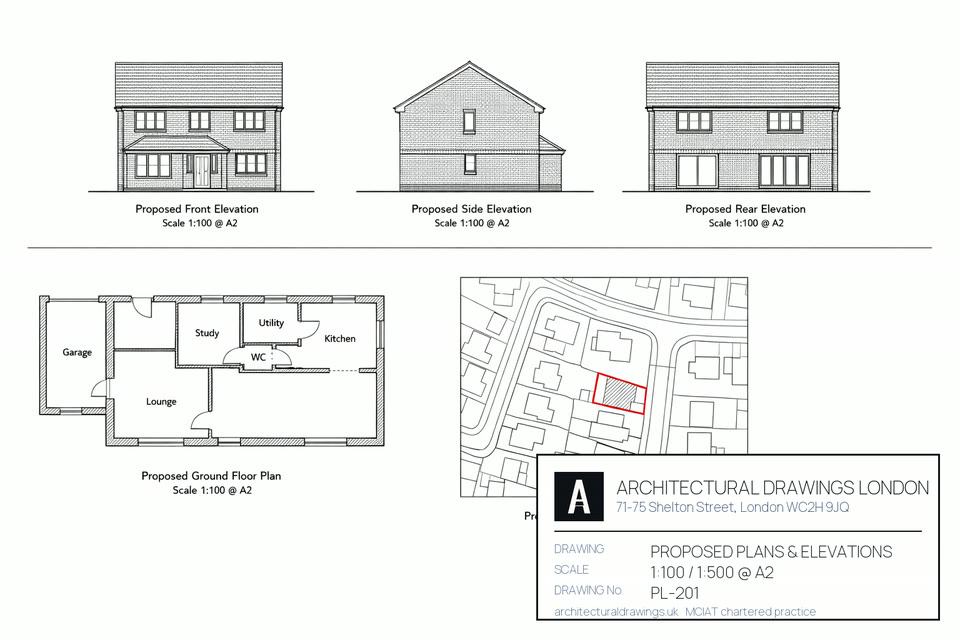
- Site location plan at 1:1250 or 1:2500 scale. This shows the property in its wider context, with the application site outlined in red and any other land in the applicant's ownership outlined in blue. The plan must include at least two named roads and surrounding buildings for orientation.
- Block plan (site plan) at 1:200 or 1:500 scale. This shows the property boundaries, the footprint of the existing and proposed buildings, access points, and the relationship to neighbouring properties.
- Existing floor plans at 1:50 or 1:100 scale. These show every floor of the existing building as it currently is, with room labels, dimensions, and indications of door and window positions.
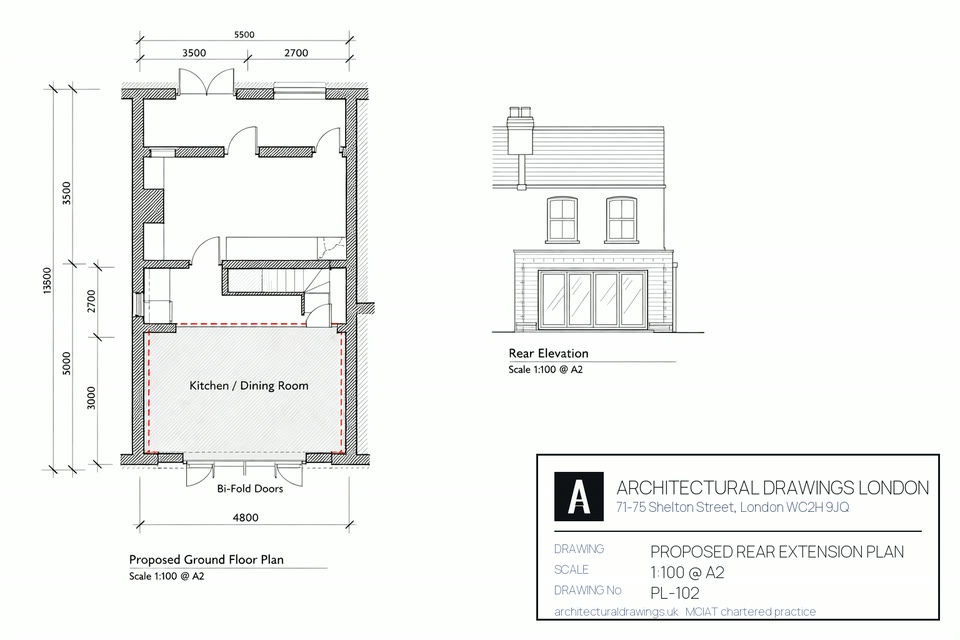
- Proposed floor plans at 1:50 or 1:100 scale. These show the layout after the proposed development, clearly indicating what is new, what is being demolished, and what is being retained.
- Existing elevations at 1:50 or 1:100 scale. These show the external faces of the building as they currently appear, including materials annotations.
- Proposed elevations at 1:50 or 1:100 scale. These show what the building will look like after the work, including new materials, window styles, and roof profiles.
- Existing and proposed roof plans (where the roof is being altered, e.g. for a loft conversion or mansard).
- Existing and proposed section drawings (for extensions, loft conversions, and any work that changes internal floor levels or roof structure).
Additional documents that may be required
- Design and Access Statement (D&AS) -- required for most applications in conservation areas and for major developments. Explains the design rationale, contextual analysis, and how accessibility has been considered.
- Heritage Statement -- required for applications in conservation areas and affecting listed buildings.
- Tree survey / Arboricultural Impact Assessment -- required if trees on or near the site could be affected.
- Flood Risk Assessment -- required if the site is in Flood Zone 2 or 3, or if the development exceeds 1 hectare in Flood Zone 1.
- Daylight/Sunlight Assessment -- may be requested by the council if the development could reduce light to neighbouring properties.
- Contamination assessment -- required for sites with potential contamination (former industrial or commercial use).
Our Essentials package includes all required drawings (items 1-8 above). Our Complete package adds the Design and Access Statement, Heritage Statement, and 3D visualisations to help the planning officer understand your proposal.
Common reasons planning is refused in London
Understanding why applications are refused can help you avoid the same mistakes. Based on our experience across all 33 London boroughs, here are the most common reasons for refusal:
- Overbearing impact on neighbours. The proposed extension is too large, too high, or too close to the boundary, causing an unacceptable loss of light, privacy, or outlook to neighbouring properties. This is the most common reason for refusal.
- Out of character with the streetscape. The design, materials, or scale of the proposal do not respect the character and appearance of the surrounding area. This is particularly common in conservation areas.
- Loss of garden space. London boroughs increasingly protect garden land. If your extension covers more than 50% of the original garden area, or the remaining garden is considered too small for the size of dwelling, this can be a reason for refusal.
- Overlooking and loss of privacy. New windows or balconies that directly overlook neighbouring gardens or habitable rooms within 18 metres. This is a frequent issue with loft conversions and two-storey extensions.
- Poor design quality. Generic, low-quality, or out-of-proportion designs that do not demonstrate thoughtful consideration of the context. A Design and Access Statement helps you articulate the design rationale.
- Non-compliance with policies. The proposal conflicts with specific policies in the borough's Local Plan -- for example, basement development policies, rooftop extension policies, or minimum amenity space standards.
- Inadequate drawings or missing information. Applications submitted with insufficient detail, incorrect scales, or missing supporting documents. This is entirely avoidable with professional drawings.
How to avoid refusal
- Use a pre-application service to get the council's informal view before submitting.
- Instruct a professional who knows the borough's policies and has a track record of approvals.
- Design sensitively -- match materials, respect roof lines, maintain gaps to boundaries.
- Consider your neighbours -- 45-degree rule for daylight, no direct overlooking, reasonable boundary distances.
- Submit complete, accurate drawings -- do not give the council a reason to invalidate or request further information.
At Architectural Drawings London, our council-ready drawing review is a direct result of rigorous policy checking, borough-specific design knowledge, and meticulous drawing quality. We review every project against the relevant Local Plan policies before submission. Get a free quote to discuss your project.
Planning appeals
If your planning application is refused, you have the right to appeal to the Planning Inspectorate (PINS). An appeal is an independent review of the council's decision by a government-appointed planning inspector.
The appeal process
- Time limit. You must submit a householder appeal within 12 weeks of the refusal date. For other appeal types, the deadline is 6 months.
- Type of appeal. Most householder appeals are decided by written representations -- both you and the council submit your arguments in writing, and the inspector decides on the papers. More complex cases may involve a hearing (informal discussion chaired by the inspector) or a public inquiry (formal proceedings with legal representation).
- Cost. There is no fee for submitting an appeal. However, you will incur professional costs for preparing your appeal statement and any additional evidence. Typically £800-£2,000 for a written representations appeal on a householder case.
- Timeline. Written representations appeals are typically decided within 8-12 weeks of submission. Hearings take longer -- typically 16-24 weeks.
- Success rate. Nationally, around 30-35% of planning appeals succeed. However, success rates vary significantly depending on the quality of the original application, the strength of the council's reasons for refusal, and the quality of the appeal submission.
Costs awards
In some cases, the inspector can award costs against the council if the refusal was unreasonable -- for example, if the council failed to give clear reasons for refusal, or refused permission on grounds that are contrary to established policy. Costs awards are relatively rare but can reimburse your professional fees. Equally, the council can apply for costs against you if your appeal is deemed to have been without merit.
Before appealing, consider whether it might be more effective to submit a revised application that addresses the council's reasons for refusal. A revised application is free of charge if submitted within 12 months of the original decision, and it avoids the uncertainty and delay of the appeal process.
Frequently asked questions
Do I need planning permission for a loft conversion in London?
Most loft conversions in London fall under Permitted Development (PD) rights and do not require planning permission, provided the property is not in a conservation area or subject to an Article 4 Direction. Dormer loft conversions that face the highway, mansard conversions, and conversions on flats always need planning permission. The volume of the roof extension must not exceed 40 cubic metres for terraced and semi-detached houses, or 50 cubic metres for detached houses. Even when PD applies, we recommend applying for a Lawful Development Certificate (LDC) -- it costs £274 and provides formal confirmation for future property sales. See our loft conversion service.
How much does a planning application cost in London?
A householder planning application in London costs £548 in council fees (2026 rate). On top of that, you need professional drawings. At Architectural Drawings London, making a typical total cost between £1,098 and £2,008 for a straightforward householder application. Major applications have higher council fees starting at £610. View our full pricing.
How long does planning permission take in London?
The statutory determination period for a householder planning application in London is 8 weeks. Major applications have a 13-week determination period. In practice, many London boroughs exceed these targets due to high caseloads. Pre-application consultation typically takes 4-6 weeks. From initial instruction to final decision, expect 12-16 weeks for a straightforward householder application, or 16-22 weeks if you include a pre-application stage.
Can I build without planning permission?
Yes, many home improvements fall under Permitted Development (PD) rights and do not need planning permission. This includes single-storey rear extensions up to 6 metres (detached houses up to 8 metres under Prior Approval), loft conversions within volume limits, and internal alterations. However, PD rights can be removed by Article 4 Directions or if your property is in a conservation area. Always check with your local planning authority or apply for a Lawful Development Certificate to confirm your development is lawful before starting work.
What happens if I build without planning permission?
Building without the required planning permission is a breach of planning control. The council can issue an enforcement notice requiring you to undo the work, and failure to comply is a criminal offence. Even if the council does not take action immediately, the breach stays on record and will cause problems when you try to sell the property. Buyers' solicitors will flag the lack of approval, and mortgage lenders may refuse to lend against the property. Retrospective planning permission can be applied for, but approval is not guaranteed -- the council assesses it against the same policies as any other application.
Do I need an architect for planning permission?
You do not legally need an architect to apply for planning permission. You need accurate, scaled drawings showing the existing and proposed plans, elevations, and site layout. These can be prepared by an architectural technologist, a building designer, or an architect. CIAT-affiliated architectural technologists specialise in the technical drawing and regulatory side of construction projects.Learn more about our planning drawings service.
What is a Lawful Development Certificate?
A Lawful Development Certificate (LDC) is a formal legal document from your local planning authority confirming that a proposed development is lawful and does not require planning permission. There are two types: a "proposed" LDC (for work you plan to do) costing £274, and an "existing" LDC (for work already completed) costing £548. We strongly recommend obtaining an LDC for any Permitted Development project, as it provides legal certainty and prevents issues when selling the property. Your conveyancing solicitor and the buyer's mortgage lender will both want to see evidence that work was done lawfully.
How do I find my local planning authority in London?
In London, your local planning authority (LPA) is your borough council. There are 33 London boroughs, each with its own planning department and Local Plan. You can find your LPA by entering your postcode on the Planning Portal (planningportal.co.uk). Each borough has different policies, conservation areas, and Article 4 Directions, so it is important to check the specific rules that apply to your property. Browse all 33 London boroughs to find your local page with borough-specific planning guidance.