TL;DR — Key Facts
- Dormer loft conversion: £40,000 – £60,000 (outer London borough)
- Mansard conversion: £60,000 – £95,000
- Velux conversion: £25,000 – £40,000
- Planning permission: Generally available for rear dormers
- Conservation areas: 20 in Barnet
What does a loft conversion cost on a Barnet 1930s semi?
Barnet is dormer country: 8,832 rear dormer applications in the Datahub at 76% approved, against 1,045 loft conversions at 80%. A hip-to-gable plus rear dormer is the standard move on an inter-war semi, and Barnet issued 2,585 lawful development certificates in three years.
| Measure | Barnet | Outcome |
|---|---|---|
| Rear dormer applications in the Datahub | 8,832 | 76% approved |
| Loft conversion applications in the Datahub | 1,045 | 80% approved |
| Lawful development certificates issued | 2,585 | — |
| Householder decisions | 4,584 | 83.5% approved |
| Conservation areas | 16 | 1,243 hectares |
| Householder appeals decided | 927 | 49.1% allowed, median 76 days |
Sources: rows one and two from the Planning London Datahub, retrieved 15 August 2026 — phrase-matched descriptions, comparable within Barnet only. Rows three and four from MHCLG PS1 and PS2, twelve quarters to March 2026. Row five from planning.data.gov.uk, retrieved 1 September 2026. Row six from Planning Inspectorate casework decided 2016–2026, where Barnet’s 49.1% allowed rate is the second highest in London, behind Hounslow. Build costs on this page are our own 2026 London range.
What does a Barnet loft cost by roof type?
Costs are the subject here. For the submission itself — routes, drawings, timescales — see loft conversions in Barnet.
Type of conversion sets the budget; the borough only shifts it at the margins. Barnet's housing is mostly interwar and suburban — of its 160,460 dwellings, 21.2% date from the 1930s, more than any other build period recorded, and those semis with their generous hipped roofs are the reason hip-to-gable comes up here far more than it does in inner London. Shares as at 31 March 2025. Contains public sector information licensed under the Open Government Licence v3.0
Loft conversion build costs in Barnet
Those are construction figures. They exclude what you pay us, what the structural engineer and any party wall surveyor charge, and the council's own application fee. Four things then move the number: how big the loft is, how far the fit-out specification goes, whether the existing structure needs more steel than usual, and how hard the site is to get materials into. A Mill Hill detached with side access is a different job from a Cricklewood terrace with a hallway and nothing else.
A dormer commonly yields somewhere between 20 and 30 usable square metres; a mansard yields 30 to 50, with full standing height right across the plan. What that is worth is a separate question, and honest answers are local. Half of all Barnet homes sold in 2025 changed hands between £407,000 and £850,000, with the midpoint at £583,000 across 3,567 recorded transactions — barely moved on 2024's £580,000. On stock priced like that, an extra bedroom and bathroom is normally worth having; nobody can promise you a fixed percentage back, and anyone quoting one is guessing. Contains HM Land Registry data (c) Crown copyright and database right 2026
Which loft type suits Barnet properties?
Hip-to-gable with a rear dormer is the default on a Finchley or Edgware semi and generally the only configuration that produces full standing height across the floor. On the Edwardian villas around Muswell Hill and Church End the roof is often deep enough for a rear dormer alone. In Hampstead Garden Suburb, assume neither: the Suburb's own design controls treat the roofline as part of a designed composition and a visible dormer is rarely acceptable.
Hip-to-gable and dormer combinations
Barnet carries the second-largest housing stock in London — 160,460 homes, behind Croydon's 168,250 — and 21.2% of it went up in the 1930s, against 6.5% before 1900 (VOA council tax stock by build period at 31 March 2025, retrieved 1 September 2026). Hipped roofs on semis, in other words, are the borough's characteristic problem, and squaring the hip into a full gable with a rear dormer behind it is the characteristic answer, worth 25 to 35 square metres. The Barnet-specific caution is what the council does with the notification. It determined 935 larger-householder prior approvals in the twelve quarters to March 2026 and refused 352 of them — 37.6%, against 24.9% across London and the fifth highest refusal share of the twenty-seven boroughs with a publishable rate (MHCLG planning statistics, retrieved 1 September 2026). Those are rear extensions rather than roofs, but they tell you something about the officer culture: the notification route is not treated as a formality here, and a scheme sent in thin gets sent back.
Velux (rooflight) conversions
A rooflight scheme fits inside the roof as built, so nothing about the outline changes and there is nothing for a case officer to assess. Where it comes into its own in Barnet is Hampstead Garden Suburb, which is both a conservation area and subject to its own scheme of management, and where a dormer proposal on a visible elevation is close to a wasted fee. It is also the route people take when they want the certainty rather than the space: Barnet recorded 2,585 certificates of lawful development in the twelve quarters to March 2026 (MHCLG planning statistics, retrieved 1 September 2026). The national return does not split those into granted and refused for any English authority, so the figure is a measure of how many owners here want their permitted development put beyond argument before they sell, not a success rate.
Does a Barnet loft need planning permission?
Most of Barnet is 1930s semi-detached with a hipped roof, which sets the shape of the job before planning is even considered: the hip has to become a gable before the ridge runs far enough to be useful. Barnet issued 2,585 lawful development certificates in three years, more than any London borough (MHCLG planning statistics, retrieved 1 September 2026), and a large share of those are exactly this conversion being confirmed as permitted rather than applied for.
Permitted Development for lofts
Rear dormers and Velux schemes usually clear without a planning application, because the General Permitted Development Order already allows them. The conditions that decide it:
- The dormer must not exceed the highest part of the existing roof
- The dormer must be set back at least 200mm from the eaves
- Materials must be similar in appearance to the existing house
- No verandas, balconies, or raised platforms
- Side-facing windows must be obscure-glazed and non-opening below 1.7m
- Volume limit: 40 cubic metres for terraced houses, 50 cubic metres for others
Conservation areas
Hampstead Garden Suburb, Monken Hadley, Mill Hill, Hendon and Golders Green are the designations most Barnet loft schemes run into, and inside any of them article 2(3) removes the roof enlargement allowance, so a dormer becomes a householder application judged against that area's character appraisal. What is unusual about Barnet is what happens next. Of 927 householder appeals against the council decided between 2016 and 2026, 455 were allowed — 49.1%, against 35.6% for England and second only to Hounslow among the thirty-three boroughs (Planning Inspectorate casework, retrieved 1 September 2026). That is an appeal statistic and nothing more: the people who appeal are the refused minority who chose to fight, so it says nothing about the odds on a first application, which Barnet grants at 83.5% for householder work. What it does say is that a Barnet refusal on a well-evidenced roof scheme is close to a coin toss on review, and worth a considered second look before you redesign it away.
Mansard planning permission
Because a mansard alters the roof's height and profile, permission is required for one everywhere. In Barnet it is seldom the natural choice - the borough is interwar semis with hipped roofs, where a hip-to-gable and rear dormer gives more usable floor for less money. The exception is Hampstead Garden Suburb, where the roofline is part of a designed composition and neither form is likely to be acceptable.
Barnet publishes its own pre-application charges; use that scale rather than a generic figure. The case for paying it here is narrow, because most Barnet work is permitted development - the borough issued 2,585 certificates in three years (MHCLG planning statistics, retrieved 1 September 2026). Buy the advice for a Hampstead Garden Suburb address or a conservation-area scheme, not for a standard rear dormer.
Our drawing fees for loft conversions in Barnet
Architectural Drawings London. Our MCIAT chartered technologists produce the drawing set for the planning submission, where one is needed, and the fuller technical set that building regulations approval turns on.
Drawing fees for loft conversions
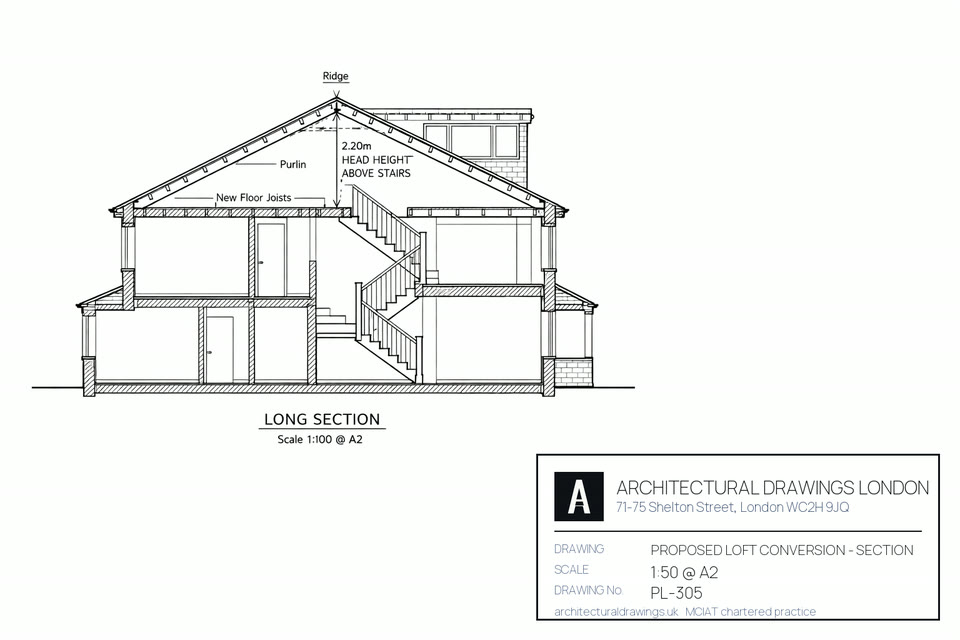
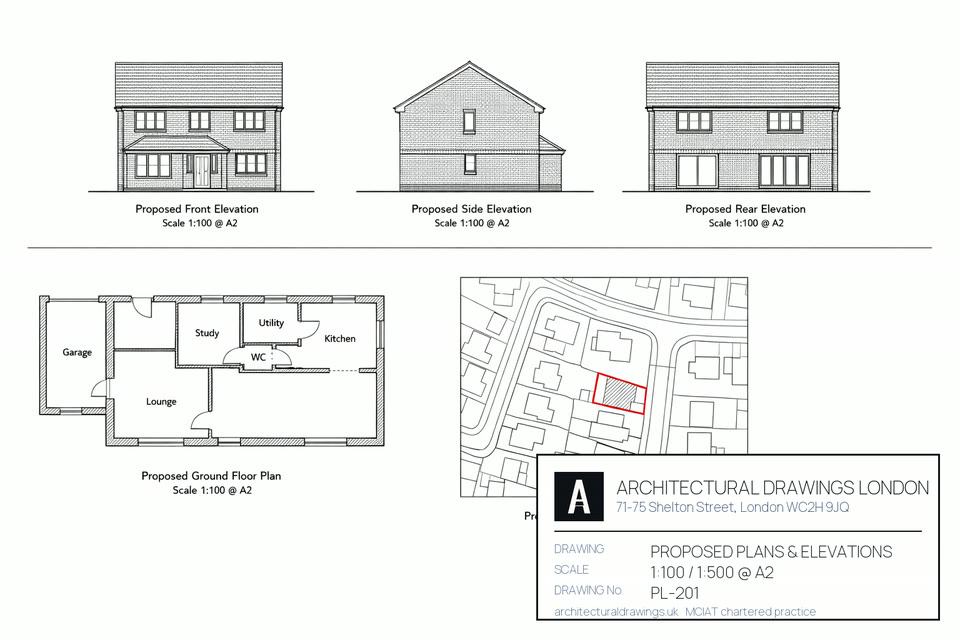
Every package starts with a measured survey recording the building exactly as built, and out of it come floor plans before and after, elevations, a plan of the roof, sections cut through the new stair, and the site plan. Mansards need more: a streetscene elevation setting the new roof beside its neighbours, plus the design and access statement that explains it. Set against what an architect's practice in the capital charges for identical scope, our fee comes in about 30% lower.
We work across N2, N3, N11, N12, N20, NW2, NW4, NW7, NW9, NW11, EN4 and EN5. Two more get listed as Barnet on other sites and should not be: N10 is Muswell Hill, which Haringey determines, and N14 is Southgate, which is Enfield's. Both border the borough; neither is validated by it.
Frequently asked questions
How much does a loft conversion cost in Barnet?
Type drives the cost far more than postcode does. Building a rear dormer in the borough is typically a £40,000 to £60,000 job. A mansard, which reconstructs the roof instead of pushing a box out of it, costs £60,000 to £95,000. Leave the roof line untouched and put in a Velux conversion instead: £25,000 to £40,000. Construction only; professional and council fees sit outside all three.
Do I need planning permission for a loft conversion in Barnet?
In most of the borough, yes. Barnet has no borough-wide Article 4 Direction and 20 conservation areas, so a rear dormer within the 50 cubic metre allowance for a semi, set back from the eaves and away from the highway, is usually permitted. A mansard is not, anywhere. Hampstead Garden Suburb is the exception that catches people: its Scheme of Management is a separate consent from planning permission and applies whatever the permitted development position.
What is the minimum head height for a loft conversion in Barnet?
Barnet's 1930s semis generally clear the working threshold of 2.2 metres at the apex — the difficulty is width, not height, because the hipped end cuts the usable floor back sharply. A hip-to-gable recovers it. The survey settles which you are dealing with.
Do I need a Party Wall Agreement for a loft conversion in Barnet?
On a semi, yes — and Barnet is mostly semis. The beam that carries a new floor typically bears into the party wall, which is notifiable work under the Party Wall etc. Act 1996 regardless of whether planning permission is needed. Serve the notice two months before work begins. Where the conversion also raises the party wall to take a hip-to-gable, that is a second class of notifiable work and should be in the same notice.
Can I get a mansard loft conversion approved in Barnet?
Mansards get judged individually, never by rule. The questions are what the new roof does to the street read as a whole, whether the address sits in a conservation area, the quality of the detailing, and whether anything comparable has already been permitted nearby. The last of those does real work. Where a comparable roof already stands a few doors down and was permitted, that consent is the single strongest thing a mansard application can put in front of an officer.