TL;DR — Key Facts
- Dormer loft conversion: £40,000 – £60,000 (outer London borough)
- Mansard conversion: £60,000 – £95,000
- Velux conversion: £25,000 – £40,000
- Planning permission: Generally available for rear dormers
- Conservation areas: 24 in Enfield
What does an Enfield loft conversion cost, and is it permitted development?
Usually not, and Enfield is set up to confirm that quickly. It recorded 1,810 certificates of lawful development in the twelve quarters to March 2026 against 2,814 householder decisions — roughly two certificates for every three applications — and of 868 larger extensions put through prior approval, 680 were told approval was not required. The reason the answer comes back fast is a number nobody publishes: Enfield agreed an extension of time on only 6.7% of its decisions, the lowest share of any London borough, where the capital averages 34.5%. This council works to the eight-week clock rather than around it.
| Measure | Enfield | Outcome |
|---|---|---|
| Rear dormer applications in the Datahub | 4,898 | 76% approved |
| Loft conversion applications in the Datahub | 116 | 79% approved |
| Lawful development certificates issued | 1,810 | — |
| Householder decisions | 2,814 | 77.8% approved |
| Decided inside eight weeks | 91.0% | — |
| Householder appeals decided | 612 | 34.6% allowed, median 63 days |
Sources: rows one and two from the Planning London Datahub, retrieved 15 August 2026 — phrase-matched descriptions, comparable within Enfield only. Rows three to five from MHCLG PS1 and PS2, twelve quarters to March 2026. Row six from Planning Inspectorate casework decided 2016–2026. Build costs on this page are our own 2026 London range, not a published statistic.
What does an Enfield loft cost by roof type?
This is the cost picture. The service page for loft conversions in Enfield covers the submission itself.
Type sets the range and the roof structure moves you within it. Enfield spreads across three quite different vintages — 10.7% of its homes predate 1900, 12.7% came between 1900 and 1918, and 28.3% went up in the 1930s — so the answer to what your loft will cost depends less on the borough than on which of those three you live in. Cut rafters in an Edwardian roof give you a clear space to work with. A 1930s hipped roof needs the hip dealt with before anything else. Anything post-1965 is likely trussed, and that is a structural redesign rather than a conversion.
Loft conversion build costs in Enfield
Build cost only. Drawings, the structural engineer, a party wall surveyor where you share a wall, and the council's fee all sit on top. One thing that genuinely helps a budget in this borough is the timetable. Because Enfield agrees an extension of time on only 6.7% of decisions, the eight-week determination period is close to a real date rather than a nominal one, which means a builder's start date booked off the back of it tends to hold. That is worth money on a job where the scaffold and the roofer have to arrive in the same week.
Enfield's Edwardian villas at Palmers Green and Winchmore Hill are the stock most likely to reach the top of a dormer's usual 20-30 square metres without further work, because the roofs are deep to start with. Edmonton's Victorian terraces sit lower and return less from the same footprint.
Which loft type suits Enfield properties?
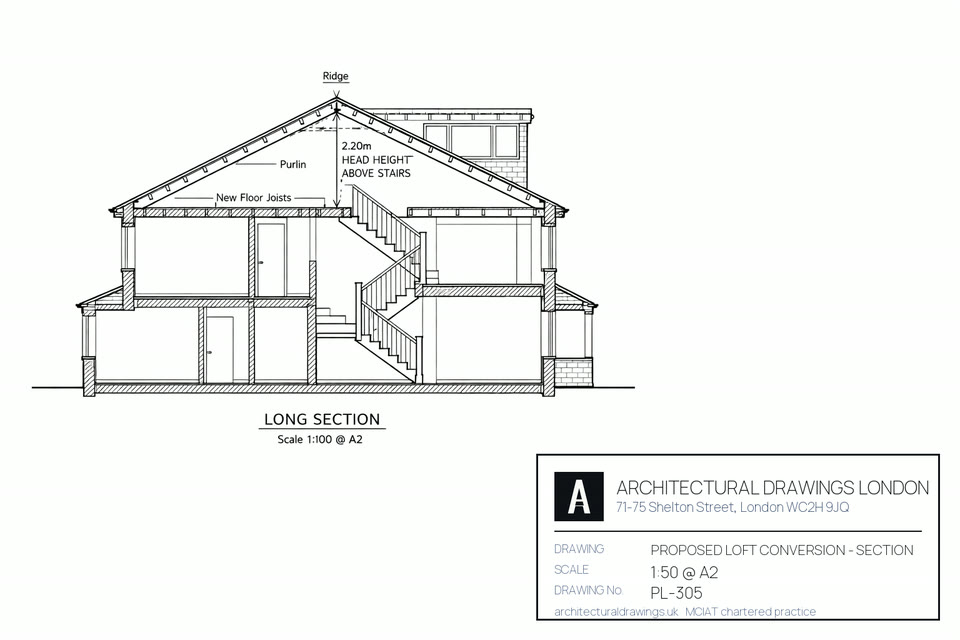
The Palmers Green and Winchmore Hill villas have the deepest roofs in the borough and often convert with a rear dormer alone. A Southgate semi needs the hip removing first. Edmonton's Victorian terraces are lower and tighter, and a rooflight conversion is sometimes all the head height supports — worth measuring from the top of the ceiling joist to the underside of the ridge before any design work.
Dormer loft conversions
Enfield's terraces run mostly through Edmonton, Palmers Green and the older parts of Enfield Town, and on those a flat-roofed rear dormer is the standard answer — 20 to 30 square metres, no application, provided it stays below the ridge, sits back 200mm from the eaves, matches the existing materials and keeps inside the 40-cubic-metre allowance for a terraced house. Where people come unstuck is on the borough's very large interwar stock instead: 28.3% of Enfield's 128,340 homes were built between 1930 and 1939, against 16.0% across London (VOA council tax stock, 31 March 2025), and those are semis with hipped ends rather than terraces with straight ridges. A plain rear dormer on a hipped roof wastes most of what you paid for.
Mansard loft conversions
A mansard takes the roof off and rebuilds it as a steep face with a shallow cap, giving a full storey at standing height rather than a room with sloping shoulders. It always needs planning permission. In Enfield it is rarer than in the inner boroughs and for a straightforward reason: the mansard is a terrace form, and Enfield is mostly not terraces. Where it does come up, on the older stock around Enfield Town and Edmonton, expect the case to turn on whether the street already carries any. Bear in mind the wider record here — the council granted 77.8% of householder applications in the twelve quarters to March 2026, a little under the London figure of 83.0%, so a marginal roof form is not a safe bet in this borough.
Hip-to-gable and dormer combinations
Given the shape of Enfield's housing this is the combination that pays. Squaring the hipped end into a gable and then adding the rear dormer recovers the width you lose at the sloping corner, and takes the usable floor from around 20 to 30 square metres up to 25 to 35. Semi-detached and detached houses have 50 cubic metres of roof enlargement to play with rather than the terrace's 40, which is usually enough for both operations together. The gable must not go above the existing ridge and must not come forward of the front wall. On a £680,000 median semi — 561 of them changed hands in Enfield in 2025 — the additional structural cost of the gable is small against what the extra floor area is worth (HM Land Registry Price Paid Data).
Velux (rooflight) conversions
Windows in the existing slope, roof shape untouched, about half the cost of a dormer. Because nothing projects, it is normally permitted development even inside one of the borough's 24 conservation areas when the windows go on a rear slope, which makes it the realistic option in Bush Hill Park, Winchmore Hill or Grange Park. Check head height first — the clear distance from the ceiling joists to the underside of the ridge needs to be around 2.4 metres before you allow for insulation and the new floor. The 1930s roofs that dominate Enfield often have it; anything trussed from the late 1960s onward usually does not.
Does a Southgate loft need planning permission?
Enfield divides between Edwardian villas at Palmers Green and Winchmore Hill, interwar semis around Southgate, and Victorian terraces in Edmonton, with Green Belt across the north. There is no borough-wide Article 4 Direction and 22 conservation areas, so most loft conversions here are a structural question rather than a planning one. The borough's 692 contravention notices in three years (MHCLG planning statistics, retrieved 1 September 2026) are a reason to document the position rather than assume it.
Permitted Development for lofts
Most rear dormer and Velux loft conversions fall under Permitted Development and do not require a planning application. The key PD conditions are:
- The dormer must not exceed the highest part of the existing roof
- The dormer must be set back at least 200mm from the eaves
- Materials must be similar in appearance to the existing house
- No verandas, balconies, or raised platforms
- Side-facing windows must be obscure-glazed and non-opening below 1.7m
- Volume limit: 40 cubic metres for terraced houses, 50 cubic metres for others
Conservation areas
Twenty-four sit in the national register for Enfield, covering about 845 hectares. Three of them were designated in 1968, in the first wave after the Civic Amenities Act: Enfield Town, reference CA01, at 64.1 hectares; Forty Hill, CA02, at 120.3; and Southgate Green, CA17, at 31.4. Trent Park, CA18, is much the largest at 389.5 hectares and dates from 1973, and the newest is the Lakes Estate, CA31, from 2010. The register stores only the year for each, so we do not give a day. Inside any of them a dormer or rooflight on a roof slope facing a highway loses its permitted right, and Bush Hill Park is where this matters most for lofts — it is a coherent late-Victorian and Edwardian suburb where the front roof planes read as one composition (planning.data.gov.uk, retrieved 1 September 2026).
Mansard planning permission
Because it changes the roof's height and shape, a mansard needs permission wherever it is proposed. Enfield's Edwardian villas at Palmers Green and Winchmore Hill have the roof depth to make a rear dormer sufficient, and the Southgate semis suit a hip-to-gable, so a mansard is rarely the efficient answer here. Edmonton's Victorian terraces are the exception where the form fits the building.
Enfield publishes its own pre-application charges - use those. The stronger argument for engaging early in this borough is its investigative record: 692 contravention notices in three years, more than anywhere in London (MHCLG planning statistics, retrieved 1 September 2026). Getting the position established on paper before work starts is worth more here than the advice itself.
Our drawing fees for loft conversions in Enfield
Our fee is fixed and quoted before the survey. In Enfield the first question is almost always whether you need an application at all — and given how many certificates this council records, it is a question with a good chance of a helpful answer. An MCIAT chartered architectural technologist prepares the survey, the certificate or planning submission, and the building regulations package.
Drawing fees for loft conversions
Every package includes a measured survey, existing and proposed floor plans and elevations, roof plan, sections, and a site plan. For mansard conversions, we also prepare a design and access statement and streetscene elevation. Our fees are 30% below typical London architect rates for the same scope of work.
We cover all Enfield postcodes: EN1, EN2, EN3, N9, N11, N13, N14, N18, N21.
Frequently asked questions
How much does a loft conversion cost in Enfield?
Loft conversion costs in Enfield vary by type. A rear dormer loft conversion typically costs £40,000 to £60,000. A mansard conversion costs £60,000 to £95,000. A Velux (rooflight only) conversion costs £25,000 to £40,000. These are build costs only.
Do I need planning permission for a loft conversion in Enfield?
Generally yes, outside the 22 conservation areas: no Article 4 Direction applies borough-wide, and Enfield issued 1,810 lawful development certificates in three years (MHCLG planning statistics, retrieved 1 September 2026). A rear dormer within the volume allowance, away from the highway, is the normal permitted form; a mansard is not. Given how actively this council investigates suspected unauthorised work, the certificate is the cheap part of the job.
What is the minimum head height for a loft conversion in Enfield?
Enfield's Edwardian villas at Palmers Green and Winchmore Hill are among the more generous roofs in north London and usually clear it easily. Edmonton's Victorian terraces are lower and tighter, and it is worth taking the measurement there before any design work, because the answer decides whether a dormer is even the right form.
Do I need a Party Wall Agreement for a loft conversion in Enfield?
Yes on the terraces and semis, which is most of the borough. Where beams land in the dividing wall, or that wall goes up to make a gable end, statutory notice runs a clear two months ahead under the 1996 party wall regime. Detached properties on the Green Belt fringe may escape the beam provisions, but excavation within three metres of an adjoining foundation is separately notifiable and easy to overlook.
Can I get a mansard loft conversion approved in Enfield?
Enfield assesses mansard applications on a case-by-case basis. Enfield Council will consider the impact on the streetscene, conservation area status, design quality, and any existing precedents on your street.