Key facts at a glance
- Rear extensions add 15–30 sqm; side returns add 4–12 sqm
- Rear build cost: £55,000–£120,000 | Side return: £40,000–£75,000
- Both can be Permitted Development — but side extensions lose PD in conservation areas
- Wraparound (both combined) maximises space: 20–40+ sqm
- council-ready drawing review across all 33 London boroughs
Rear or side return — which one is easier to get through planning?
Neither is inherently easier. A rear extension can use permitted development depth — 3m on a terrace, 6m under prior approval. A side return is also permitted development at up to half the original house width, but wrapping it around the back takes the scheme outside Class A and into a full application.
| Permitted development limit | Terrace or semi-detached | Detached |
|---|---|---|
| Rear extension depth, single storey | 3m | 4m |
| Rear extension depth under prior approval | 6m | 8m |
| Maximum height within 2m of a boundary | 3m at the eaves | 3m at the eaves |
| Side extension width | half the width of the original house | half the width of the original house |
| Side extension storeys and height | single storey, 4m maximum | single storey, 4m maximum |
| Total ground covered by extensions and outbuildings | 50% of the curtilage | 50% of the curtilage |
Source: Town and Country Planning (General Permitted Development) (England) Order 2015, Schedule 2, Part 1, Class A, as amended, read at 1 September 2026. None of Class A applies on Article 2(3) land — conservation areas, National Parks, AONBs and World Heritage Sites — where a side extension needs full permission whatever its width. London-wide, councils approved 83.0% of the 77,680 householder applications they decided in the twelve quarters to March 2026 (MHCLG PS1 and PS2).
The London homeowner's dilemma
If you own a terraced or semi-detached house in London and want more ground floor space, two options dominate the conversation: a rear extension that pushes the back of your house further into the garden, or a side return extension that infills the narrow alley alongside your rear addition. Both are proven ways to transform a cramped Victorian or Edwardian layout into a modern, open-plan living space. But they differ significantly in how much space they add, what they cost, how they affect your garden, and whether you need planning permission.
This guide compares the two options head-to-head across every factor that matters -- cost, space, planning, structural work, design impact, and timeline. If you are weighing up the two or considering a wraparound that combines both, this is the comparison you need before instructing a designer.
The short answer: how to choose
If you only read one paragraph: a side return buys you usable width in the room you already have, and a rear extension buys you a new room. On a standard London terrace the side return is usually the better value of the two, because infilling a 1.5 to 2 metre alley that currently grows nothing but moss turns a narrow galley kitchen into a room you can put a table in, and it costs you no garden. A rear extension adds more floor area per pound of construction, but it takes that area directly out of the garden, which on a short London plot is the scarcer commodity.
Three tests settle it in most cases:
- Is your kitchen narrow rather than short? If the problem is that two people cannot pass each other, width is what you are missing, and depth will not fix it. Side return.
- Is your garden already short? Under about 10 metres, a 3 metre rear extension is a noticeable loss of outdoor space and often a harder sell to a case officer on daylight grounds. Side return.
- Do you need a distinct new room rather than a bigger one? A garden room, a playroom, a proper dining space separate from the kitchen — that is what depth gives you. Rear extension.
The planning routes differ too, and it matters more than most people expect. A rear extension on a house often falls within permitted development, whereas a side return infill frequently does not, because the side infill sits beyond the original side wall and the permitted development allowance for a side extension is half the width of the original house and single storey only. Neither route is inherently harder to get approved — but one is a certificate and the other is an application, and that changes the timeline. The detail is in the planning section below.
Space: how much do you actually gain?
Side return extension
A side return extension infills the narrow strip between the rear addition of your house and the garden boundary wall. On a typical London Victorian terrace, this strip is 0.9 to 1.8 metres wide and 4 to 6 metres deep. The additional floor space is therefore typically 4 to 12 sqm.
That does not sound like a lot on paper. But the impact is transformative because the side return opens up the full width of the house at ground floor level. Instead of a cramped galley kitchen in a 2.5-metre-wide rear addition, you get a wide, light-filled room of 4 to 5 metres across -- enough for a proper kitchen-diner with an island, dining table, or seating area.
Rear extension
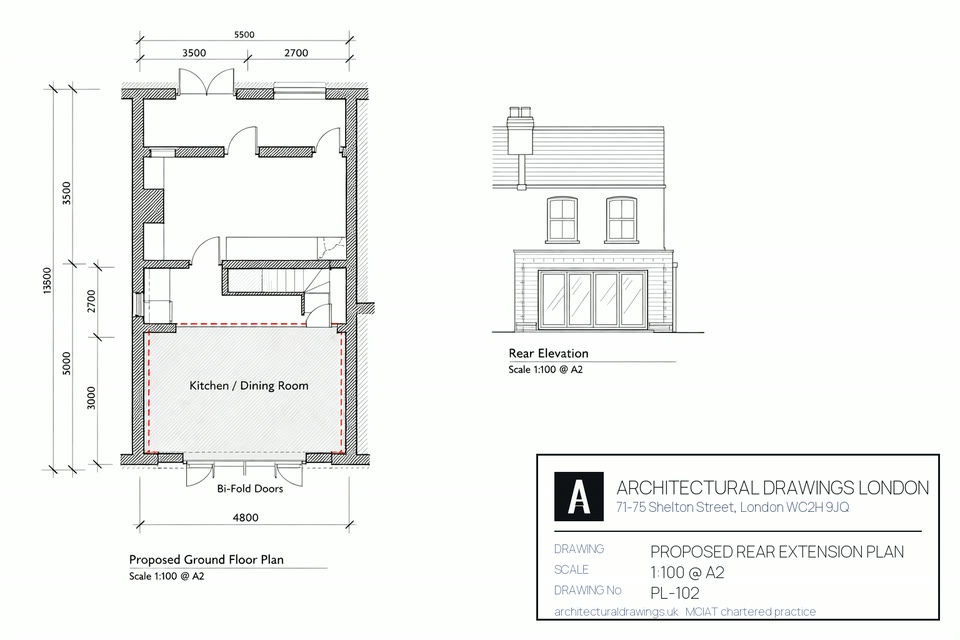
A single-storey rear extension pushes the back wall of the house further into the garden. Under Permitted Development, you can extend up to 6 metres from the original rear wall for a terraced or semi-detached house (or 8 metres for detached houses via Prior Approval). At the full width of the house (typically 4 to 5 metres for a terraced property), that is 15 to 30 sqm of additional floor space.
A rear extension adds genuinely new floor area in a way that a side return does not. The side return is reclaiming wasted space; the rear extension is creating new space from garden. For households that need a large family kitchen-diner, utility room, or open-plan living-dining-kitchen, a rear extension delivers considerably more room.
Wraparound: the best of both
A wraparound extension combines a side return infill with a rear extension. This is arguably the most popular extension type on London terraced houses because it maximises the ground floor footprint, creating an L-shaped or full-width ground floor that can be 20 to 40+ sqm larger than the original layout. For our complete guide to wraparound extensions, see our wraparound extension guide.
Cost comparison
London build costs for extensions are typically £3,000 to £4,500 per square metre in 2026, depending on specification and location. Here is how the total project costs compare.
| Cost element | Side return | Rear extension |
|---|---|---|
| Build cost | £40,000–£75,000 | £55,000–£120,000 |
| Structural steel (RSJ) | £2,500–£5,000 | £3,000–£7,000 |
| Foundations | Strip or trench fill | Strip, trench, or piled |
| Roof | Flat or glazed | Flat, pitched, or glazed |
| Architectural drawings (our fees) | ||
| Building regs drawings | ||
| Planning fees (if needed) | £548 householder | £548 householder |
| Party Wall | £1,000–£2,500 | £700–£2,000 |
| Total project cost | £55,000–£115,000 | £70,000–£160,000 |
Side return extensions are cheaper in absolute terms because they are smaller. But the cost per square metre is often similar because both require foundations, structural steelwork, drainage, and similar finishes. The key difference is in the total amount you spend, not the rate.
Planning permission: the critical differences
Both types can qualify as Permitted Development (PD) -- meaning no planning application is needed. But the rules differ in an important way.
Rear extensions under PD
Rear extensions are treated under Class A of Part 1 of the GPDO. The key limits for single-storey rear extensions are:
- Maximum depth: 6m from the original rear wall (terraced/semi), or 8m (detached via Prior Approval)
- Maximum height: 4m (eaves 3m)
- Must not cover more than 50% of the garden
- Rear extensions are still permitted in conservation areas, but with reduced limits (3m terraced, 4m detached, no Prior Approval option)
Side extensions under PD
Side extensions also fall under Class A, but with a crucial restriction: side extensions are NOT permitted under PD in conservation areas. This matters enormously in London, where conservation areas cover large portions of the most popular boroughs -- Islington, Camden, Hackney, Lambeth, Kensington and Chelsea, and Westminster.
If your property is in a conservation area and you want a side return extension, you will need a householder planning application (£548 fee, 8-week target decision).
Article 4 Directions
Some London boroughs have Article 4 Directions that remove PD rights for certain types of development, even outside conservation areas. We check PD status as part of every project. If you are unsure, request a free quote and we will confirm your PD position before you commit.
Design impact: how each changes your home
Side return: width over depth
A side return extension widens your ground floor. The most common use is to create an open-plan kitchen across the full width of the house (4 to 5 metres) rather than the narrow rear addition (2.5 to 3.5 metres). This is particularly effective because you gain light from both sides -- the existing rear windows and new rooflights or a glazed roof over the former alleyway.
The garden is not affected at all, which is a significant advantage in London where outdoor space is precious. You are only infilling a strip that was previously used for bins and the gas meter.
Rear extension: depth over width
A rear extension pushes the ground floor deeper into the garden. This creates genuinely new room -- enough for a separate utility space, a large seating area, or a dining zone. The trade-off is garden loss: a 6-metre-deep extension across 4.5 metres of width consumes 27 sqm of garden.
Rear extensions also create opportunities that side returns cannot: bi-fold or sliding doors across the new back wall, opening onto the garden and creating an indoor-outdoor feel. This is the single most requested design feature in London house extensions.
Light
Side return extensions excel at bringing light into the centre of the house -- the rooflights over the former alleyway wash the kitchen with overhead light from an unexpected direction. Rear extensions bring light primarily from the back (the new glazed doors) and from rooflights, but can sometimes make the middle of a deep room feel darker if not carefully designed.
Structural considerations
Both extensions require structural steelwork, but the engineering is slightly different.
A side return extension needs a steel beam (RSJ) to replace the load-bearing side wall of the rear addition. This beam carries the first floor and roof above. It is typically a single span of 3 to 5 metres. The steelwork itself costs £500–£1,500; installation and making good brings the total to £2,500–£5,000.
A rear extension needs a beam where the new extension meets the existing rear wall -- this carries the first floor above the opening. If you are also removing the wall between the front and rear reception rooms (to create a fully open-plan layout), you will need a second beam. Total structural costs for a rear extension are typically £3,000–£7,000.
Foundations for a rear extension may be more complex if there are trees nearby (tree root influence zones require deeper foundations, sometimes piled foundations at £8,000–£15,000). Side return foundations are usually simpler because they are close to the existing house. For more on when you need structural engineering, see our structural engineer guide.
Party Wall implications
Both extensions are likely to trigger the Party Wall Act. A side return extension builds on or near the boundary with one neighbour (the side boundary). A rear extension may affect the rear neighbour if the foundations are within 3 or 6 metres of their building.
Party Wall surveyor costs in London are typically £700–£2,500 per neighbour, depending on whether the neighbour consents or dissents. Side return extensions are more likely to face objections because the new structure is directly alongside the neighbour's property. Rear extensions may not trigger the Act at all if the neighbour's building is far enough away.
Timeline comparison
| Stage | Side return | Rear extension |
|---|---|---|
| Architectural drawings | 2–3 weeks | 2–3 weeks |
| Planning permission (if needed) | 8 weeks | 8 weeks |
| Building regulations | 3–5 weeks | 3–5 weeks |
| Party Wall procedures | 2–8 weeks | 2–8 weeks |
| Construction on site | 10–12 weeks | 12–16 weeks |
| Total | 5–7 months | 6–9 months |
The main difference in timeline is on site: a rear extension is bigger and therefore takes longer to build. The pre-construction stages are essentially the same for both.
Which should you choose?
The answer depends on your priorities, your property, and your budget.
Choose a side return extension if:
- Your main goal is a wider, brighter kitchen-diner
- You want to keep your full garden
- You have a tight budget (under £80,000 total)
- Your house is a London terrace with the classic narrow rear addition
- Speed matters -- you want a shorter build programme
Choose a rear extension if:
- You need significantly more floor space (15+ sqm)
- You want bi-fold doors and an indoor-outdoor connection
- Garden loss is acceptable (or your garden is large enough to absorb it)
- You are in a conservation area where side extensions are not PD
- You are combining with a loft conversion and need maximum ground floor space
Choose a wraparound if:
- You want the maximum possible ground floor space
- Your budget allows £100,000+
- You are already doing a major project (loft, full refurbishment) and want to extend in one go
We design all three types of extension -- side return, rear, and wraparound -- across all 33 London boroughs. Our MCIAT chartered architectural technologists will assess your property and recommend the option that gives you the most space for your budget. Get a free quote.
Our drawing fees
Whether you choose a rear extension, side return, or wraparound, our drawing fees are the same -- and 30% below typical London architect rates.
Extension drawing fees
Get a free quote for your extension →
Frequently asked questions
Which adds more space: a rear or side extension?
A rear extension adds more total floor space -- typically 15 to 30 sqm under Permitted Development, compared with 4 to 12 sqm for a side return. However, a side return can feel more impactful because it transforms the width and light of the existing kitchen rather than simply extending the back of the house. For maximum space, a wraparound combining both adds 20 to 40+ sqm.
Is a side extension cheaper than a rear extension in London?
Yes, in absolute terms. A side return costs £40,000–£75,000 to build versus £55,000–£120,000 for a rear extension. The cost per square metre is similar (£3,000–£4,500/sqm) because both require foundations, structural steelwork, and similar finishes. The difference is total spend, not rate.
Do I need planning permission for a rear or side extension?
Both can fall under Permitted Development if they meet the size, height, and boundary conditions. The critical difference: side extensions are NOT permitted under PD in conservation areas, whereas rear extensions with reduced limits are still PD in conservation areas. Properties with Article 4 Directions may lose PD rights for both. We check PD status on every project. Read our PD guide.
Can I combine a rear and side extension?
Yes -- this is called a wraparound extension and is one of the most popular extension types in London. It combines a side return infill with a rear extension to create a large, L-shaped or full-width ground floor. The combined scheme may exceed PD limits, especially in conservation areas, so a planning application is often needed. Read our wraparound guide.
How long does a rear extension take vs a side extension?
A side return extension takes 10–12 weeks on site; a rear extension takes 12–16 weeks. Pre-construction timelines (drawings, planning, building regs, Party Wall) are similar for both, at 3–5 months. Total timeline from instruction to completion: 5–7 months for a side return, 6–9 months for a rear extension.