Key facts at a glance
- A structural engineer is needed for most extensions, loft conversions, and internal wall removals
- They design beams, foundations, and load paths — not the architectural design
- Typical costs: £500–£2,500 depending on project complexity
- Required for building regulations approval (Part A — Structure)
- Always use a Chartered Engineer (CEng) or IStructE member
When does a London project actually need a structural engineer?
Whenever load paths change: removing a wall, forming an opening, cutting roof members for a dormer, or underpinning next to a neighbour. Building control can require calculations at full plans stage, and must decide that application within five weeks. Part A is the requirement they are checking against.
| Work | Calculations normally required | Why |
|---|---|---|
| Removing a load-bearing wall | Yes | Beam sizing and padstone bearing, Part A |
| Forming an opening in a rear wall | Yes | Lintel or goalpost frame, Part A |
| Rear dormer cutting roof rafters | Yes | Trimming and new floor loading, Part A |
| Loft floor to habitable loading | Yes | Imposed load rises to 1.5 kN/m², Part A |
| Non-structural stud partition | No | No change to load path |
| Full plans decision period | — | 5 weeks, Building Regulations 2010 reg 14 |
Sources: the Building Regulations 2010 (as amended), Schedule 1 Part A and regulation 14; Approved Document A; and BS EN 1991-1-1 with its UK National Annex for imposed floor loading, which sets 1.5 kN/m² for a domestic floor. Read at 1 September 2026. A structural engineer’s calculations are submitted to building control, not to planning — the planning application does not assess structure at all.
What does a structural engineer do?
A structural engineer designs the structural elements of your building project -- the bones that hold everything up. While an architect or architectural technologist designs the layout, appearance, and spatial quality of your home, the structural engineer makes sure the building does not fall down.
On a typical London residential project, the structural engineer's work includes:
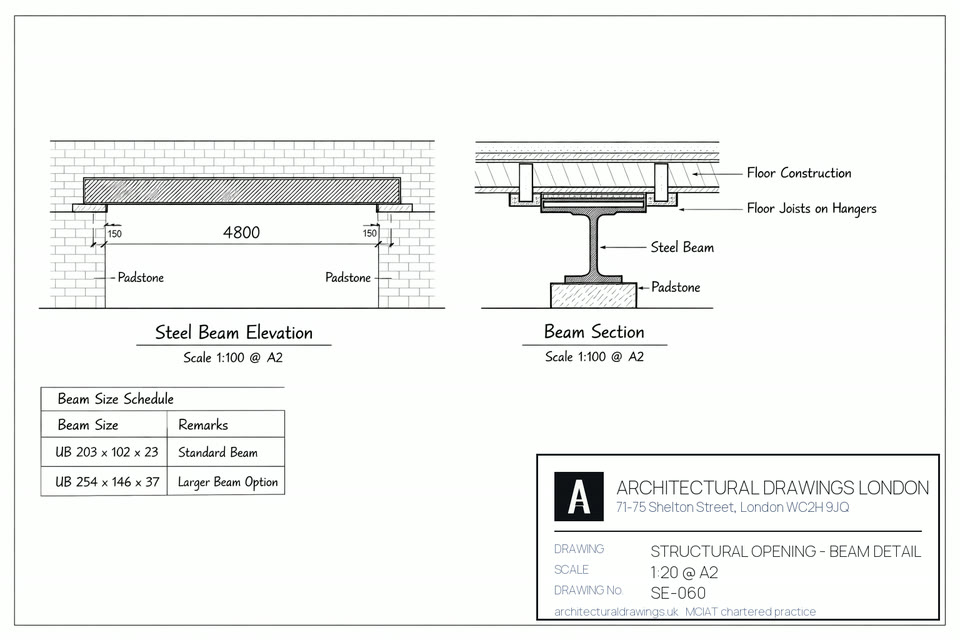
- Steel beam design (RSJs): calculating the size, grade, and bearing requirements of steel beams that replace load-bearing walls. This is the most common structural task in London home improvements -- opening up a kitchen by removing a wall requires a beam to carry the load above.
- Foundation design: specifying the type, depth, and dimensions of foundations for extensions. In London, ground conditions vary significantly between boroughs, and clay soils (common in south and west London) require deeper foundations than sandy soils.
- Load path analysis: tracing how loads (the weight of the roof, floors, walls, furniture, and people) travel through the building to the ground. This is essential when you change the structure -- removing a wall, adding a storey, or converting a loft.
- Loft conversion steelwork: designing the steel beams and columns needed to support a new floor, new roof structure, and dormer or mansard walls.
- Underpinning design: for basement conversions or when extending near trees on clay soil, the engineer may design underpinning to existing foundations.
- Temporary works: specifying the propping and support needed during construction while walls are removed and beams installed.
When do you need a structural engineer?
You need a structural engineer for any project that changes the structural behaviour of your building. In London residential work, the most common triggers are:
Extensions (rear, side return, wraparound)
Every extension needs foundations (designed by the engineer) and usually requires a steel beam where the extension meets the existing house (to open up the back wall). The engineer sizes the beam based on the loads above and specifies the foundation type and depth based on the ground conditions and proximity to trees.
Loft conversions
Loft conversions are structurally complex because you are converting a roof structure (designed only to support its own weight and wind loads) into a habitable floor (designed to support people, furniture, and partition walls). The engineer designs new floor joists or steels, reinforces the roof structure, and designs any dormer or mansard steelwork.
Internal wall removal
Removing a load-bearing wall to create an open-plan layout is one of the most common structural tasks in London. The engineer determines whether the wall is load-bearing (not always obvious), designs the replacement beam, specifies bearing pads, and provides drawings for building regulations and the builder.
Basement conversions
Basements are the most structurally complex residential project. The engineer designs underpinning to the existing foundations, waterproofing systems, retaining walls, and the new floor slab. In boroughs like Kensington and Chelsea, Camden, and Westminster, specialist basement engineers are essential. See our basement conversion guide.
Mansard roofs
A mansard roof replaces the existing roof structure entirely. The engineer designs the new mansard walls (which are structural, not just cladding), the new roof structure, and any necessary reinforcement to the existing walls and foundations to support the additional weight.
Structural engineer costs in London
| Project type | Structural engineer fee |
|---|---|
| Single beam calculation (wall removal) | £300–£600 |
| Rear or side extension | £800–£1,500 |
| Loft conversion (dormer or Velux) | £1,000–£1,800 |
| Mansard roof conversion | £1,200–£2,000 |
| Basement conversion | £2,000–£5,000+ |
| Full structural package (extension + loft + internal alterations) | £1,500–£2,500 |
We work with a panel of experienced structural engineers across London and coordinate the structural design with our architectural drawings, so everything is consistent and submission-ready.
Architect vs structural engineer: what's the difference?
This is a common point of confusion. The architect (or architectural technologist) designs what your home looks like and how the spaces work -- the floor plan layout, the room sizes, the window positions, the materials. The structural engineer designs how the building stands up -- the beams, columns, foundations, and load paths.
Both are essential. You cannot get building regulations approval without structural calculations. You cannot get planning permission without architectural drawings. On most London projects, the two professionals work together: the architect produces the design drawings, the structural engineer produces the structural calculations, and both are submitted together for building regulations approval.
At Architectural Drawings London, we coordinate this process. When you choose our Complete package, we commission the structural engineer, coordinate the design, and submit everything as a single package. You do not need to find or manage the structural engineer yourself.
How to find a good structural engineer
If you need to find a structural engineer independently, look for:
- Chartered status: CEng (Chartered Engineer) or IStructE (Institution of Structural Engineers) membership. These are the gold standards for structural engineering qualifications.
- London residential experience: structural engineering for London terraced houses is different from new-build commercial work. Look for engineers who regularly work on Victorian and Edwardian properties.
- Professional indemnity insurance: any structural engineer you use should carry PI insurance (minimum £1 million). This protects you if there is an error in their calculations.
- Clear communication: a good structural engineer explains their design decisions in plain English, not just in technical calculations. They should be willing to discuss options (e.g. steel beam vs timber beam) and their cost implications.
- Reasonable turnaround: structural calculations for a typical extension or loft conversion should take 1–2 weeks. If an engineer is quoting 4–6 weeks, they may be overloaded.
We work with a panel of IStructE and ICE chartered structural engineers across London. Get a free quote.
Structural engineers and building regulations
Structural calculations are required for building regulations approval under Part A (Structure) of the Building Regulations. The building control body (either the council's Building Control team or a private Approved Inspector) will review the structural engineer's calculations and drawings as part of the Full Plans application.
Common structural elements reviewed include:
- Steel beam sizes and connections
- Foundation types, depths, and reinforcement
- Floor joist sizes and spans (especially in loft conversions)
- Roof structure adequacy
- Lateral stability (bracing to prevent the building from racking)
- Load calculations for new floors, walls, and roofs
Without structural calculations, building control will not approve your plans, and your builder cannot legally start the structural work. This is not optional -- it is a legal requirement.
Our fees (structural included)
Frequently asked questions
Do I need a structural engineer for a house extension?
Yes. Every extension needs foundation design and usually a steel beam where the new extension meets the existing house. Structural calculations are required for building regulations approval under Part A (Structure).
How much does a structural engineer cost in London?
Costs range from £300–£600 for a single beam calculation to £1,500–£2,500 for a full structural package (extension + loft + internal alterations). Basement conversions can be £2,000–£5,000+.
What is the difference between an architect and a structural engineer?
The architect designs how your home looks and how the spaces work -- layouts, aesthetics, materials. The structural engineer designs how the building stands up -- beams, columns, foundations. Both are essential for most London projects.
Do I need a structural engineer to remove a wall?
If the wall is load-bearing, yes. A structural engineer determines whether the wall is load-bearing, designs the replacement beam, specifies bearings, and provides calculations for building regulations. Not all internal walls are load-bearing -- the engineer will confirm.
How do I find a good structural engineer in London?
Look for Chartered status (CEng or IStructE membership), London residential experience, professional indemnity insurance, and a reasonable turnaround of 1–2 weeks. Or instruct our Complete package and we coordinate the structural engineer for you.