TL;DR — Key Facts
- Planning authority: Brent Council
- Conservation areas: 22 designated areas
- Article 4 Directions: Yes
- Postcodes covered: NW2, NW6, NW9, NW10, HA0, HA9
- Typical housing: Edwardian villas in Queen's Park and Mapesbury
- Householder application fee: £548 (2026 rate)
Is Brent harder than the London average?
Brent approved 78.5% of the householder applications it decided in the three years to March 2026 — 2,231 of 2,843 — against 83.0% across London. It settled 94.3% inside eight weeks and issued 1,367 lawful development certificates, and the Inspectorate allowed 40.1% of Brent householder appeals.
| Householder applications, three years to March 2026 | Brent | London |
|---|---|---|
| Approval rate | 78.5% | 83.0% |
| Decisions made | 2,843 | 77,680 |
| Approved | 2,231 | — |
| Refused | 612 | — |
| Decided inside eight weeks | 94.3% | — |
| Lawful development certificates issued | 1,367 | — |
| Householder appeals allowed after refusal | 40.1% of 411 | 40.8% of 13,067 |
Sources: MHCLG District Planning Application Statistics (PS1 and PS2), decisions made in the twelve quarters to March 2026; appeal figures from Planning Inspectorate casework decided 2016–2026. Both Open Government Licence v3.0, retrieved 1 September 2026. Counts are decisions made in the window, not applications submitted, so a scheme refused in 2024 and approved on resubmission in 2025 appears twice.
Planning in Brent — what you need to know
Brent enforces more heavily than almost any London borough. It issued 399 enforcement notices in three years, second only to Westminster, alongside 302 contravention notices and 39 breach-of-condition notices — the highest count of the last of those anywhere in London (MHCLG planning statistics, retrieved 1 September 2026). A breach-of-condition notice is served when a permission was granted and then not complied with, so the message is specific: Brent grants, then checks.
Brent is two boroughs wearing one name, and the split shows up in the housing numbers before it shows up in any policy. Of 135,080 dwellings, 21.2% were built between 1930 and 1939 — the interwar semis that fill Wembley, Kingsbury, Preston and Sudbury — against 16.0% across London. A further 17.0% have gone up since 2010, well ahead of London’s 11.8%, and most of that is flats around Wembley Park (VOA council tax stock at 31 March 2025, published via the London Datastore). In between sit the Edwardian villas of Queen’s Park and Mapesbury and the Victorian terraces of Kilburn and Harlesden. The borough covers NW2, NW6, NW9, NW10, HA0 and HA9.
One local inversion is worth knowing before you budget. In Brent a terraced house is worth more than a semi. The median terrace sold for £667,500 in 2025 across 414 sales, the median semi for £650,000 across 364, and the median detached house for £997,500 across 70 (HM Land Registry Price Paid data, 2025 completions). That is the Queen’s Park and Mapesbury effect: the expensive terraces stand inside conservation areas, and most of the semis do not. It is also why the two halves of the borough send us different work — careful elevational drawings and materials schedules in the south-east, volume-driven rear extension and loft schemes on the interwar stock further north.
With 22 designated conservation areas and active Article 4 Directions, Brent splits sharply in two. The Queen's Park and Mapesbury villas in the south-east are among the most tightly controlled streets in outer London, while Wembley, Kingsbury and Preston — interwar semis on generous plots — are where most of the borough's 518 larger-extension prior approvals were granted. Which half your address falls in matters more than any policy in the local plan.
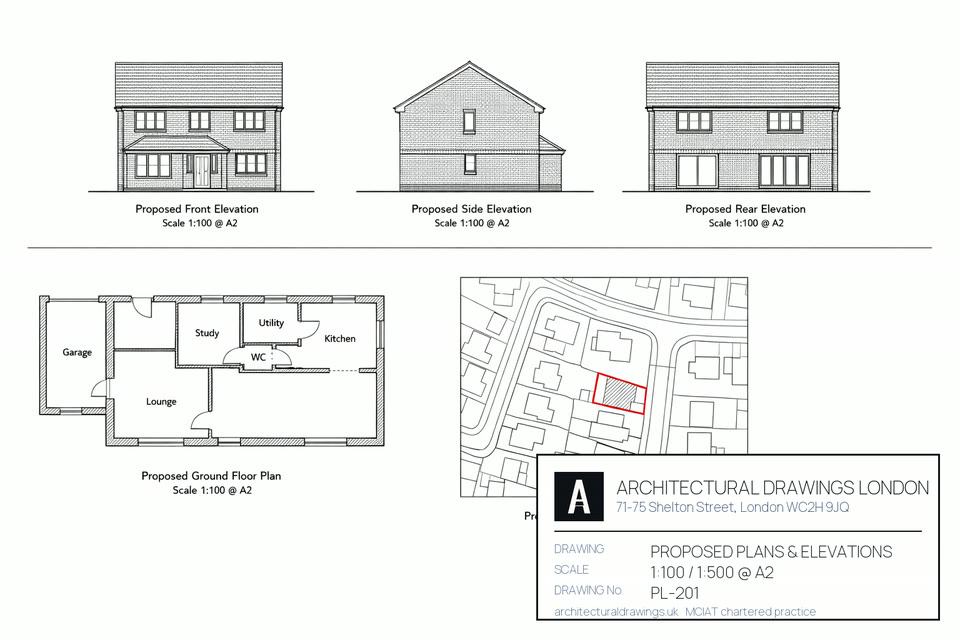
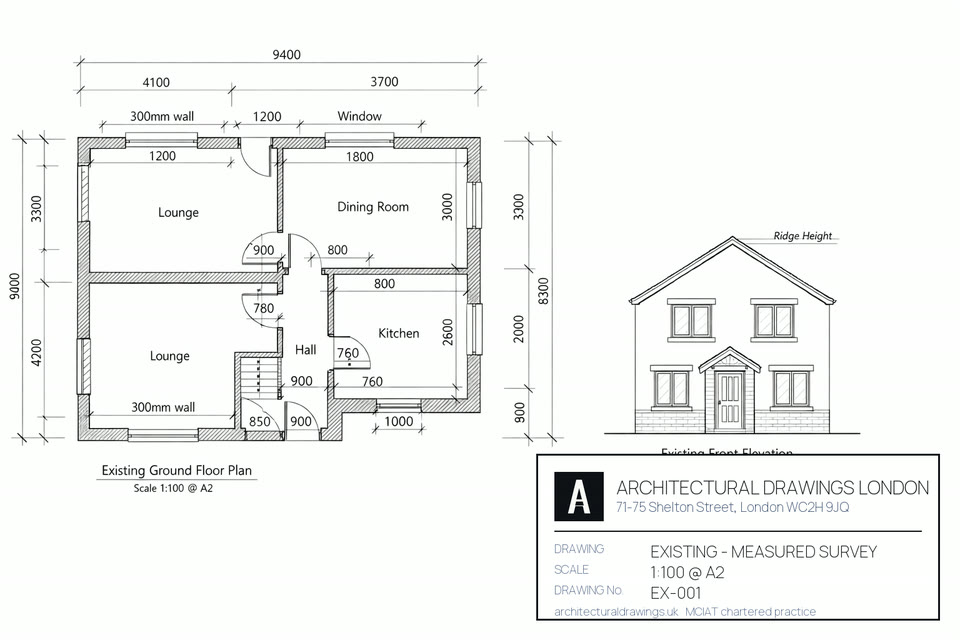
We prepare planning and building regulations drawings across every Brent postcode, and the first thing we settle on any Brent job is which side of that line the address falls on. A Mapesbury villa and a Kingsbury semi are governed by different rules, judged against different documents and start from different odds. Our technologists are MCIAT chartered, and the assessment that opens a project is a check of the constraints attached to your particular address rather than a summary of borough policy.
Article 4 Directions in Brent
Brent’s Article 4 Direction is narrower than the phrase normally suggests. It is aimed at the conversion of family houses into small houses in multiple occupation — the change from Class C3 to Class C4 that would otherwise be permitted development — in named streets around Wembley and Harlesden. It does not touch your right to extend, to convert a loft or to put up a garden room, and it is not a borough-wide direction.
What a direction actually does is withdraw one named permitted development right, so that the works it names need an application. The consequences are a £548 householder fee where there would have been none, a validation checklist to satisfy, and a determination period rather than a start date of your own choosing. Brent handles that clock better than most: 91.0% of its decisions excluding prior approvals landed inside the statutory period, against 87.6% across London (MHCLG planning application statistics, twelve quarters to March 2026, retrieved 1 September 2026). Here the direction costs you paperwork and fee more than it costs you months.
A direction and a conservation area are separate instruments and a house can sit under both, which is worth untangling because they remove different things. A direction withdraws whichever right it names. A conservation area is article 2(3) land, and that switches off roof enlargements under Class B and side extensions under Class A whatever any direction happens to say. Brent’s designations span more than half a century — Roe Green Village was designated on 31 October 1968 and Kensal Rise as recently as 27 May 2024 (planning.data.gov.uk conservation area register, retrieved 1 September 2026) — so the appraisal document behind your street may be much older or much newer than the houses on it.
Conservation areas in Brent
Brent has 22 designated conservation areas. Notable conservation areas include:
- Queen's Park
- Mapesbury
- Kensal Green
- Harlesden
- Sudbury Court
Designation withdraws most of the permitted development rights a Brent homeowner would otherwise rely on, and it does so unevenly — the Edwardian villas of Queen’s Park and Mapesbury are read by conservation officers as intact terraced set-pieces, where a rear dormer visible from the street is refused on principle, while the Sudbury Court estate is assessed on its 1930s garden-suburb layout and building line rather than on individual elevations. What is withdrawn across all of them:
- No cladding, stone, artificial stone, pebble dash, render, timber, plastic, or tile to any external wall without planning permission
- No side extensions under Permitted Development
- Rear extensions are limited and may require planning permission
- Dormer loft conversions facing the highway require planning permission
- Satellite dishes on front elevations or chimneys are not permitted
- Demolition of gates, walls, fences, or other boundary treatment requires planning permission
Twenty-two conservation areas and an Article 4 Direction, concentrated in the Edwardian streets of Queen's Park and Mapesbury rather than spread across the borough. Brent delegates 98.9% of decisions to officers (MHCLG planning statistics, retrieved 1 September 2026), so in practice a conservation-area application is judged by a case officer against the appraisal document for that area, not by a committee. That is who the drawings have to convince, and it is why we work from the appraisal rather than from precedent.
Popular projects in Brent
Queen's Park and Mapesbury Edwardian villas at one end, Kilburn and Harlesden terraces in the middle, Wembley semis and regeneration at the other. Across all of it the borough took 5,822 planning decisions and approved 73.8% (MHCLG planning statistics, retrieved 1 September 2026). Schemes creating a new dwelling do noticeably worse, at 49.4%, which matters in a borough where subdividing a large villa is a common ambition and the enforcement record above is the consequence of doing it without asking.
Loft conversions
In Brent the loft question is settled by the roof you happen to own. On the Kilburn and Harlesden terraces a rear dormer is the standard move and returns something like 20 to 30 square metres. On the Wembley and Kingsbury semis the roof is hipped, so the flank has to be squared into a gable before the dormer earns its keep — with the compensation that a semi gets a 50 cubic metre allowance where a terrace gets 40. Either route can be permitted development outside a designated area. Inside one it cannot be: Class B does not operate on article 2(3) land, so a Mapesbury dormer needs a full application whichever way it faces.
Side-return and rear extensions
Filling the alley beside the back addition of a Victorian terrace — the side return — is the drawing set we produce most often in Kilburn, Willesden and Harlesden. Depth is the decision that matters. Up to 3 metres from the original rear wall on a terrace or semi is ordinary permitted development; beyond that and up to 6 you are into the neighbour consultation scheme, and this is exactly where Brent parts company with the London average. The borough refused 249 of the 794 larger householder prior approvals it determined in the three years to March 2026, or 31.4%, against 24.9% across London (MHCLG planning application statistics, PS1, retrieved 1 September 2026). Draw the deep one only when the neighbouring windows and the boundary levels genuinely support it.
Two-storey extensions
The semi-detached and detached housing stock in Brent is well suited to two-storey rear extensions, which almost always require planning permission. A two-storey extension can add a larger kitchen-diner at ground floor and an additional bedroom and bathroom above. The constraint that decides most Brent schemes is not height but the flank boundary: the interwar semis in Kingsbury, Preston and Sudbury were built in pairs with narrow side gaps, so a two-storey rear extension taken to the shared boundary reads as a terracing of the pair and attracts an objection on that ground alone. Setting the upper storey in from the flank, and keeping the rear projection shallower than the ground floor beneath it, is what separates an approval from a refusal here.
How much do planning drawings cost in Brent?
Two council charges apply: one to determine a householder application, a smaller one to certify that work is already lawful. In Brent the cost worth planning for is neither, but the cost of being wrong — with 39 breach-of-condition notices and 399 enforcement notices on the record (MHCLG planning statistics, retrieved 1 September 2026), unauthorised or non-compliant work here has a real chance of having to be undone. Our drawing fee is fixed in advance and sits about 30% under the London architect rate.
Planning costs in Brent
We include a measured survey, existing and proposed plans, elevations, and a site plan — everything required for a valid planning submission to Brent Council. Our fees are 30% below typical London architect rates for the same scope of work. Brent decided 94.3% of its householder applications within the statutory eight weeks and approved 78.5% of them (MHCLG planning statistics, retrieved 1 September 2026) — a faster and slightly more permissive authority than the London average, which means the drawings, not the queue, are usually what determines how long your project takes.
Two versions of the Lawful Development Certificate exist. The proposed-works certificate confirms a scheme is permitted before you build it; the existing-works certificate establishes that something already standing is lawful. In a borough serving this many enforcement notices, the second is the one people end up needing and the first is the one they should have bought. Brent recorded 1,367 certificate applications in the three years to March 2026 (MHCLG planning application statistics, PS1, retrieved 1 September 2026). The return carries no granted-or-refused split for certificates, so read that as a measure of how heavily the route is used here and not as a success rate. Where one is refused, the appeal is a genuine option: the Inspectorate decided 135 Brent certificate appeals between 2016 and 2026 and allowed 54 of them.
Our experience in Brent
We work across NW2, NW6, NW9, NW10, HA0 and HA9, and in a borough this tightly built the site visit is rarely the constraint: 83.9% of Brent’s 4,125 hectares is built-up land, the seventh highest share among the 33 London planning authorities (Ordnance Survey built-up areas, retrieved 1 September 2026). What varies street to street is the constraint set — a conservation area, the Article 4 Direction, a tree preservation order, or nothing at all. We establish which of those attach to your address before the survey rather than after it.
Our MCIAT chartered technologists run the whole sequence: measured survey, existing and proposed drawings, submission, and the correspondence with the case officer that follows. If a refusal does arrive, it is worth knowing that Brent refusals stand up less often than most. The Planning Inspectorate decided 411 householder appeals from this borough between 2016 and 2026 and allowed 165 of them — 40.1%, against 35.6% across England (Planning Inspectorate appeal casework, retrieved 1 September 2026). Those are appeals against refusal, not applications, so it is a statement about how well Brent refusals survive scrutiny, not about your chances first time round.
We also work in Brent's neighbouring boroughs:
What are the odds of approval in Brent?
Brent decides quickly and refuses larger rear extensions almost as a matter of course. The council approved 2,231 of 2,843 householder applications in the three years to March 2026 — 78.5% against a London average of 83.0% — and turned round 94.3% of them inside eight weeks, with under 1% running past thirteen.
The prior-approval figures are the outlier. Of the larger rear extensions that reached a decision under the neighbour-consultation scheme, Brent granted 27 and refused 249 — 9.8%. Another 518 were found not to need prior approval. Read together, those numbers say the borough is comfortable with extensions that stay inside the ordinary permitted-development envelope and hostile to the ones that reach beyond it.
Brent also carries an Article 4 direction covering HMO conversions in named streets around Wembley and Harlesden, which removes the permitted-development right to convert a family house into a small house in multiple occupation. If your project is a conversion rather than an extension, check the street before anything else: an Article 4 direction does not make consent harder to get, it makes an application compulsory.
Source: MHCLG District Planning Application Statistics, the PS1 and PS2 forms Brent Council returns to central government each quarter. The counts here are decisions Brent issued between the start of April 2023 and the close of the 2025-26 year, so an application lodged inside that span but determined after it will not appear. Housing-stock ages come from VOA Council Tax Stock of Properties table CTSOP4.1 as at 31 March 2025, which counts all 135,080 dwellings in the borough by build period. Both datasets are published under the Open Government Licence v3.0.
Frequently asked questions
Do I need planning permission in Brent?
Often not. Brent granted 1,367 lawful development certificates over the period covered by the MHCLG returns (PS1/PS2, retrieved 1 September 2026) — each one a project that proceeded without planning permission. A single-storey rear extension up to 6m on a semi, a rear dormer not facing the highway, and internal alterations are the usual candidates. Two things remove that route in Brent specifically: one of the 22 conservation areas, and the Article 4 Direction covering HMO conversions in named streets around Wembley and Harlesden. Where the answer is genuinely unclear, the certificate is the cheaper question to ask — £274 against £548 for a full householder application.
Does Brent have Article 4 Directions?
Yes. Article 4 for HMO conversions in specific streets around Wembley and Harlesden.
How many conservation areas are in Brent?
Twenty-two, and they are concentrated rather than spread evenly — Queen's Park, Mapesbury, Kensal Green, Harlesden and Sudbury Court between them account for most of the borough's protected housing stock. Brent also records 162 Article 4 areas, 582 listed buildings and 301 tree preservation zones (MHCLG planning statistics, retrieved 1 September 2026), so a designation check on its own is not enough: a Mapesbury villa can sit inside a conservation area, an Article 4 Direction and a TPO at once, and each constrains a different part of the same scheme. Check all four before you draw anything.
How much does a London Borough of Brent planning application cost?
Fees are the same nationally - £548 for the application, £274 for the certificate. Brent's own contribution to the cost is enforcement: 399 enforcement notices and 39 breach-of-condition notices in three years (MHCLG planning statistics, retrieved 1 September 2026). Work that turns out to be unauthorised here has a real prospect of having to be undone, and the council has 8 weeks to decide the application that would have prevented it, and that is the expense worth insuring against rather than the fee itself. Our drawings start at £840, so budget from about £1,388 before any build cost.
How long does London Borough of Brent take to decide a planning application?
Faster than most of London: Brent decided 94.3% of householder applications inside the statutory eight weeks and only 0.8% ran past thirteen (MHCLG planning statistics, retrieved 1 September 2026). Across 2,843 householder decisions that is one of the shorter tails in the capital. Budget four to six weeks for pre-application advice if you need it, and twelve to sixteen weeks from instruction to decision once drawing time is included. Major applications carry a thirteen-week target.