TL;DR — Key Facts
- Planning authority: RBKC Planning
- Conservation areas: 38 designated areas
- Article 4 Directions: Yes
- Postcodes covered: SW1, SW3, SW5, SW7, SW10, W8, W10, W11, W14
- Typical housing: Grand white stucco Regency and Victorian terraces
- Householder application fee: £548 (2026 rate)
What happens to an application in Kensington and Chelsea?
A fifth of them never reach a decision. The borough withdrew 20.3% of applications before determination, the highest rate in London, while approving 90.2% of those it did decide. It issued only 118 lawful development certificates in three years, and holds 2,609 listed buildings.
| Measure | Kensington and Chelsea | London |
|---|---|---|
| Applications withdrawn before decision | 20.3% | 7.4% |
| Householder approval rate | 90.2% | 83.0% |
| Householder decisions made | 2,072 | 77,680 |
| Lawful development certificates issued | 118 | — |
| Listed buildings in the register | 2,609 | second most in London |
| Conservation areas | 41 covering 919 ha | 1,141 across London |
| Householder appeals allowed after refusal | 42.3% of 234 | 40.8% of 13,067 |
Sources: decision figures from MHCLG District Planning Application Statistics (PS1 and PS2), twelve quarters to March 2026; registers from the MHCLG Planning Data Platform, retrieved 1 September 2026; appeals from Planning Inspectorate casework decided 2016–2026. Read the withdrawal rate with the approval rate rather than instead of it: a scheme withdrawn under officer pressure never appears as a refusal. A zero in this return means the measure was not recorded for that borough, never that none exist — the publisher suppresses a rate wherever it withholds one, and the counts beside a suppressed rate are not a substitute for it.
Planning in Kensington and Chelsea — what you need to know
Kensington and Chelsea approved 90.2% of householder applications, which sounds like a permissive borough and is not one. Over the same three years 1,378 applications were withdrawn — 20.3% of everything decided, the highest withdrawal rate in this guide (MHCLG planning statistics, retrieved 1 September 2026). A withdrawal is an application that was going to fail and was pulled first, so the approval rate here is measuring what survived a filtering process, not how easy the council is to satisfy.
Internationally wealthy residents; extensive listed building coverage; heritage and streetscape prioritised in every decision. The borough has a population of approximately 143,000 residents and covers postcodes SW1, SW3, SW5, SW7, SW10, W8, W10, W11, W14.
The housing stock in Kensington and Chelsea is predominantly grand white stucco Regency and Victorian terraces; red-brick Queen Anne mansions in Kensington; Edwardian mansion blocks; almost no post-war housing stock. This mix of property types means that RBKC Planning deals with a wide range of applications, from rear extensions on terraced houses to loft conversions on semi-detached properties and full refurbishments of period homes in conservation areas.
With 38 designated conservation areas and active Article 4 Directions, Kensington and Chelsea has a relatively controlled planning environment where Permitted Development rights may be restricted in many areas.
At Architectural Drawings London, we prepare planning drawings and building regulations drawings for properties across all Kensington and Chelsea postcodes. Our MCIAT chartered architectural technologists have experience with RBKC Planning and understand the specific policies, design guides, and precedents that apply in Kensington and Chelsea.
Where do the Article 4 Directions apply here?
Kensington and Chelsea has Article 4 Directions in place that remove certain Permitted Development rights. Article 4 Directions covering HMOs, office-to-residential, and basement developments — RBKC has some of the strictest basement policies in London.
Article 4 Directions are used by councils to protect the character of an area by requiring planning permission for changes that would otherwise be permitted. If your property is affected by an Article 4 Direction in Kensington and Chelsea, you will need to submit a full planning application even for works that would normally fall under Permitted Development. The council fee for a householder application is £548, and we prepare the necessary drawings and supporting documents.
It is important to note that Article 4 Directions in Kensington and Chelsea are separate from conservation area restrictions. A property can be affected by both, and in practice many Article 4 areas overlap with conservation areas. We check the specific restrictions affecting your property as part of our initial assessment.
How much of the borough is designated?
Kensington and Chelsea has 38 designated conservation areas. Notable conservation areas include:
- Kensington
- Chelsea
- Notting Hill
- Holland Park
- Earls Court
In conservation areas, Permitted Development rights are more restricted than in non-designated areas. Key restrictions include:
- No cladding, stone, artificial stone, pebble dash, render, timber, plastic, or tile to any external wall without planning permission
- No side extensions under Permitted Development
- Rear extensions are limited and may require planning permission
- Dormer loft conversions facing the highway require planning permission
- Satellite dishes on front elevations or chimneys are not permitted
- Demolition of gates, walls, fences, or other boundary treatment requires planning permission
Thirty-eight conservation areas, an Article 4 Direction, and listed building coverage dense enough that the heritage question is usually the only question. The council also issued four certificates for proposed works to listed buildings and served 17 temporary stop notices in three years (MHCLG planning statistics, retrieved 1 September 2026), which tells you it is willing to intervene mid-works. On a Kensington or Chelsea address we resolve the consent route — planning, listed building consent, or both — before design work starts, because getting that wrong is what produces the withdrawals.
Popular projects in Kensington and Chelsea
The borough recorded no larger rear extensions at all under the neighbour-consultation scheme in three years, and issued 118 lawful development certificates (MHCLG planning statistics, retrieved 1 September 2026). Westminster and the City of London are the only other boroughs that recorded no such determinations, and only the City issued fewer certificates. Both figures follow from the housing stock: stucco Regency terraces, red-brick Queen Anne mansions and Edwardian blocks, overwhelmingly listed or in a conservation area, where permitted development has largely been removed. What is left is applications for internal reconfiguration, basements and rear elevations, each judged on heritage grounds.
Loft conversions
Kensington and Chelsea has extensive streets of terraced housing, making loft conversions one of the most popular home improvement projects in the borough. A rear dormer loft conversion on a typical Victorian or Edwardian mid-terrace can add 20-30 square metres of living space and significant value to the property. In many cases, rear dormers fall under Permitted Development rights, though properties in conservation areas or subject to Article 4 Directions will need full planning permission. We prepare loft conversion drawings for properties across Kensington and Chelsea.
Side-return and rear extensions
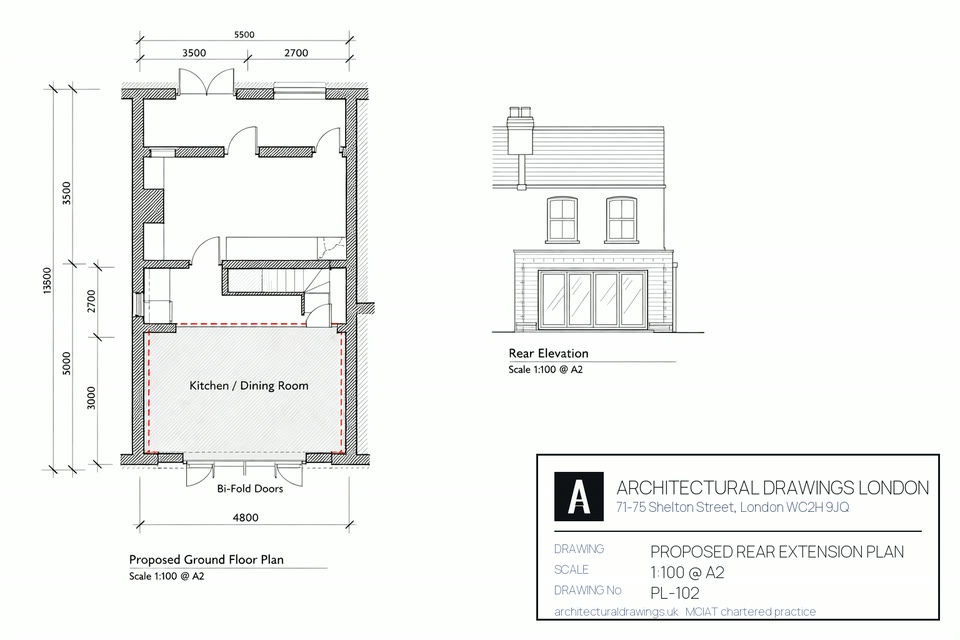
The classic Victorian and Edwardian terrace layout in Kensington and Chelsea leaves a side return passage that is prime territory for a kitchen extension. A single-storey rear or side-return extension can often be built under Permitted Development, extending up to 6 metres from the rear wall (or up to 8 metres for detached houses under the Prior Approval process). We prepare extension plans for properties across all Kensington and Chelsea postcodes (SW1, SW3, SW5, SW7, SW10, W8, W10, W11, W14).
Flat conversions and internal alterations
With mansion blocks and converted flats forming part of Kensington and Chelsea's housing stock, internal layout changes and flat conversions are common projects. While internal alterations rarely need planning permission, converting a house to flats (C3 to C4 HMO) or vice versa may require planning approval, particularly given Kensington and Chelsea's Article 4 Direction covering HMO conversions. We can prepare the necessary floor plans, elevations, and supporting documents for flat conversion applications in Kensington and Chelsea.
Basement extensions
Basement extensions in Kensington and Chelsea are subject to specific planning policies. RBKC's basement policy (post-2015) limits to single-storey under 50% of garden area; double-storey basements effectively prohibited in residential streets. Despite these restrictions, basement conversions remain popular for adding living space in high-value Kensington and Chelsea properties where lateral or upward extension is limited. We prepare basement extension drawings that comply with RBKC Planning's policies, including structural methodology statements.
How much do planning drawings cost in Kensington and Chelsea?
Planning fees are national, so a householder submission here costs the same £548 as it would in Barking — and on most Royal Borough addresses that is the smallest number in the whole project. What decides the cost here is whether the scheme needs listed building consent alongside planning permission, and whether it survives — one application in five in this borough is withdrawn rather than determined (MHCLG planning statistics, retrieved 1 September 2026). We agree the figure in advance, near 30% under the London architect rate, with the heritage assessment inside that scope rather than billed on top.
Planning costs in Kensington and Chelsea
We include a measured survey, existing and proposed plans, elevations, and a site plan — everything required for a valid planning submission to RBKC Planning. Our fees are 30% below typical London architect rates for the same scope of work.
The Royal Borough issued just 118 certificates of lawfulness in three years (MHCLG planning statistics, retrieved 1 September 2026), second-lowest in London. That is what an Article 4 Direction, 38 conservation areas and dense listing produce. Note also what a certificate does not do: on a listed building it speaks to planning only, and says nothing about listed building consent.
Our experience in Kensington and Chelsea
We cover all Kensington and Chelsea postcodes: SW1, SW3, SW5, SW7, SW10, W8, W10, W11, W14. Whether your property is in a conservation area, affected by an Article 4 Direction, or in an unrestricted residential street, we have experience with RBKC Planning and understand the borough's planning policies.
Our MCIAT chartered architectural technologists prepare planning drawings and building regulations drawings for residential projects across Kensington and Chelsea. We handle the full process from initial measured survey through to planning submission, and we liaise with RBKC Planning on your behalf.
We also work in Kensington and Chelsea's neighbouring boroughs:
What are the odds of approval in Kensington and Chelsea?
The odds in Kensington and Chelsea are better than the London average. The council decided 2,072 householder applications in the three years to March 2026 and approved 1,868 of them — 90.2%, against 83.0% across London. Only 204 were refused. That is not a reason to be casual: a refusal still costs eight weeks and a resubmission, and the applications that fail here tend to fail on the same avoidable points — missing or inconsistent drawings, and a scheme that ignores the immediate context.
Speed is not the problem here. Kensington and Chelsea decided 97.2% of householder applications within the statutory eight weeks. If your project has a fixed start date, the determination period is the predictable part of the programme — the variable is how long the drawings take before submission.
Too few larger-extension prior approvals have been determined in Kensington and Chelsea in this window to quote a rate. Where the numbers are thin, the prior-approval route is worth checking on its merits rather than on local precedent.
The council also issued 118 certificates of lawful development in the same three years. That is the route for work that is already permitted development: it is not a permission, it is proof you did not need one, and it costs £274 against the £548 householder application fee.
Source: MHCLG District Planning Application Statistics (PS1 and PS2), the statutory return every English planning authority files. Figures cover the twelve quarters to March 2026 and are decisions made in that window, not applications submitted. Published under the Open Government Licence v3.0.
Frequently asked questions
Do I need planning permission in Kensington and Chelsea?
Rarely, and you should start from the assumption that it does not. Kensington and Chelsea has an Article 4 Direction, 38 conservation areas and extensive listed building coverage; the neighbour-consultation route for deep rear extensions produced no determinations here at all over three years, and only 118 lawful development certificates were issued (MHCLG planning statistics, retrieved 1 September 2026). Internal alterations to an unlisted property are the main survival. If the building is listed, internal work needs consent too, which is the point most often missed.
Does Kensington and Chelsea have Article 4 Directions?
Yes. Article 4 Directions covering HMOs, office-to-residential, and basement developments — RBKC has some of the strictest basement policies in London.
How many conservation areas are in Kensington and Chelsea?
Kensington and Chelsea has 38 designated conservation areas, including Kensington, Chelsea, Notting Hill, Holland Park, Earls Court. In conservation areas, Permitted Development rights are more restricted. For example, you cannot add cladding, build side extensions, or install satellite dishes without planning permission. Rear extensions and loft conversions may also be restricted. Always check whether your property falls within a conservation area before starting work.
How much does a Royal Borough of Kensington and Chelsea planning application cost?
On most Royal Borough projects the published planning fees are the smallest numbers involved. One application in five here is withdrawn rather than determined - 1,378 in three years, 20.3% (MHCLG planning statistics, retrieved 1 September 2026), the highest rate in London. A withdrawal spends the fee and the drawings and returns nothing, which is the real financial exposure. Our drawings start at £840, so even a withdrawn Royal Borough application has cost about £1,388.
How long does Royal Borough of Kensington and Chelsea take to decide a planning application?
The Royal Borough decided 97.2% of householder applications within 8 weeks and 1.9% beyond thirteen, across 2,072 decisions (MHCLG planning statistics, retrieved 1 September 2026). The determination period is not the risk here. The risk is the 20.3% of applications that never reach a decision at all because they are withdrawn, so the time to spend is at the front — establishing what the conservation and listed building position allows before drawings are produced. Budget a further four to six weeks if you go through the pre-application service first. Major applications carry a thirteen-week target.