TL;DR — Key Facts
- Planning authority: Camden Council
- Conservation areas: 40 designated areas
- Article 4 Directions: Yes
- Postcodes covered: NW1, NW3, NW5, NW6, WC1, WC1H, WC1N, WC1R, WC1V, WC1X, N6, N7, N19
- Typical housing: Victorian and Edwardian terraces, Georgian townhouses in Bloomsbury and Hampstead, post-war mansion blocks, modern developments in King's Cross
- Householder application fee: £548 (2026 rate)
Why does Camden take so long to decide?
Camden approves generously and slowly. It granted 88.7% of the householder applications it decided in the three years to March 2026, but only 73.8% inside eight weeks, and 17.2% ran past thirteen. It also agreed an extension of time on 46.5% of all applications, and 16.8% were withdrawn.
| Camden, three years to March 2026 | Camden | London |
|---|---|---|
| Householder approval rate | 88.7% | 83.0% |
| Decided inside eight weeks | 73.8% | — |
| Decided beyond thirteen weeks | 17.2% | — |
| Applications with an agreed extension of time | 46.5% | 34.5% |
| Applications withdrawn before decision | 16.8% | 7.4% |
| Householder decisions made | 1,179 | 77,680 |
| Householder appeals allowed after refusal | 35.1% of 154 | 40.8% of 13,067 |
Source: MHCLG District Planning Application Statistics (PS1 and PS2), decisions made in the twelve quarters to March 2026, and Planning Inspectorate casework decided 2016–2026. Open Government Licence v3.0, retrieved 1 September 2026. An extension of time is agreed between applicant and council, and it stops the statutory clock — so a high approval rate combined with a high extension rate means schemes are being negotiated to a yes rather than refused.
Planning in Camden — what you need to know
Camden's headline approval rate is high and its withdrawal rate is higher than almost anywhere: 1,026 applications pulled in three years, 16.8% of all decisions and second only to Kensington and Chelsea (MHCLG planning statistics, retrieved 1 September 2026). Roughly one application in six never reaches a determination. That is the number to hold in mind when reading any Camden approval statistic, because the schemes that would have failed have largely left the sample before it is taken.
Camden is old in a way that changes every answer on this page. Of its 113,890 dwellings, 44.7% predate 1900 — 50,900 houses and flats — against 20.9% across the capital, while just 6.1% date from the 1930s against a London figure of 16.0% (VOA council tax stock at 31 March 2025, published via the London Datastore). Set beside that 1,968 listed buildings, 57 of them Grade I and 153 Grade II* (Historic England, via the MHCLG Planning Data Platform, retrieved 2 September 2026). Heritage control here is the default condition rather than a local exception. The borough covers NW1, NW3, NW5, NW6, the WC1 districts, N6, N7 and N19.
The sharpest measure of that is what the council spends its time deciding. In the three years to March 2026 Camden determined 1,303 applications for listed building consent to alter or extend, and granted 1,233 of them. Over exactly the same period it determined 1,179 householder planning applications (MHCLG planning application statistics, twelve quarters to March 2026, retrieved 1 September 2026). More listed building consents than householder permissions — no other borough covered in this guide comes within an order of magnitude of that ratio. What it means for an owner is worth stating plainly: in Camden the question is seldom whether a design is good, and almost always whether it is right for this particular building.
Forty designated conservation areas cover a borough of 2,178 hectares that Ordnance Survey mapping shows to be 79.1% built up, and Article 4 Directions sit over parts of it as well. The practical effect is that in much of Camden you should assume permitted development has been narrowed until you have checked the address, rather than assuming it survives until someone tells you otherwise.
We prepare planning and building regulations drawings across every Camden postcode. On a Camden project the constraint check comes first and it is longer than elsewhere: listing and its grade, conservation area, the Article 4 Direction, and whether the address falls inside one of the basement directions. Our technologists are MCIAT chartered. Where the building is listed we prepare the heritage material alongside the drawings rather than after them, because the two applications are decided together and an excellent drawing set with no heritage case is a refusal already being written.
Where do Camden’s Article 4 Directions apply?
Camden has Article 4 Directions in place that remove certain Permitted Development rights. Article 4 removes permitted development for HMO conversions (C3 to C4) across the borough, plus restrictions on basement extensions in 12 conservation areas.
A direction withdraws a named permitted development right, so that works needing nothing at all instead need a £548 householder application. In Camden the more telling fact is how little permitted development there is left to withdraw. The council determined fifteen larger householder prior approvals in three years, and recorded 342 certificate of lawful development applications — against 2,048 certificates in Ealing over the identical period (MHCLG planning application statistics, PS1, retrieved 1 September 2026). Fifteen cases is far too thin to support any rate and we are not offering one. The number is quoted because it shows the route is effectively closed here, not because it says anything about your odds.
A direction, a conservation area and a listing are three different instruments, and a Camden house frequently sits under all three. They are worth telling apart. A conservation area is article 2(3) land, which removes side extensions, rear extensions of more than one storey, cladding, and Class B roof enlargements; Camden’s designations are large, with Bloomsbury covering 184.9 hectares, Hampstead 95.9, Highgate Village 80.0 and Redington Frognal 73.2 (planning.data.gov.uk conservation area register, retrieved 1 September 2026). A listing works differently again: it attaches to the building rather than to an area, it covers the interior as well as the exterior, and carrying out works affecting character without consent is a criminal offence rather than a planning breach.
How many conservation areas does Camden have?
Camden has 40 designated conservation areas. Notable conservation areas include:
- Hampstead
- Primrose Hill
- Bloomsbury
- Camden Town
- Fitzrovia
Camden's conservation areas bite harder than the national default because of what sits inside them. Nearly half the borough's 113,890 dwellings, 44.7% of them, predate the twentieth century entirely on the VOA council-tax stock record at 31 March 2025, and the designations were drawn around exactly that fabric. Rights an owner would take for granted on a 1980s estate are narrowed or withdrawn here. The ones to check before you draw anything:
- No cladding, stone, artificial stone, pebble dash, render, timber, plastic, or tile to any external wall without planning permission
- No side extensions under Permitted Development
- Rear extensions are limited and may require planning permission
- Dormer loft conversions facing the highway require planning permission
- Satellite dishes on front elevations or chimneys are not permitted
- Demolition of gates, walls, fences, or other boundary treatment requires planning permission
Forty conservation areas and an Article 4 Direction, over one of the densest concentrations of listed buildings outside the centre. Camden also sends more work to committee than most London councils: 92.1% of decisions were delegated to officers, among the four lowest rates in London (MHCLG planning statistics, retrieved 1 September 2026). A contested scheme in a designated area therefore has a realistic chance of being decided in public, with objectors speaking, and that changes what the drawings need to do.
Popular projects in Camden
Georgian Bloomsbury and Hampstead, Victorian and Edwardian terraces through Kentish Town and Gospel Oak, mansion blocks, and the modern quarter at King's Cross. Camden took 6,122 planning decisions in three years, approving 90.2%, and new-dwelling proposals ran at 89.8% (MHCLG planning statistics, retrieved 1 September 2026) — unusually high, and a reflection of a borough where converting large houses into flats is long-established practice rather than a novelty.
Loft conversions
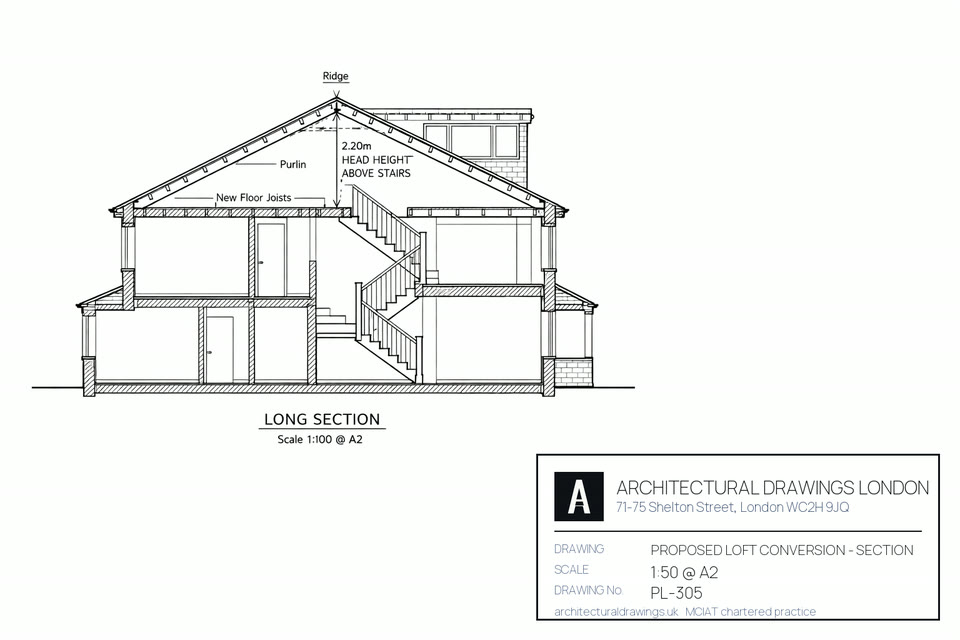
Start from the assumption that the loft needs permission and work backwards. On the terraces of Kentish Town, Gospel Oak and Tufnell Park a rear dormer would be permitted development almost anywhere else in London, but a conservation area removes Class B outright and a great deal of this borough is designated. Where the roof is visible from Hampstead Heath, or reads as part of one of the long Bloomsbury and Belsize street compositions, the streetscene case is the entire application. Where a mansard already stands on the row, that is the strongest evidence available to you, and it is worth finding before the design is fixed rather than after it has been drawn.
Side-return and rear extensions
The side return infill is still the best-value move on a Camden terrace, because it buys width in the kitchen without touching the roof or the front elevation. Almost all of them go in as full householder applications rather than prior approvals, for the reason set out above. That is less of an obstacle than it sounds: Camden approved 1,046 of the 1,179 householder applications it decided, 88.7%, the ninth-highest rate of the 32 boroughs the figure can be calculated for and well above the London average of 83.0% (MHCLG planning application statistics, retrieved 1 September 2026). What does need proper survey work on this stock is the party structure — closet wings, shared rear boundary walls and lightwells — because that is where the cost and the delay hide.
Flat conversions and internal alterations
Internal alterations rarely need planning permission — unless the building is listed, in which case they usually need listed building consent, and in this borough that reverses the normal assumption for a great many addresses. Two changes are constantly confused with one another. Converting a house into self-contained flats takes one dwelling and makes several, and always requires a full planning application. Converting it into a small house in multiple occupation is the Class C3 to Class C4 change, which Camden’s borough-wide Article 4 Direction has removed from permitted development. Subdivision as such is not discouraged here: the council approved 89.8% of the minor-dwellings applications it decided, against 70.1% across London.
Basement extensions
Basement extensions in Camden are subject to specific planning policies. Camden's basement policy (Policy A5) restricts single-storey basements to 50% of garden area; double-storey basements generally refused outside commercial zones. Despite these restrictions, basement conversions remain popular for adding living space in high-value Camden properties where lateral or upward extension is limited. We prepare basement extension drawings that comply with Camden Council's policies, including structural methodology statements.
How much do planning drawings cost in Camden?
The council charge is the predictable part. In Camden the real exposure is the withdrawal risk above — a pulled application has cost the fee and the drawings and produced no decision. We would rather spend the first week establishing the conservation and listed position, and submit a scheme that will be determined. Our fee is agreed in advance as one figure, roughly 30% under the London architect rate.
Planning costs in Camden
The first thing we do on a Camden job is send a surveyor out. A measured survey is not optional in this borough: these terraces have been subdivided, re-roofed and re-fronted for a century and a half, so what the title plan shows and what stands on the plot are rarely the same thing. Everything else is dimensioned off that survey and nothing else — the existing drawings, the proposed drawings, the elevations, the block plan — which together form the set a Camden Council validation officer checks against. Our fee runs about 30% under the going rate at a London architect's office for identical scope.
Camden granted just 342 certificates of lawful development over three years (MHCLG planning statistics, retrieved 1 September 2026), because the Article 4 Direction and 40 conservation areas leave little permitted development to certify. Where your address does fall outside that coverage, the proposed-works certificate is unusually valuable - it establishes that you sat outside a regime that governs most of your neighbours.
Our experience in Camden
We work across NW1, NW3, NW5, NW6, the WC1 districts, N6, N7 and N19. One thing belongs in the programme from day one: on the statutory clock, Camden is the slowest planning authority in London. It settled 70.2% of its decisions inside the statutory period against 87.6% across the capital, and 73.8% of householder applications inside eight weeks against 92.5% — last on both measures among the boroughs for which they can be calculated (MHCLG planning application statistics, twelve quarters to March 2026, retrieved 1 September 2026). It also agreed an extension of time on 46.5% of everything it decided. None of that is a reason not to apply. It is a reason not to book a builder for ten weeks’ time.
Our MCIAT chartered technologists carry a project from the measured survey through to submission and handle everything that follows. In Camden that can include a committee. Some 92.1% of decisions here are taken under delegated powers, the fourth-lowest share of the 33 London authorities and well below the London figure of 97.0% (MHCLG planning application statistics, retrieved 1 September 2026). Roughly one application in thirteen is decided by councillors rather than by an officer, and that changes what the drawings have to do: they have to be legible to someone seeing them for the first time, in a room, in a few minutes.
We also work in Camden's neighbouring boroughs:
What are the odds of approval in Camden?
Camden grants more householder applications than London does, and it does so on harder buildings. The council issued 1,179 householder decisions across the three financial years ending March 2026: 1,046 approvals against 133 refusals, or 88.7%, where the 33 boroughs pooled come to 83.0%. Set that beside a stock where 44.7% of homes predate 1900 and only 8.9% have gone up since 2010, and the message is that the binding constraint here is drawing quality, not hostility. Refusals cluster on two things: a survey that does not match the building, and a proposal drawn as though the terrace either side of it were not there. Source: MHCLG live planning statistics
Assume the eight-week clock will not hold. Of the 583 householder decisions Camden reached without an agreed extension, 430 landed inside eight weeks, which is 73.8%, and 100 of them, 17.2%, ran past thirteen. The context matters more than the headline: 596 of the borough's 1,179 householder decisions were taken under an extension of time or a performance agreement, so for roughly half of applicants the statutory period was renegotiated rather than met. Build a month of slack around your builder's start date, and do not sign anything that assumes a decision on week eight.
The prior-approval route for larger rear extensions has barely been used in Camden: fifteen determinations across three years is far too small a base to quote a percentage from, and any rate computed on it would be noise rather than signal. The thinness is itself informative. With rear gardens this short and this much of the borough designated, most Camden householders are on the full planning route from the outset. Judge the prior-approval option on your own plot geometry, not on local precedent.
Alongside those decisions, 342 certificates of lawful development were recorded in Camden over the same three years. A certificate grants nothing. It is the council confirming in writing that your work never needed permission in the first place, and at £274 it costs half the £548 householder application fee. On a nineteenth-century house whose roof has been altered before, often more than once, it is the cheaper way to settle the question before a buyer's solicitor raises it.
Every English council files a quarterly PS1 and PS2 planning return; the numbers below are Camden's. They record decisions issued between April 2023 and March 2026, so an application lodged in 2022 and settled in 2024 sits in these totals while one submitted last month does not. Contains public sector information licensed under the Open Government Licence v3.0
Frequently asked questions
Do I need planning permission in Camden?
Less often than almost anywhere else in London. Camden granted 8 prior approvals for larger rear extensions (MHCLG planning statistics, retrieved 1 September 2026) — a number that tells you the standard permitted development route is close to unavailable across much of the borough. Between 40 conservation areas, 1,967 listed buildings and 21 recorded Article 4 areas, most Camden addresses carry at least one designation. Assume you need permission, and treat a lawful development certificate as the way to prove an exception rather than the normal route.
Does Camden have Article 4 Directions?
Yes. Article 4 removes permitted development for HMO conversions (C3 to C4) across the borough, plus restrictions on basement extensions in 12 conservation areas.
How many conservation areas are in Camden?
Forty, covering Hampstead, Primrose Hill, Bloomsbury, Fitzrovia and most of the borough's residential stock. Camden also holds 1,967 listed buildings, more than any borough in this guide except Westminster and Kensington and Chelsea (MHCLG planning statistics, retrieved 1 September 2026). The practical effect is that in Camden the designation question is usually answered yes, and the real work is establishing what a conservation officer will accept: materials matched to the original, no visible alteration to the front roof slope, and rear extensions subordinate in both height and depth to the host building.
How much does a London Borough of Camden planning application cost?
The Camden-specific cost does not appear on any fee schedule and dwarfs the £548 that does: 1,026 applications were withdrawn here in three years, 16.8% of all decisions (MHCLG planning statistics, retrieved 1 September 2026). A withdrawal has spent the fee and the drawings and produced no decision at all, and that is the outcome worth designing against. A certificate of lawfulness is £274 where it applies, and our drawings start at £840, so a Camden submission that does reach a decision costs about £1,388 on paper.
How long does London Borough of Camden take to decide a planning application?
Camden is the slowest authority in this guide by a wide margin. It decided 73.8% of householder applications within the statutory eight weeks, and 17.2% ran beyond thirteen (MHCLG planning statistics, retrieved 1 September 2026) — roughly one application in six. That is not a busy-period effect; it is the standing position, and it reflects the consultation load that 40 conservation areas and 1,967 listed buildings generate. Plan for eighteen to twenty-two weeks from instruction to decision in Camden, not twelve. Major applications carry a thirteen-week target that is frequently exceeded.