TL;DR — Key Facts
- Planning authority: Ealing Council
- Conservation areas: 30 designated areas
- Article 4 Directions: Yes
- Postcodes covered: W3, W5, W7, W13, UB1, UB2, UB5, UB6, NW10
- Typical housing: Victorian and Edwardian villas in Ealing central
- Householder application fee: £548 (2026 rate)
How fast is Ealing, really?
Fast on the clock and generous on the outcome: 98.6% of householder decisions inside eight weeks, only 0.4% beyond thirteen, and 86.6% approved. The counterweight is the 6m prior approval route, where Ealing refused 243 notifications against 54 granted. It issued 2,048 lawful development certificates over the same window.
| Measure | Ealing | London |
|---|---|---|
| Decided inside eight weeks | 98.6% | — |
| Decided beyond thirteen weeks | 0.4% | — |
| Householder approval rate | 86.6% | 83.0% |
| Householder decisions made | 3,182 | 77,680 |
| Larger-extension notifications | 891 | 594 not required, 54 granted, 243 refused |
| Lawful development certificates issued | 2,048 | — |
| Householder appeals allowed after refusal | 38.4% of 344 | 40.8% of 13,067 |
Source: MHCLG District Planning Application Statistics (PS1 and PS2), decisions made in the twelve quarters to March 2026, and Planning Inspectorate casework decided 2016–2026. Open Government Licence v3.0, retrieved 1 September 2026. Ealing also agreed an extension of time on 48.9% of all applications, well above the 34.5% London figure, so the eight-week record and the negotiated clock belong in the same sentence.
Planning in Ealing — what you need to know
Ealing is among the quickest councils in London. It decided 98.6% of householder applications within eight weeks and just 0.4% beyond thirteen, across 3,182 decisions — only Barking and Dagenham was faster, and Sutton matched it (MHCLG planning statistics, retrieved 1 September 2026). For a homeowner that changes what the critical path is: the determination period is not the thing that will delay your extension in Ealing, so the schedule is set almost entirely by how long the survey and drawings take before anything is submitted.
Leafy outer-west London; Bedford Park conservation area has strict heritage controls; rest of borough generally permissive. The borough has a population of approximately 342,000 residents and covers postcodes W3, W5, W7, W13, UB1, UB2, UB5, UB6, NW10.
The housing stock in Ealing is predominantly victorian and Edwardian villas in Ealing central; 1930s semi-detached in Northolt and Hanwell; mansion blocks along main roads; Bedford Park is a listed Arts & Crafts garden suburb. This mix of property types means that Ealing Council deals with a wide range of applications, from rear extensions on terraced houses to loft conversions on semi-detached properties and full refurbishments of period homes in conservation areas.
With 30 designated conservation areas and active Article 4 Directions, Ealing has a relatively controlled planning environment where Permitted Development rights may be restricted in many areas.
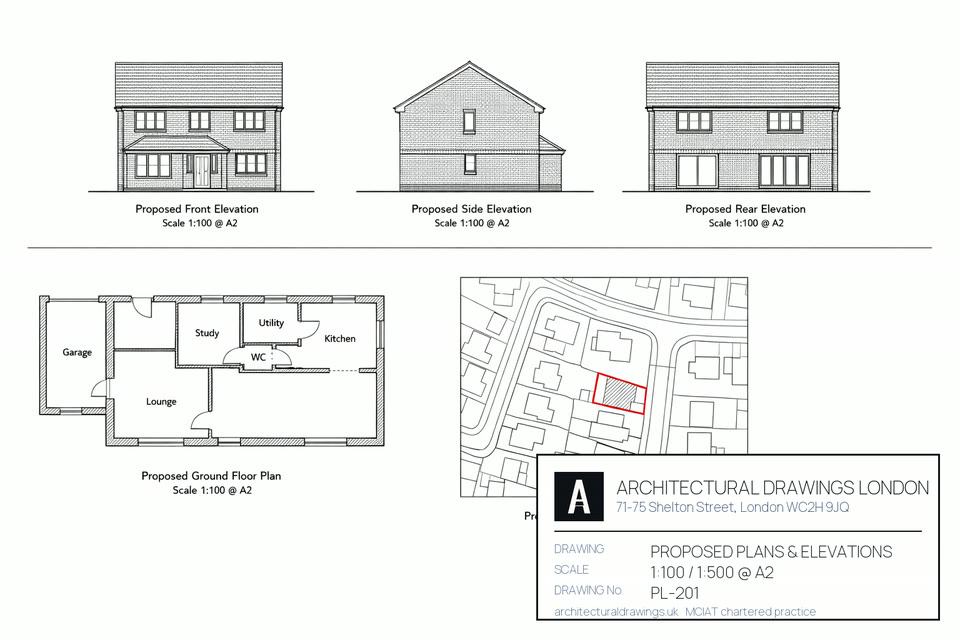
At Architectural Drawings London, we prepare planning drawings and building regulations drawings for properties across all Ealing postcodes. Our MCIAT chartered architectural technologists have experience with Ealing Council and understand the specific policies, design guides, and precedents that apply in Ealing.
Where do Ealing’s Article 4 Directions apply?
Ealing has Article 4 Directions in place that remove certain Permitted Development rights. Article 4 for HMOs in specific streets in Acton, Ealing and Southall.
Article 4 Directions are used by councils to protect the character of an area by requiring planning permission for changes that would otherwise be permitted. If your property is affected by an Article 4 Direction in Ealing, you will need to submit a full planning application even for works that would normally fall under Permitted Development. The council fee for a householder application is £548, and we prepare the necessary drawings and supporting documents.
It is important to note that Article 4 Directions in Ealing are separate from conservation area restrictions. A property can be affected by both, and in practice many Article 4 areas overlap with conservation areas. We check the specific restrictions affecting your property as part of our initial assessment.
How many conservation areas does Ealing have?
Ealing has 30 designated conservation areas. Notable conservation areas include:
- Ealing Broadway
- Pitshanger
- Bedford Park
- Acton Green
- Hanwell
In conservation areas, Permitted Development rights are more restricted than in non-designated areas. Key restrictions include:
- No cladding, stone, artificial stone, pebble dash, render, timber, plastic, or tile to any external wall without planning permission
- No side extensions under Permitted Development
- Rear extensions are limited and may require planning permission
- Dormer loft conversions facing the highway require planning permission
- Satellite dishes on front elevations or chimneys are not permitted
- Demolition of gates, walls, fences, or other boundary treatment requires planning permission
Thirty conservation areas, an Article 4 Direction in force, and one address type that behaves unlike the rest of the borough. In Bedford Park the constraint is rarely the extension itself but the front elevation, the joinery and the roofline, because the suburb's value as a designated group depends on those repeating across the street. We work out what the conservation officer will be assessing before the design is fixed, and put the heritage justification in the application rather than waiting to be asked for it.
Popular projects in Ealing
The borough splits cleanly in two and the applications follow. Bedford Park — the Arts and Crafts garden suburb west of Turnham Green, dense with listed buildings — is scrutinised elevation by elevation, while the 1930s semis of Northolt and Hanwell are ordinary permitted-development territory. That split also shows in the minor-dwellings figures: Ealing approved 71.0% of them (MHCLG planning statistics, retrieved 1 September 2026), well above what most outer-west boroughs manage, which is what a council looks like when it has decided where it will and will not accept new units.
Two-storey extensions
The semi-detached and detached housing stock in Ealing is well suited to two-storey rear extensions, which almost always require planning permission. A two-storey extension can add a larger kitchen-diner at ground floor and an additional bedroom and bathroom above. Ealing Council generally supports two-storey extensions that are subordinate to the original dwelling, set in from the boundary, and do not result in unacceptable loss of light or privacy to neighbours.
Flat conversions and internal alterations
With mansion blocks and converted flats forming part of Ealing's housing stock, internal layout changes and flat conversions are common projects. While internal alterations rarely need planning permission, converting a house to flats (C3 to C4 HMO) or vice versa may require planning approval, particularly given Ealing's Article 4 Direction covering HMO conversions. We can prepare the necessary floor plans, elevations, and supporting documents for flat conversion applications in Ealing.
How much do planning drawings cost in Ealing?
The council fee is £548 for a householder application and £274 for a lawful development certificate. Ealing issued 2,048 certificates in three years (MHCLG planning statistics, retrieved 1 September 2026), so the certificate is not an unusual route here — it is the standard way work in the permissive parts of the borough gets recorded. We quote a fixed drawing fee before any work begins, roughly a third under what a London architect charges to produce the same set.
Planning costs in Ealing
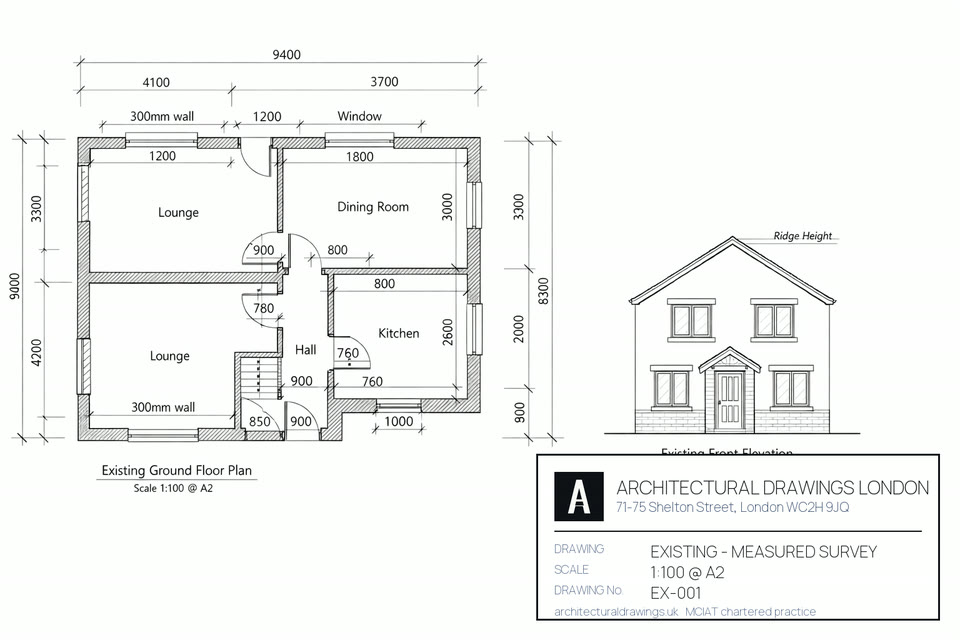
We include a measured survey, existing and proposed plans, elevations, and a site plan — everything required for a valid planning submission to Ealing Council. Our fees are 30% below typical London architect rates for the same scope of work.
The proposed-works Lawful Development Certificate confirms a scheme before you build; the existing-works version regularises something already standing. Ealing issued 2,048 certificates in three years (MHCLG planning statistics, retrieved 1 September 2026), the third-highest count in London, which is what you would expect of a borough split between a heavily controlled suburb and a permissive remainder - where rights survive, people confirm them in writing.
Our experience in Ealing
We cover all Ealing postcodes: W3, W5, W7, W13, UB1, UB2, UB5, UB6, NW10. Whether your property is in a conservation area, affected by an Article 4 Direction, or in an unrestricted residential street, we have experience with Ealing Council and understand the borough's planning policies.
Our MCIAT chartered architectural technologists prepare planning drawings and building regulations drawings for residential projects across Ealing. We handle the full process from initial measured survey through to planning submission, and we liaise with Ealing Council on your behalf.
We also work in Ealing's neighbouring boroughs:
What are your chances, and how long will they take?
Slightly better than the London average, and much better than average if the scheme is ordinary. Ealing granted 2,755 of the 3,182 householder applications it determined over the three years ended March 2026, refusing 427. At 86.6% that is eleventh among the 32 boroughs with a publishable householder rate, three and a half points above the pooled London figure. There is no local bias to design around and no local leniency to rely on; the outcome here is set by the scheme and the drawings.
The speed figure is real, but read what it covers. Of the 1,822 householder decisions taken without an extension of time, 1,797 — 98.6% — were made inside eight weeks. Only Barking and Dagenham reports a higher share, and its return records no householder decision at all outside the fastest band, in any quarter of the three years, which is a way of completing the form rather than a measured spread of decision times. A second point matters more: Ealing agreed an extension of time on 48.9% of all its decisions, the fourth highest share of any borough. Nearly half the caseload is therefore running to a renegotiated deadline rather than the statutory one. When Ealing commits to a date it hits it. It is quick to ask for a different date.
Prior approval is a genuine coin toss here, and the coin is weighted. Of 891 larger rear extensions determined under the neighbour-consultation procedure, 594 were returned as prior approval not required, 54 were granted after an objection was considered, and 243 — 27.3% — were refused. That refusal share sits above the 24.9% London figure. What turns those decisions is a neighbour objection about daylight to a rear window, so on a tight terraced plot the £249 notification is worth less than the eight weeks it can cost you.
Most Ealing work never becomes an application at all. The council recorded 2,048 certificates of lawful development over the same three years — only Barnet and Redbridge recorded more — against 3,182 householder decisions. Nearly a quarter of the borough's housing, 22.9%, went up in the 1930s against 16.0% across London: the era of the side return and the deep rear plot that Part 1 was written around. A certificate costs £274, proves you never needed permission, and is the document a buyer's solicitor asks for.
Source: MHCLG District Planning Application Statistics (PS1 and PS2), the statutory return every English planning authority files. Figures cover the twelve quarters to March 2026 and are decisions made in that window, not applications submitted. Published under the Open Government Licence v3.0.
Frequently asked questions
Do I need planning permission in Ealing?
Often. Ealing determined 891 larger rear extensions under the neighbour-consultation scheme: 594 needed no prior approval, 54 were granted and 243 refused (MHCLG planning statistics, retrieved 1 September 2026). A single-storey rear extension within the stated limits, a rear dormer that does not face the road, and internal reconfiguration are the work that normally proceeds with no application at all. What removes it is the Article 4 Direction or one of the 30 conservation areas, and in Bedford Park you should assume permission is required for anything visible from the street.
Does Ealing have Article 4 Directions?
Yes. Article 4 for HMOs in specific streets in Acton, Ealing and Southall.
How many conservation areas are in Ealing?
Ealing has 30 designated conservation areas, including Ealing Broadway, Pitshanger, Bedford Park, Acton Green, Hanwell. In conservation areas, Permitted Development rights are more restricted. For example, you cannot add cladding, build side extensions, or install satellite dishes without planning permission. Rear extensions and loft conversions may also be restricted. Always check whether your property falls within a conservation area before starting work.
How much does a London Borough of Ealing planning application cost?
Fees are national - £548 and £274 - and Ealing determines 98.6% of householder applications inside eight weeks (MHCLG planning statistics, retrieved 1 September 2026). So the money and the calendar are both predictable here; what is not is Bedford Park, where a listed Arts and Crafts suburb means the drawings and heritage evidence behind an application cost considerably more than the application itself. Drawings from £840 take the total for an Ealing submission to about £1,388.
How long does London Borough of Ealing take to decide a planning application?
Only one London borough determines householder applications faster than Ealing: 98.6% decided inside eight weeks, 0.4% beyond thirteen (MHCLG planning statistics, retrieved 1 September 2026). Plan on the statutory period being met rather than exceeded, and put the contingency into the pre-submission stage instead — measured survey, drawings and any heritage statement. Pre-application advice, if you use it, adds four to six weeks ahead of that. Major applications carry a thirteen-week target.