TL;DR — Key Facts
- Dormer loft conversion: £45,000 – £65,000 (inner London borough)
- Mansard conversion: £70,000 – £110,000
- Velux conversion: £25,000 – £38,000
- Planning permission: Restricted by Article 4 in some areas
- Conservation areas: 43 in Southwark
Is a Southwark loft conversion likely to be approved?
More likely than almost anywhere in London. Southwark’s Datahub set records 2,098 rear dormer applications at 90% approved, the highest dormer rate in the capital, and the council granted 93.8% of the householder applications it decided, refusing just 100 of 1,617 over three years.
| Measure | Southwark | Outcome |
|---|---|---|
| Rear dormer applications in the Datahub | 2,098 | 90% approved |
| Loft conversion applications in the Datahub | 423 | 86% approved |
| Mansard roof applications in the Datahub | 679 | 72% approved |
| Householder decisions | 1,617 | 93.8% approved |
| Lawful development certificates issued | 604 | — |
| Conservation areas | 56 | 782 hectares |
Sources: rows one to three from the Planning London Datahub, retrieved 15 August 2026 — phrase-matched application descriptions, comparable within Southwark only. Rows four and five from MHCLG PS1 and PS2, twelve quarters to March 2026. Row six from planning.data.gov.uk, retrieved 1 September 2026. Build costs on this page are our own 2026 London range, not a published statistic.
What does a Peckham or Dulwich loft cost?
Costs live on this page. When the scheme is settled and the drawings have to go in, loft conversions in Southwark covers the submission end.
Loft conversion build costs in Southwark depend primarily on the type of conversion, and the borough sits mid-range for inner London. Two local figures set the context around that range. The median residential sale in Southwark was £540,000 across 2025, so a loft conversion at the upper end of the build range is a substantial fraction of the property's value and worth appraising as an investment rather than a fitting. And 43.2% of the borough's land sits in Flood Zone 3, second only to Hammersmith and Fulham. That matters less for a roof than for anything at ground level, but it decides whether a combined loft-and-extension application needs a Flood Risk Assessment, which is cost the build quote will not show you.
Loft conversion build costs in Southwark
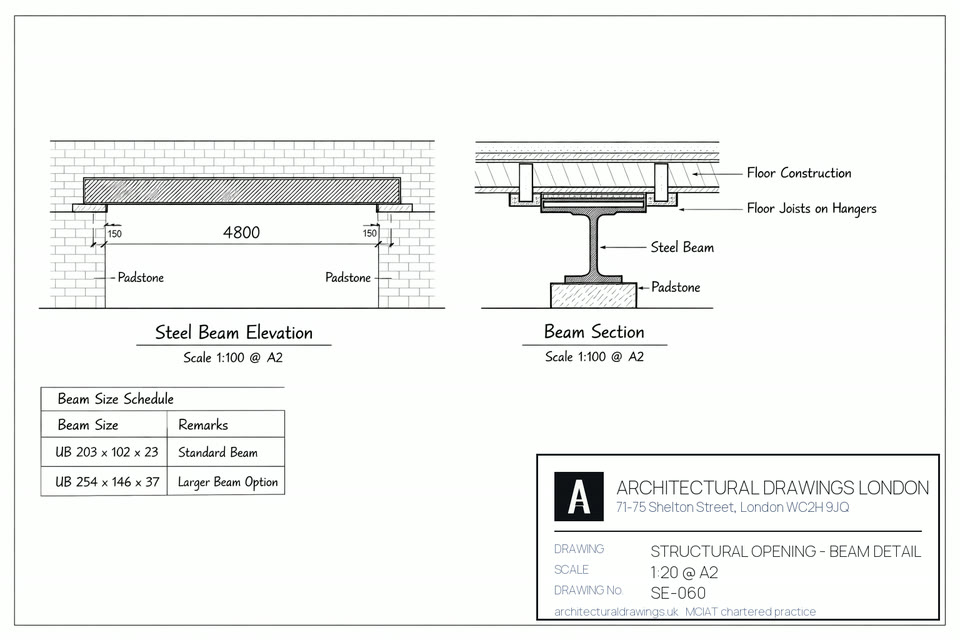
None of those ranges include the people who make a build lawful. Our drawings, a structural engineer's calculations, the council's charges, and a party wall surveyor in the event a neighbour serves a counter-notice all sit above the construction figure. The rest of the variance is visible on site: loft footprint, fit-out specification, whether the existing structure is straightforward, and how close a lorry can park.
Camberwell and Peckham's Victorian terraces suit a dormer and its 20-30 square metres; the Georgian and Regency stock around Bermondsey and Borough is mansard territory where it is possible at all. On a Dulwich Estate address, the Estate's own design standards may limit the achievable form before the council is consulted.
Which loft type suits Southwark properties?
Camberwell and Peckham's Victorian terraces take a rear dormer well. Bermondsey and Borough's Georgian and Regency houses hide shallow roofs behind parapets, which leaves a mansard as the sole way of winning space; listed status is common on that stock. On a Dulwich Estate address the Estate's design standards will shape the scheme before the council sees it, and its timetable runs separately.
Dormer loft conversions
The rear dormer dominates here because the dominant Southwark house is a terrace with a back addition. Of the borough's 149,990 dwellings, 22.3% predate 1900 on the Valuation Office's 2025 dwelling-age count, and those older streets are where a flat-roofed rear box adds 20 to 30 square metres while the road sees nothing change at all. Permitted Development covers that box while it stays below the ridge and sits back off the eaves. Designation changes the test: within one of the borough's conservation areas, whatever the highway can see needs an application.
Mansard loft conversions
A mansard rebuilds the roof outright: near-vertical front, shallow top, one more full storey with standing height across it. Planning permission is unavoidable, because the roofline changes. The record is friendlier than that word sounds. Southwark decided 1,617 householder applications across the three financial years ending March 2026, granting 1,517 and refusing 100. An officer's test on this kind of scheme is design quality, streetscene impact, and whether the house stands in a conservation area. Source: MHCLG live planning statistics
Velux (rooflight) conversions
Rooflights are the cheapest route in, and the only one that leaves the roof shape alone. A Velux conversion sets windows into the slope that is already there, so the deciding question is whether the ridge gives you standing height today — nothing in the scheme creates any. Since nothing projects, Permitted Development covers it in nearly every case, and an officer in one of Southwark's 43 conservation areas is left with very little to object to. The cost is usable width: a rooflight scheme yields a narrower strip of floor than a dormer would.
Does a Southwark loft need planning permission?
Southwark approves 93.8% of householder applications, the second-highest rate in London (MHCLG planning statistics, retrieved 1 September 2026), which makes it a comparatively encouraging borough to apply in. Two things complicate that. It has 43 conservation areas and an Article 4 Direction, and much of SE21 and SE22 sits under the Dulwich Estate's scheme of management, a private consent that a planning permission does not discharge.
Permitted Development for lofts
Rear dormers and Velux rooflight schemes usually reach completion without a planning application ever being made, because the GPDO already allows them. The allowances it grants are cubic, not square, and they run out faster on a narrow terrace than most owners expect. What has to hold true:
- The dormer must not exceed the highest part of the existing roof
- The dormer must be set back at least 200mm from the eaves
- Materials must be similar in appearance to the existing house
- No verandas, balconies, or raised platforms
- Side-facing windows must be obscure-glazed and non-opening below 1.7m
- Volume limit: 40 cubic metres for terraced houses, 50 cubic metres for others
Article 4 Directions
Southwark has Article 4 Directions in place. Article 4 for HMOs borough-wide; additional Article 4 for office-to-residential in Bermondsey and Elephant & Castle. While most Article 4 Directions in London target HMO conversions or commercial changes of use rather than loft conversions directly, it is important to check whether any specific restrictions apply to your property. We verify this as part of our initial assessment.
Conservation areas
Southwark carries 43 conservation areas, running from Bermondsey Street in the north to Dulwich Village in the south, with Borough, Peckham Rye and the Camberwell Grove terraces in between. Designation narrows what Permitted Development still covers. A dormer on the front or the side, in view of the road, will need an application. A rear one often still qualifies, but expect the conservation team to comment on lead, slate and window proportion. Mansards are tested against the individual area’s character appraisal and management plan rather than any borough-wide rule, which is why two streets a mile apart can get opposite answers.
Mansard planning permission
Mansards change the roof's height and shape and need permission accordingly. Southwark's Camberwell and Peckham terraces suit the form; the Georgian and Regency stock in Bermondsey and Borough often carries listed status, where consent is a separate matter. On a Dulwich Estate address the Estate's scheme of management applies as well, and a planning permission does not discharge it.
Southwark's pre-application charges sit on a scale it publishes itself. Householder approval here runs at 93.8%, second-highest in the capital (MHCLG planning statistics, retrieved 1 September 2026), so for consent alone the enquiry is rarely decisive. On a Dulwich Estate property the conversation worth having early is with the Estate, whose design standards and timetable run independently of the council's.
Our drawing fees for loft conversions in Southwark
We are MCIAT chartered architectural technologists. Where a planning application is needed we draw it; the building regulations set is prepared regardless, since it is required whether or not consent was.
Drawing fees for loft conversions
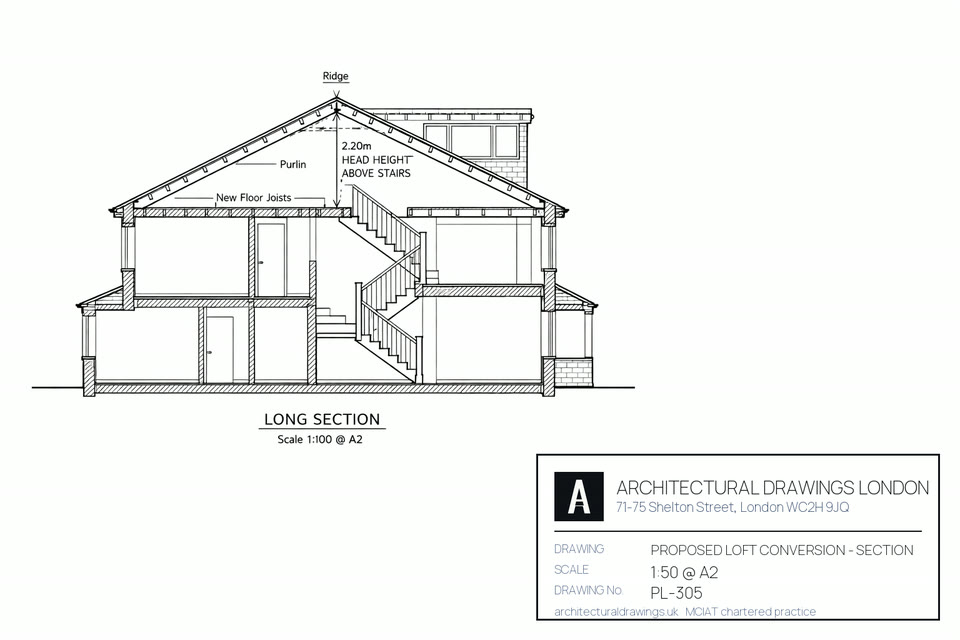
Nothing in the drawing set is optional: measured survey, plans and elevations as they stand, plans and elevations as proposed, roof plan, sections, site plan. Two further sheets come with a mansard — a streetscene drawing placing the new roof beside the two it will sit between, and the design and access statement a case officer will look for. Priced 30% under a London architect's figure for identical scope.
Our Southwark coverage runs across SE1, SE5, SE15, SE16, SE17, SE21, SE22. SE21 and SE22 straddle the Lambeth boundary, so check the council on your council tax bill before assuming which authority decides.
Frequently asked questions
How much does a loft conversion cost in Southwark?
Three roof types, three budgets. A rear dormer in Southwark builds at roughly £45,000 to £65,000. A mansard, which takes the existing roof off altogether, runs £70,000 to £110,000. A Velux scheme, which leaves the slope where it is, costs £25,000 to £38,000. Construction only — nothing in those ranges pays a consultant or the council.
Do I need planning permission for a loft conversion in Southwark?
Often not: 43 designated areas and an Article 4 Direction between them strip the rights from a large share of addresses, and only 604 lawful development certificates were issued over three years (MHCLG planning statistics, retrieved 1 September 2026). The council also served 16 temporary stop notices over the same period, among the highest counts in London, so beginning work on an assumption is a genuine risk here rather than a theoretical one.
What is the minimum head height for a loft conversion in Southwark?
Camberwell and Peckham's Victorian terraces generally carry the 2.2 metres that makes a conversion worth doing. Bermondsey and Borough's Georgian and Regency houses hide shallow roofs behind parapets, so there is nothing there to measure in the usual way. On a Dulwich Estate address, the Estate's consent is a separate matter from whatever the roof measures.
Do I need a Party Wall Agreement for a loft conversion in Southwark?
Southwark's terraced stock means notice on both flanks for a mid-terrace conversion, two months each under the 1996 Act. On a Dulwich Estate property you are dealing with three separate permissions in sequence — the Estate's consent, the council's, and the party wall award — and none of them substitutes for either of the others. Sequencing them properly is most of the programme.
Can I get a mansard loft conversion approved in Southwark?
Southwark judges mansards one at a time, and the flood map is part of the file. Environment Agency mapping puts 46.2% of the borough's 28.88 square kilometres in Flood Zone 2 and 43.2% in Zone 3. Those zones describe the undefended extent: the mapping sets aside every defence, the Barrier included, so it is not a forecast that your street will flood. Its practical effect is documentary. A mansard cannot be built without planning permission, and across most of this borough that submission will need a Flood Risk Assessment lodged beside the drawings. Contains public sector information licensed under the Open Government Licence v3.0