TL;DR — Key Facts
- Dormer loft conversion: £40,000 – £60,000 (outer London borough)
- Mansard conversion: £60,000 – £95,000
- Velux conversion: £25,000 – £40,000
- Planning permission: Generally available for rear dormers
- Conservation areas: 16 in Bexley
Does a Bexley loft conversion need permission?
Usually not, and Bexley is one of the easier boroughs in London on either route. It granted 91.7% of the 2,859 householder applications it decided in the twelve quarters to March 2026, a share beaten only by Hammersmith and Fulham and Southwark, and settled 97.9% of them inside eight weeks. On the notification route it determined 282 larger rear extensions, returned 213 as prior approval not required and refused 42 — 14.9%, well under the 24.9% figure for the 33 boroughs taken together. It issued 24 enforcement notices in three years. The council recorded 882 lawful development certificates over the same period, which is the sensible way to put a permitted conversion on the record.
| Measure | Bexley | Outcome |
|---|---|---|
| Householder decisions | 2,859 | 91.7% granted — third highest in London |
| Decided inside eight weeks | 97.9% of 2,415 | 92.5% for London |
| Larger rear extensions put through prior approval | 282 | 213 not required, 27 granted, 42 refused |
| … refusal share | 14.9% | 24.9% pooled |
| Dwellings built in the 1930s | 37.0% of 101,740 | 16.0% across London |
| Enforcement notices issued | 24 | 3,554 across London |
| Lawful development certificates recorded | 882 | — |
| Rear dormer applications in the Datahub | 2,665 | 75% approved |
Sources: rows one to three from the Planning London Datahub, retrieved 15 August 2026 — phrase-matched descriptions, comparable within Bexley only. Rows four to six from MHCLG PS1 and PS2, twelve quarters to March 2026. Build costs on this page are our own 2026 London range and are an estimate, not a published statistic.
What does a Bexley loft cost by roof type?
Once the budget stacks up, the next thing is the drawing set: loft conversions in Bexley covers what a submission contains and how long the council takes over it.
Bexley is the most uniformly interwar borough in London bar one. Of its 101,740 dwellings, 37.0% were built between 1930 and 1939 against 16.0% across the capital, and only Harrow has a higher share. That single fact governs the numbers below: a 1930s semi has a hipped roof, and a hipped roof gives you a triangle of usable space rather than a rectangle. Whether the quotation you are reading includes taking that hip off and building a gable is the first thing to check, because it is the difference between the bottom and the top of the dormer range.
Loft conversion build costs in Bexley
These are construction figures. Excluded from them: design work, structural engineering, the Party Wall surveyor your neighbour may appoint, and whatever the council itself charges — £274 for a certificate, or £548 where a householder application is genuinely required. Inside the brackets the movement comes from floor area, fit-out specification, how much of the roof has to be rebuilt and whether a lorry can get to the back garden.
Expect 20 to 30 square metres from a rear dormer and 30 to 50 from a mansard with standing height throughout. On Bexley's stock the mansard is rarely the right form and always needs an application; the dormer usually does not need one at all. Set the build cost against a borough median sale price of £430,000 across 2,912 registered transactions in 2025 — the third cheapest in London — and the sensible question is not whether the conversion pays for itself but whether the roof you have will give you a room worth having.
Which loft type suits Bexley properties?
Hip-to-gable plus rear dormer, on most of the borough's stock. The Victorian cottages in Bexley Village and Crayford are a different proposition — lower ridges, often too little height for anything but a rooflight conversion, and sitting inside the borough's small designated areas. On the post-war estates at Thamesmead and Erith the roof form frequently rules a conversion out before planning is reached.
Hip-to-gable and dormer combinations
Hipped roofs are standard on the borough's interwar semis, and a hip removes exactly the corner a staircase landing needs. A hip-to-gable squares that end off, and paired with a rear dormer it typically returns 25 to 35 square metres. Both moves can sit inside permitted development on a semi-detached house, provided the new gable stays behind the plane of the original front roof. Bexley determined 282 larger householder prior approvals in the period and found 213 of them, 75.5%, needed no prior approval at all, against 61.9% across the capital (MHCLG planning statistics, retrieved 1 September 2026).
Velux (rooflight) conversions
A Velux conversion leaves the roof shape untouched — the rooflights drop into the existing slope — which makes it both the cheapest route and the one that survives inside Bexley's 16 conservation areas, where altering a roofline is precisely what officers resist. The catch is that it needs head height you already have and returns the least usable floor of any option. On a shallow-pitched interwar semi that trade often goes the wrong way.
Does a Bexleyheath loft need permission?
Bexley is dominated by 1930s semi-detached houses with hipped roofs, and it is one of the most permissive planning authorities in London: 16 conservation areas, no Article 4 Direction, and 87.1% of all applications approved (MHCLG planning statistics, retrieved 1 September 2026). For a loft conversion here the planning question is rarely the obstacle. The roof is. A hipped 1930s roof needs the hip removed before the usable floor area justifies the work.
Permitted Development for lofts
Bexley is a 1930s borough before it is anything else: 37.0% of its 101,740 dwellings went up between 1930 and 1939, the largest band by a wide margin, against 6.9% predating 1900 (VOA CTSOP4.1, at 31 March 2025). That shapes the loft question, because interwar semis were framed with cut roofs on generous plots. A rear dormer, or rooflights on their own, will normally sit within permitted development here and never reach the council as an application at all. The conditions deciding that:
- The dormer must not exceed the highest part of the existing roof
- The dormer must be set back at least 200mm from the eaves
- Materials must be similar in appearance to the existing house
- No verandas, balconies, or raised platforms
- Side-facing windows must be obscure-glazed and non-opening below 1.7m
- Volume limit: 40 cubic metres for terraced houses, 50 cubic metres for others
Conservation areas
Bexley has 16 conservation areas, including Bexley Village, Old Bexley, Crayford, Welling. In conservation areas, Permitted Development rights for loft conversions are more restricted. Front-facing dormers and side-facing dormers visible from the highway generally require planning permission. Rear dormers may still qualify as PD, but the conservation officer may have views on materials and design. Mansard conversions in conservation areas are assessed against the area's character appraisal and management plan.
Mansard planning permission
Mansards need full permission wherever they are built, since they change both the height and the shape of the roof. Bexley's 1930s stock rarely calls for one: the hipped roofs here suit a hip-to-gable conversion, and a mansard on a suburban semi tends to read as a full extra storey rather than a roof alteration. That is the objection it would have to overcome.
Take the pre-application fee from Bexley's own published scale. In practice there is limited reason to pay it in this borough - 87.1% of all applications are approved and there is no Article 4 Direction (MHCLG planning statistics, retrieved 1 September 2026) - so the enquiry is worth it mainly for a Bexley Village or Crayford conservation-area address, where the design assessment is real.
Our drawing fees for loft conversions in Bexley
All of it is drawn in-house by MCIAT chartered architectural technologists: a planning submission when the route calls for one, and the building regulations package regardless, since Building Control approval is required whether or not planning is.
Drawing fees for loft conversions
Every package carries a measured survey, plans and elevations covering both existing and proposed, a roof plan, cut sections and the site plan itself. Go mansard and two more drawings join it: a design and access statement, plus a streetscene elevation setting your roof against the neighbours' on both sides. The whole scope is priced 30% under typical London architect rates.
The borough spreads over ten districts and we survey in all of them: DA1, DA5, DA6, DA7, DA8, DA14, DA15, DA16, DA17, DA18 — Crayford out to Erith Marshes.
Frequently asked questions
How much does a loft conversion cost in Bexley?
Build costs sort by roof type. A rear dormer here generally runs £40,000 to £60,000. A mansard lands somewhere between £60,000 and £95,000. Rooflights on their own, a Velux job, come in at £25,000 to £40,000. Those are construction figures from our own quoting and carry no professional fees. For scale: the median Bexley home changed hands at £430,000 across 2,912 transactions in 2025, 1.2% above 2024. Source: HM Land Registry Price Paid data for 2025, retrieved 1 September 2026.
Do I need planning permission for a loft conversion in Bexley?
Yes, on most Bexley addresses. There is no borough-wide Article 4 Direction, and with only 16 conservation areas the majority of properties keep their full entitlement to a rear dormer or a rooflight scheme, provided the added volume stays inside the allowance. Mansards always need an application. Bexley issued 882 lawful development certificates over three years (MHCLG planning statistics, retrieved 1 September 2026), which is the sensible way to record a permitted conversion in a borough where most of them are.
What is the minimum head height for a loft conversion in Bexley?
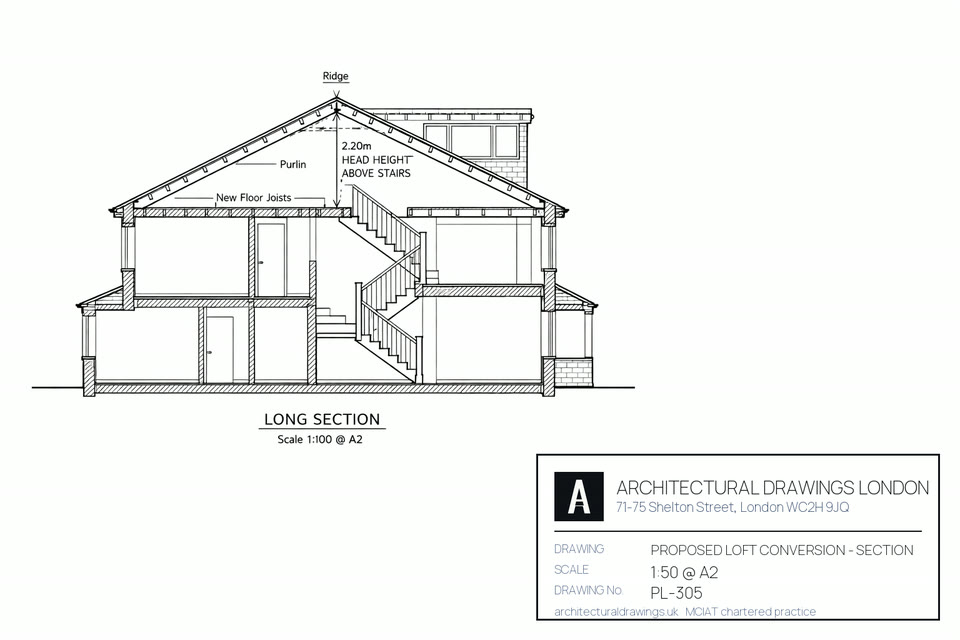
Bexley's interwar stock usually carries its 2.2 metres at the ridge line, that being the point below which a conversion stops paying for itself once floor build-up and insulation have taken their share. The Victorian cottages in Bexley Village and Crayford frequently do not, and on those a rooflight scheme is often the honest ceiling rather than the starting point.
Do I need a Party Wall Agreement for a loft conversion in Bexley?
Yes, on any semi-detached or terraced Bexley house, which is nearly all of them. Inserting steels into the party wall and raising it for a hip-to-gable are both notifiable under the Party Wall etc. Act 1996. The Act runs on its own timetable independently of planning: two months' notice for party wall work, and the neighbour's dissent triggers the appointment of surveyors, which is a cost to budget for rather than a risk to avoid.
Can I get a mansard loft conversion approved in Bexley?
Mansards get judged one at a time here, and Bexley is not a hard council to satisfy: 2,622 of 2,859 householder decisions were granted, 91.7% against a pooled London figure of 83.0% (MHCLG planning statistics, retrieved 1 September 2026). What the case officer weighs is the effect on the streetscene, whether your road already carries a precedent, and how honestly the detailing answers the original roof.