TL;DR — Key Facts
- Build cost per sqm: £2,200 – £3,200 (outer London borough)
- Council planning fee: £548 (householder application, 2026)
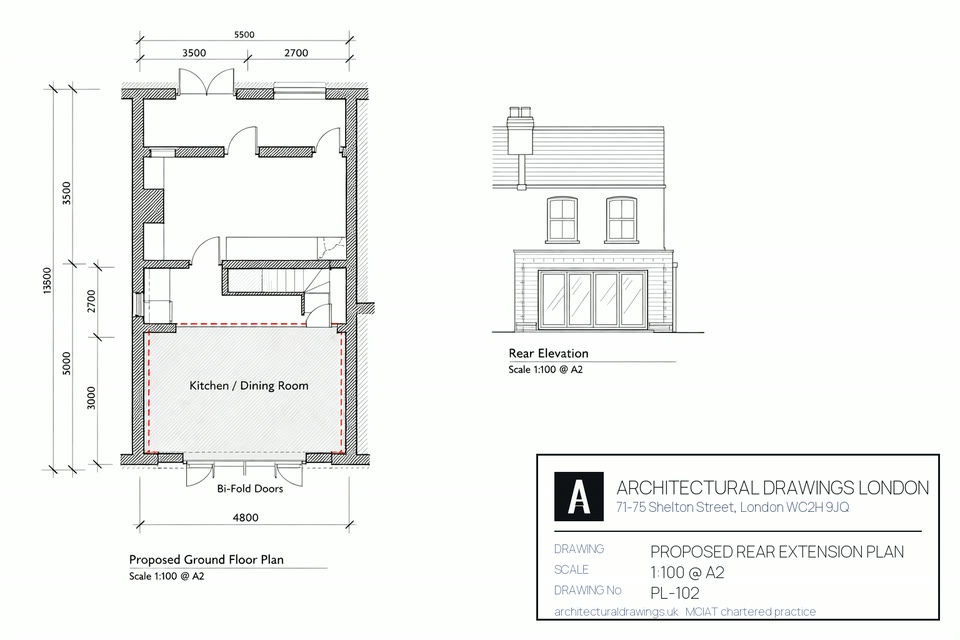
- Typical projects: rear extension, side-return, two-storey, wraparound
- Conservation areas: 85 records in the national register in Richmond upon Thames
- Permitted Development: Generally available outside conservation areas
What does a rear extension in Richmond actually cost?
Drawings from £1,225 for a full planning set, £548 to the council for a householder application, or £249 if the larger home extension route fits. Of 289 larger extensions Richmond determined in the twelve quarters to March 2026, it refused 78 — 27.0%, close to the London figure of 24.9%. What sets this borough apart is what happens after a refusal: the Planning Inspectorate allowed 292 of the 667 householder appeals it decided from Richmond between July 2016 and June 2026, 43.8%, against 35.6% across England. Nearly half of the refusals that were fought were overturned, which says something about how tightly the council reads its own policies.
| Measure | Richmond upon Thames | London |
|---|---|---|
| Conservation areas | 85 covering 3,172 ha | 1,141 across London |
| Householder approval rate | 80.2% | 83.0% |
| Householder decisions made | 4,125 | 77,680 |
| Larger-extension prior approvals granted | 211 | 73.0% of those determined |
| Householder appeals involving a listed building | 12.1% | — |
| Householder appeals allowed after refusal | 43.8% of 667 | 40.8% of 13,067 |
Sources: conservation areas from planning.data.gov.uk, retrieved 1 September 2026, with hectares computed from the published boundaries; decision figures from MHCLG PS1 and PS2, twelve quarters to March 2026; appeals from Planning Inspectorate casework decided 2016–2026. Open Government Licence v3.0. Build costs quoted elsewhere on this page are our own 2026 London range and are an estimate, not a published statistic.
What does a Richmond extension cost in 2026?
This is the cost picture. The service page for house extensions in Richmond upon Thames covers the submission itself.
Take £2,200 to £3,200 per square metre as the build range, with the top of it doing more work here than the outer-London label suggests. Terraced houses in this borough sold at a median of £900,000 across 934 registered transactions in 2025 and semi-detached at £1,097,500 across 524 (HM Land Registry Price Paid Data), so specifications tend upward, and so does the standard the planners hold you to. Professional fees, the planning fee and VAT all sit outside the range.
With 72 conservation areas, a Richmond extension is nearly always being detailed for a conservation officer, and matched brick, tile and joinery are what carry a quote to the top of its range. Where the property is listed as well - common along the river and around Richmond Green - specialist trades and a heritage statement are additional, and neither is optional.
Typical extension costs in Richmond upon Thames (build only)
On top of the build cost, you will need architectural drawings. These fees are 30% below typical London architect rates.
What pushes a Richmond extension price up?
Richmond refused 818 householder applications in three years, the second-highest count in London, across 4,125 decisions (MHCLG planning statistics, retrieved 1 September 2026). With 72 conservation areas - more than any other borough - the working assumption is that your address is designated and the scheme will be assessed on its design. That assessment, not the build logistics, is where a Richmond extension budget is really decided.
Conservation areas
The national register holds 85 conservation area records for this borough, more than for any other in London, though none of them carries a designation date in the open data so we do not give one. Five of the largest are public open space rather than housing: Richmond Park at 945.9 hectares, Bushy Park at 430.1, Hampton Court Park at 301.1, Old Deer Park at 152.3 and the Royal Botanic Gardens at Kew at 136.4. The ones that will decide your application are smaller and residential — Petersham at 86.2 hectares, Twickenham Riverside at 85.0, Ham Common at 74.3. Inside any of them the permitted development allowance narrows and a full application at £548 becomes the likely route, with materials specified rather than assumed. Budget 10 to 20% more on the build for that (planning.data.gov.uk, retrieved 1 September 2026).
Property type
Richmond has no single dominant vintage, which is unusual in London and is why extension advice here travels badly between neighbourhoods. At 31 March 2025 its 85,800 homes split 20.3% pre-1900, 17.5% from 1900 to 1918, 9.9% from the 1920s and 14.2% from the 1930s — four substantial bands rather than one. Add 818 listed buildings, 40 of them Grade I and 88 Grade II* (Historic England via the Planning Data Platform, retrieved 2 September 2026), and the practical consequence is that the survey does more work here than the cost table does. A Barnes villa takes a side-return; a Whitton interwar semi takes a two-storey rear addition; a Georgian house near the Green may take neither.
Access and logistics
Barnes and East Sheen villas are often semi-detached with usable side access. Whitton's interwar semis have the standard side passage. The riverside cottages along the Thames are small, tightly packed and reached from narrow historic lanes, where deliveries and skips are genuinely difficult and the constraint is the street rather than the plot.
Our drawing fees for Richmond upon Thames extensions
One fixed fee, agreed before we start, with no hourly billing behind it. In a borough where 818 householder applications were refused in three years and where refusals are overturned on appeal more often than the England average, the money is best spent on getting the first submission right rather than on holding an appeal in reserve. The fee covers a valid submission to Richmond Council and the building regulations set the builder prices from.
Drawing fees for extensions in Richmond upon Thames
Every package includes a measured survey of your existing property, existing floor plans and elevations, proposed floor plans and elevations, a site plan, and a design and access statement where required. Our MCIAT chartered architectural technologists handle the full process from survey to submission, and we liaise with Richmond Council on your behalf.
We cover all Richmond upon Thames postcodes: SW13, SW14, TW1, TW2, TW9, TW10, TW11, TW12.
Is permitted development available in Richmond upon Thames?
Fewer than in most of outer London, because of how much of this borough is designated. Where the rights do survive, a single-storey rear extension may run 6 metres past the original rear wall on a terrace or semi, or 8 metres on a detached house, using the prior approval procedure that gives the neighbours a chance to object. Richmond refused 78 of the 289 larger extensions it determined in the twelve quarters to March 2026. One caution on the published statistics for this council: it records no 'prior approval not required' outcomes at all while recording grants, which means its grant figure is not comparable with other boroughs and only its refusal share is.
Richmond has 72 conservation areas, more than any other London borough, so the working assumption is that all three restrictions apply to you. On the Barnes and East Sheen villas the side-extension loss is felt; along the riverside terraces it is the materials rule. There is no Article 4 Direction here - 72 designations do that job by sheer coverage.
Two-storey extensions almost always require full planning permission. Richmond Council generally expects two-storey extensions to be subordinate to the original dwelling, set in from the side boundary, and designed to avoid unacceptable loss of light or privacy to neighbouring properties.
Richmond granted 1,323 certificates of lawfulness in three years (MHCLG planning statistics, retrieved 1 September 2026). Note what the same data says about the council's approach: across 289 larger rear extensions it recorded not one as requiring no prior approval. This is an authority that prefers to look at schemes, so a certificate here confirms a genuinely narrow position rather than a broad one.
Frequently asked questions
How much does a house extension cost in Richmond upon Thames?
Between £2,200 and £3,200 per square metre, so a 15 to 20 square metre single-storey rear extension comes out at roughly £33,000 to £64,000 for the build alone, before drawings, the council fee, the structural engineer and VAT. There is a local item to price early that most cost guides omit. Environment Agency Flood Zone 2 covers 24.79% of this borough and Zone 3 covers 16.93%, which is a large fraction for a borough this far up the river. Those zones are the undefended extent and say nothing about whether your house has ever flooded, but they do determine paperwork: on a plot inside one, the application will need a Flood Risk Assessment.
Can I extend under Permitted Development in Richmond upon Thames?
Sometimes, but check before you assume it. The allowance is 6 metres beyond the original rear wall for a terrace or semi and 8 metres for a detached house, single storey, through the prior approval route. What complicates it here is coverage: the national register lists 85 conservation areas across this borough, and inside one of them the permitted right for extensions is narrowed or removed. Given that Richmond refused 818 householder applications in the three years to March 2026, a Lawful Development Certificate at £274 is a cheap way to establish that you never needed permission in the first place.
How long does a house extension take in Richmond upon Thames?
A typical house extension project in Richmond upon Thames takes 5-8 months from initial instruction to completion. This breaks down as: 2-3 weeks for measured survey and drawing preparation, 8 weeks for planning determination by Richmond Council (if required), 2-4 weeks for building regulations approval, and 8-16 weeks for construction depending on the size and complexity of the extension.
Do I need a Party Wall Agreement for an extension in Richmond upon Thames?
One adjoining owner on the villa and semi stock, two on the riverside terraces. The excavation provision is the usual trigger. Where a property is listed as well as designated - common along the river and around Richmond Green - listed building consent runs alongside planning permission and the party wall award, and none of the three substitutes for either of the others.
What experience do you have with extensions in Richmond upon Thames?
We prepare extension drawings for properties across all Richmond upon Thames postcodes (SW13, SW14, TW1, TW2, TW9, TW10, TW11, TW12). Our MCIAT chartered architectural technologists understand Richmond Council's policies, design guides, and local precedents. We have a council-ready drawing review across all 33 London boroughs.