TL;DR — Key Facts
- Build cost per sqm: £2,200 – £3,200 (outer London borough)
- Council planning fee: £548 (householder application, 2026)
- Typical projects: rear extension, side-return, two-storey, wraparound
- Conservation areas: 22 designated areas in Kingston upon Thames
- Permitted Development: Generally available outside conservation areas
What does Kingston add to an extension budget?
A tree survey, more often than anywhere else. Kingston upon Thames holds 7,145 tree preservation zones in the national register, the most in London, plus 114 Article 4 areas. It approved 78.4% of the householder applications it decided. It issued 969 lawful development certificates over the same period.
| Measure | Kingston upon Thames | London |
|---|---|---|
| Tree preservation zones in the register | 7,145 | most of the 9 boroughs in the tree register |
| Article 4 areas in the register | 114 | — |
| Householder approval rate | 78.4% | 83.0% |
| Householder decisions made | 2,454 | 77,680 |
| Extension applications in the Datahub | 436 | 86% approved |
| Householder planning application fee | £548 | statutory, England 2026 |
Sources: registers from the MHCLG Planning Data Platform, retrieved 1 September 2026; decision figures from MHCLG PS1 and PS2, twelve quarters to March 2026; the Datahub row from the Planning London Datahub, retrieved 15 August 2026, phrase-matched and comparable within Kingston only; the fee from the Fees for Applications Regulations 2012 as amended. Build costs on this page are our own 2026 London range, not a published statistic.
What does a Kingston extension cost in 2026?
Cost is the subject of this page; the submission itself, with scope, fee and programme, sits on house extensions in Kingston upon Thames.
The knowable part of the budget is the council's. A householder application is £548 and a full application £610, both set nationally rather than by the borough; the whole scale is on our planning fees page. Riverside plots carry one extra document, because 11.2% of the borough's land falls inside Flood Zone 2 (Environment Agency flood map) and an application there needs a Flood Risk Assessment with it. Build rates themselves move with specification, ground conditions and access, and a single per-metre number quoted before anyone has seen the site is a guess.
Kingston's cost spread is mostly about depth. Surbiton and New Malden plots tempt a deep single-storey addition, and going past the permitted limits means the prior-approval route with its own risk attached. On the build, the Edwardian villas have wide rear elevations where a full-width opening needs a substantial steel. Chessington and Tolworth semis are the simpler and cheaper proposition.
Typical extension costs in Kingston upon Thames (build only)
Drawings are a separate line from the build, and ours are priced around 30% under what London architects ask for the same deliverables.
What moves the price in Kingston?
Kingston is light-touch until a neighbour objects. It has no borough-wide Article 4 Direction and issued three enforcement notices in three years, but under the neighbour-consultation scheme for larger rear extensions it granted 18 and refused 174 (MHCLG planning statistics, retrieved 1 September 2026). If your extension is deep enough to trigger that consultation, the depth is the biggest single decision in the budget, and it is worth testing before design.
Conservation areas
Kingston Old Town, Surbiton, Hampton Wick and Coombe Hill are among the 22 conservation areas in the borough. Inside one, permitted development is curtailed and the £548 householder application usually stops being avoidable. Officers look hardest at materials and at the junction where new work meets original brickwork, and a designation tends to push the specification upward — by how much depends on the house, not on a percentage anyone can publish.
Property type
The housing stock in Kingston upon Thames is predominantly edwardian villas in surbiton and new malden; victorian terraces in kingston central; 1930s semi-detached in chessington and tolworth; post-war in new malden. Victorian and Edwardian terraces typically suit side-return and rear extensions, while 1930s semi-detached properties are well suited to two-storey rear extensions. Detached houses offer the most flexibility but often have larger footprints, meaning higher absolute costs even if the per-sqm rate is similar.
Access and logistics
Chessington and Tolworth semis have side passages and price conventionally. Surbiton and New Malden's Edwardian villas are often generously spaced. Kingston town's Victorian terraces are the tight ones, where the groundworks run through the house. The borough is suburban enough that vehicular access to the rear is available more often than in most of London, and that is worth confirming at survey.
Our drawing fees for Kingston upon Thames extensions
One fixed figure and no hourly billing: it covers what a valid submission to the council needs, and what building regulations approval requires afterwards.
Drawing fees for extensions in Kingston upon Thames
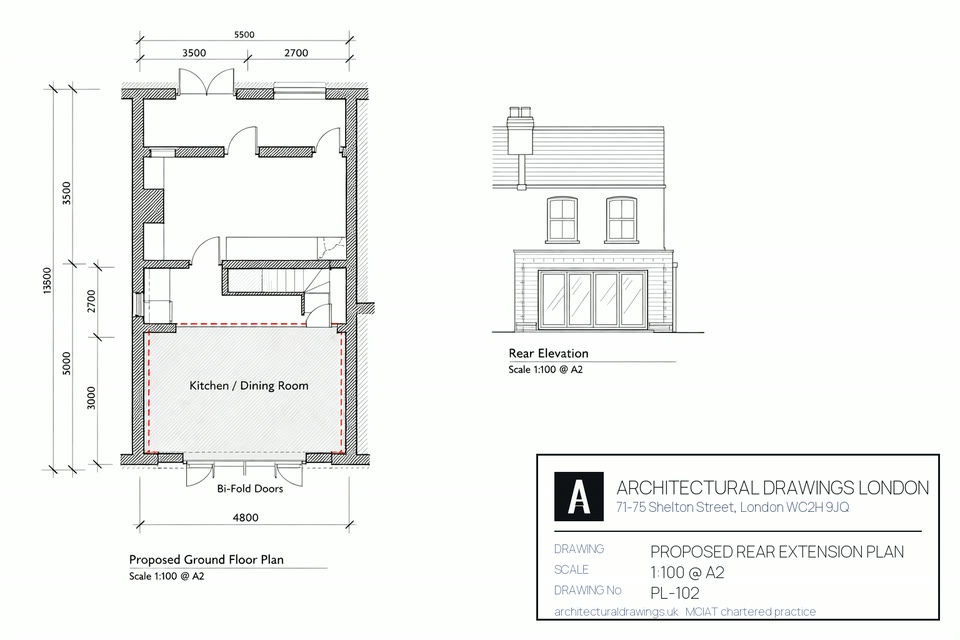
Work starts on site with a measured survey recording the property exactly as built, and the drawing set follows: existing and proposed plans, elevations, the site plan, plus a design and access statement when an application calls for one. MCIAT-chartered technologists run it through to the decision, officer correspondence included.
We draw right across the borough: KT1, KT2, KT3, KT5, KT6, KT9, SW15, SW19 and SW20, with the survey visit included at every one of them.
Planning or permitted development in Kingston?
Much of the inter-war stock here still carries useful Permitted Development rights: a single-storey rear extension of 3m on a terrace or semi, 4m on a detached house, and 6m or 8m once the neighbour consultation built into prior approval has run. Those rights disappear on flats, on listed buildings, and anywhere a direction has already withdrawn them.
Kingston's 22 conservation areas cluster along the riverside and through the town centre. On the Chessington and Tolworth semis outside them, none of this applies. Inside, the side-extension restriction is the practical loss on suburban stock, while on the Kingston town terraces it is the materials rule and the reduced rear depth that shape what can be built.
Two-storey extensions need an application. Kingston's Edwardian villas at Surbiton and New Malden generally have the plot width for one, and the interwar semis at Chessington and Tolworth are more constrained at the boundary. The borough is permissive in the absence of objection but hard once a neighbour raises one, so the relationship with the adjoining owner is worth attending to early.
Kingston granted 969 certificates of lawfulness in three years (MHCLG planning statistics, retrieved 1 September 2026). Given the refusal record on deep extensions, the certificate has a specific tactical value here: a scheme designed to stay inside permitted development limits, and certified as such, never reaches the process that refuses 174 out of 192. Designing to the limit is often worth more than arguing past it.
Frequently asked questions
How much does a house extension cost in Kingston upon Thames?
Contractors quote build rates per square metre and no public dataset records them, so none is printed here. The published figures show where the real risk sits instead: 776 appeals from this borough were decided between 2016 and 2026, and inspectors allowed 289 of them (Planning Inspectorate casework, OGL v3.0). Winning one is not a cheap outcome, since it arrives months after the refusal it answers, and that is the argument for spending the design time before submission rather than after it.
Can I extend under Permitted Development in Kingston upon Thames?
Plenty of single-storey rear extensions here never need planning permission at all: 3m on an attached house, 4m on a detached one, doubling to 6m and 8m through prior approval. That second route is where this borough stands apart. Of 352 larger householder prior approvals determined over the twelve quarters to March 2026, 174 came back refused. That is 49.4% where the 33 pooled boroughs sit on 24.9%, and it is the top end of a 42-point spread (MHCLG planning statistics, retrieved 1 September 2026). Rights narrow again inside the 22 conservation areas. Against a refusal rate like that, spending £274 on a Lawful Development Certificate before the builder unloads is cheap certainty.
How long does a house extension take in Kingston upon Thames?
Reckon on five to eight months here from instruction to finished work. Two to three weeks of that is the measured survey and the drawing, eight weeks is the council's determination period where an application is needed, two to four weeks covers building regulations, and the remainder is construction, which runs eight to sixteen weeks with the size of the job.
Do I need a Party Wall Agreement for an extension in Kingston upon Thames?
One adjoining owner on the suburban stock, two on the terraces around Kingston town. The trigger on a rear extension is nearly always the excavation provision - a footing within three metres of the neighbour's, dug deeper - which needs a month's notice. Work on the line of junction itself needs two. The Act operates whether the council is involved or not.
What experience do you have with extensions in Kingston upon Thames?
We prepare extension drawings for properties across all Kingston upon Thames postcodes (KT1, KT2, KT3, KT5, KT6, KT9, SW15, SW19, SW20). Our MCIAT chartered architectural technologists understand Kingston Council's policies, design guides, and local precedents. We have a council-ready drawing review across all 33 London boroughs.