40+ Questions Answered

Frequently Asked Questions

Everything London homeowners ask about planning permission, building regulations, loft conversions, house extensions, costs, and working with our MCIAT chartered team.

Planning Permission

Do I need planning permission for a rear extension in London?

Many single-storey rear extensions in London fall under Permitted Development and do not need planning permission. The limits are 6 metres from the original rear wall for semi-detached and terraced houses, or up to 8 metres for detached houses via Prior Approval. However, if your property is in a conservation area or subject to an Article 4 Direction, you will likely need a full planning application. We recommend checking with your borough or applying for a Lawful Development Certificate to confirm.

How long does planning permission take in London?

The statutory determination period for a householder planning application is 8 weeks from validation. Major applications have a 13-week target. In practice, many London boroughs exceed these targets due to high caseloads. From initial instruction to final decision, expect 12-16 weeks for a straightforward householder application. Read our complete guide to planning permission in London for a detailed timeline breakdown.

How much does a planning application cost in London?

A householder planning application costs £258 in council fees (2026 rate). On top of that, you need professional drawings. Our Essentials package starts from £840 and our Complete package from £1,750, making a typical total cost between £1,098 and £2,008 for a straightforward householder application.

What happens if planning permission is refused?

If planning permission is refused, you have three options: amend the scheme and resubmit (free if within 12 months of the original decision), appeal to the Planning Inspectorate (free but typically takes 6-12 months), or accept the decision. Our 98% first-time approval rate means refusals are rare when you work with us, but if it happens we will advise on the best path forward.

What is a Design & Access Statement?

A Design & Access Statement (D&AS) is a document that explains the design rationale behind your proposal and how the site will be accessed. It is required for most planning applications in conservation areas and for major developments. Our Complete package includes a professionally written D&AS tailored to your borough's policies.

Can I build without planning permission?

Yes, many home improvements fall under Permitted Development rights and do not need planning permission. This includes single-storey rear extensions within size limits, loft conversions within volume limits, and internal alterations. However, PD rights can be removed by Article 4 Directions or conservation area designations. Always confirm your rights before starting work -- read our guide to Permitted Development vs planning for details.

What is a Lawful Development Certificate?

A Lawful Development Certificate (LDC) is a formal document from your council confirming that your proposed development is lawful and does not require planning permission. It costs £129 and provides legal certainty for future property sales. We strongly recommend obtaining one for any Permitted Development project -- it prevents problems when buyers' solicitors ask for proof that work was done legally.

Do I need planning permission in a conservation area?

Conservation areas restrict many Permitted Development rights. You will typically need planning permission for any work that alters the front elevation, involves cladding, adds a dormer facing the highway, or requires demolition. London has over 1,000 conservation areas, so it is essential to check whether your property falls within one. Our team has experience with planning applications in conservation areas across all 33 London boroughs.

Building Regulations

What are building regulations?

Building regulations are the minimum standards for the design, construction, and alteration of buildings in England. They cover structural safety, fire protection, energy efficiency, ventilation, drainage, and accessibility. Building regulations approval is separate from planning permission and is required for most construction work, even projects that do not need planning. See our building regulations drawings service for more detail.

Do I need building regulations for a loft conversion?

Yes, all loft conversions require building regulations approval regardless of whether planning permission is needed. This covers structural calculations for the new floor, fire escape routes, staircase design, insulation to meet Part L, and soundproofing between floors. Our loft conversion package includes full building regulations drawings.

What is Part L compliance?

Part L of the Building Regulations sets the energy efficiency standards that new building work must meet. This includes insulation values (U-values) for walls, roofs, and floors, as well as window performance and heating system efficiency. Extensions and conversions must comply with the current Part L requirements, which were significantly updated in June 2022. Our drawings include the necessary Part L calculations and specifications.

What is the difference between planning and building regs?

Planning permission controls whether you can build something in a given location -- considering appearance, impact on neighbours, and policy compliance. Building regulations control how you build it -- covering structural safety, fire, insulation, and accessibility. Most projects need both, but they are separate applications with different fees and timelines. Read our planning guide for a detailed comparison table.

Can I use LABC or an approved inspector?

Yes, you can choose either your council's building control team or a private approved inspector (such as LABC-registered inspectors) to handle your building regulations application. Private inspectors often offer faster turnaround and a single point of contact. We can recommend approved inspectors we work with regularly across London.

How much do building regulations drawings cost?

Our building regulations drawing packages start from £840 for the Essentials tier and from £1,750 for the Complete tier, which includes structural engineer coordination and energy calculations. These are fixed fees with no hidden extras, and are 30% below typical London architect rates. See our pricing page for full details.

What is a completion certificate?

A completion certificate is issued by building control (council or approved inspector) once the finished work has been inspected and confirmed to meet building regulations. It is essential for selling your property, as buyers' solicitors and mortgage lenders require it as proof that work was done to the required standard. Never accept work as complete without this certificate.

Loft Conversions

Do I need planning permission for a loft conversion?

Most loft conversions in London fall under Permitted Development and do not require planning permission, provided the property is not in a conservation area or subject to an Article 4 Direction. Dormers facing the highway, mansard conversions, and conversions on flats always need planning. We recommend applying for a Lawful Development Certificate even when PD applies. See our loft conversion drawings service for details.

What types of loft conversion are there?

The main types are: rear dormer (the most common in London terraces), L-shaped dormer, hip-to-gable (for semi-detached and detached houses), mansard (adds a full new storey with a distinctive sloped roof profile), and Velux or rooflight conversion (the simplest, using only roof windows with no external structural changes). The best type depends on your property, budget, and planning constraints.

What is the minimum head height for a loft?

Building regulations require a minimum head height of 2.2 metres at the centre of the loft room for habitable space. Most Victorian and Edwardian terraces in London have sufficient ridge height to achieve this with a dormer. We carry out a feasibility assessment at the survey stage to confirm whether your loft can be converted.

How much does a loft conversion cost in London?

Our loft conversion drawing packages start from £1,225 and include planning drawings (or LDC application), building regulations drawings, and structural engineer coordination. Construction costs vary but typically range from £45,000 to £75,000 for a rear dormer in London, and £65,000 to £120,000 for a mansard.

Loft conversion vs mansard — which is better?

A standard rear dormer loft conversion is simpler, cheaper, and often falls under Permitted Development. A mansard creates a full additional storey with more usable space and typically adds more value to the property, but always requires planning permission and costs more to build. The right choice depends on your budget, the property type, and your borough's planning policies.

Do loft conversions need Party Wall notices?

Yes, if your loft conversion involves work on or near a shared wall (party wall) with a neighbour, you are legally required to serve a Party Wall Notice under the Party Wall etc. Act 1996. This applies to most terraced and semi-detached house loft conversions in London. The notice must be served at least two months before work begins.

House Extensions

How big can I extend under Permitted Development?

Under Permitted Development, you can build a single-storey rear extension up to 6 metres from the original rear wall for semi-detached and terraced houses, or up to 8 metres for detached houses (via Prior Approval). The maximum height is 4 metres at the eaves and ridge. These limits assume no Article 4 Direction applies and the property is not in a conservation area. See our house extension drawings service for details.

Single storey vs double storey extension — cost difference?

A double-storey extension typically costs 50-70% more than a single-storey extension of the same footprint, not double. This is because the foundations, roof, and groundworks are shared. In London, single-storey extensions typically cost £1,800-£2,800 per sqm, while double-storey extensions cost £2,500-£3,500 per sqm for construction.

Do I need a Party Wall agreement for an extension?

You need to serve a Party Wall Notice if your extension involves excavation within 3 metres of a neighbouring building's foundation, or if you are building on or astride the boundary line. This is common for side-return extensions and rear extensions on terraced properties in London. Notices must be served at least two months before work starts.

How much does a house extension cost per sqm in London?

Construction costs for house extensions in London typically range from £1,800 to £2,800 per sqm for a single-storey extension and £2,500 to £3,500 per sqm for a double-storey extension, depending on specification and borough. Our drawing fees start from £840 (Essentials) and are separate from construction costs.

What is a wraparound extension?

A wraparound extension combines a side-return extension with a rear extension, wrapping around the back corner of the house to create a large open-plan kitchen-diner. This is one of the most popular extension types for Victorian and Edwardian terraces in London. Depending on the size, it may fall under Permitted Development or require planning permission.

Can I extend a flat in London?

Flats and maisonettes have no Permitted Development rights for extensions, so any extension to a flat requires full planning permission. You will also need freeholder consent and possibly consent from other leaseholders. Ground-floor flats with garden access are the most common candidates for flat extensions in London. Get a free quote for your flat extension project.

Costs & Fees

How much do architectural drawings cost in London?

Our fixed-fee packages start from £840 for the Essentials tier (existing and proposed plans, elevations, site plan) and from £1,750 for the Complete tier (includes Design & Access Statement, pre-app liaison, and 3D visuals). Loft conversion packages start from £1,225 and mansard packages from £1,575. All fees are 30% below typical London architect rates. See our full pricing page.

Are your fees fixed or hourly?

All our fees are fixed. You receive a clear quote before we start, and that price does not change regardless of how many hours the work takes. There are no hidden extras, hourly charges, or percentage-of-build-cost fees. This is one of the key differences between us and many traditional architectural practices.

What’s included in your fee?

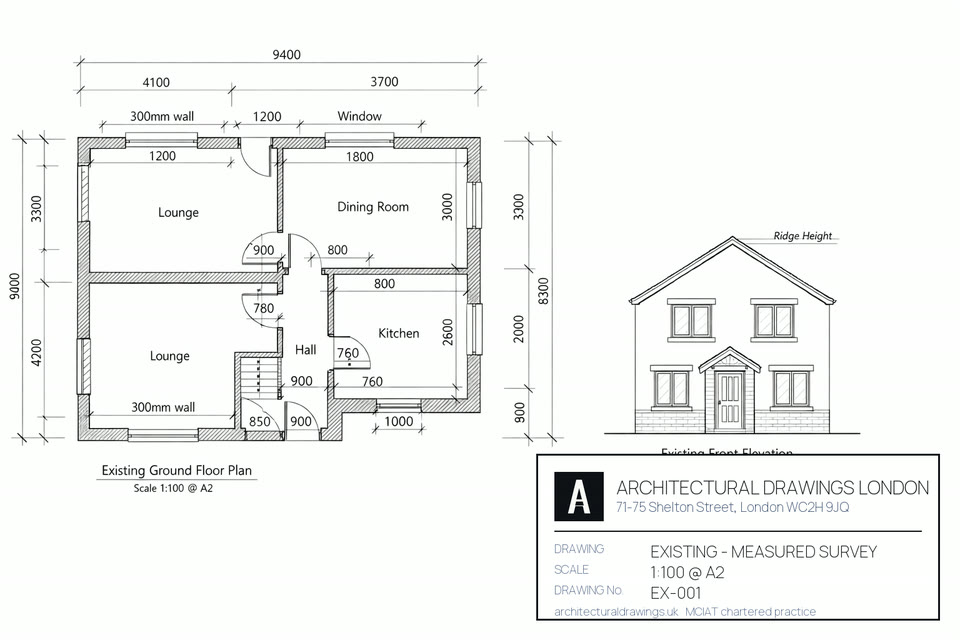
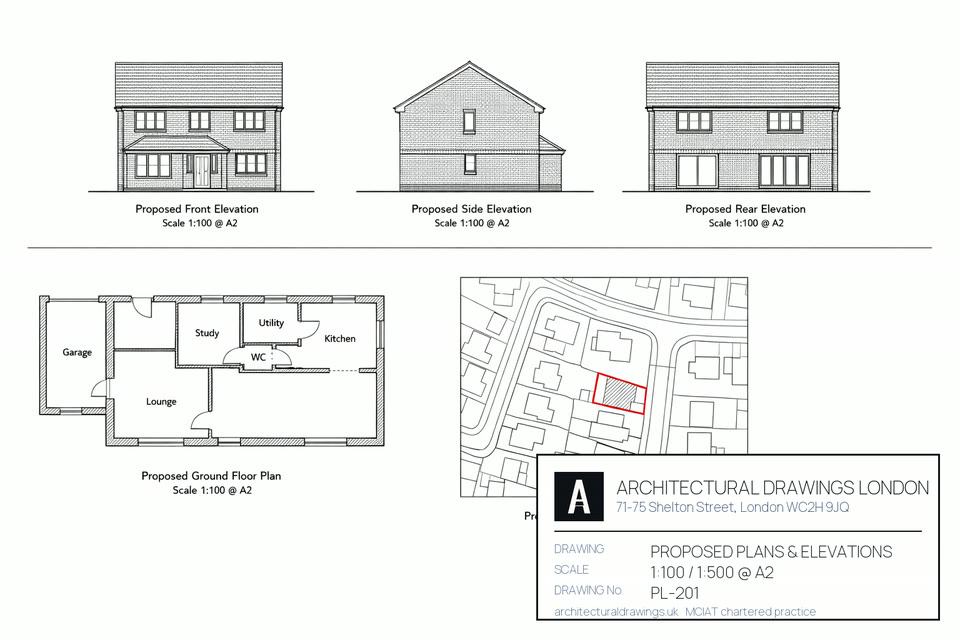
Every package includes a measured site survey, existing plans and elevations, proposed plans and elevations, a site and block plan, and two rounds of revisions. The Complete tier adds a Design & Access Statement, pre-application consultation liaison, 3D visualisations, and planning application submission on your behalf. See pricing for full tier comparisons.

Do I need to pay council fees separately?

Yes, council application fees are separate from our professional fees and are paid directly to the council at the time of submission. A householder planning application costs £258 and a Lawful Development Certificate costs £129 (2026 rates). We handle the submission process for you in our Complete package.

How much cheaper are you than an architect?

Our fees are typically 30% below London architect rates for equivalent drawing services. This is because we are MCIAT chartered architectural technologists who specialise in the technical drawing and regulatory side of projects. We do not offer interior design, furniture layouts, or full project management, which keeps our overheads lean and our prices lower.

Do you offer payment plans?

Yes, we offer staged payment plans on all packages. A typical split is 50% on instruction and 50% on completion of drawings. For larger projects, we can arrange three-stage payments. Contact us to discuss a payment schedule that works for your budget.

Working With Us

What areas of London do you cover?

We cover all 33 London boroughs, from Barnet to Bromley and from Hillingdon to Havering. We have submitted planning applications to every single London borough and have in-depth knowledge of each council's policies, conservation areas, and Article 4 Directions. Browse all 33 borough pages to see local planning guidance for your area.

How long does your process take?

From instruction to submission-ready drawings, our standard turnaround is 2-3 weeks. This includes the site survey, initial drawings, client review, and revisions. If you include the council's determination period (8 weeks for householder applications), the total timeline is typically 12-14 weeks from start to planning decision. See our 5-step process for details.

What is an architectural technologist?

An architectural technologist is a construction professional who specialises in the technical, regulatory, and practical aspects of building design. MCIAT chartered architectural technologists are qualified to the same degree level as architects but focus on building technology rather than aesthetic design. We produce planning and building regulations drawings, coordinate with structural engineers, and manage the regulatory approval process. Learn more on our about page.

Do I need an architect or a technologist?

For most residential planning applications and building regulations submissions in London, an architectural technologist is the most cost-effective choice. Architects are better suited to bespoke design-led projects where aesthetics and interior design are the primary focus. If your project is a standard extension, loft conversion, or mansard, a chartered technologist offers the same technical quality at a lower cost.

Can I see examples of your work?

Yes, we can share examples of completed projects similar to yours during your initial consultation. We have a portfolio covering rear extensions, loft conversions, mansard roofs, wraparound extensions, and new-build projects across all 33 London boroughs. Get in touch for a free consultation and we will walk you through relevant case studies.

How do I get started?

The easiest way to get started is to request a free quote through our website. Tell us about your property and project, and we will send you a fixed-fee proposal within 24 hours. Alternatively, call us on 020 7946 0000 or message us on WhatsApp for an immediate response.

Still have questions?

Get a free, no-obligation quote from our MCIAT chartered team. Fixed fees from £840, 30% below London architect rates.

Get a free quote → View all services
Free quote in 60 seconds — From £840 fixed fee Get my free quote →

Before you go…

Get a free, no-obligation quote for your project. Fixed fees from £840. MCIAT chartered.

98% first-time approval rate · All 33 London boroughs