Which Hammersmith and Fulham postcodes does this house extension service cover?
Hammersmith and Fulham district by district: the housing each holds, and the desk an extension application from it arrives on. Every fee in the table is a 2026 statutory charge applying across England, fixed in regulations and nothing to do with our quotation.
| Postcode | Area | Dominant stock | What it means for a house extension |
|---|
| SW6 | Fulham / Parsons Green | Victorian terraces, mansion blocks | SW6 holds Fulham and Parsons Green in full, so one council and one set of policies govern everything drawn there. |
| W6 | Hammersmith / Brackenbury Village | Victorian terraces, mansion blocks | W6 is Hammersmith and Brackenbury Village, wholly inside the borough and decided under its own Local Plan. |
| W12 | Shepherd's Bush / White City | Victorian and Edwardian terraces | W12 covers Shepherd's Bush and White City alone; Hammersmith & Fulham handles the application and reads it against the W12 conservation-area map. |
| W14 | West Kensington / Barons Court | Victorian and Edwardian villas | W14 crosses the boundary at West Kensington and Barons Court, so an extension there may be validated by Hammersmith & Fulham or by RBKC. Establish which before the drawings go in. |
| SW10 | West Brompton / World's End | Georgian and Victorian terraces, listed buildings | SW10 divides West Brompton and World's End between RBKC and Hammersmith & Fulham, so the address gets checked against both policies maps at the outset. |
Which Hammersmith and Fulham neighbourhoods suit a house extension best?
Almost half the borough's houses predate 1900: 48.1% of 95,070 dwellings on the council-tax stock record for March 2025. Even so, one street differs from the next in the pitch of its roofs, the make-up of its walls and the depth behind the back door. What an extension can achieve differs with them.
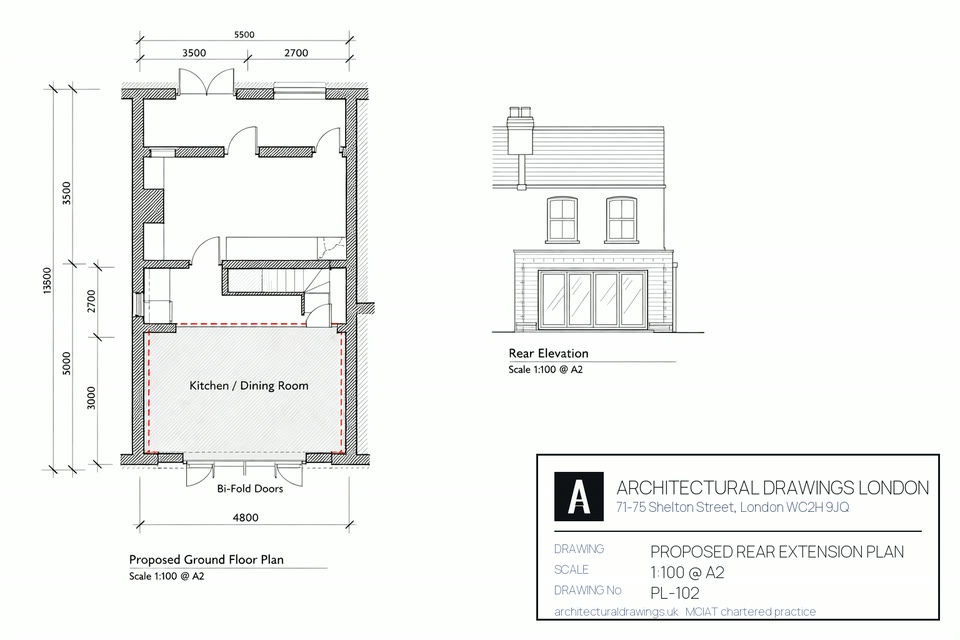
- Brackenbury Village (W6) — a house extension in Brackenbury Village starts from victorian terraces, and Brackenbury Village reads as Victorian conservation area. The side-return infill is the classic move on these Victorian terraces — 3 m of permitted development depth plus the width of the original side passage in W6. Hammersmith & Fulham Council assesses Brackenbury Village house extensions against its own Brackenbury Village character guidance, and the location plan we draw for Brackenbury Village references Ravenscourt Park.
- Sand's End (SW6) — a house extension in Sand's End starts from victorian terraces, new-build, and Sand's End reads as Victorian terraces, riverside regen. The side-return infill is the classic move on these Victorian terraces — 3 m of permitted development depth plus the width of the original side passage in SW6. Hammersmith & Fulham Council assesses Sand's End house extensions against its own Sand's End character guidance, and the location plan we draw for Sand's End references Imperial Wharf.
- Fulham (SW6) — a house extension in Fulham starts from victorian terraces, mansion blocks, and Fulham reads as Victorian bay-fronted terraces. The side-return infill is the classic move on these Victorian terraces — 3 m of permitted development depth plus the width of the original side passage in SW6. Hammersmith & Fulham Council assesses Fulham house extensions against its own Fulham character guidance, and the location plan we draw for Fulham references Fulham Broadway.
- Hammersmith (W6) — house extension work in Hammersmith means victorian terraces, mansion blocks. Hammersmith is Victorian terraces, riverside character. The side-return infill is the classic move on these Victorian terraces — 3 m of permitted development depth plus the width of the original side passage throughout W6. Hammersmith & Fulham Council decides the Hammersmith application, and Hammersmith Bridge anchors the Hammersmith location plan.
- Shepherd's Bush (W12) — Victorian and Edwardian terraces defines Shepherd's Bush, where victorian and edwardian terraces set what a house extension can do. The side-return infill is the classic move on these Victorian terraces — 3 m of permitted development depth plus the width of the original side passage across W12. Any Shepherd's Bush house extension is validated by Hammersmith & Fulham Council, with Westfield London the usual Shepherd's Bush reference point on the site plan.
- White City (W12) — regenerated quarter, post-war estates defines White City, where post-war estates, new-build set what a house extension can do. Post-war houses on these estates often sit under an estate management scheme across W12. Any White City house extension is validated by Hammersmith & Fulham Council, with Television Centre the usual White City reference point on the site plan.
- Parsons Green (SW6) — house extension work in Parsons Green means victorian terraces. Parsons Green is Victorian bay-fronted terraces around the green. The side-return infill is the classic move on these Victorian terraces — 3 m of permitted development depth plus the width of the original side passage throughout SW6. Hammersmith & Fulham Council decides the Parsons Green application, and Parsons Green park anchors the Parsons Green location plan.
Does Hammersmith and Fulham planning policy restrict a house extension?
How designation changes a Hammersmith and Fulham house extension: Hammersmith & Fulham Council maintains 45 conservation areas, including Hammersmith Grove, Brackenbury Village, Fulham Palace Road. Inside any of them a Hammersmith and Fulham house extension cannot rely on permitted development, and the route becomes a £548 householder application determined in 8 weeks rather than a £249 prior approval in 6 weeks. Walham Green sets the tone for Hammersmith and Fulham casework.
Article 4 and your Hammersmith and Fulham house extension: Article 4 removes PD for HMO conversions; restrictions on ground-floor shop-to-residential in certain streets. At a SW6 address that matters twice over, because Hammersmith & Fulham Council applies the direction unevenly across Hammersmith and Fulham — we read the Hammersmith and Fulham policies map for the exact SW6 address before quoting house extensions.
The building fabric around Hammersmith and Fulham: Victorian and Edwardian terraces — particularly two-storey bay-fronted terraces south of the river in Fulham and Parsons Green; mansion blocks along main roads. Suburban-feel residential streets with strong conservation area coverage; well-established mansard precedents on many terraces. A house extension in Hammersmith and Fulham is scoped against that stock first, because it decides whether the scheme runs as permitted development, a £274 Lawful Development Certificate, or a full £548 application to Hammersmith & Fulham Council.
What happens if a Hammersmith and Fulham property sits on a boundary?
- Brent — adjoining Hammersmith and Fulham, with 22 conservation areas centred on NW2. A house extension on the far side of the Hammersmith and Fulham line is determined by Brent Council, so the Hammersmith and Fulham quote for house extensions is checked against Brent guidance before it is issued.
- Ealing — adjoining Hammersmith and Fulham, with 30 conservation areas centred on W3. A house extension on the far side of the Hammersmith and Fulham line is determined by Ealing Council, so the Hammersmith and Fulham quote for house extensions is checked against Ealing guidance before it is issued.
- Hounslow — the Hounslow boundary runs against Hammersmith and Fulham, so a house extension a street from Hammersmith and Fulham is decided by Hounslow Council instead. Hounslow runs 30 conservation areas across W3 and its neighbours, which is why house extensions priced for Hammersmith and Fulham are re-checked against Hounslow policy whenever the Hammersmith and Fulham address sits on that edge.
- Richmond upon Thames — cross the Hammersmith and Fulham boundary and Richmond Council takes the house extension instead, applying 72 conservation areas of its own around SW13. We re-price house extensions at the Hammersmith and Fulham edge because Richmond upon Thames policy and Hammersmith and Fulham policy rarely align on house extension depth.
Sources for this Hammersmith and Fulham house extension page: borough policies maps and
conservation-area registers (2025–26), Royal Mail postcode district boundaries,
the Town and Country Planning (Fees for Applications) (England) Regulations, the Town
and Country Planning (General Permitted Development) (England) Order 2015 as amended,
and the Party Wall etc. Act 1996.