TL;DR — Key Facts
- Planning authority: Merton Council
- Conservation areas: 28 designated areas
- Article 4 Directions: None currently in force
- Postcodes covered: SW16, SW17, SW19, SW20, CR4
- Typical housing: Victorian villas in Wimbledon
- Householder application fee: £548 (2026 rate)
What does a 99.3% delegation rate mean for your application?
It means a case officer decides, not a committee. Merton delegated 99.3% of its planning decisions, second only to Redbridge, and approved 88.9% of householder applications. It withdrew only 3.7% before decision, so schemes here are settled on the paperwork rather than in a public meeting.
| Measure | Merton | London |
|---|---|---|
| Decisions made under delegated powers | 99.3% | 97.0% |
| Householder approval rate | 88.9% | 83.0% |
| Householder decisions made | 2,494 | 77,680 |
| Applications withdrawn before decision | 3.7% | 7.4% |
| Decided inside eight weeks | 91.4% | — |
| Lawful development certificates issued | 156 | — |
| Householder appeals allowed, 2016–2026 | 77 of 211 (36.5%) | England 35.6% |
Source: MHCLG District Planning Application Statistics (PS1 and PS2), decisions made in the twelve quarters to March 2026, and Planning Inspectorate casework decided 2016–2026. Open Government Licence v3.0, retrieved 1 September 2026. Merton’s 156 lawful development certificates over three years is among the lowest counts in London, so more Merton work goes through a full application than the permitted development route would suggest.
Planning in Merton — what you need to know
Merton recorded eight certificates of lawfulness for proposed works to listed buildings over three years. Sorted across all 33 boroughs that puts it third, well behind Harrow on 110 and Westminster on 85, out of a London total of 224 (MHCLG planning statistics, retrieved 1 September 2026). Eight is a small number in absolute terms and a large one for an outer south London borough, and it points where you would expect: at Wimbledon, which holds most of Merton's 243 listed buildings. Morden and Mitcham behave like ordinary interwar suburbs. The two halves need different advice, and most guidance about this borough averages them into something that describes neither.
The split shows up in the numbers as well as on the ground. Merton granted 88.9% of householder applications in the twelve quarters to March 2026, comfortably above the London figure of 83.0% — and yet it refused a third of the larger rear extensions submitted through prior approval, 246 of 735, where London refuses a quarter. A council that approves designed schemes readily and rejects oversized ones sharply is exactly what you would expect from a borough where Wimbledon Village sits alongside Morden. The postcodes it covers are SW16, SW17, SW19, SW20 and CR4.
Nearly two thirds of Merton's 87,810 homes went up in the four decades before the Second World War: 11.6% before 1900, 14.9% from 1900 to 1918, 12.2% in the 1920s and 24.6% in the 1930s (VOA council tax stock, 31 March 2025). Very little was built between 1945 and 1972, which is unusual in outer London and explains why so much of the borough still reads as one continuous suburban expansion. In practice that means rear extensions on solid-wall Edwardian terraces towards Colliers Wood, loft conversions on hipped 1930s semis at Raynes Park and Morden, and careful repair work on the Victorian villas in conservation areas around Wimbledon.
With 28 designated conservation areas and no current Article 4 Directions, Merton is two planning environments under one council. Wimbledon Village and the John Innes estate are among the most tightly controlled residential areas in south London, while Morden and Mitcham are ordinary interwar suburbs where permitted development does most of the work. The borough approved 88.9% of householder applications (MHCLG planning statistics, retrieved 1 September 2026), and that figure is an average of those two very different halves rather than a description of either.
We prepare planning and building regulations drawings across every Merton postcode, at a fixed fee agreed before the survey. Because 99.3% of this council's decisions are taken by officers rather than by committee — the second highest delegation rate in London after Redbridge — the drawings and the covering documents are effectively the whole argument. Nobody is going to hear you explain them.
Where does Merton’s Article 4 Direction apply?
There is no borough-wide Article 4 Direction here withdrawing permitted development rights for ordinary householder work — no loft conversion, rear extension or outbuilding in Merton loses its rights simply because of where the borough boundary falls. That puts Merton in a minority among London councils, most of which have withdrawn something. It also means the conservation area boundary, rather than a direction, is the line that decides what you can build without applying.
So the ordinary Merton improvements — a rear extension inside the depth limits, a loft under the volume allowance, a garden room — can proceed with no application at all, as long as they satisfy the national tests on size, height and position. We would still take out a Lawful Development Certificate at £274. It converts your reading of the rules into the council’s, on paper, and that paper is the first thing a conveyancer asks for when the house sells.
The 28 conservation areas still restrict permitted development, and they are large: Wimbledon North covers 150.3 hectares, Wimbledon West 115.9, the Wandle Valley 113.1, Upper Morden 88.8 and Mitcham Cricket Green 65.2, out of about 707 hectares designated across a 3,763-hectare borough. The open register carries no designation date for any of the 28, so we identify them by boundary rather than by year. Checking which one an address falls in, and reading its appraisal, is the first thing we do.
How many conservation areas does Merton have?
Merton has 28 designated conservation areas. Notable conservation areas include:
- Wimbledon Village
- John Innes
- Mitcham Cricket Green
- Wimbledon Common
Designation narrows what can be done without applying, and in Merton that reaches a lot of houses: 63.3% of the borough’s 87,810 dwellings went up before 1940 (VOA CTSOP4.1, 31 March 2025), which is precisely the stock the conservation-area boundaries were drawn around. The restrictions that bite most often are these:
- No cladding, stone, artificial stone, pebble dash, render, timber, plastic, or tile to any external wall without planning permission
- No side extensions under Permitted Development
- Rear extensions are limited and may require planning permission
- Dormer loft conversions facing the highway require planning permission
- Satellite dishes on front elevations or chimneys are not permitted
- Demolition of gates, walls, fences, or other boundary treatment requires planning permission
Twenty-eight designated areas, unsupported by any Article 4 Direction, weighted heavily towards Wimbledon. Where a Merton property is listed rather than merely designated, the consent requirement is different in kind: listed building consent covers internal work and is a criminal matter if skipped, where conservation-area control is about external appearance. The eight listed-building certificates above are why we check status, not just location, at the outset.
Popular projects in Merton
Victorian villas in Wimbledon, Edwardian terraces towards Tooting and Colliers Wood, interwar semis at Raynes Park and Morden, post-war flats in Mitcham. Across all of it Merton took 3,611 planning decisions and approved 85.5%, with new-dwelling schemes at 62.3% (MHCLG planning statistics, retrieved 1 September 2026) — both comfortably above the London pattern. This is a borough that says yes more often than most, provided the scheme respects the part of it you are in.
Loft conversions
Two different jobs go by this name in Merton. On an Edwardian terrace towards Colliers Wood or Tooting, a rear dormer on a straight ridge returns 20 to 30 square metres and usually stays within permitted development. On a 1930s semi at Raynes Park or Morden — and a quarter of the borough's homes are 1930s — the hipped end has to be squared into a gable first, which costs more, returns more, and needs the 50-cubic-metre allowance a semi gets rather than the terrace's 40. Inside a conservation area both routes need a full application. Terraced houses here sold at a median of £650,000 in 2025 and semis at £870,000 (HM Land Registry Price Paid Data), so the second job is generally the one that pays for itself.
Side-return and rear extensions
The classic Victorian and Edwardian terrace layout in Merton leaves a side return passage that is prime territory for a kitchen extension. A single-storey rear or side-return extension can often be built under Permitted Development, extending up to 6 metres from the rear wall (or up to 8 metres for detached houses under the Prior Approval process). We prepare extension plans for properties across all Merton postcodes (SW16, SW17, SW19, SW20, CR4).
Two-storey extensions
Two-storey rear extensions suit what Merton is built from, and the reason sits in the age profile: 24.6% of dwellings date from 1930 to 1939 and a further 12.2% from the twenties (VOA CTSOP4.1, 31 March 2025), which is mostly semi-detached and detached housing with a back addition worth building over. They always need planning permission. The second storey buys a bedroom and bathroom above a widened kitchen-diner. Merton Council will back one that reads as secondary to the house it is attached to, is set in from the boundary, and takes neither light nor privacy from next door — and on a pair of semis, next door is the entire argument.
Flat conversions and internal alterations
Merton has mansion blocks and converted flats as well as houses, and internal reorganisation is the commonest work inside them. Moving walls within a single flat rarely needs consent. Splitting a house into flats, or taking a family house to C3 to C4 shared occupation, generally does — and where the pre-war stock is this large and much of it already subdivided, the planning history of the building usually answers the question before the drawings get near it. We prepare the floor plans, elevations and supporting statements either way.
How much do planning drawings cost in Merton?
Against the council charge, the cost that catches people in Merton is time on the larger applications: 1,439 had an extension of time agreed, 39.9% of all decisions (MHCLG planning statistics, retrieved 1 September 2026). Householder work is quicker than that number suggests, but a conversion or a listed-building scheme should be programmed generously. We agree a fixed drawing fee up front, approximately 30% under the going London architect rate for the same deliverables.
Planning costs in Merton
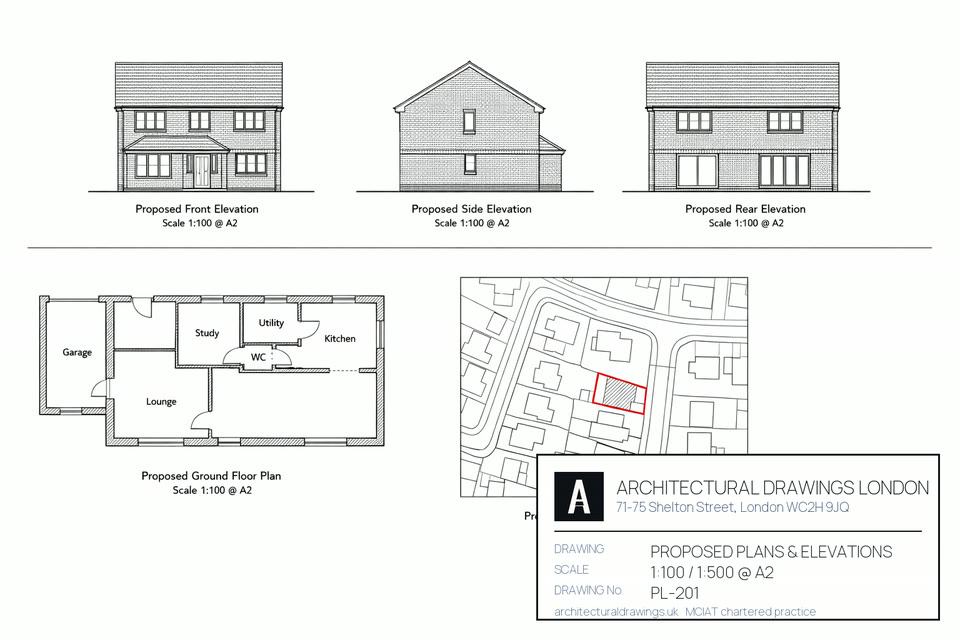
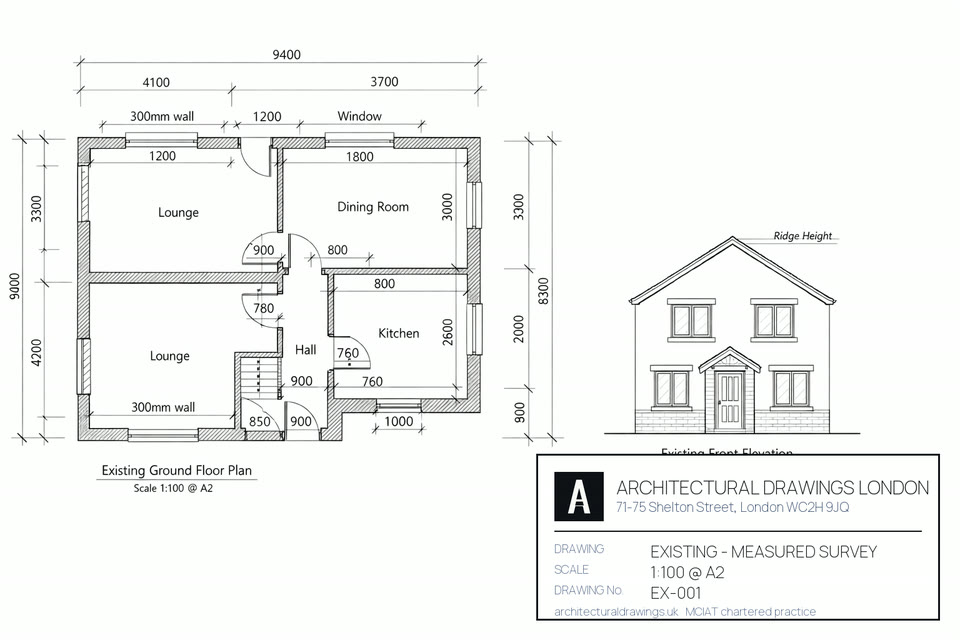
Every package opens with a measured survey of what is actually standing, because on Merton’s Edwardian and interwar houses the recorded plan and the built plan seldom agree after a century of alterations. From that we draw existing and proposed floor plans, every elevation and a site plan — the full set Merton Council needs before it will validate a submission. The fee is fixed, and it sits roughly 30% below the London architect rate for identical scope.
Merton's certificate volume is strikingly low for a permissive borough, so the useful question before paying anything is whether your scheme needs an application at all. That is the cheaper question, an officer settles it on the facts, and on the evidence it is under-asked here.
Our experience in Merton
We cover all Merton postcodes: SW16, SW17, SW19, SW20, CR4. Whether your property is in a conservation area, affected by an Article 4 Direction, or in an unrestricted residential street, we have experience with Merton Council and understand the borough's planning policies.
The work in Merton is done by MCIAT chartered architectural technologists and it runs from the first site visit to the decision notice: survey, planning drawings, building regulations drawings, and all the correspondence with Merton Council in between. Householder cases here are settled by officers rather than by committee in all but a handful of instances, so the drawings and the written case are what the outcome actually turns on.
We also work in Merton's neighbouring boroughs:
What are the odds of approval in Merton?
Merton grants more householder applications than London as a whole does. Across the three financial years from 2023-24 to 2025-26 the council decided 2,494 householder applications and granted 2,216 of them — 88.9%, against 83.0% for the 33 boroughs pooled — leaving 278 refusals. Read that as headroom, not as a licence: a refusal still costs the statutory eight weeks and a fresh submission, and the ones that fail here fail on the same two things, drawings that contradict each other and a scheme drawn without looking at the houses either side.
Merton got 91.4% of its householder decisions out inside eight weeks, a shade under the 92.5% the 33 boroughs manage between them. Plan on the statutory period holding; do not hang a completion date on it.
The prior-approval route is a poor bet in Merton. Of the 735 larger rear extensions determined under the neighbour-consultation scheme, only 19.1% were granted. A neighbour objection is what turns that decision, and in a borough refusing this many it is usually cheaper to design within the ordinary permitted-development envelope, or to make a full application with a proper daylight assessment, than to gamble the £249 fee and eight weeks on prior approval.
Alongside those, 156 certificates of lawful development were recorded in Merton over the same three-year run. A certificate is not a permission — it is the council agreeing on the record that you never needed one — and at £274 it costs half of the £548 a householder application does. In a borough this heavily interwar it is the document that stops a future buyer’s solicitor reopening a loft conversion finished twenty years ago.
Decision counts on this page come from the MHCLG District Planning Application Statistics return — PS1 and PS2 — which every English planning authority is obliged to file. They span twelve quarters, April 2023 through March 2026, and they count decisions reached inside that span rather than applications lodged in it. The housing figures are VOA council tax stock data as at 31 March 2025. Both datasets are Open Government Licence v3.0.
Frequently asked questions
Do I need planning permission in Merton?
Often, but Merton householders check far less than their neighbours do. The council issued 156 lawful development certificates (MHCLG planning statistics, retrieved 1 September 2026) — against 1,810 in Enfield on a comparable caseload. That is a twelvefold difference in how often the question is formally asked, not a difference in the law. Given Wimbledon's designations, the low figure is better read as a risk being carried than a risk that is absent: a certificate costs £274 and is the document a buyer's solicitor will ask for.
Does Merton have Article 4 Directions?
No. Merton has no borough-wide Article 4 Direction stripping householder permitted development rights, so a 1930s semi outside a designated area keeps the standard allowances. That is not the same as an unrestricted borough. A planning condition can remove rights from one property on its own, and conservation-area rules sit on top of everything else. Where the interwar stock alone accounts for a quarter of all dwellings, the condition history attached to your particular house matters far more than the borough-wide answer.
How many conservation areas are in Merton?
Twenty-eight, and their distribution is the single most important thing to know about building in Merton. Wimbledon Village, the John Innes estate, Mitcham Cricket Green and Wimbledon Common account for most of the protected stock, and they sit almost entirely in the north and west of the borough. Morden, Colliers Wood and much of Mitcham carry no designation at all. Inside one, expect the standard withdrawals — no cladding, no side extension under permitted development, no street-facing dormer. Outside, the 431 larger-extension prior approvals the council granted show what is achievable.
How much does a London Borough of Merton planning application cost?
Against a national £548 application fee, one local figure is worth weighing: the borough issued only 156 certificates of lawful development in three years (MHCLG planning statistics, retrieved 1 September 2026), the third-lowest count in London, despite having no Article 4 Direction. That pattern suggests homeowners here pay the larger fee where the smaller one would have done, which is worth checking before you follow suit. Our drawings from £840 make the full paper cost of a Merton application roughly £1,388.
How long does London Borough of Merton take to decide a planning application?
Merton has the shortest tail of any borough in this guide: 91.4% of householder applications decided within 8 weeks and just 0.3% running beyond 13 weeks, across 2,494 decisions (MHCLG planning statistics, retrieved 1 September 2026). In practice that means a Merton decision arrives close to when the statutory clock says it will, which is not true everywhere in London. Budget 12-14 weeks from instruction, and 4-6 weeks more if you take pre-application advice. Major applications carry a thirteen-week target.