TL;DR — Key Facts
- Planning authority: Sutton Council
- Conservation areas: 17 designated areas
- Article 4 Directions: None currently in force
- Postcodes covered: SM1, SM2, SM3, SM4, SM5, SM6, SM7
- Typical housing: 1930s semi-detached dominates
- Householder application fee: £548 (2026 rate)
How quickly does Sutton decide a planning application?
Sutton settled 98.6% of its householder decisions inside the statutory eight weeks and only 0.4% ran past thirteen. It approved 86.3% of 2,141 decisions and agreed an extension of time on just 13.5% of applications, well below the 34.5% London figure.
| Measure | Sutton | London |
|---|---|---|
| Decided inside eight weeks | 98.6% | — |
| Decided beyond thirteen weeks | 0.4% | — |
| Applications with an agreed extension of time | 13.5% | 34.5% |
| Householder approval rate | 86.3% | 83.0% |
| Householder decisions made | 2,141 | 77,680 |
| Enforcement notices issued | 13 | 3,554 |
| Householder appeals allowed after refusal | 38.8% of 250 | 40.8% of 13,067 |
Source: MHCLG District Planning Application Statistics (PS1 and PS2), decisions made in the twelve quarters to March 2026, and Planning Inspectorate casework decided 2016–2026. Open Government Licence v3.0, retrieved 1 September 2026. The low extension-of-time rate is the reason the eight-week figure is meaningful here: Sutton is genuinely fast rather than fast on a clock it has stopped.
Planning in Sutton — what you need to know
Sutton is the most predictable planning authority in this guide. It decided 98.6% of householder applications within eight weeks, agreed an extension of time on only 13.5% of all decisions — second-lowest in London — and issued 13 enforcement notices in three years (MHCLG planning statistics, retrieved 1 September 2026). Fast, consistent, and light-touch. For a homeowner that means the council is rarely the reason a Sutton project slips.
Outer south London suburban; generally permissive; Carshalton and Cheam conservation areas add heritage in pockets. The borough has a population of approximately 207,000 residents and covers postcodes SM1, SM2, SM3, SM4, SM5, SM6, SM7.
The housing stock in Sutton is predominantly 1930s semi-detached dominates; Edwardian terraces and villas in Sutton central; Victorian cottages in Carshalton; post-war in Hackbridge. This mix of property types means that Sutton Council deals with a wide range of applications, from rear extensions on terraced houses to loft conversions on semi-detached properties and full refurbishments of period homes in conservation areas.
With 17 designated conservation areas and no current Article 4 Directions, Sutton has a planning environment that balances heritage protection in conservation areas with generally permissive policies elsewhere.
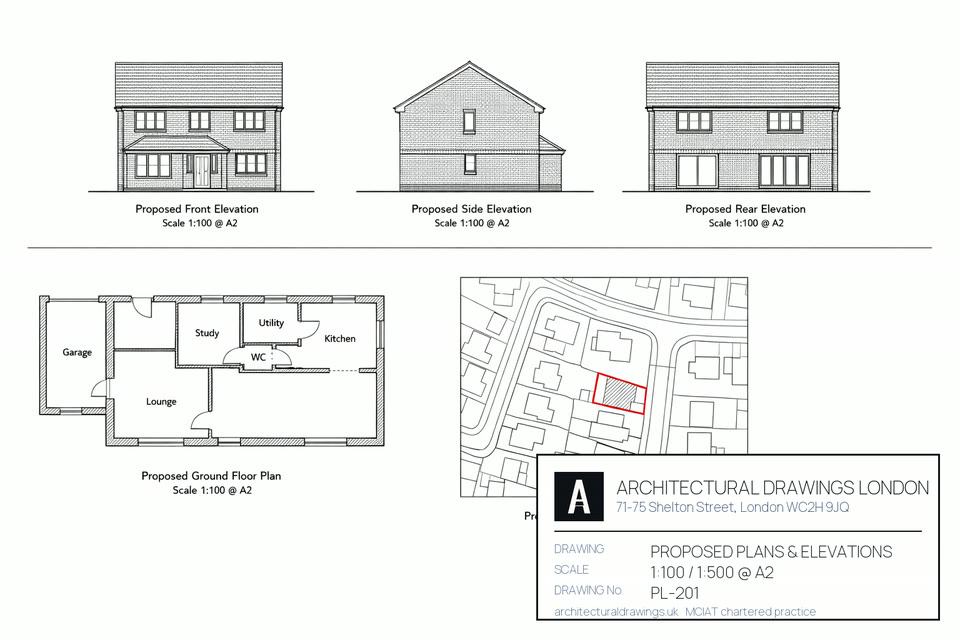
We draw both the planning application and the building regulations package for houses in every Sutton postcode. The second set is the one a loft or extension is actually built from — structure, escape, insulation, thermal elements — and commissioning both from one team is what keeps the approved scheme and the buildable scheme the same scheme.
Are there Article 4 Directions in Sutton?
No borough-wide Article 4 Direction strips householder rights anywhere in Sutton. Directions of that kind, common in inner London, are usually aimed at loft alterations or front boundary treatments street by street; nothing equivalent covers this borough, so the national limits are what your design has to satisfy.
Most improvements here can therefore go ahead without a planning application at all, provided the scheme stays inside the national allowances for height, depth and position. Spending £274 on a Lawful Development Certificate is still worth it: Sutton recorded 972 of them in three years, and it is the piece of paper that stops a sale stalling while a purchaser's solicitor asks what authorised your loft.
Even without Article 4 Directions, properties in Sutton's 17 conservation areas have additional restrictions on permitted development. We check the specific restrictions affecting your property as part of our initial assessment.
How many conservation areas does Sutton have?
Sutton has 17 designated conservation areas. Notable conservation areas include:
- Carshalton Village
- Beddington Park
- Cheam Village
- Sutton Central
Designation narrows the work you can do unasked. Below are the specific curbs that most often move a Sutton project out of certificate territory and into a full application:
- No cladding, stone, artificial stone, pebble dash, render, timber, plastic, or tile to any external wall without planning permission
- No side extensions under Permitted Development
- Rear extensions are limited and may require planning permission
- Dormer loft conversions facing the highway require planning permission
- Satellite dishes on front elevations or chimneys are not permitted
- Demolition of gates, walls, fences, or other boundary treatment requires planning permission
Seventeen conservation areas, concentrated around Carshalton and Cheam, and no borough-wide Article 4 Direction. Outside those pockets Sutton applies the national rules and little else, which is why the enforcement count is so low: there is not much to enforce against. Inside them, the older village cores are exactly the streets where materials and window detail get scrutinised. The check takes minutes and settles which of the two you are in.
Popular projects in Sutton
Interwar semis dominate, from Cheam and Worcester Park across to Hackbridge, with Edwardian terraces in Sutton town and Victorian cottages in Carshalton. That stock produces rear extensions and loft conversions at scale and mostly keeps them inside permitted limits: 298 larger rear extensions were recorded as needing no prior approval, against 34 granted and 131 refused where it was needed (MHCLG planning statistics, retrieved 1 September 2026). The pattern is familiar — go deep enough to trigger consultation and the odds change sharply.
Loft conversions
Sutton's roof space is mostly inter-war. Of 86,290 dwellings in the borough, 30.6% carry a 1930-39 build period and only 5.2% anything before 1900, on VOA council tax stock counts as at 31 March 2025. That shapes a loft project: a 1930s hipped semi generally wants a hip-to-gable before a rear dormer is worth building, whereas a straight-gabled terrace needs only the dormer. Both routes stay inside permitted development on most plots, and it is a conservation area boundary or an Article 4 Direction that pushes either into a full application.
Side-return and rear extensions
The classic Victorian and Edwardian terrace layout in Sutton leaves a side return passage that is prime territory for a kitchen extension. A single-storey rear or side-return extension can often be built under Permitted Development, extending up to 6 metres from the rear wall (or up to 8 metres for detached houses under the Prior Approval process). We prepare extension plans for properties across all Sutton postcodes (SM1, SM2, SM3, SM4, SM5, SM6, SM7).
Two-storey extensions
A two-storey rear extension suits Sutton's semi-detached and detached stock better than almost anything else, and it usually needs full permission: permitted development tolerates a two-storey rear addition only where it projects no more than three metres and still leaves seven metres to the rear boundary, which most plots here cannot manage. What officers look for is subordination — set in from the side boundary, ridge below the main roof, no material loss of light to the neighbour's rear windows. Settle those three at design stage and the application rarely turns into an argument.
How much do planning drawings cost in Sutton?
A householder application costs £548 and a certificate of lawfulness £274. Sutton issued 972 certificates in three years (MHCLG planning statistics, retrieved 1 September 2026), so the certificate route is well-worn here. In a borough this predictable the main cost risk is not the council but scope: agree the drawing package before work starts. Ours is a fixed fee set in advance, roughly a third below the going London architect rate for an identical package.
Planning costs in Sutton
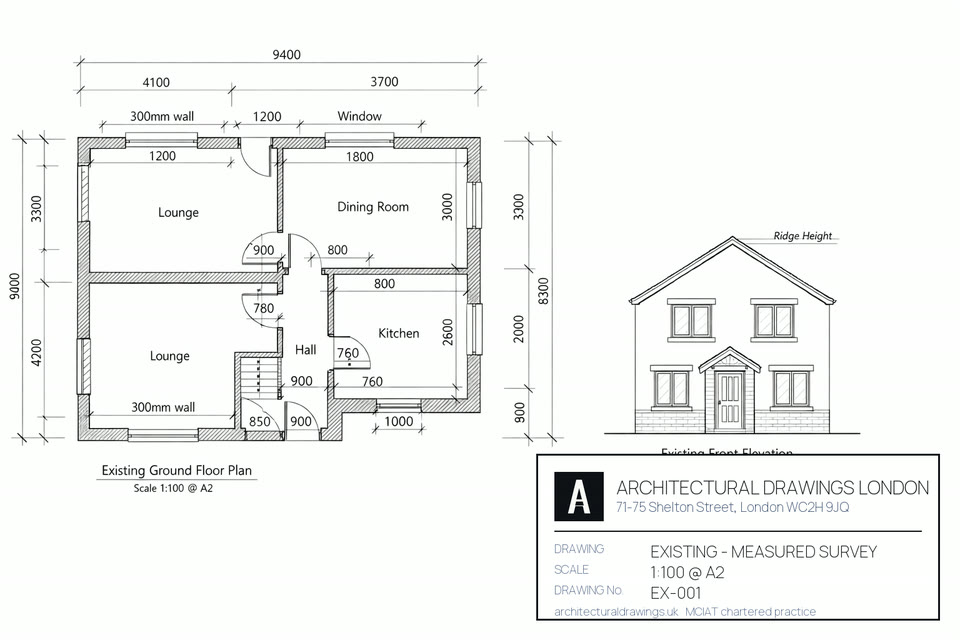
A measured survey comes first; then the existing and proposed plans, the elevations and the site plan that make a submission valid at Sutton Council's front door. All of it is quoted as one fixed sum, and that sum lands about 30% under this borough's architect rates for the identical list of drawings.
In a borough with almost no enforcement activity the certificate's value is deferred rather than immediate - when a purchaser's solicitor asks, in ten years, about work nobody kept a file on, this is the answer. Sutton granted 972 of them in three years (MHCLG planning statistics, retrieved 1 September 2026), and the drawings for one already exist.
Our experience in Sutton
We cover all Sutton postcodes: SM1, SM2, SM3, SM4, SM5, SM6, SM7. Whether your property is in a conservation area, affected by an Article 4 Direction, or in an unrestricted residential street, we have experience with Sutton Council and understand the borough's planning policies.
Sutton owners pull applications far less often than London owners do. The council took in 3,148 applications over the three years ending last March and 120 were withdrawn before any decision — 3.8%, where the 33 boroughs together sit at 6.9%. Withdrawal is usually what happens when a case officer signals refusal and the applicant retreats to redraw, so a low rate is a sign that schemes here tend to arrive in a shape an officer can work with. Our MCIAT chartered technologists prepare the planning and building regulations drawings, lodge the submission, and answer the officer's queries as they come.
We also work in Sutton's neighbouring boroughs:
What are the odds of approval in Sutton?
Sutton is the most predictable planning authority in London. It decided 98.6% of householder applications within the statutory eight weeks over the three years to March 2026, with 0.4% running past thirteen — and approved 1,847 of 2,141, a rate of 86.3% against the London average of 83.0%. Better odds and a faster answer than the London norm, at the same time.
For anyone working to a fixed date that combination is worth real money. It means the determination period can be treated as a planning assumption rather than a risk, and the variable in your programme is how long the drawings take before submission, not how long the council sits on them afterwards.
The prior-approval route is the exception to the easy ride: 34 larger rear extensions were granted against 131 refused, a grant rate of 20.6%, with a further 298 found not to need prior approval. Sutton's 1930s semi-detached stock sits on deep plots, so most extensions clear the ordinary limits without needing the scheme at all — and those that reach for the extra depth tend to be the ones a neighbour objects to.
Every count on this page comes from Sutton Council's own PS1 and PS2 submissions to MHCLG, the statutory quarterly return each English authority is obliged to make. They record decisions issued over the three years ending last March; an application lodged inside that period but still undetermined does not appear anywhere in them. Contains public sector information licensed under the Open Government Licence v3.0
Frequently asked questions
Do I need planning permission in Sutton?
Usually. No borough-wide Article 4 Direction, only 17 conservation areas, and 13 enforcement notices across three years (MHCLG planning statistics, retrieved 1 September 2026) make Sutton one of the safer boroughs to rely on permitted development in. Single-storey rear extensions within the standard dimensions, a rear roof dormer set away from the highway and internal alterations are the normal permitted work. The exception is a deep rear extension that triggers neighbour consultation, where 131 of 165 were refused.
Does Sutton have Article 4 Directions?
Not for ordinary householder work, no. A planning condition on an individual plot can still remove rights — newer estates are where that turns up most — and conservation area controls operate independently of Article 4 in any event. Read the decision notice for your own house before assuming the national allowances are intact.
How many conservation areas are in Sutton?
Seventeen conservation areas are designated across the borough — among them Carshalton Village, Cheam Village, Sutton Central and Beddington Park. Inside a boundary, cladding, side extensions and satellite dishes all lose their permitted development cover, and rear extensions and dormers get read against the area's character appraisal rather than against the national allowances alone. Establish which side of the line your address falls before a designer starts drawing, not after.
How much does a London Borough of Sutton planning application cost?
Beyond the standard £548, Sutton is the most predictable authority in this guide - 98.6% of householder applications decided inside eight weeks, an extension-of-time rate of 13.5%, and thirteen enforcement notices in three years (MHCLG planning statistics, retrieved 1 September 2026). Where a Sutton project overruns its budget, the council will very rarely be the reason.
How long does London Borough of Sutton take to decide a planning application?
Sutton decided 98.6% of householder applications inside eight weeks and 0.4% beyond thirteen, from 2,141 decisions (MHCLG planning statistics, retrieved 1 September 2026). Only Barking and Dagenham is faster, and Sutton's low extension-of-time rate means the eight weeks is a real eight weeks rather than an agreed longer period. If you need a decision by a fixed date, this is one of the few London boroughs where you can plan on it. A pre-application enquiry adds four to six weeks in front. Major applications carry a thirteen-week target.