TL;DR — Key Facts
- Dormer loft conversion: £50,000 – £70,000 (inner London premium borough)
- Mansard conversion: £80,000 – £120,000
- Velux conversion: £28,000 – £40,000
- Planning permission: Restricted by Article 4 in some areas
- Conservation areas: 29 in Hackney
What does a Hackney loft conversion cost, and which form is it?
Hackney splits almost evenly between forms: 1,283 rear dormer applications at 75% approved and 892 mansards at 72%. The mansard share is high for east London and it moves the budget, because a mansard rebuilds the roof rather than adding a box to the back of it.
| Measure | Hackney | Outcome |
|---|---|---|
| Rear dormer applications in the Datahub | 1,283 | 75% approved |
| Mansard roof applications in the Datahub | 892 | 72% approved |
| Householder decisions | 1,350 | 81.3% approved |
| Applications withdrawn before decision | 12.4% | against 7.4% across London |
| Conservation areas | 44 | 699 hectares |
| Mansard drawing package | from £1,575 | our fixed fee |
Sources: rows one and two from the Planning London Datahub, retrieved 15 August 2026 — phrase-matched descriptions, comparable within Hackney only. Rows three and four from MHCLG PS1 and PS2, twelve quarters to March 2026. Row five from planning.data.gov.uk, retrieved 1 September 2026. Row six is our own published fixed fee. Build costs on this page are our 2026 London range, not a published statistic.
What does a Hackney loft cost by roof type?
Ready to move from budgeting to drawings?
Hackney sits at the expensive end of the London range, and its decisions carry a long tail: 62 householder applications took more than thirteen weeks and 14 of them more than a full year, on the same MHCLG returns. Some of that is what is over your head. Of the borough's 120,680 dwellings, 29.4% were built before 1900 on the VOA council tax stock table dated 31 March 2025, so a loft here is far more often a hand-cut Victorian roof above a narrow terrace than a trussed post-war one.
Loft conversion build costs in Hackney
Read those brackets as builder's money and nothing else. Outside them sit our drawing fee, the council's application charge, the structural engineer, and whatever a party wall surveyor ends up costing. Even then the final figure moves with floor area, the specification you choose, how much steel the roof turns out to need, and whether a lorry can get anywhere near the house.
A conventional dormer buys 20-30 square metres. A mansard buys 30-50, with standing height across nearly all of it rather than only down the centre line. What that space is worth in resale we will not guess at: the Land Registry price-paid returns put the 2025 median Hackney sale at £591,000 across 2,227 transactions, 1.5% below the year before, and no published dataset attributes any part of that figure to a loft.
Which loft type suits Hackney properties?
On the Victorian terraces that dominate the borough, a rear mansard following the design guide gives the most space and has the clearest route through. A rear dormer is the lighter-touch alternative where the ridge allows it. The Georgian fragments in De Beauvoir and Stoke Newington are a different case, with listed status frequently in play. The post-war estates around Hackney Wick generally offer nothing convertible.
Dormer loft conversions
The rear dormer is the default in Hackney because the roofs are. Just under three dwellings in ten here — 29.4% of 120,680 — were built before 1900, against 20.9% across London (VOA council tax stock by build period at 31 March 2025, retrieved 1 September 2026). That is a borough of Victorian mid-terraces with butterfly or duo-pitch rear roofs, and a flat-roof box dormer on one will usually recover 20 to 30 square metres. What decides feasibility is almost never the planning position. It is the clear distance from the existing ceiling joists to the underside of the ridge, and whether the party walls on both flanks can be raised without a separate agreement with two sets of neighbours. Measure that first; price second.
Mansard loft conversions
A mansard replaces the roof slope with a near-vertical face and a shallow top, which buys a full storey at standing height and always needs permission. Hackney is one of the few London boroughs that will tell you in advance what it accepts: the council publishes roof design guidance setting out profile, setback and materials for a rear-of-terrace mansard, so a scheme drawn to that document argues from a written standard rather than from whatever the neighbour got away with. Where that fails, the refusal is worth testing. Of 279 householder appeals decided against Hackney between 2016 and 2026, 129 were allowed — 46.2%, against 35.6% for England as a whole (Planning Inspectorate casework, retrieved 1 September 2026). Read that as a comment on how contestable a Hackney refusal is, not as an approval rate: appellants are the refused minority who chose to fight. An appeal still costs the best part of a year, which is the argument for drawing to the guidance at the outset.
Velux (rooflight) conversions
A rooflight conversion sits in the roof you already have and alters no part of its outline, which is why a character appraisal has nothing much to object to. There is a second Hackney argument for it. The council decided 84.1% of its householder applications inside eight weeks — 689 of 819 — against 92.5% across the capital, and agreed an extension of time on 44.1% of all 3,843 decisions it made (MHCLG planning statistics, retrieved 1 September 2026). A conversion that needs no application never joins that queue. The trade is floor area: you get head height and daylight where the existing roof already provides them, and nothing at all where it does not, so the survey either supports this route on the day or rules it out.
Does a Hackney loft need planning permission?
Hackney is unusual in publishing a design guide that its officers then apply consistently, and that guide accepts rear-of-terrace mansards in positions many boroughs refuse. So the answer here is often yes, permission is needed — a mansard always needs it — but the odds of getting it are better than the 29 conservation areas and Article 4 Direction would suggest, provided the scheme is detailed to the guide.
Permitted Development for lofts
In Hackney most rooflight schemes, and a fair number of rear dormers, never reach a planning officer at all — they are permitted development. Velux units set flush in the slope are the safest of the lot. The catch is that the entitlement is a volume budget, counted in cubic metres, and it runs out faster than people expect. Its conditions:
- The dormer must not exceed the highest part of the existing roof
- The dormer must be set back at least 200mm from the eaves
- Materials must be similar in appearance to the existing house
- No verandas, balconies, or raised platforms
- Side-facing windows must be obscure-glazed and non-opening below 1.7m
- Volume limit: 40 cubic metres for terraced houses, 50 cubic metres for others
Article 4 Directions
Hackney's Article 4 directions are aimed at HMO conversion across the borough and at office-to-residential change of use in the commercial cores. Neither of them touches a loft. It is worth saying that flatly, because owners read the phrase as a blanket and stop reading. Three other things do remove the permitted development route on a Hackney roof: conservation area designation, listing, and the property being a flat or maisonette rather than a house — Schedule 2, Part 1 of the Town and Country Planning (General Permitted Development) (England) Order 2015 has never applied to flats. In a borough holding as much converted and purpose-built flatted stock as this one, that last point catches more owners than the first two together. We check the address against the policies map and the listing register before quoting, because the answer decides whether you are buying a prior-approval pack or a full householder set.
Conservation areas
Designation does not stop a Hackney loft. It changes which drawings have to prove it. Inside a conservation area, article 2(3) switches off the Class B roof enlargement allowance altogether, so the dormer that would have been permitted development two streets north becomes a householder application at £548, and the set has to carry a streetscene elevation plus a heritage statement written against that particular area's character appraisal rather than a generic one. De Beauvoir Town, Clapton and the Stoke Newington designations each have their own appraisal, and they do not agree with one another about roof form. The encouraging number is that carefully evidenced heritage work does land in this borough: Hackney decided 220 applications to alter or extend a listed building in the twelve quarters to March 2026 and granted 191 of them (MHCLG planning statistics, retrieved 1 September 2026).
Mansard planning permission
Mansards need permission everywhere, and Hackney is the borough where they are most likely to get it. The council's published design guide accepts rear-of-terrace mansards in positions many authorities refuse, so a scheme detailed to that document is arguing from a written standard rather than from precedent. Departing from the guide removes that advantage entirely.
Hackney charges for pre-application advice on its own published scale. Here the guide does much of what a pre-application enquiry does elsewhere - it tells you the standard in advance and for nothing. Buy the enquiry where your scheme departs from the guide, or where the property is one of the Georgian houses in De Beauvoir or Stoke Newington that may also be listed.
Our drawing fees for loft conversions in Hackney
Everything a Hackney submission needs is drawn in-house by MCIAT chartered architectural technologists — the planning or certificate application where one is required, and the building regulations package behind it. Worth knowing before you fix a start date: of the 819 householder decisions Hackney recorded against the statutory clock in MHCLG's returns for the three years ending March 2026, 689 landed inside eight weeks. That is 84.1%, where London as a whole managed 92.5%.
Drawing fees for loft conversions
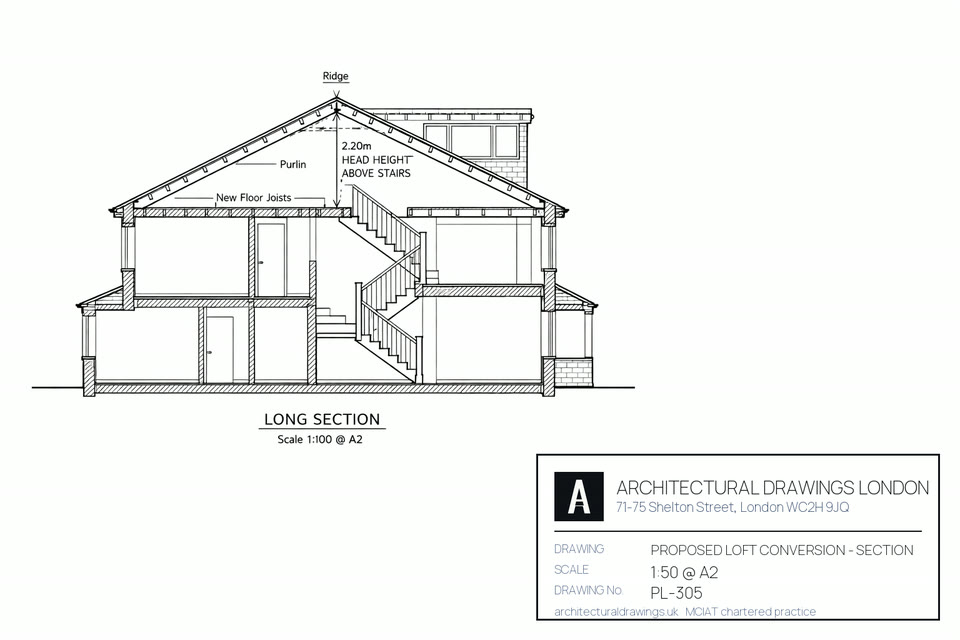
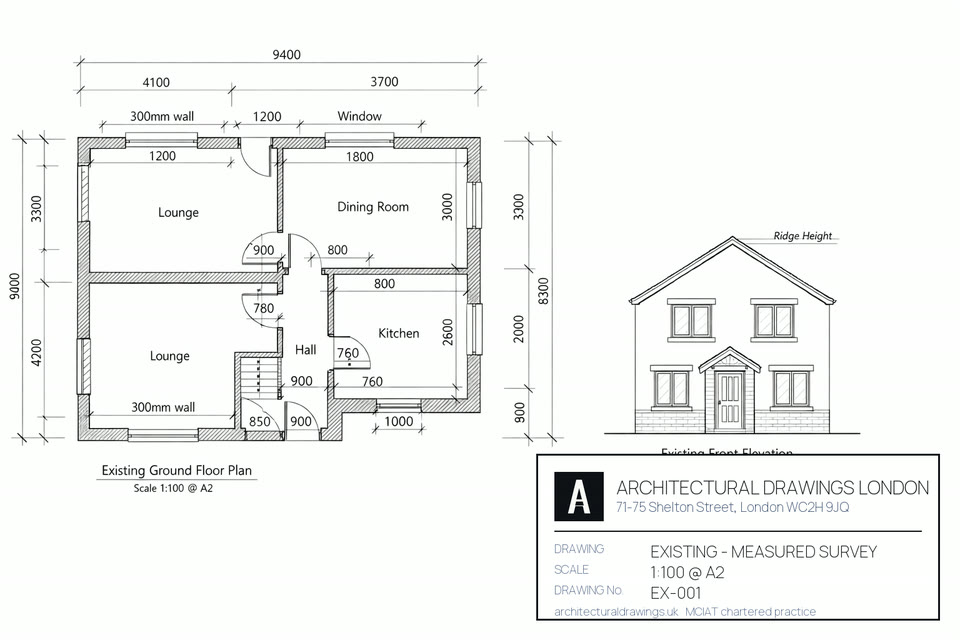
Route makes no difference to what we draw. Someone comes out and does a measured survey — the Hackney terrace on the drawing has to be the one on the street, not a tidied version of it. Then elevations and plans as existing, the same pair as proposed, sections cut through the new stair, a roof plan, and the site plan validation asks for. Mansards need more than that. They pick up an elevation of the terrace roofline entire, plus the design and access statement that justifies the form. Our price for all of it sits roughly 30% under the London architect norm.
We draw across the whole borough, from Haggerston up to Stamford Hill: E2, E5, E8, E9, N1, N4, N5, N16.
Frequently asked questions
How much does a loft conversion cost in Hackney?
Type drives the number in Hackney. A rear dormer runs £50,000 to £70,000 to build. A mansard, which means taking the roof off and rebuilding it, runs £80,000 to £120,000. A Velux conversion that leaves the existing envelope alone runs £28,000 to £40,000. Those are our own 2026 London build ranges, and nothing professional sits inside them.
Do I need planning permission for a loft conversion in Hackney?
Often not, and that is less of a problem here than elsewhere. The Article 4 Direction and 29 conservation areas remove rights across much of the borough, and a mansard needs permission regardless. Hackney's 766 lawful development certificates over three years (MHCLG planning statistics, retrieved 1 September 2026) reflect that. What compensates is predictability: design to the published guide and the application is being judged against a document you can read in advance.
What is the minimum head height for a loft conversion in Hackney?
Hackney's Victorian terraces usually carry the 2.2 metres a conversion wants, which is part of why the borough's design guide can be as specific as it is about roof additions — the stock is consistent enough that a written standard works. The post-war estates around Hackney Wick are the exception.
Do I need a Party Wall Agreement for a loft conversion in Hackney?
Yes, on effectively every Hackney house. A mansard rebuilds the top of the party wall outright, and the 1996 party wall legislation treats that as a heavier class of notifiable work than the beam seatings a dormer needs, and adjoining owners on these terraces are often mid-conversion themselves. Serve notice two months ahead, and expect surveyors to be appointed more often than not on this stock.
Can I get a mansard loft conversion approved in Hackney?
Yes. Mansards are well established on Hackney's Victorian and Edwardian terraces, and an approval on a neighbouring street is a material consideration an officer can properly be pointed at. Precedent is an argument rather than a right, though, and it has to be evidenced street by street in the streetscene elevation.