TL;DR — Key Facts
- Build cost per sqm: £3,000 – £4,500 (inner London premium borough)
- Council planning fee: £548 (householder application, 2026)
- Typical projects: rear extension, side-return, two-storey, wraparound
- Conservation areas: 38 designated areas in Kensington and Chelsea
- Permitted Development: Restricted by Article 4 in some areas
Why is an extension in Kensington and Chelsea a different problem?
Because the borough is almost entirely designated. 41 conservation areas cover 919 hectares, and the council issued just 118 lawful development certificates in three years — fewer than any borough except the City of London. Its return records no larger-extension prior approval decisions, which the publisher treats as not recorded rather than as none.
| Measure | Kensington and Chelsea | London |
|---|---|---|
| Conservation areas | 41 covering 919 ha | 1,141 across London |
| Lawful development certificates issued | 118 | — |
| Larger-extension prior approval decisions | not recorded | — |
| Householder approval rate | 90.2% | 83.0% |
| Applications withdrawn before decision | 20.3% | 7.4% |
| Basement applications in the Datahub | 1,027 | 96% approved |
| Householder appeals allowed after refusal | 42.3% of 234 | 40.8% of 13,067 |
Sources: conservation areas from planning.data.gov.uk, retrieved 1 September 2026; decision figures from MHCLG PS1 and PS2, twelve quarters to March 2026; basement figures from the Planning London Datahub, retrieved 15 August 2026, phrase-matched and comparable within this borough only; appeals from Planning Inspectorate casework 2016–2026. The 20.3% withdrawal rate is the highest in London and the number to weigh against the 90.2% approval rate. A zero in this return means the measure was not recorded for that borough, never that none exist — the publisher suppresses a rate wherever it withholds one, and the counts beside a suppressed rate are not a substitute for it.
What does an extension cost in Kensington and Chelsea?
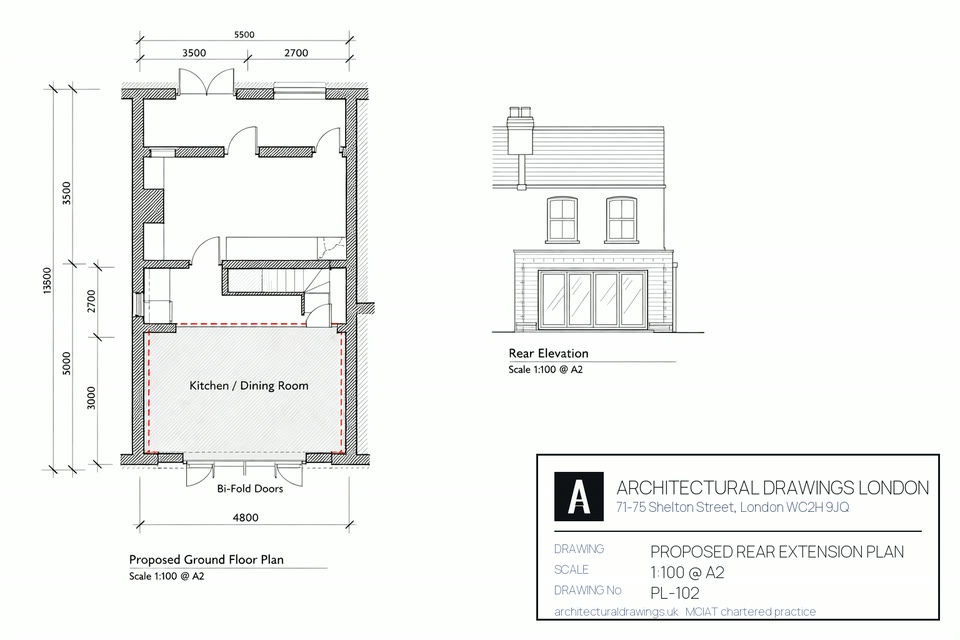
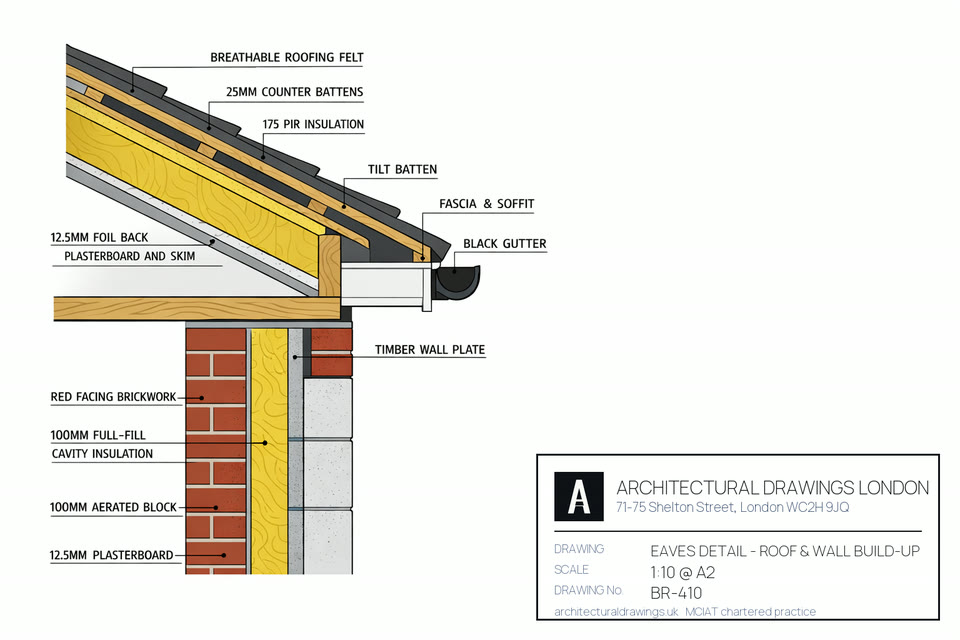
Once the budget stands up, the drawings are what turn it into a decision: house extensions in Kensington and Chelsea.
House extension build costs in Kensington and Chelsea typically run from £3,000 to £4,500 per square metre, and the reason sits in the age of the stock rather than in the postcode's reputation. 62.6% of dwellings in the Royal Borough were built before 1900 — three times the London figure of 20.9%, and the highest share of any borough. Pre-1900 construction is what drives the rate: solid walls rather than cavity, lime mortar that does not behave like cement, foundations shallower than anything a modern detail assumes, and almost invariably a conservation area or a listing on top. The median sale here was £1,195,000 in 2025, the highest in London, so the specification a scheme is held to is correspondingly unforgiving.
The Royal Borough's cost range is set by what happens below ground. With almost no rear space to build into, the local equivalent of an extension is a basement or a lowered ground floor, which brings underpinning, structural design, and party wall awards with neighbours on both sides. Add listed building consent on much of the stock and the professional cost alone exceeds a whole outer-London extension.
Typical extension costs in Kensington and Chelsea (build only)
The shell is only half the outlay. You also need a drawing set good enough for Kensington and Chelsea to validate first time, and our fixed fee for that undercuts the usual London architect quote for identical scope by roughly a third.
What drives the price up in Kensington and Chelsea?
The Royal Borough withdrew 1,378 applications in three years, 20.3% of all decisions and the highest rate in London (MHCLG planning statistics, retrieved 1 September 2026). One application in five is pulled rather than determined, which is the dominant financial risk on a project here. It also recorded no larger rear extensions at all under the neighbour-consultation scheme, so the surface-level rear extension that dominates outer London is largely not the local project.
Conservation areas
Kensington and Chelsea has 38 designated conservation areas, including Kensington, Chelsea, Notting Hill, Holland Park, Earls Court. If your property is in a conservation area, Permitted Development rights are restricted, meaning you may need a full planning application (£548 council fee). Conservation area applications also tend to require higher-quality materials and more sympathetic design, which can increase build costs by 10-20%.
Article 4 Directions
Kensington and Chelsea has Article 4 Directions in place. Article 4 Directions covering HMOs, office-to-residential, and basement developments — RBKC has some of the strictest basement policies in London. Where Article 4 applies, works that would normally be Permitted Development require a full planning application. This adds £548 to the council fee and typically 2-3 months to the project timeline, which can affect overall costs if you are renting alternative accommodation during the build.
Property type
The housing stock in Kensington and Chelsea is predominantly grand white stucco regency and victorian terraces; red-brick queen anne mansions in kensington; edwardian mansion blocks; almost no post-war housing stock. Victorian and Edwardian terraces typically suit side-return and rear extensions, while 1930s semi-detached properties are well suited to two-storey rear extensions. Detached houses offer the most flexibility but often have larger footprints, meaning higher absolute costs even if the per-sqm rate is similar.
Access and logistics
Stucco terraces in Kensington and Chelsea have no side return and frequently no rear vehicular access, on streets where a skip and a parking suspension are separate applications in themselves. Because ground-level space is so limited, the local equivalent of an extension is often downward rather than backward - and basement work brings its own structural, party wall and neighbour considerations well beyond a rear infill.
Our drawing fees for Kensington and Chelsea extensions
At Architectural Drawings London. No hourly billing, no surprises. Our fees cover everything needed for a valid planning submission to RBKC Planning and for building regulations approval.
Drawing fees for extensions in Kensington and Chelsea
Every package includes a measured survey of your existing property, existing floor plans and elevations, proposed floor plans and elevations, a site plan, and a design and access statement where required. Our MCIAT chartered architectural technologists handle the full process from survey to submission, and we liaise with RBKC Planning on your behalf.
Every Kensington and Chelsea postcode is inside our survey radius — SW1, SW3, SW5, SW7, SW10, W8, W10, W11, W14 — and the fee is the same whichever end of the borough your house sits at.
Is permitted development available in Kensington and Chelsea?
Many house extensions in Kensington and Chelsea can be built under Permitted Development (PD) rights without needing a planning application. Under PD, single-storey rear extensions can extend up to 6 metres from the original rear wall for terraced and semi-detached houses, or 8 metres for detached houses (under the Prior Approval process). However, Kensington and Chelsea has Article 4 Directions that may remove some PD rights. Article 4 Directions covering HMOs, office-to-residential, and basement developments — RBKC has some of the strictest basement policies in London.
Inside the Royal Borough's 38 conservation areas the three restrictions are close to academic, because permitted development has effectively been removed altogether: no larger rear extensions were determined under the neighbour-consultation scheme in three years. Listed status across much of the stock is the operative control, and it reaches internal alterations that conservation designation does not.
Two-storey extensions require full permission and are rarely the shape a Royal Borough project takes. The stucco terraces are listed or designated almost throughout, rear elevations are visible in ways that matter to the designation, and space is more often found downwards. Note that one application in five here is withdrawn rather than determined (MHCLG planning statistics, retrieved 1 September 2026) - test the principle before the drawings exist.
Only 118 certificates of lawful development were issued in three years (MHCLG planning statistics, retrieved 1 September 2026), the second-lowest count in London after the City. That is what happens when an Article 4 Direction, 38 conservation areas and dense listing between them remove permitted development from most of the borough. On a listed building, remember that a certificate speaks to planning and not at all to listed building consent.
Frequently asked questions
How much does a house extension cost in Kensington and Chelsea?
Check the flood map before you price anything. Roughly 4.07% of the borough's 12.13 square kilometres falls inside Flood Zone 3 and 6.06% inside Zone 2, on the Environment Agency's published extents. What a zone determines is paperwork, not peril: it decides whether your application must carry a Flood Risk Assessment. The mapped extents are undefended ones, which is to say the maps ignore the Barrier and the embankment walls entirely, so a Zone 3 address near Cheyne Walk is an evidence requirement rather than a warning. Away from the riverside strip an extension here is an ordinary householder case — 2,072 of them were decided across the 2023-24 to 2025-26 financial years, 1,868 granted and 204 refused, on the borough's MHCLG returns. The council's own fee of £548 sits on top of whatever the builder quotes.
Can I extend under Permitted Development in Kensington and Chelsea?
Inside the Royal Borough's 38 conservation areas, permitted development has effectively been removed - it recorded no larger rear extensions at all under the neighbour-consultation scheme, and issued 118 lawful development certificates in three years. Layered on top is listed status across much of the stock, where consent reaches internal alterations as well and is a criminal matter if skipped.
How long does a house extension take in Kensington and Chelsea?
A typical house extension project in Kensington and Chelsea takes 5-8 months from initial instruction to completion. This breaks down as: 2-3 weeks for measured survey and drawing preparation, 8 weeks for planning determination by RBKC Planning (if required), 2-4 weeks for building regulations approval, and 8-16 weeks for construction depending on the size and complexity of the extension.
Do I need a Party Wall Agreement for an extension in Kensington and Chelsea?
Terraced throughout, so two adjoining owners as a matter of course. Any excavation below the level of a neighbour's foundations within three metres is notifiable, and on this stock that includes essentially all basement or lowered-floor work. The council also served 17 temporary stop notices in three years (MHCLG planning statistics, retrieved 1 September 2026), the most in London, so beginning before the award is settled carries a real risk here.
What experience do you have with extensions in Kensington and Chelsea?
We prepare extension drawings for properties across all Kensington and Chelsea postcodes (SW1, SW3, SW5, SW7, SW10, W8, W10, W11, W14). Our MCIAT chartered architectural technologists understand RBKC Planning's policies, design guides, and local precedents. We have a council-ready drawing review across all 33 London boroughs.