



The brief
The clients had purchased a mid-terrace Victorian house on Broadhurst Gardens in the South Hampstead conservation area. Like many London Victorian terraces, the house had a narrow side return passage running alongside the kitchen — roughly 1.2 metres wide and 6 metres deep. The passage was essentially dead space: too narrow to use, too exposed to be pleasant, and cutting off natural light from the kitchen window that faced onto it.
Their brief was clear: extend the kitchen into the side return to create an open-plan kitchen-dining space with a large rooflight, while maintaining the Victorian character of the front elevation and keeping the rear garden untouched. They wanted to do everything properly — planning permission, building regulations, structural calculations — as a single, coordinated package. They had been quoted £4,500 by a local RIBA practice for drawings alone.
The challenge
The property sits within the South Hampstead conservation area, one of Camden's most rigorously enforced. Camden Council has extensive Article 4 Directions covering this area, removing several permitted development rights that would otherwise apply. Side extensions on terraced houses in Camden conservation areas always require full planning permission — there is no PD shortcut.
Three specific challenges shaped our approach:
- Party wall proximity. The side return shares a party wall with the neighbouring property. Any construction this close to the boundary triggers Party Wall Act obligations. Our drawings needed to show precise construction details to support the party wall surveyor's award.
- Conservation area design sensitivity. Camden's supplementary planning document on extensions in conservation areas requires that new structures are "subordinate to the host building" and use materials that are sympathetic to the existing Victorian palette. We could not use aluminium bi-fold doors or a flat zinc roof — both common in side return extensions elsewhere in London — without careful material justification.
- Drainage and services. The original Victorian soil stack ran down the side return wall. Extending over it meant rerouting the stack within the new structure — a building regulations issue (Part H) that had to be designed before planning was submitted, not after.

Our approach
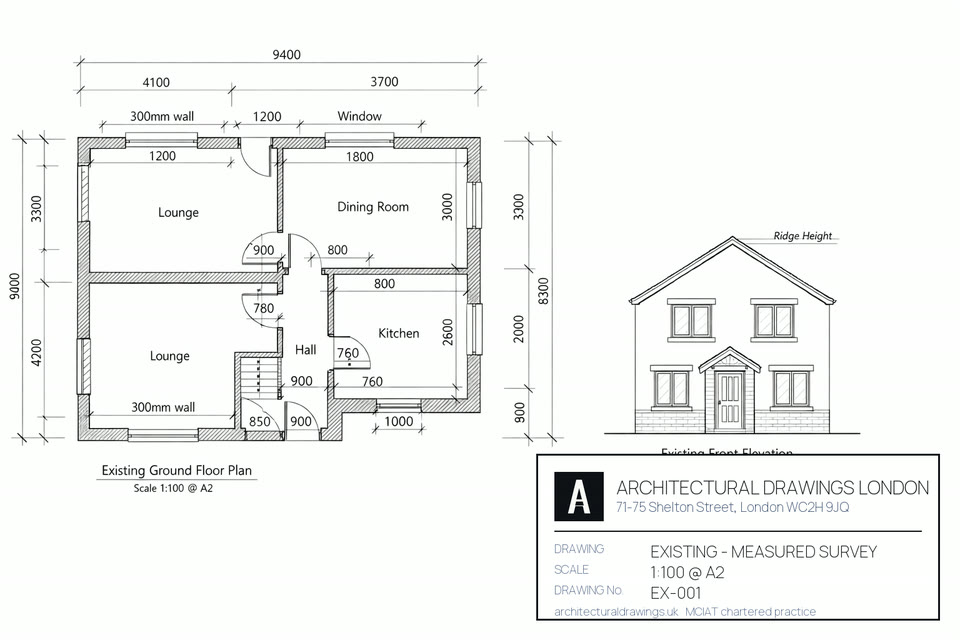
We began with a measured survey of the existing property using a laser measure and total station for the external boundaries. The survey confirmed the side return at 1,180 mm wide (narrower than the estate agent's floorplan suggested) and identified a slight step in the party wall that would affect the roof junction detail.
The drawing set included:
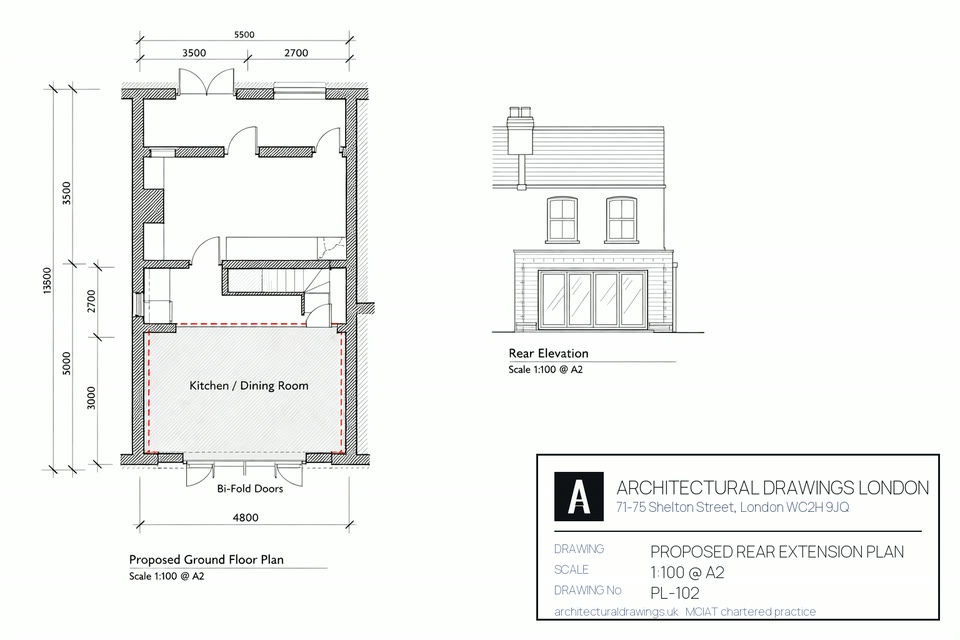
- Existing and proposed floor plans at 1:50
- Existing and proposed elevations (all four sides) at 1:100
- Two cross-sections through the side return extension at 1:50, showing the rooflight, the stepped party wall junction, and the new structural beam
- A site plan at 1:200 showing the property in its conservation area context
- A design and access statement referencing Camden's conservation area guidance
- Building regulations drawings showing Part L insulation details, Part B fire separation at the party wall, and Part H drainage rerouting
- Structural calculations for the opening between the existing kitchen and the new extension (a 3.6-metre span requiring a 203 UB 25 steel beam, specified by our in-house structural engineer)
For the design and access statement, we specifically addressed Camden's conservation area policies by proposing London stock brick to match the existing side wall, a lean-to roof with natural slate to match the existing rear addition, and a single large rooflight (Velux Heritage conservation specification) rather than a glazed roof. This approach demonstrated that the extension would read as a natural continuation of the Victorian rear outrigger, not as a contemporary insertion — a distinction that matters enormously to Camden's conservation officers.

The result
The planning application was submitted via the Planning Portal within two weeks of instruction. Camden validated the application within five working days (fast for Camden). No objections were received during the 21-day neighbour consultation period. The case officer recommended approval without amendments, and the decision notice was issued at week six — well within the 8-week statutory determination period.
The building regulations drawings were approved by Camden Building Control on a Full Plans application simultaneously. The structural calculations were signed off without queries. The client proceeded to tender with three contractors using our drawing set, and construction began eight weeks after planning approval.
The completed extension added 7.2 square metres to the ground floor — transforming a dark, narrow galley kitchen into an open-plan kitchen-dining space with natural light from the new rooflight. The clients estimated the project added approximately £80,000 to the property value against a total project cost (drawings, construction, fees) of £52,000.


