



The brief
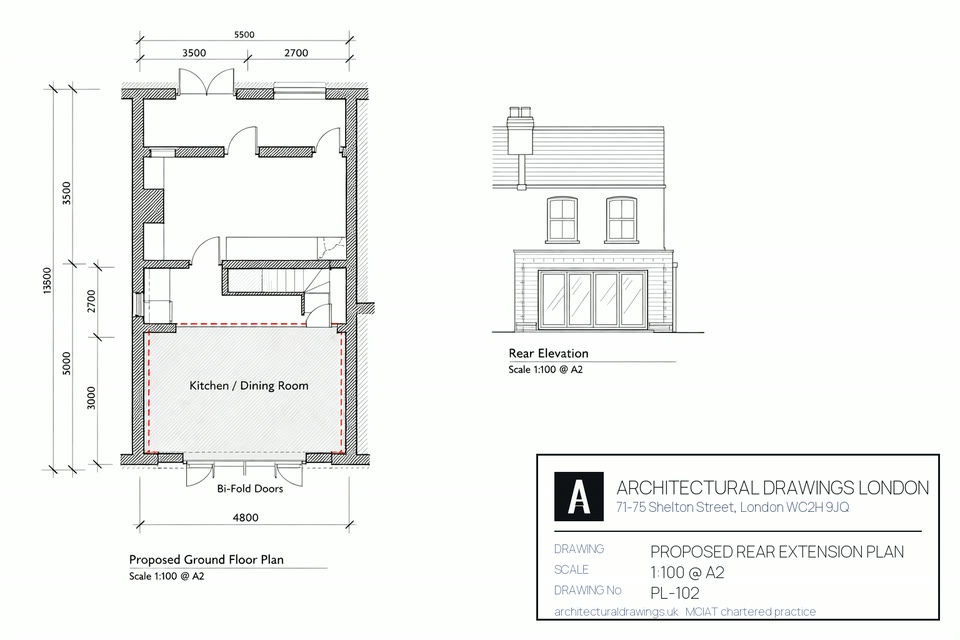
The clients owned a handsome Edwardian detached house on a tree-lined road within the Dulwich Estate — one of South London’s most desirable residential areas. The house had generous proportions but the kitchen was a poky room at the rear, cut off from the garden by a utility area and a small WC. They wanted a single-storey rear extension to create a contemporary open-plan kitchen-dining space with large glazed doors opening onto the garden.
The complication was that properties on the Dulwich Estate are subject to a dual planning regime. In addition to the standard planning permission from Southwark Council, every external alteration on the Estate requires a separate approval from the Dulwich Estate’s own Scheme of Management. These are two independent processes with different application forms, different assessment criteria, and different timescales. Many homeowners on the Estate discover this only after they have submitted to Southwark — and then face months of additional delay waiting for Estate approval.
Our clients had been warned by their solicitor about the dual regime. They came to us specifically because we had handled multiple Dulwich Estate projects and understood both sets of requirements from the outset. Our Complete package, covering planning drawings for both Southwark and the Estate, building regulations drawings, and structural calculations, 750. A local practice familiar with the Estate had quoted £5,500 for the same scope.
The challenge
The Dulwich Estate is a unique feature of London’s planning landscape. Established in 1619 under the terms of Edward Alleyn’s charitable foundation, the Estate retains freehold ownership of approximately 1,500 properties across Dulwich Village, West Dulwich, and parts of Herne Hill. The Estate operates a Scheme of Management under the Leasehold Reform Act 1967, which gives it statutory authority to control external alterations to properties on the Estate — even those that have been enfranchised.
This project faced three distinct challenges arising from the dual planning regime:
- Two separate approval bodies with different priorities. Southwark Council assesses applications against the Local Plan and the NPPF, focusing on matters like residential amenity, daylight impact, and general design quality. The Dulwich Estate, by contrast, focuses almost exclusively on the visual impact on the Estate’s character — materials, proportions, and architectural detailing. An extension that Southwark might readily approve could be rejected by the Estate if it uses the wrong brickwork bond, the wrong window proportions, or a roof material they consider inappropriate. The design had to satisfy both sets of criteria simultaneously, which sometimes conflict.
- The Estate’s material palette. The Dulwich Estate publishes detailed design guidance specifying acceptable materials. For rear extensions, they typically require London stock brick to match existing walls, clay tile or natural slate roofing, and painted timber or powder-coated aluminium windows in approved colours (generally dark green, dark grey, or white). UPVC is banned entirely. The Estate also has views on window proportions — they prefer vertically proportioned openings that echo the Georgian and Victorian character of the Estate, even on contemporary extensions. Our clients wanted a large-format sliding glass door system, which required careful negotiation with the Estate’s surveyor.
- Simultaneous submissions. If submitted sequentially, the dual approval process could take 16–20 weeks (8 weeks for Southwark, then 8–12 weeks for the Estate). We recommended submitting to both bodies simultaneously, but this required designing to satisfy both sets of requirements from the outset — no opportunity to amend the design between submissions. This demanded a thorough understanding of both the council’s and the Estate’s requirements before putting pen to paper.

Our approach
We began with a measured survey of the existing property and a detailed photographic record of the rear elevation, side boundaries, and garden context. We also reviewed the Estate’s published design guidance and studied three recently approved extensions on neighbouring streets to understand the Estate surveyor’s current preferences.
The design was resolved to satisfy both approval bodies simultaneously:
Extension design. The single-storey rear extension was designed at 4 metres deep — within the 4-metre limit that Southwark generally considers acceptable for a detached property without significant amenity impact. The roof was a flat parapet design with a concealed gutter, faced in London stock brick to match the existing rear wall. The parapet height was kept below the existing ground-floor windowsill heads, ensuring the extension read as visually subordinate to the main house — a key requirement for both Southwark and the Estate.
Material specification to satisfy the Estate. We specified London stock brick from a salvaged stock to ensure a close colour and texture match with the existing Edwardian brickwork. The mortar was specified as a lime-based mix with a bucket-handle joint profile to match the original. The flat roof was specified as a single-ply membrane (not visible from any public vantage point, so not subject to Estate material requirements). The key negotiation point was the glazing: the clients wanted 4-metre-wide minimal-frame sliding doors. The Estate typically prefers divided-light windows, but we proposed a slimline aluminium system (Minimal Windows by IQ Glass) finished in RAL 7016 anthracite grey with a concealed bottom track. We presented this to the Estate’s surveyor in a pre-submission meeting, demonstrating that the glazing was set back 300 mm from the rear parapet wall — making it virtually invisible from any viewpoint outside the property. The Estate accepted the proposal.
Part L thermal and Part B fire strategy. The building regulations package addressed the full range of compliance requirements for the extension. Part L thermal performance was achieved with 120 mm full-fill PIR cavity insulation (achieving a U-value of 0.18 W/m²K for walls) and 150 mm PIR insulation on the flat roof deck (0.13 W/m²K). The sliding door system met the 1.4 W/m²K requirement with double-glazed argon-filled units. For Part B fire safety, the extension’s proximity to the side boundary (1.2 metres) required a fire-rated external wall construction on the boundary side — we specified a 60-minute fire-rated cavity barrier system with non-combustible insulation, avoiding the need for the entire wall to be constructed in concrete blockwork.
Simultaneous submissions. We prepared two application packages: one for Southwark Council (via the Planning Portal) and one for the Dulwich Estate (via their application form with additional drawings showing the Estate context). Both were submitted on the same day. The Southwark package included the standard planning drawings, design and access statement, and a CIL liability form. The Estate package included the same drawings plus additional context elevations showing the extension in relation to neighbouring properties on the street, and a material sample schedule with brick, mortar, and glazing specifications.

The result
The Southwark Council application was validated within four working days. No neighbour objections were received during the consultation period. The case officer raised one query — requesting confirmation of the existing and proposed site coverage percentage — which we responded to within 24 hours with an updated block plan. The application was approved under delegated powers at week seven, with standard conditions including an approved materials condition (already met by our specification) and a drainage condition (addressed in the building regulations package).
The Dulwich Estate application was assessed in parallel by the Estate’s surveyor. Following our pre-submission meeting, the Estate had no material concerns with the design. Their surveyor visited the site once during the assessment period to verify the existing rear elevation and boundary conditions. The Estate’s approval was issued at week nine — two weeks after Southwark’s decision. Had we submitted sequentially rather than simultaneously, the total timeline would have been approximately 16 weeks instead of 9.
The building regulations drawings were submitted to Southwark Building Control under a Full Plans application at the same time as the planning application. The structural calculations — specifying a 203 UB 25 steel beam to form the opening between the existing kitchen and the new extension, supported on padstones in the existing rear wall — were approved without queries. The Full Plans approval was issued at week eight, between the two planning approvals.
The client appointed a contractor experienced with Dulwich Estate properties and construction began six weeks after the final approval. The completed extension added 22 m² to the ground floor, transforming the rear of the house into a bright, open-plan kitchen-dining space with the 4-metre sliding doors that the clients had originally envisioned. The salvaged London stock brick matches the existing house so closely that the extension appears original from the garden. The total project cost, including design fees, planning fees, Estate fees, and construction, came to approximately £78,000. The clients’ estate agent estimated the extension added roughly £110,000 to the property value.
The client later told us that the most valuable part of our service was not the drawings themselves, but the fact that we understood both approval processes and designed for both from day one. “Every other architect I spoke to said they’d deal with the Estate after planning,” she said. “That would have added months.”


