



The brief
The clients — a couple with three young children — owned an Edwardian semi-detached house on a quiet residential street in Balham. The house had four bedrooms upstairs but the ground floor felt cramped: a separate kitchen, dining room, and living room, each too small for a family of five. The kitchen in particular was a narrow galley with no space for a table. They wanted to transform the rear of the house into a large open-plan kitchen-dining-family space, and add a fourth bedroom above by extending the first floor to match.
A double-storey rear extension was the obvious solution, but it exceeded permitted development limits. A single-storey extension of up to 6 metres would have been possible under PD for a semi-detached house, but extending upward to two storeys always requires a full planning application. The clients had received quotes from three architects ranging from £4,200 to £7,000 for drawings alone. Our Complete package delivered the full scope, planning drawings, building regulations drawings, structural calculations, and SAP calculations, 750.
Their priorities were clear: maximise the ground floor kitchen-diner space, create a usable fourth bedroom above (not just a box room), maintain a reasonable garden, and keep within a construction budget of £150,000.
The challenge
Double-storey rear extensions in Wandsworth are common, but they come with a distinct set of regulatory and practical challenges that must be addressed from the outset. This project presented four specific complications:
- Party wall with both sides. As a semi-detached house, the property shares a party wall with the attached neighbour. But the proposed extension also came within 3 metres of the detached neighbour on the other side, triggering Party Wall Act obligations on both boundaries. Our drawings needed to show precise foundation depths, construction details, and the relationship between the new structure and both adjacent properties — all to a standard that would satisfy two separate party wall surveyors.
- Thames Water Build Over Agreement. A Thames Water public sewer ran beneath the rear garden, directly under the proposed extension footprint. Building over or within 3 metres of a public sewer requires a Build Over Agreement from Thames Water before construction can begin. Our drawings included a detailed drainage survey, proposed foundation design showing piled foundations to avoid loading the sewer pipe, and a protection strategy during construction. Without this, Thames Water would have refused the agreement and the project would have stalled.
- Part L 2025 thermal compliance. The project was submitted after the June 2025 update to Part L of the Building Regulations (conservation of fuel and power). The new Part L requirements demand significantly improved U-values for new extensions: 0.18 W/m²K for walls (previously 0.28), 0.13 for roofs (previously 0.16), and 1.2 for windows (previously 1.4). Meeting these targets in a two-storey extension while keeping wall thicknesses reasonable required careful specification of insulation types and thickness — 120 mm of full-fill PIR (polyisocyanurate) in the cavity, 150 mm of mineral wool between rafters plus 50 mm of rigid insulation below, and triple-glazed windows throughout.
- Overshadowing and amenity impact. A two-storey extension at the rear inevitably raises concerns about the impact on neighbouring properties. Wandsworth’s planning policies require that extensions pass the 45-degree rule from the nearest habitable room window of adjoining properties. We needed to demonstrate through accurate shadow studies that the extension would not cause an unacceptable loss of light or outlook to either neighbour.

Our approach
We began with a full measured survey of the existing property, including a below-ground drainage survey using CCTV to locate and map the Thames Water sewer. The survey confirmed the sewer at 1.8 metres depth, running diagonally beneath the proposed extension footprint — exactly where we expected based on Thames Water’s asset maps, but 300 mm shallower than their records indicated. This discrepancy was critical: it meant we needed to design deeper pile foundations than initially estimated to achieve adequate clearance beneath the sewer invert.
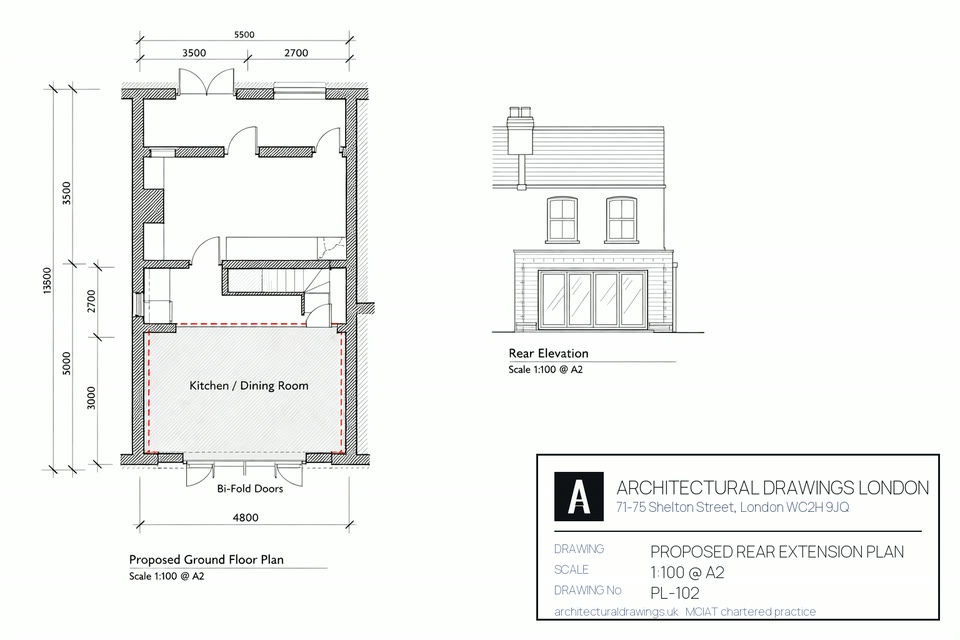
Full planning application. Since the double-storey extension exceeded PD limits, we prepared a full planning application with a comprehensive drawing package. The extension was designed at 4.2 metres deep at ground floor (providing a 28 m² kitchen-diner when combined with the existing footprint) and 3.6 metres deep at first floor (creating a 14 m² double bedroom with en-suite). The first floor was set back 600 mm from the ground floor rear wall line — a design move that reduced the visual bulk, improved the 45-degree test results, and created a small flat roof terrace accessible from the new bedroom (though we included a condition-compliant obscure glazed balustrade to address overlooking concerns).
Structural steel frame design. The structural design, prepared by our chartered structural engineer, specified a steel frame for the ground floor to achieve the open-plan layout. Two 254 UB 31 steel beams spanned the full width of the extension, supported on steel columns at the junction with the existing house. The first floor used conventional timber joists at 400 mm centres with engineered I-joists (JJI 245) to achieve the required span without intermediate support. The roof was designed as a warm flat roof with 200 mm PIR insulation and a single-ply membrane, falling to a concealed gutter at the junction with the existing roof slope.
SAP calculations. We commissioned a SAP (Standard Assessment Procedure) calculation to demonstrate Part L compliance. The assessment modelled the extension’s thermal performance including the specified insulation, triple glazing, LED lighting, and the existing boiler’s efficiency rating. The calculation confirmed the extension achieved a Target Emission Rate (TER) 12% better than required — comfortably within compliance, with margin for any minor specification changes during construction.
The complete drawing package comprised: existing and proposed floor plans and elevations at 1:50 and 1:100, two cross-sections, a site plan, a block plan, a design and access statement, structural calculations with steel and timber specifications, a drainage strategy with the sewer protection detail, SAP calculations, and a 45-degree daylight assessment for both neighbouring properties.

The result
The planning application was submitted to Wandsworth Council via the Planning Portal within two weeks of instruction. The application was validated within three working days. During the 21-day consultation period, no objections were received from either neighbour — a testament to the early engagement we recommended the clients undertake before submission, sharing the proposed drawings with both neighbours in advance.
The case officer requested one minor amendment: a condition requiring the first-floor side-facing window (serving the en-suite) to be fixed shut and fitted with obscure glass. This was a standard Wandsworth condition for side-facing windows on extensions, and we had already specified it in our drawings — so the condition was accepted without any design changes. The application was approved in 7 weeks, one week faster than the statutory target.
The building regulations drawings were approved by Wandsworth Building Control under a Full Plans application on first submission. The Thames Water Build Over Agreement was secured in parallel, taking 6 weeks from application to approval. The structural calculations were signed off without queries.
The client tendered the project to five contractors and appointed a builder who began on site within two months of planning approval. Construction was completed in 16 weeks. The finished extension added 42 m² of additional floor space: a 28 m² open-plan kitchen-diner at ground level with 3.2-metre-wide sliding glass doors to the garden, and a 14 m² double bedroom with en-suite above. The total construction cost was £145,000 including VAT — within the client’s budget. Their estate agent estimated the extension added approximately £200,000 to the property value.


