



The brief
Our clients — a young family with two children — had recently purchased a two-bedroom Victorian mid-terrace in the De Beauvoir Town conservation area of Hackney. The house had generous ground and first-floor accommodation but the existing loft was unusable: low headroom, no fixed stair access, and exposed rafters used only for occasional storage. With a third child on the way, they needed a third bedroom with an en-suite shower room, and they needed it before autumn.
Their budget was tight. A full planning application would have added 8–10 weeks to the timeline and roughly £500 in council fees. They had spoken to two local architects who quoted between £4,000 and £6,500 for drawings alone, with an additional £2,000 for structural calculations. Our Complete package, planning drawings, building regulations drawings, and structural engineering, roughly 60% less than the next cheapest quote.
The brief was specific: one double bedroom with built-in wardrobe storage along the party wall, one en-suite shower room at the rear, and a fixed staircase rising from the first-floor landing without losing an existing bedroom. Every square centimetre mattered.
The challenge
De Beauvoir Town is one of Hackney’s most tightly regulated conservation areas. The neighbourhood is characterised by uniform rows of early Victorian terraces — many still with original slate roofs, corbelled chimney stacks, and decorative barge boards. Hackney Council has Article 4 Directions in place across De Beauvoir that remove certain permitted development rights, particularly those affecting the front elevation and streetscape.
Three specific challenges shaped our design approach:
- Conservation area and Article 4 constraints. While Hackney’s Article 4 Directions in De Beauvoir restrict front-elevation changes, rear dormers remain within permitted development rights provided they comply with the dimensional limits in Schedule 2, Part 1, Class B of the GPDO 2015. The dormer must not exceed the highest point of the existing roof, must be set back at least 200 mm from the eaves, and the total volume must not exceed 50 cubic metres for a terrace. We needed to design within these exact limits — any overshoot would trigger a full planning application and months of delay.
- Party wall with both neighbours. As a mid-terrace property, the house shares party walls on both sides. The dormer construction would involve new structural loads bearing onto the party walls (the steel ridge beam and purlin connections). Both neighbours needed to be served Party Wall Act notices, and our drawings had to show construction details precise enough for the appointed party wall surveyor to prepare the award. One neighbour was cooperative; the other was initially resistant, making precise, unambiguous drawings even more critical.
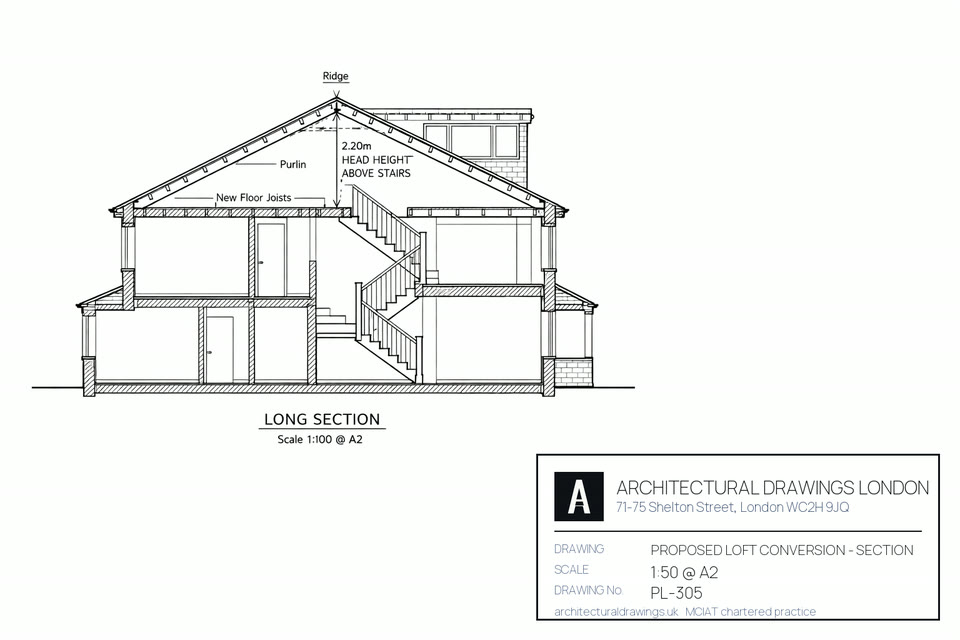
- Head height at 2.3 metres. The existing ridge height measured at just 2.3 metres from the top of the ceiling joists. Building regulations require a minimum of 2.0 metres clear head height over the staircase and 2.1 metres in habitable rooms, but 2.3 metres at the ridge left almost no margin once the floor build-up (insulation, boarding) and ceiling finish were accounted for. We needed to gain every possible millimetre through careful structural detailing.
Our approach
We began with a thorough measured survey of the existing property, including a roof-space survey with precise measurements of ridge height, rafter pitch (42 degrees), purlin positions, and chimney stack locations. The survey confirmed the ridge at 2,310 mm from joist tops — within tolerance, but only if we specified a shallow floor build-up.
Our design strategy centred on three key decisions:
Rear dormer within PD limits. We designed a flat-roofed rear dormer extending the full width of the rear roof slope, set back 200 mm from the eaves line and 300 mm from each party wall. The dormer cheeks were clad in lead-grey GRP (glass-reinforced polyester) to simulate the appearance of lead — acceptable to Hackney’s planners and significantly cheaper for the client to construct. The total volume came to 47.8 cubic metres, comfortably within the 50 m³ PD limit. We submitted a Lawful Development Certificate (LDC) application to obtain formal confirmation that the works were permitted development — essential for the client’s mortgage lender and for future resale.
Fire escape strategy. As the loft conversion created a third storey of habitable accommodation, the property required a protected escape route from the new loft bedroom down to the final exit at ground level. We designed a 30-minute fire-rated enclosure around the existing staircase from ground to loft level, with FD30S fire doors to all habitable rooms opening onto the stairwell. A mains-wired, interlinked smoke detection system (LD2 grade) was specified on every level. This satisfied Part B of the Building Regulations without requiring a sprinkler system or alternative escape window — both of which would have added significant cost.
Structural steel package. The structural design, prepared by our in-house chartered structural engineer, specified a 152 UC 23 steel ridge beam spanning between the party walls, supported on padstones built into the party wall masonry. Twin 89 × 38 mm C16 timber rafters replaced the existing single rafters at 400 mm centres, carrying the new insulated roof build-up. The floor was designed as 175 mm engineered I-joists at 400 mm centres with 18 mm structural deck — a lightweight system that achieved the required 2,050 mm clear ceiling height beneath the ridge beam while providing excellent acoustic separation from the floor below.
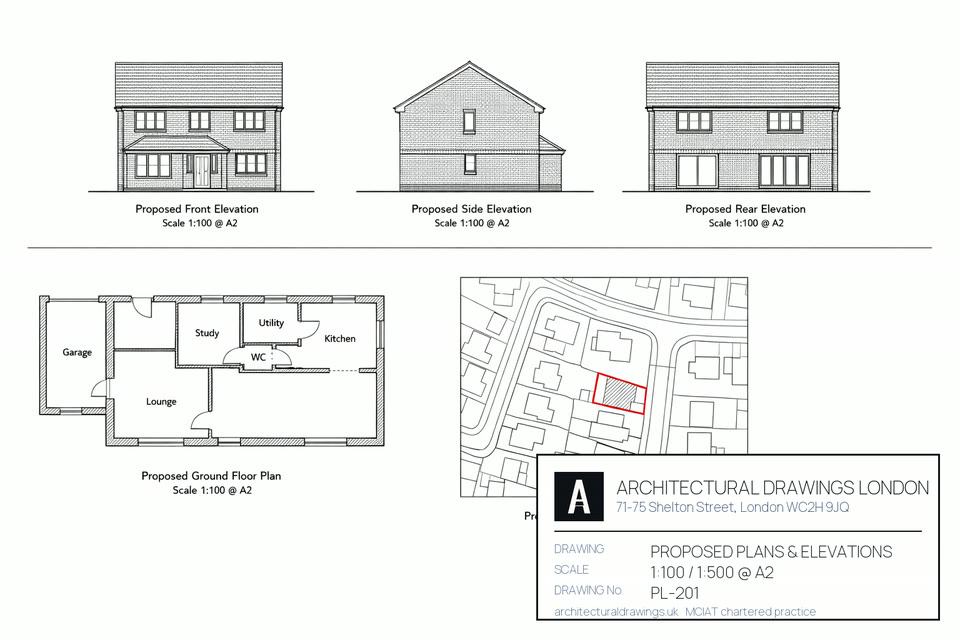
The drawing set comprised existing and proposed floor plans, four elevations, two cross-sections through the dormer, a roof plan, a site location plan, structural calculations with steel and timber specifications, and a full building regulations package covering Parts A (structure), B (fire), C (moisture), E (acoustics), F (ventilation), L (thermal performance), and P (electrics).

The result
The Lawful Development Certificate application was submitted to Hackney Council within 10 days of instruction. The LDC was granted at week five — three weeks faster than the typical 8-week planning application determination period. Hackney’s planning officer confirmed that the dormer fell within permitted development rights and issued the certificate without conditions or amendments.
The building regulations drawings were submitted simultaneously to Hackney Building Control under a Full Plans application. The structural calculations were approved without queries. Building Control confirmed compliance on first submission — no amendments were required to any drawings.
The client tendered the project to four contractors using our complete drawing package. The successful contractor began on site within three weeks of the LDC being granted. Construction was completed in 8 weeks, including the party wall works, new staircase, dormer structure, internal fit-out, and all mechanical and electrical first and second fixes.
The finished loft conversion added a 14 m² double bedroom with fitted wardrobes along the party wall and a 4.5 m² en-suite shower room with a Velux roof window providing natural light and ventilation. Clear head height at the centre of the room measured 2,240 mm — comfortable for daily use. The total construction cost came to £68,000 including VAT, and the client’s estate agent estimated the conversion added approximately £120,000 to the property value — a return of nearly two to one on the total investment.


