Key facts at a glance
- Planning permission always required — no PD rights for flat conversions
- Fire compartmentation (Part B) between every flat is mandatory
- Sound testing (Part E) required between all separating floors and walls
- CIL liability depends on net additional floor area — varies by borough
- Our flat conversion drawings from £2,100
- Total conversion cost typically £50,000–£120,000 for 2–3 flats
Do I need planning permission to convert a house into flats?
Converting a house into flats always needs full planning permission. There is no permitted development route for splitting a single dwelling, and the application is charged at £610 per new unit rather than the £548 householder rate. Expect eight weeks, plus Community Infrastructure Levy in most London boroughs.
| Requirement | Standard a conversion must meet |
|---|---|
| Planning route | Full application, £610 per dwelling |
| Sound insulation, separating floor — airborne | DnT,w + Ctr ≥ 43 dB |
| Sound insulation, separating floor — impact | L'nT,w ≤ 64 dB |
| Pre-completion sound testing | Required unless a Robust Detail is used |
| Fire — protected escape route | 30-minute construction, Part B Volume 1 |
| Fire — detection | Grade D2 LD2 interlinked alarms minimum |
| Community Infrastructure Levy | Charged per m² of new floorspace, borough rate |
| Bin and cycle storage | London Plan: 1 long-stay cycle space per 1–2 bed flat |
Sound values are Approved Document E Table 1b, which sets the lower conversion standard — 43 dB airborne and 64 dB impact — against 45 dB and 62 dB for purpose-built flats. Fire guidance from Approved Document B Volume 1. Cycle storage from the London Plan 2021, Policy T5 and Table 10.2. CIL rates are set by each borough and published on its own charging schedule.
What is a flat conversion?
A flat conversion is the subdivision of a single dwelling house (Use Class C3) into two or more self-contained residential units (each remaining in Class C3 but as separate planning units). In London, this is one of the most common ways to increase housing density without extending the building footprint. Victorian and Edwardian terraced houses, with their generous floor areas and multiple storeys, are particularly well suited to conversion.
Unlike an HMO conversion -- where occupants share facilities and the property is let on a room-by-room basis -- a flat conversion creates fully independent dwellings, each with its own kitchen, bathroom, entrance, and separate metered services. This distinction has significant implications for planning, building regulations, and the ultimate value of the property.
The most typical configurations in London are two-flat conversions (upper and lower maisonettes) and three-flat conversions (basement/ground, first floor, and second floor/loft). Larger properties may yield four or more units, though this often triggers affordable housing contribution requirements under the borough's local plan.
Why is planning permission always required for flats?
Converting a single dwelling into multiple flats always requires planning permission in London. There are no Permitted Development rights for this type of change. The application is classified as a "minor" development (not householder), and the council fee is £610 per new dwelling created (2026 rate).
What your application must include
- Application forms via the Planning Portal
- Site location plan at 1:1250 with the site edged red
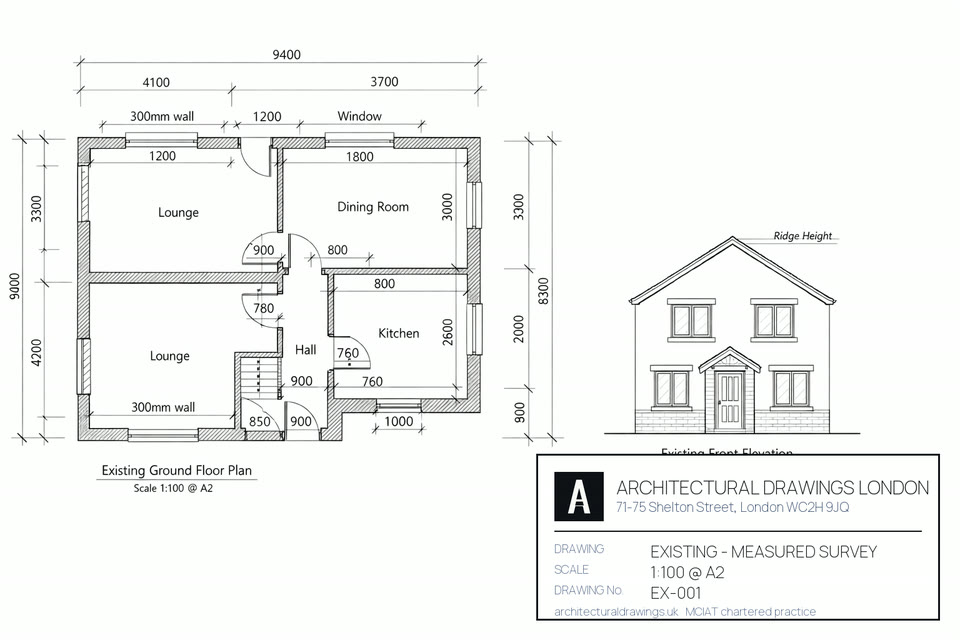
- Existing floor plans and elevations at 1:50 or 1:100
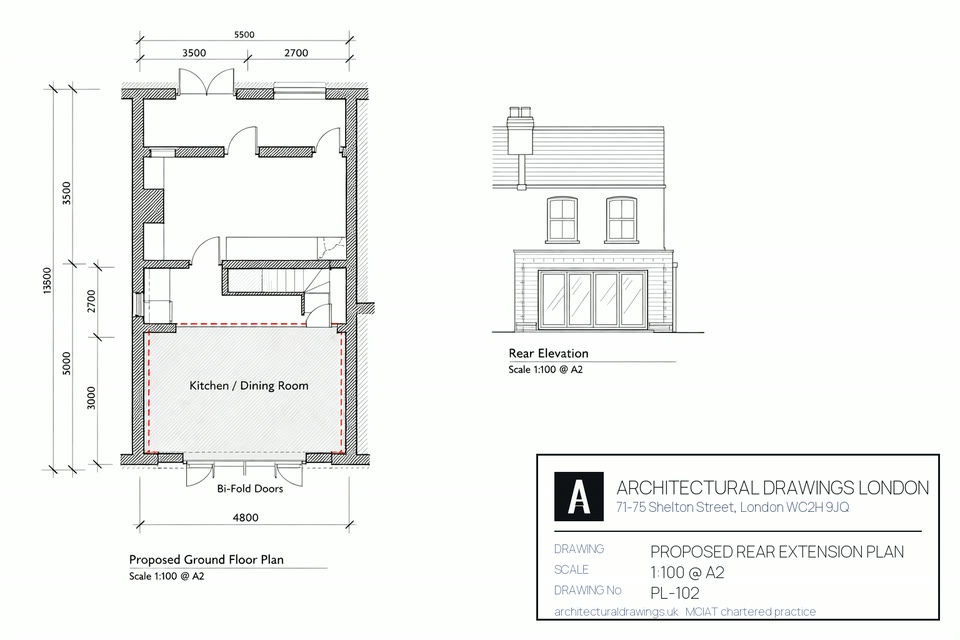
- Proposed floor plans showing the layout of each flat with room dimensions, walls, doors, kitchens, bathrooms
- Design and Access Statement
- Waste and recycling storage plan showing adequate bin provision for all units
- Cycle storage plan showing secure, covered spaces (London Plan standard: 1 space per studio/1-bed, 2 per 2-bed+)
- CIL Additional Information form if the borough charges CIL
Key policy considerations
Borough planning officers assess flat conversion applications against several local plan policies:
- Housing mix: Most boroughs want a mix of unit sizes (not all studios). The London Plan sets minimum space standards -- 37 sqm for a studio, 50 sqm for a 1-bed 2-person flat, 61 sqm for a 2-bed 3-person, 70 sqm for a 2-bed 4-person.
- Loss of family housing: Converting a 3+ bedroom family house may conflict with policies protecting family-sized dwellings, particularly in boroughs with acute shortages of larger homes.
- Amenity impact: The council will assess noise, overlooking, light, and the impact of intensified use on neighbours.
- Character of the area: External changes (separate entrances, bin stores, satellite dishes) must respect the character of the streetscape, especially in conservation areas.
- Parking and transport: Most boroughs support car-free development in well-connected areas but require adequate cycle and bin storage.
Which building regulations bite hardest on a flat conversion?
Flat conversions trigger a full building regulations application. The conversion of a house into flats is classified as a "material change of use" under Regulation 5 of the Building Regulations 2010, which means the entire building must be brought up to current standards in several key areas.
Part B: Fire safety
Fire compartmentation is the single biggest technical challenge in a flat conversion. Each flat must be a separate fire compartment, with all walls, floors, and ceilings between flats providing at least 30 minutes of fire resistance (60 minutes for buildings with a floor more than 5 metres above ground level). Specific requirements include:
- Separating floors and walls: Must achieve 30-minute fire resistance (REI 30). In practice this often means adding layers of fire-rated plasterboard to existing timber floors and adding fire barriers in void spaces.
- Fire doors: FD30S self-closing fire doors to all flat entrance doors and doors opening onto the common escape route
- Escape routes: A protected common stairway with 30-minute fire-resistant enclosure, emergency lighting, and clear exit signage
- Fire detection: LD2 grade detection in common areas plus individual flat detection. Interlinked mains-powered smoke alarms with battery backup.
- Service penetrations: All pipe, cable, and duct penetrations through compartment walls and floors must be fire-stopped
Part E: Sound insulation
Separating floors and walls between flats must meet minimum airborne and impact sound insulation standards. For conversions (as opposed to new build), the standards are slightly relaxed under Approved Document E:
| Element | Airborne (DnT,w + Ctr) | Impact (L'nT,w) |
|---|---|---|
| Separating floor (conversion) | ≥ 43 dB | ≤ 64 dB |
| Separating wall (conversion) | ≥ 43 dB | N/A |
Pre-completion sound testing by an accredited testing body is required. Failing the test means remedial work before Building Control will sign off. For timber-floor Victorian houses, achieving these standards usually requires a floating floor system, resilient bars on ceilings, and acoustic mineral wool between joists.
Separate services
Each flat must have independently metered gas, electricity, and water supplies. This means separate consumer units, individual gas meters (or electric-only heating), and separate water supplies. The utility companies typically need 6-8 weeks' notice to install new meters and service connections.
Will you have to pay Community Infrastructure Levy?
CIL is a charge that most London boroughs levy on new development to fund infrastructure. For flat conversions, CIL is calculated on the net additional gross internal area of residential floor space created. If the existing house has been in continuous lawful use for at least 6 months within the 3 years before planning permission is granted, the existing floor area can be deducted.
CIL rates vary enormously across London. Inner London boroughs like Westminster, Kensington & Chelsea, and Camden charge £200-£400+ per sqm for residential development. Outer boroughs may charge £50-£150 per sqm. Additionally, the Mayor of London charges a separate Mayoral CIL (currently £80/sqm in Zone 1, falling to £25/sqm in outer boroughs).
If you are creating a loft flat or basement flat as part of the conversion, the additional floor area created by these extensions is likely to attract the full CIL charge, since it does not benefit from the existing floor area deduction.
How much bin and bike storage does the council want?
One of the most overlooked aspects of flat conversion planning is waste and cycle storage. These seemingly minor details are frequent grounds for refusal or conditions, because they directly affect the street scene and practical amenity.
Waste storage
Each flat needs access to dedicated bin storage. For a conversion of 2-4 flats, you typically need: one 240-litre general waste bin per 2 flats, one 240-litre recycling bin per 2 flats, and one food waste caddy per flat. The bins must be stored in a screened enclosure (not visible from the street) with hardstanding and easy access for collection. Many boroughs require a Waste Management Plan as part of the planning application.
Cycle storage
The London Plan requires 1 long-stay cycle space per studio or 1-bed flat, and 2 long-stay spaces per 2-bed+ flat. Storage must be secure (lockable), covered, and easily accessible from the street. Sheffield stands or wall-mounted racks in a garden shed or secure cage are acceptable. Storing bikes in common hallways is not acceptable as it obstructs the fire escape route.
What does a flat conversion cost in London?
Typical cost breakdown: 3-flat conversion
For a typical Victorian terraced house being converted to 2-3 self-contained flats in London, total costs (including all professional fees, council fees, and build works) range from £50,000 to £120,000. The higher end applies where significant structural work is needed, en-suite bathrooms are added to every flat, or CIL liability is substantial.
Our flat conversion drawing package from £2,100 includes the measured survey, existing and proposed floor plans and elevations, fire strategy drawings, sound insulation specifications, waste and cycle storage plans, and the Design and Access Statement. We submit the planning application and building regulations application on your behalf. Get a free quote.
What does your borough require on top?
Each London borough has its own local plan policies on flat conversions. Some key differences to be aware of:
- Wandsworth and Lambeth: Generally supportive of conversions in areas with good public transport, but strict on minimum flat sizes and family housing retention
- Camden and Islington: Strong protection of family-sized dwellings; conversions of 3+ bedroom houses face significant resistance
- Lewisham and Greenwich: More permissive, particularly for larger properties on main roads
- Westminster and Kensington: Very strict conservation area controls; external changes to front elevations are rarely permitted
- Tower Hamlets and Newham: Focus on affordable housing; conversions creating 10+ units may trigger affordable housing contributions
We check your borough's specific conversion policies before designing the scheme and have experience working with planning officers across all 33 London boroughs.
Frequently asked questions
Do I need planning permission to convert a house to flats in London?
Yes, always. Converting a single dwelling (C3) into multiple self-contained flats requires full planning permission. There are no Permitted Development rights for this type of conversion. The application fee is £610 per new dwelling created. We handle the full application process including drawings, supporting statements, and Planning Portal submission. See our planning drawings service.
What building regulations apply to flat conversions?
Flat conversions must comply with all relevant Building Regulations. The most critical are Part B (fire safety) requiring compartmentation between flats, Part E (sound insulation) requiring tested separating floors and walls, and separate metered services for each flat. We prepare the full building regulations drawings and fire strategy as part of our package. See our building regulations service.
How much does it cost to convert a house to flats in London?
Total costs range from £50,000 to £120,000 for a typical 2-3 flat conversion, including all professional fees, council fees, and build works at £1,000-£2,000/sqm. CIL can add £5,000-£30,000+ depending on your borough. Our architectural drawings start from £2,100. Get a free quote for your specific project.
What is CIL and do I have to pay it for a flat conversion?
CIL (Community Infrastructure Levy) is charged on net additional residential floor area. If your existing house has been in lawful use for 6+ months within the past 3 years, the existing floor area is deducted from the calculation. Rates vary from around £50/sqm in outer boroughs to £400+/sqm in prime central London. Mayoral CIL is charged separately on top. We advise on CIL liability as part of our service.
Do I need to provide parking for a flat conversion in London?
Most London boroughs follow the London Plan's car-free development policy for conversions in areas with good public transport access (PTAL 3+). You generally do not need off-street car parking but must provide secure cycle storage (1 space per 1-bed, 2 per 2-bed+) and adequate bin storage. We include waste and cycle storage plans in every flat conversion package.