


The brief
The client owned a 1970s semi-detached house on a residential street in Ealing with an integral single garage at the front. Like thousands of similar properties across West London, the garage had never been used for parking — it stored bikes, boxes, and a broken washing machine. With the shift to remote work, the client needed a dedicated home office separate from the main living space, and the garage was the obvious candidate.
The brief was straightforward: convert the integral garage into a fully insulated, heated home office with natural light, a data connection, and proper ventilation. The garage door would be replaced with a window and insulated wall panel matching the existing brickwork. The project needed building regulations approval but, critically, no planning permission — converting an integral garage to habitable space is permitted development in most circumstances.
The challenge
Garage conversions look simple on paper but present three specific technical challenges that drive the building regulations drawing scope:
- Part L insulation upgrade. The existing garage had a single-skin brick wall to the front elevation, an uninsulated concrete floor slab, and no insulation in the flat roof above. To meet current Part L (2022) standards for a habitable room, every thermal element needed upgrading: 100mm Kingspan insulation to walls (achieving a U-value of 0.18 W/m²K), 150mm insulation to the floor with a new DPM, and 120mm insulation between the ceiling joists.
- Structural opening. The client wanted an open doorway between the new office and the existing hallway, removing a section of the internal load-bearing wall. This required a structural engineer to specify a steel beam — in this case a 152 UC 23 over the 1.8-metre opening — with padstone details and bearing calculations.
- Damp-proofing. The existing garage floor was 150mm below the internal floor level of the house. We needed to design a new floor build-up that addressed both the level change and damp protection, incorporating a DPM lapped into the existing DPC of the adjacent wall.

Our approach
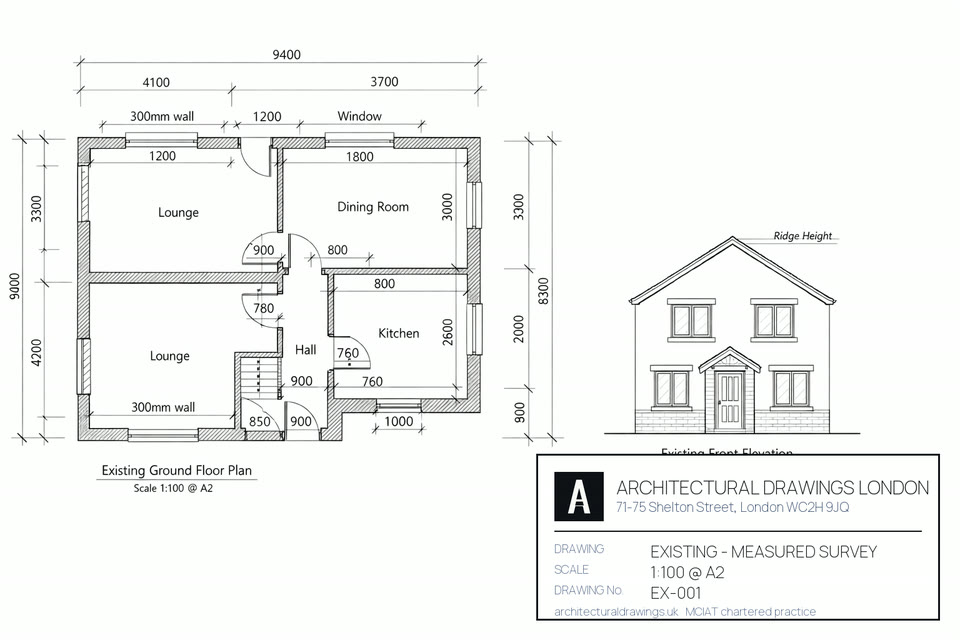
We carried out a measured survey of the garage and adjacent ground floor, recording wall thicknesses, ceiling heights, floor levels, and the existing drainage runs. The survey confirmed the garage at 5.4m × 2.8m internally — 15.1 square metres of usable space, comfortably above the minimum for a habitable room.
The drawing set included:
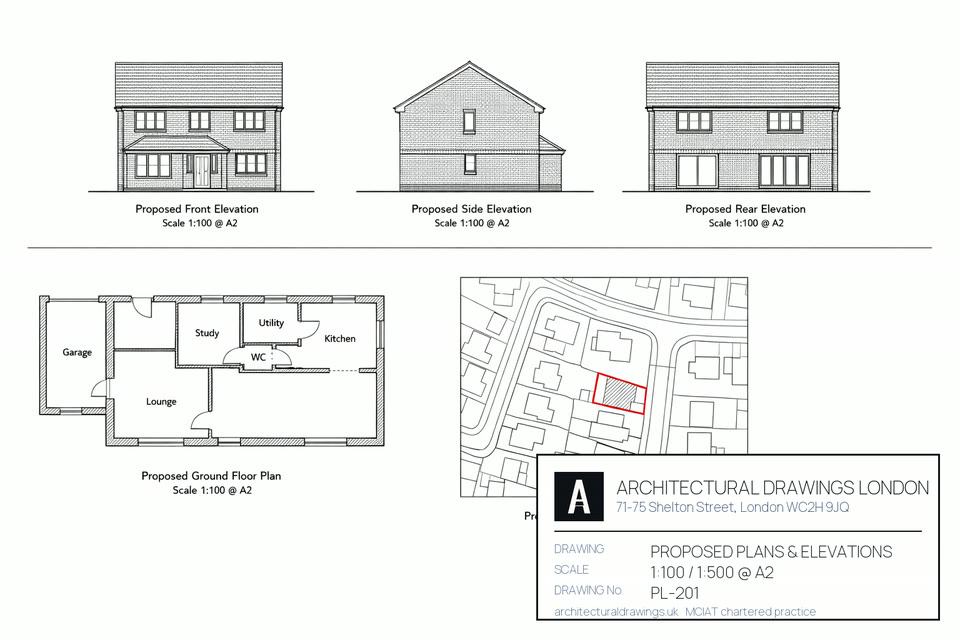
- Existing and proposed floor plans at 1:50
- Existing and proposed front elevation at 1:100, showing the new window and brick infill panel
- Cross-section through the conversion at 1:20, detailing the floor build-up, wall insulation, and ceiling insulation
- Structural details for the internal opening with steel beam specification
- Part L energy calculations demonstrating compliance with the 2022 standards
- Ventilation strategy to Part F (trickle vents in the new window plus a background ventilator)
Because no planning permission was required, we proceeded directly to a building regulations Full Plans application with Ealing Council. The drawings were designed to give the contractor everything needed to price and build without ambiguity — every insulation thickness, every DPM lap, every lintel bearing length specified on the drawings.

The result
Ealing Building Control approved the Full Plans application within two weeks, with no amendments requested. The client appointed a local contractor who completed the conversion in exactly four weeks, working within the existing building footprint with minimal disruption.
The finished office has a consistent internal temperature year-round thanks to the Part L insulation upgrade — the client reports it is actually warmer than the main house in winter. The new front window provides ample natural light, and the brick infill panel matches the existing facade so closely that the conversion is barely noticeable from the street.
The client estimated the conversion added £30,000–35,000 to the property value — a return of roughly 60% on the investment, plus the daily benefit of a proper workspace at home.


