



The brief
The clients owned a three-bedroom Victorian mid-terrace in Lewisham, a classic London two-up-two-down with a later two-storey rear addition. With a growing family, they needed a fourth bedroom and a second bathroom without losing any of the existing bedroom space. A rear dormer loft conversion was the obvious solution — it would create a new master bedroom with en-suite in the loft, freeing up the existing first-floor front bedroom for the children.
The property was not in a conservation area and had no Article 4 Directions restricting loft conversions. This meant the rear dormer fell under Permitted Development, provided it stayed within the volume and dimension limits set by Schedule 2, Part 1, Class B of the GPDO. Rather than applying for planning permission, we applied for a Lawful Development Certificate (LDC) to give the clients legal certainty that the dormer was lawful — essential for a future property sale.
The challenge
While rear dormers in South East London are common, this project had two specific challenges:
- Volume calculation. The dormer had to stay within the 50 cubic metre volume allowance for terraced houses. The existing loft already had a Velux window (installed by a previous owner), which had consumed approximately 0.3 cubic metres of the allowance. We needed to calculate the remaining volume precisely to confirm the full-width dormer was achievable. Our calculations showed the dormer at 42.8 cubic metres — comfortably within the 49.7 cubic metre remaining allowance.
- En-suite plumbing. The clients wanted a shower room in the dormer with a toilet, basin, and walk-in shower. Running new waste and water supply pipes to the loft required careful coordination with the existing soil stack. Our building regulations drawings detailed the new SVP (soil and vent pipe) route from the en-suite through a boxed-in section of the second-floor bedroom, connecting into the existing stack at first-floor level.

Our approach
We carried out a measured survey including the loft space, recording ridge height, rafter pitch, purlin positions, and the existing chimney stack location. The survey confirmed a ridge height of 3.1 metres above the existing ceiling joists — sufficient for a 2.4-metre internal floor-to-ceiling height after the new floor build-up.
The drawing set included:
- Existing and proposed floor plans at 1:50 (all floors including the new loft)
- Existing and proposed rear elevation at 1:100, showing the dormer with flat roof, cheeks clad in tile hanging, and two large windows
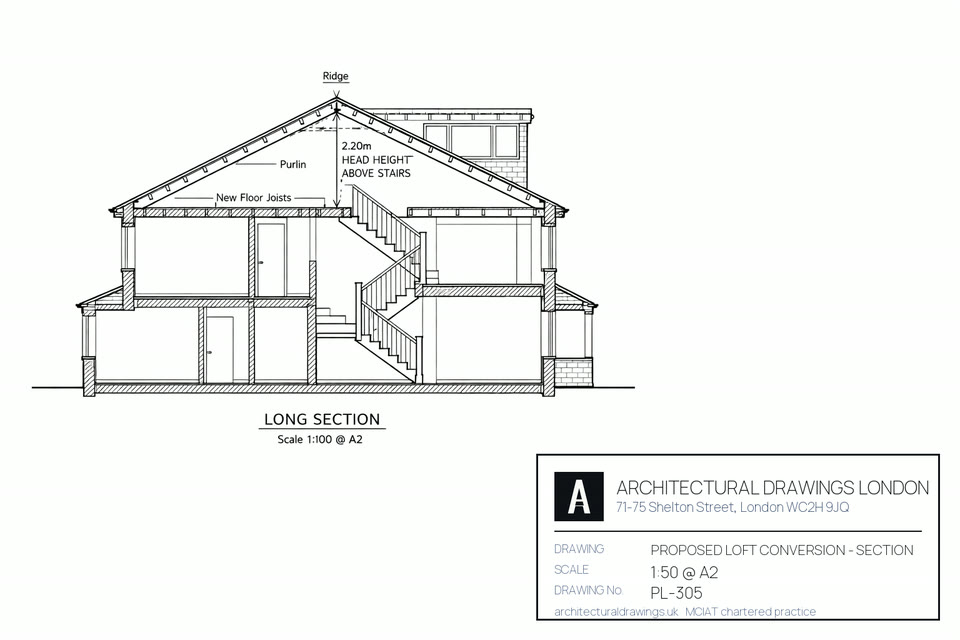
- Cross-section through the dormer at 1:50, showing the structural steel ridge beam, new floor joists, insulation build-up, and internal finishes
- Staircase detail at 1:20, showing the new flight from the second floor to the loft with compliant headroom (minimum 2.0 metres over the pitch line)
- LDC application drawings demonstrating compliance with GPDO Schedule 2, Part 1, Class B, with volume calculation annotated
- Building regulations drawings covering structural steel, Part L insulation, Part B fire escape (protected staircase with FD30 doors to all habitable rooms), Part E sound insulation, and Part H drainage for the en-suite
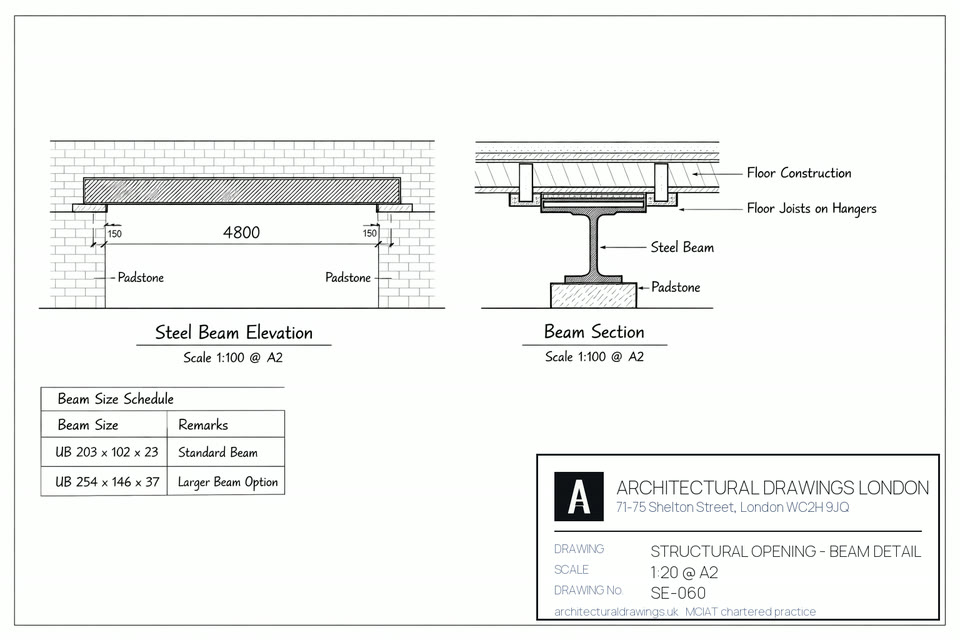
The structural engineer specified a 203 UB 25 steel beam at the ridge and 152 UC 23 trimmer beams around the staircase opening. Our drawings coordinated these with the dormer flat roof construction — a warm roof build-up with 150mm rigid insulation achieving a U-value of 0.15 W/m²K.

The result
Lewisham Council issued the Lawful Development Certificate within four weeks — faster than the typical 8-week planning application determination. The LDC confirmed that the dormer was lawful under Permitted Development and could proceed without planning permission.
The building regulations drawings were approved by a private approved inspector under a Building Notice route, with the structural calculations signed off before construction began. The contractor completed the dormer in 10 weeks, including scaffolding, structural steelwork, dormer construction, roofing, insulation, plumbing, electrics, plastering, and decoration.
The finished loft provides a 22-square-metre master bedroom with a 4.5-square-metre en-suite shower room. Total project cost was approximately £55,000 for construction. The clients’ estate agent estimated the loft conversion added £100,000–120,000 to the property value — a significant return on a £56,000 total investment.


