TL;DR — Key Facts
- Planning authority: Greenwich Council
- Conservation areas: 20 designated areas
- Article 4 Directions: None currently in force
- Postcodes covered: SE3, SE7, SE9, SE10, SE18, SE28
- Typical housing: Georgian in Greenwich town centre
- Householder application fee: £548 (2026 rate)
What are your chances of getting planning permission in Greenwich?
Greenwich approved 70.7% of the householder applications it decided in the three years to March 2026 — 1,627 of 2,301 — against 83.0% across London. It is a harder authority than the London average by roughly twelve percentage points, and 93.8% of its decisions still landed inside the statutory eight weeks.
| Householder applications, 3 years to March 2026 | Greenwich | London |
|---|---|---|
| Approval rate | 70.7% | 83.0% |
| Decisions made | 2,301 | — |
| Approved | 1,627 | — |
| Refused | 674 | — |
| Decided inside 8 weeks | 93.8% | — |
| Lawful development certificates issued | 1,228 | — |
Source: MHCLG District Planning Application Statistics (PS1 and PS2), the statutory return every English planning authority files, published under the Open Government Licence v3.0. Figures are decisions made in the twelve quarters to March 2026, not applications submitted. The twelve-point gap is the strongest argument on this page for getting the drawings right before submission rather than after a refusal.
Planning in Greenwich — what you need to know
Greenwich contains a UNESCO World Heritage Site, and that is not a decorative detail: Maritime Greenwich brings an additional layer of assessment around the town centre that has no equivalent in Eltham or Thamesmead. A second map matters just as much and is far less discussed. Just over a fifth of Greenwich — 20.4% of its land — sits in Flood Zone 3, the highest share of any borough east of the Thames crossings apart from Newham and Barking. That is not a prediction that the ground will flood; the zones are drawn as though the Thames Barrier and the tidal walls were not there. What it determines is procedural: a site inside Flood Zone 3 needs a Flood Risk Assessment submitted with the application, which is a real addition to cost and to the timetable. Riverside Greenwich, Woolwich and Thamesmead carry that requirement; Eltham and Blackheath largely do not.
World Heritage Site status in Greenwich town centre adds heritage weight; outer borough areas (Eltham, Thamesmead) generally permissive. The borough has a population of approximately 287,000 residents and covers postcodes SE3, SE7, SE9, SE10, SE18, SE28.
The housing stock in Greenwich is predominantly georgian in Greenwich town centre; Victorian terraces in East Greenwich, Charlton; inter-war semi-detached in Eltham; new-build along the riverside. This mix of property types means that Greenwich Council deals with a wide range of applications, from rear extensions on terraced houses to loft conversions on semi-detached properties and full refurbishments of period homes in conservation areas.
With 20 designated conservation areas and no current Article 4 Directions,Greenwich refused 674 of 2,301 householder applications, an approval rate of 70.7% (MHCLG planning statistics, retrieved 1 September 2026) — among the lowest in London. It also granted no prior approvals at all for larger rear extensions. Those two figures together describe a borough where the margin for a scheme that pushes at the limits is unusually thin, and where the Maritime Greenwich World Heritage Site imposes a level of scrutiny that has no equivalent in outer London.
We draw across every Greenwich postcode, from Woolwich and Plumstead through Eltham to Blackheath, and we prepare the building regulations set alongside the planning set so the two never contradict one another. The quartiles are worth knowing before a budget is fixed: a quarter of 2025 sales in the borough completed under £365,000 and a quarter above £600,000 (HM Land Registry, 2025). A specification that makes sense at the top of that spread is often money you will not see again at the bottom of it.
Article 4 Directions in Greenwich
Nothing in Greenwich currently strips householder permitted development rights borough-wide through an Article 4 Direction. Lofts, single-storey rear extensions and garden outbuildings therefore start from the national allowances. The live question on any given site is usually not the borough's policy at all, but whether an earlier owner already spent part of the house's volume or extension budget.
Most routine improvements in Greenwich — a rear dormer, a modest single-storey extension, a garden studio — can be built under permitted development where they meet the national tests on size, height and siting. Where a scheme sits close to one of those limits, or where you expect to sell inside a few years, a Lawful Development Certificate at £274 converts "we think this was permitted" into a document the council has signed. Conveyancers ask for it, and a wall that is already built is expensive to un-build if the answer turns out to be no.
Even without Article 4 Directions, properties in Greenwich's 20 conservation areas have additional restrictions on permitted development. We check the specific restrictions affecting your property as part of our initial assessment.
Conservation areas in Greenwich
Greenwich has 20 designated conservation areas. Notable conservation areas include:
- Greenwich Town Centre (World Heritage Site)
- Blackheath
- Charlton
- Eltham Park
Greenwich carries fourteen conservation areas on the national register, and once a house sits inside one, the permitted development allowances a homeowner would otherwise rely on are trimmed back. These are the limits that come up most often on a Greenwich address:
- No cladding, stone, artificial stone, pebble dash, render, timber, plastic, or tile to any external wall without planning permission
- No side extensions under Permitted Development
- Rear extensions are limited and may require planning permission
- Dormer loft conversions facing the highway require planning permission
- Satellite dishes on front elevations or chimneys are not permitted
- Demolition of gates, walls, fences, or other boundary treatment requires planning permission
Twenty designated areas, unaccompanied by any Article 4 Direction, with the heritage weight concentrated tightly around the World Heritage Site rather than spread across the borough. Greenwich served 70 contravention notices in three years (MHCLG planning statistics, retrieved 1 September 2026), a moderate level of investigation. Outside the town centre the national rules largely apply as written; inside it, assume that anything visible in a protected view will be assessed as such.
Popular projects in Greenwich
Georgian around the town centre, Victorian terraces through East Greenwich and Charlton, interwar semis in Eltham, and new riverside stock. The council took 4,568 planning decisions in three years and approved 73.0%, with new-dwelling schemes at 55.2% (MHCLG planning statistics, retrieved 1 September 2026). It also delegated 94.0% of decisions to officers, a lower share than most London boroughs, so a contested application here is more likely than average to be decided by committee.
Loft conversions
Terraced streets run through much of the western half of the borough, so a rear dormer is where most Greenwich loft enquiries end up. On a standard Victorian mid-terrace a rear dormer buys 20 to 30 square metres of usable floor at a build cost far below the borough's £460,000 median sale price, and a good share of those dormers sit inside permitted development rather than needing consent. Conservation area frontages, and properties caught by an Article 4 Direction, are the exceptions — both change the drawing set rather than ruling the loft out.
Side-return and rear extensions
The classic Victorian and Edwardian terrace layout in Greenwich leaves a side return passage that is prime territory for a kitchen extension. A single-storey rear or side-return extension can often be built under Permitted Development, extending up to 6 metres from the rear wall (or up to 8 metres for detached houses under the Prior Approval process). We prepare extension plans for properties across all Greenwich postcodes (SE3, SE7, SE9, SE10, SE18, SE28).
Two-storey extensions
The semi-detached and detached stock across Eltham, Kidbrooke and Shooters Hill takes a two-storey rear extension well, and a two-storey rear always needs a full application. Greenwich approved 1,627 of 2,301 householder decisions over the three financial years ending March 2026 (MHCLG PS1). The ones that fail here tend to fail on the same three points: bulk that stops reading as subordinate to the original house, a flank wall carried to the boundary at first-floor level, and daylight taken from a neighbour's rear window. Design past those and the second storey is rarely the objection.
How much do planning drawings cost in Greenwich?
The council charge is standard; what varies here is the evidence required. A scheme within or affecting the World Heritage Site setting needs a heritage assessment that an Eltham semi does not, and that is where the professional cost separates. Greenwich agreed an extension of time on 27.5% of decisions (MHCLG planning statistics, retrieved 1 September 2026), so the timetable is generally reliable. We quote one fixed fee covering the whole set, roughly a third under the London architect rate.
Planning costs in Greenwich
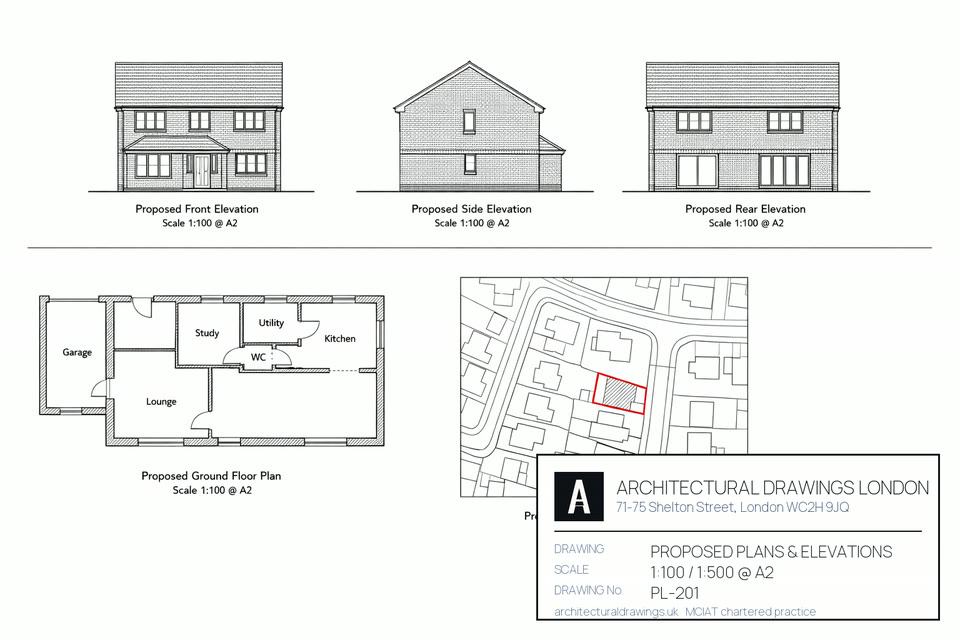
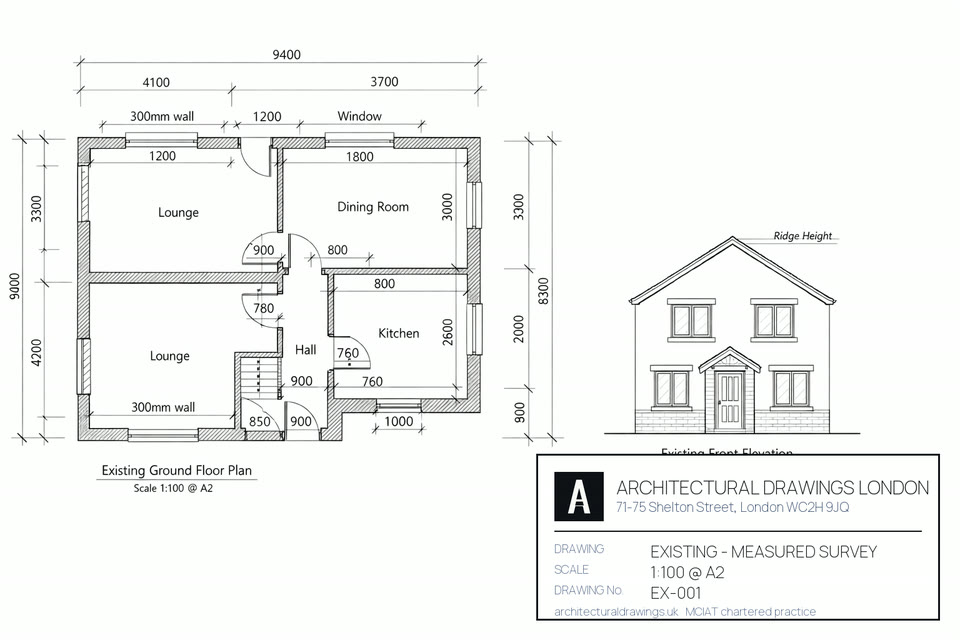
A valid Greenwich submission needs a measured survey, drawn existing and proposed floor plans, every affected elevation and a site plan at a recognised scale. We produce the whole set as one fixed package, priced around 30% under what a London architect's practice charges for identical scope. Against a borough median sale of £460,000, that gap is better spent on the build than on the drawings.
Within the Maritime Greenwich World Heritage Site setting the proposed form is worth more than the count suggests, because the heritage question can be reopened long after the work is done and a certificate fixes what was lawful at the time. Greenwich issued 1,228 of them in three years (MHCLG planning statistics, retrieved 1 September 2026).
Our experience in Greenwich
We cover all Greenwich postcodes: SE3, SE7, SE9, SE10, SE18, SE28. Whether your property is in a conservation area, affected by an Article 4 Direction, or in an unrestricted residential street, we have experience with Greenwich Council and understand the borough's planning policies.
The median Greenwich home changed hands at £460,000 during 2025, across 2,635 registered transactions — the same median the borough recorded in 2024 (HM Land Registry Price Paid, 2025 completions). A flat market means the value an extension adds here has to come from the floor area it creates, not from waiting. Our MCIAT chartered architectural technologists measure the house, draw the scheme, submit it to the Royal Borough of Greenwich and answer the case officer's queries through to a decision.
We also work in Greenwich's neighbouring boroughs:
What are the odds of approval in Greenwich?
Nearly three householder applications in ten are refused in Greenwich; across London the figure is closer to one in six. The return records 2,301 householder decisions, 1,627 of them approvals and 674 refusals — 70.7% granted, against 83.0% for the 33 boroughs pooled (MHCLG PS1, April 2023 to March 2026). Twelve percentage points of extra downside is not something you design around after a refusal arrives. It is the reason to spend the extra week on the survey, the planning statement and the neighbour conversation before anything is submitted at all.
The determination clock is the reliable part of a Greenwich job. Of the 1,837 householder decisions that count towards the statutory measure, 1,724 landed inside 8 weeks — 93.8%, slightly ahead of the 92.5% recorded across the 33 boroughs (MHCLG PS2, April 2023 to March 2026). The tail is short but real: 17 cases ran between 16 and 26 weeks, and seven took longer than a year. Those are applications that were argued rather than simply decided.
Greenwich determined 435 larger rear extensions under the neighbour-consultation route and refused 205 of them. That 47.1% refusal rate is close to double the 24.9% recorded across London, and it is the only figure from this borough's prior-approval return that compares safely: Greenwich books its approvals under 'granted' where most councils record 'prior approval not required', so the two approval columns are not like-for-like (MHCLG PS1, three years to 31 March 2026). What survives the caveat is blunt enough. On a 6m or 8m single-storey rear here, whether an adjoining owner objects decides the outcome more often than anything drawn on the sheet, which makes the conversation over the fence worth having early.
Sitting beside those planning decisions, Greenwich recorded 1,228 lawful development certificates. A certificate is not a permission; it is written confirmation that the work never needed one, which is precisely what a buyer's solicitor asks for years later. It costs £274 against the £548 householder planning fee. MHCLG publishes no approval rate for certificates, for Greenwich or any other English authority, so read that number as volume and not as a success measure.
Source: the MHCLG District Planning Application Statistics return, forms PS1 and PS2, which the Royal Borough of Greenwich files with central government every quarter. Everything counted here is a decision the council issued between April 2023 and the end of March 2026 — applications lodged but not yet determined are outside it. Reproduced under the Open Government Licence v3.0.
Frequently asked questions
Do I need planning permission in Greenwich?
Sometimes, but Greenwich is the borough where assuming it is most expensive. The council granted zero prior approvals for larger rear extensions (MHCLG planning statistics, retrieved 1 September 2026), and refused nearly three in ten of the applications it did decide. It issued 1,228 lawful development certificates, which is the sensible route here: at £274 it is the cheap way to convert a reasonable assumption into a document, and in a borough with a World Heritage Site and 20 conservation areas that assumption fails more often than the national picture suggests.
Does Greenwich have Article 4 Directions?
No borough-wide Article 4 Direction applies to householder work in Greenwich, so the ordinary permitted development allowances survive across most of the borough. That is not a blanket yes. A planning condition attached to a newer estate, a listed building, or a conservation area boundary that runs down the middle of a street can each remove the same rights at one address and leave them intact next door. We check the address rather than the borough.
How many conservation areas are in Greenwich?
Twenty, and one of them is not a conservation area at all but a World Heritage Site — Maritime Greenwich, inscribed for the Royal Naval College, the Queen's House and the Royal Observatory. That inscription protects the setting as well as the buildings, so sightlines and anything visible on a roof carry weight that they would not carry in an ordinary designation. Across the borough's other nineteen areas the controls follow the familiar pattern: external wall finishes are fixed, additions to the side of a house need consent, roof alterations visible from the street are resisted, and walls, railings and gates are protected in their own right rather than treated as incidental.
How much does a Royal Borough of Greenwich planning application cost?
The £548 application fee is national, and the odds of spending it well are not. Greenwich approved 70.7% of householder applications (MHCLG planning statistics, retrieved 1 September 2026), among the lower rates in London, so a refusal is a realistic outcome rather than a remote one - and within the World Heritage Site setting the supporting evidence costs more than the fee that accompanies it.
How long does Royal Borough of Greenwich take to decide a planning application?
Greenwich decided 93.8% of householder applications within the statutory eight weeks and 2.5% ran beyond thirteen (MHCLG planning statistics, retrieved 1 September 2026). Speed is not the problem here; outcome is. With 674 of 2,301 applications refused, the realistic horizon is sixteen weeks or more once the possibility of a revision and resubmission is priced in. Pre-application advice is worth more in Greenwich than in most boroughs for that reason. Major applications carry a thirteen-week target.