TL;DR — Key Facts
- Build cost per sqm: £2,200 – £3,200 (outer London borough)
- Council planning fee: £548 (householder application, 2026)
- Typical projects: rear extension, side-return, two-storey, wraparound
- Conservation areas: 24 designated areas in Croydon
- Permitted Development: Generally available outside conservation areas
What does Croydon charge, and what does it approve?
Croydon is unusually receptive to the 6m rear extension route: 294 prior approvals granted against 80 refused, a 78.6% grant rate on the applications it determined. It approved 81.6% of householder applications overall and issued 1,699 lawful development certificates in three years.
| Croydon, three years to March 2026 | Count | Outcome |
|---|---|---|
| Larger-extension notifications decided | 529 | — |
| Prior approval not required | 155 | work may proceed |
| Prior approval granted | 294 | 78.6% of those determined |
| Refused | 80 | — |
| Householder decisions | 2,701 | 81.6% approved |
| Lawful development certificates issued | 1,699 | — |
| Householder planning application fee | £548 | statutory, England 2026 |
Sources: decision figures from MHCLG District Planning Application Statistics (PS1 and PS2), decisions made in the twelve quarters to March 2026, Open Government Licence v3.0; the statutory fee from the Town and Country Planning (Fees for Applications) (England) Regulations 2012 as amended, 2026 rate. Retrieved 1 September 2026. Build costs elsewhere on this page are our own 2026 London range and are an estimate, not a published statistic.
What does a Croydon extension cost in 2026?
Cost is one half of the decision. What Croydon Council expects to receive in the submission itself is set out on our page for house extensions in Croydon.
Build costs for a Croydon extension sit in our outer-London band of £2,200 to £3,200 per square metre. That is construction only, before professional fees, planning fees or VAT. Two local things push a job toward the top of the band. The first is ground: the borough climbs steeply from Thornton Heath up through Upper Norwood and again from Purley toward Coulsdon, and a rear garden that falls away turns a straightforward slab into retaining work with its own foundations. The second is access, which is dealt with further down. Neither appears in a rate per square metre, and both appear in a tender.
Ground is the variable in Croydon. Upper Norwood and Crystal Palace sit on noticeably sloping land, and a level rear extension there needs retaining and stepped foundations before anything above ground begins. On the flatter Purley and Thornton Heath stock the same floor area costs materially less. Establish the fall across the garden at survey, because it is the single largest unknown on a hillside plot.
Typical extension costs in Croydon (build only)
Drawings are the next line, and they repay some deliberation here, because Croydon treats householder work and everything else very differently. The council approved 81.6% of the householder applications it decided in the three years to March 2026, but only 55.3% of its minor applications — the lowest minor approval rate of the 33 London authorities (MHCLG planning application statistics, retrieved 1 September 2026). An extension to the house you live in is householder work and sits on the comfortable side of that line. Anything that creates a separate dwelling does not, and it is a different conversation. Our fees are fixed in advance and run about 30% below typical London architect rates.
What moves the price of a Croydon extension?
Croydon is a large borough with two cost profiles. Purley and Coulsdon semis sit on plots with side access and price like outer London. Thornton Heath and Selhurst terraces do not. The council itself is barely a constraint on an ordinary extension - 24 conservation areas, no Article 4 Direction, and seventeen enforcement notices in three years (MHCLG planning statistics, retrieved 1 September 2026) - but it approves only 37.5% of schemes that create a new dwelling.
Conservation areas
Inside a designated area, the thing that changes first is the route rather than the brickwork. The house stands on article 2(3) land, so permitted development no longer covers an extension beyond a side elevation, a rear extension of more than one storey, or cladding and render, and a £548 householder application takes the place of the certificate. Croydon’s designations vary enormously in scale: Addington Village covers 48.5 hectares, Norwood Grove 30.7 and South Norwood 28.7, while St Bernards covers 0.9 and Wellesley Road North 1.4 (planning.data.gov.uk conservation area register, retrieved 1 September 2026). The small ones catch people out more often than the large, because a boundary running two doors away is still a boundary.
Property type
Which extension suits your house is mostly decided by the decade that built it. Croydon holds 168,250 dwellings, a stock that has grown 11.7% in ten years, with 10.9% of it now dating from 2010 or later (VOA council tax stock at 31 March 2025, published via the London Datastore). On the Edwardian terraces of Thornton Heath and Selhurst the standard job is the side-return infill, hemmed by a party wall on both flanks and by the neighbour’s windows behind. On the interwar semis of Purley, Coulsdon and Sanderstead a two-storey rear addition usually fits, because the plot is wide enough to hold the upper floor off the boundary. On a detached house — a 2025 median of £725,000 across 476 sales (HM Land Registry Price Paid data) — the rate per square metre is much the same and the bill is simply bigger, because the room you want is bigger.
Access and logistics
A Purley or Coulsdon semi will normally take a machine down the side. Terraced Thornton Heath and Selhurst property will not, and the difference is in the groundworks: hand-dug foundations and barrowed spoil rather than a day with an excavator. The Victorian villas of Upper Norwood and Crystal Palace sit on steeper ground, where the retaining and levelling work becomes its own line item.
Our drawing fees for Croydon extensions
No hourly billing and no variations: one fee, fixed before we start, covering everything a valid submission to Croydon Council needs and the building regulations package if you take it as well. Build some margin into the programme while you are at it. Croydon agreed an extension of time on 40.6% of everything it decided, against 34.5% across London (MHCLG planning application statistics, twelve quarters to March 2026, retrieved 1 September 2026). Four applications in ten here finish outside the statutory period by agreement rather than inside it.
Drawing fees for extensions in Croydon
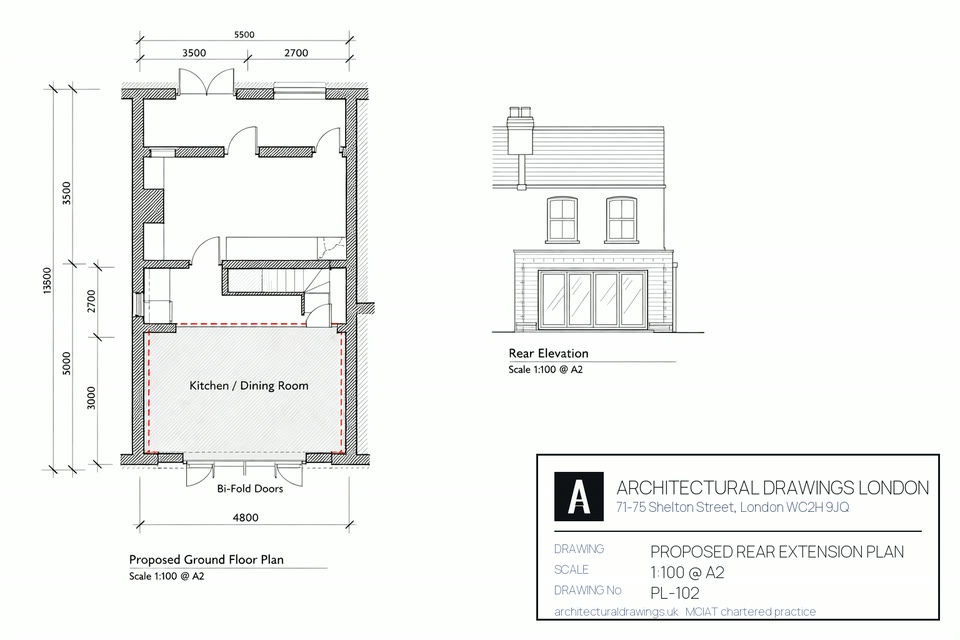
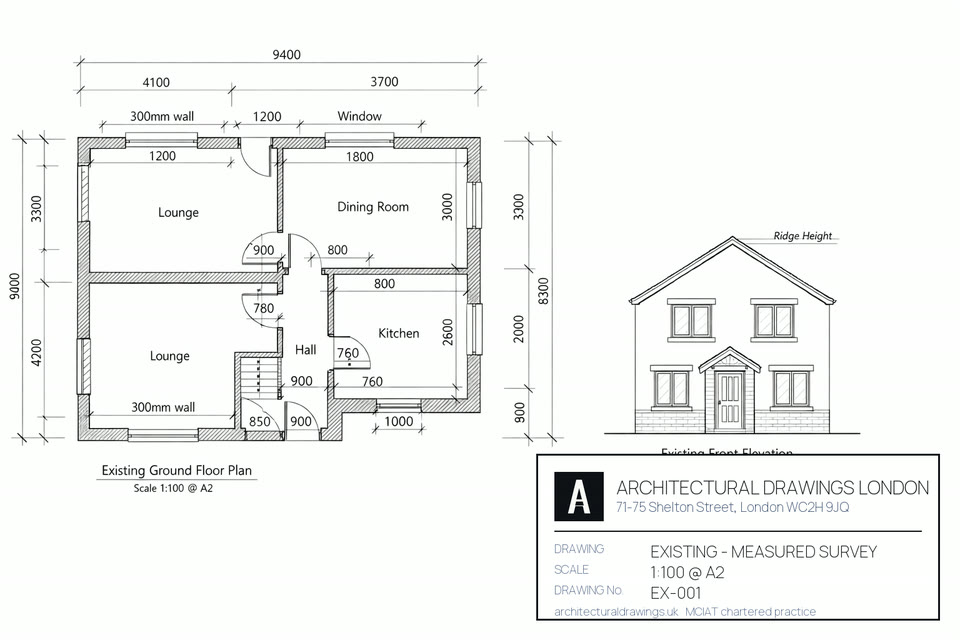
Each package begins with a measured survey of the house as built, and delivers existing and proposed plans and elevations, a site plan, and a design and access statement where the application calls for one. Our MCIAT chartered technologists carry it from survey through to submission and handle the case officer afterwards. If a refusal arrives regardless, the appeal record is worth reading before deciding what to do next: the Planning Inspectorate decided 440 Croydon householder appeals between 2016 and 2026 and allowed 161, or 36.6%, against 35.6% across England (Planning Inspectorate appeal casework, retrieved 1 September 2026). That describes how Croydon’s refusals fare on review. It says nothing about your odds at the first attempt, which are considerably better.
Croydon addresses we draw for run across CR0, CR2, CR5, CR7, CR8, CR9, SE19, SE20 and SE25. SE19 is the one worth checking early: barely half the property sales in that district sit inside Croydon, with Upper Norwood and Crystal Palace addresses falling either side of the Lambeth line, so the validating authority is decided street by street.
Planning or permitted development — which route in Croydon?
A large share of Croydon extensions need no planning application at all. Under permitted development a single-storey rear extension can project 3 metres from the original rear wall on a terrace or a semi and 4 metres on a detached house, doubling to 6 and 8 metres through the neighbour consultation scheme. Croydon is among the more accommodating boroughs on that deeper route. Of the 529 larger notifications it determined in the three years to March 2026, 294 were granted and 155 found not to need prior approval, with 80 refused — a refusal share of 15.1% against 24.9% pooled across London (MHCLG planning application statistics, PS1, retrieved 1 September 2026).
Croydon has 24 conservation areas across a very large borough, so most addresses sit well outside one. Inside, the side-extension rule is the significant loss on the Purley and Coulsdon semis. On the Victorian villas of Upper Norwood and Crystal Palace, where plots are tighter and the elevations more elaborate, the materials and cladding restriction does more work.
Two-storey extensions leave permitted development behind almost without exception and go in as full householder applications. Croydon refused 498 of the 2,701 householder decisions it made over that three-year run — 18.4%, against 17.0% for the 33 boroughs pooled — and design judgement accounts for most of it. A two-storey addition is expected to stay below the main ridge, step in from the side boundary, and leave the neighbour's windows their daylight.
Croydon granted 1,699 certificates of lawfulness in three years (MHCLG planning statistics, retrieved 1 September 2026). Given how light the enforcement footprint is here, the certificate's value is almost entirely at sale rather than during the build - it is the document that stops a buyer's solicitor asking questions nobody kept the answers to. We prepare the drawings for it alongside the build package.
Frequently asked questions
How much does a house extension cost in Croydon?
Croydon build rates sit at the outer-London end of the scale, and £2,200 to £3,200 per square metre is the band we see quoted here. A 15–20 sqm single-storey rear therefore lands between £33,000 and £64,000 for the structure alone. Read that against the borough median sale price of £425,000 across 3,942 Croydon sales in 2025 (HM Land Registry Price Paid, read September 2026) and the build is somewhere between 8% and 15% of what the house is worth. Fees, statutory charges and VAT sit on top of it.
Can I extend under Permitted Development in Croydon?
Most single-storey rear extensions in Croydon are permitted development, and the reason to prove that on paper is not the council knocking at the door. Croydon issued 17 enforcement notices and served a single planning contravention notice over those same twelve quarters, against 3,554 notices and 3,634 contravention notices across the 33 boroughs together (MHCLG PS2 enforcement returns, 2023 Q2 to 2026 Q1, read September 2026). Formal enforcement here is unusual. Unauthorised work surfaces instead at sale, in the conveyancer's enquiries, years after the builder has gone. Prior Approval lets a semi or terrace project 6 metres past its original back wall, and a detached house 8. Croydon's 24 conservation areas cut those rights back. For £274 the council will issue a Lawful Development Certificate, and that document is what closes the question off years ahead of the buyer's solicitor asking it.
How long does a house extension take in Croydon?
Budget five to eight months in Croydon from instruction to handover. The first two to three weeks are the measured survey and the drawing set. If planning is needed, Croydon Council works to eight weeks, and it hit that on 1,659 of the 1,777 householder decisions taken on the ordinary clock across the twelve quarters MHCLG has published to March 2026. Building regulations approval adds two to four weeks and can run alongside. Construction is then eight to sixteen weeks, depending on span, access and how much of the rear wall comes out.
Do I need a Party Wall Agreement for an extension in Croydon?
Digging a rear extension footing inside three metres of the neighbouring foundation is notifiable in Croydon exactly as it is elsewhere, and on the terraced stock so is any work to the shared wall. One month for excavation notices, two for wall notices. On a semi it is a single neighbour; on a mid-terrace it is two, each with their own period.
What experience do you have with extensions in Croydon?
We prepare extension drawings for properties across all Croydon postcodes (CR0, CR2, CR5, CR7, CR8, CR9, SE19, SE20, SE25). Our MCIAT chartered architectural technologists understand Croydon Council's policies, design guides, and local precedents. We have a council-ready drawing review across all 33 London boroughs.